
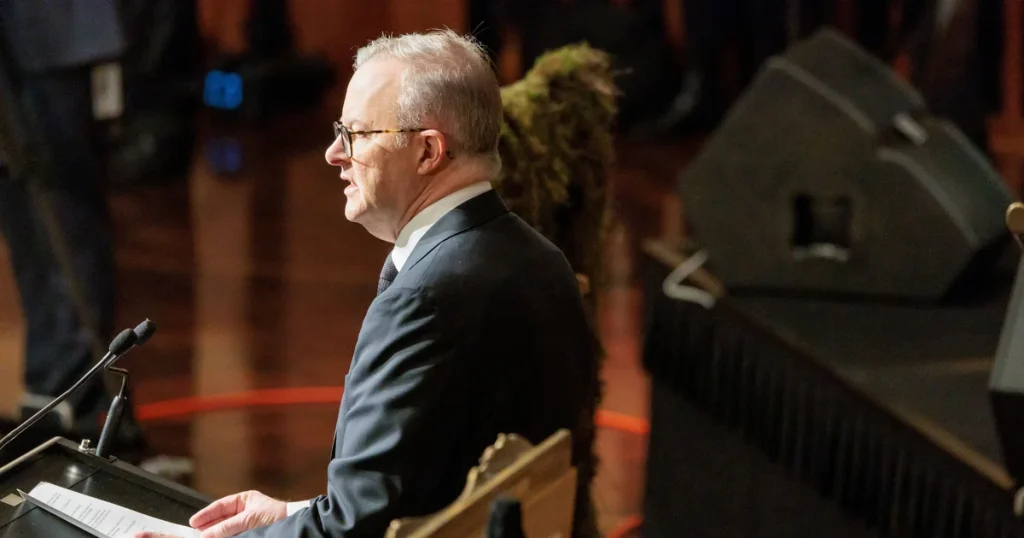




Anthony Albanese spent Saturday morning at Apple Park in Cupertino. The official account from his own office says he went to meet Tim Cook about Apple’s new parental controls, which Cook said were inspired in part by Australia’s social media ban for under 16s, as the prime minister’s office set out before the trip.
The part that matters for business came around it. Albanese used the visit to talk about the AI standards Australia is writing and about copyright, and he left one question conspicuously open: whether Australian creators will have to opt out of having their work used to train AI, rather than being asked first.
What happened at Apple Park
The closed door part ran about 45 minutes, according to the ABC, alongside a walk through the gardens and a demonstration of the parental controls that shipped with iOS 27. Albanese called it a proud moment, pointing to Cook recognising the lead Australia had taken on children and social media.
That framing is the easy half of the story. Apple gets to show a government that its safety features answer a real policy, and the government gets a large company agreeing in public that its reform worked.
Why Cook and not the chief executive
Worth being precise about who took the meeting. Tim Cook stopped being Apple’s chief executive on 1 September. John Ternus has the job now, and Cook moved to executive chair of the board, a role that explicitly includes engaging with policymakers around the world.
So a prime minister arriving to talk about regulation was not fobbed off. He was sent to the person whose remit is now exactly that. It is a small detail that says something about how large technology companies are organising themselves for a decade of governments asking harder questions.

The rules sitting behind the visit
Australia is writing national standards for AI and for data centres, covering safety, environmental and industrial rules, and Albanese said he hopes to legislate early next year. That is a date, and it is close.
On copyright he was less settled. He said there is a way through, and that creators would keep control of their intellectual property and be paid for any use of their work. But he left the door open to an opt out model, which would reverse the current onus: instead of a company asking permission, the creator would have to say no in advance. He also said Australia needs to be forward leaning to attract AI investment, which is the tension in one sentence.
Why Australian businesses should care
If you buy compute or run anything in a local data centre, the environmental and industrial rules are no longer a consultation. They are a bill with a rough date on it, and they sit on top of the data centre standards agreed at National Cabinet in August. Where your workloads physically sit is becoming a compliance question as much as a cost one, which is the same ground our guide to data residency covers.
If your business produces anything that can be scraped, the opt out matters more. A default of yes unless you object is a very different world from a default of ask first, and it would put the administrative burden on the smallest parties. Working out which of these actually touches your operations is the sort of question our AI strategy work starts with.
What to watch in New York
Albanese travels on to the United Nations General Assembly High Level Week, where he delivers Australia’s national statement. The trip runs to 24 September.
The thing to watch is whether the AI framing survives the move from a company campus to a room full of heads of government. Standards that only exist in one country are a trade problem waiting to happen, and Australia has just spent a morning telling one of the largest companies in the world that it intends to set some.



