
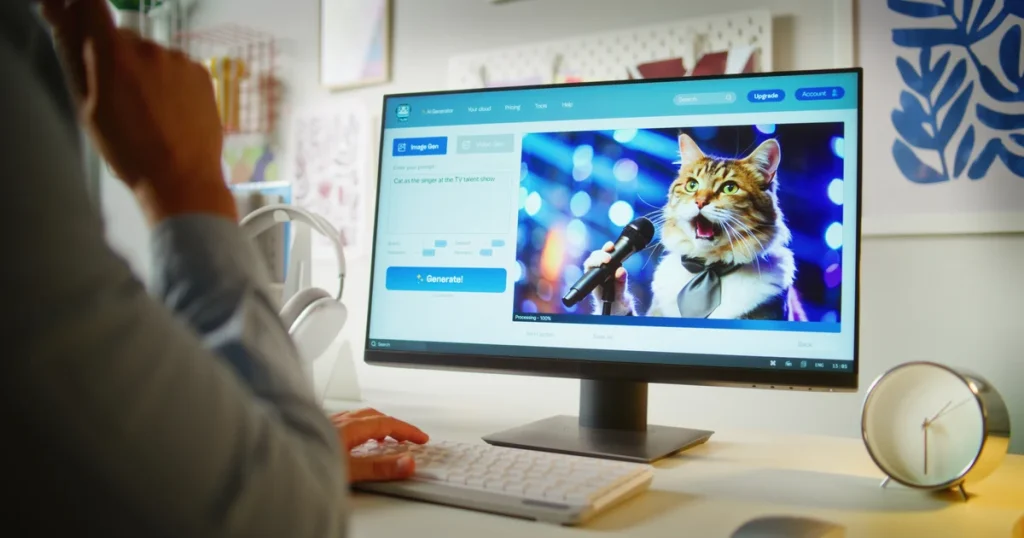




Canva has released Craft, the first image generation model it has built and trained itself. The Sydney company announced it on 22 October and says the model debuted fourth on DesignArena, a crowdsourced leaderboard where people vote on AI images side by side. By Canva’s count, that makes its in house lab the second most advanced image generation lab in the world.
Until now, Canva’s image tools leaned on other people’s technology. Its 2022 text to image feature was built on Stable Diffusion, and Dream Lab ran on the Phoenix model from Leonardo.ai, the Sydney startup Canva bought in 2024. Craft is Canva’s own, and it is available today to all Canva users, according to Canva’s announcement.
What Canva’s new model actually does
Craft is built for design rather than photography. Most image models learn mainly from photos, but Canva trained Craft on millions of templates from its own library: posters, social posts, presentations, menus and infographics. The goal is a model that understands layout, hierarchy and typography, not just what a finished picture looks like.
It creates images at up to 2K resolution in more than 30 aspect ratios, or a custom size. Prompts can be written in any language, and Craft can render text in 55 languages. Canva puts accurate text inside the image at the centre of its pitch, which matters because garbled lettering has long been a weak spot for image generators.
How the two stage model works
Craft splits the job in two. A planning model reads the prompt first and writes a detailed plan of the composition: which elements appear, where they sit, how big they are and what text the image needs. A second model then renders that plan into the final image.
Because the structure is decided first, Canva says you can change one element without regenerating everything else. The outputs are also designed to work with Magic Layers, the Canva feature that turns a flat image into separate, editable design elements. Canva says distillation and a custom inference engine made Craft an order of magnitude faster than its first internal version.
Where it ranks against the big labs
Canva says Craft ranks first on DesignArena for people and portraits, out of 87 models, and for landscapes and nature, out of 85. It places second for abstract and patterns and fourth for products. TechCrunch names Google, OpenAI, ByteDance and Meta as the companies Craft is competing with, and OpenAI shipped two image models for developers only last month.
Two caveats apply. The rankings are Canva’s reading of a crowdsourced leaderboard that shifts as new models arrive, and neither the announcement nor early coverage includes API prices. For its own testing, Canva says professional designers and researchers compared more than 25,000 image pairs against leading models, and sided with the designer whenever automated scores disagreed.
Why Australian businesses should care
Canva says more than a quarter of a billion people use it, and plenty of Australian small businesses and marketing teams are among them. For them there is nothing to install: Craft sits in Dream Lab, in the bottom left panel of the editor. The practical gain is images with readable text and layouts that drop straight into a flyer, a menu, a social post or an ad.
The public API is the bigger change for businesses that build things. Retailers, print shops and ad platforms can wire Craft into their own tools, and Canva says two faster, cheaper versions, Craft fast and Craft ultrafast, are coming. Teams deciding where image generation fits can weigh it against other AI marketing tools before they commit.
There is a local angle too. TechCrunch reports that researchers from Leonardo.ai, the Sydney startup Canva bought in 2024, worked on the model. For businesses shaping an AI strategy, it is a reminder that serious model work is no longer limited to the big US labs.
What comes next for Canva
Canva says Craft will reach AI assistants through the Canva MCP server, which is still marked as coming soon. TechCrunch reports that this includes chatbots such as ChatGPT and Gemini, so an assistant could produce a launch graphic or a product shot as one step in a bigger task.
Canva also plans to improve fine print and technical drawings and to add more editing and reference image features. For the many Australian businesses that open Canva every week, the next few months will show whether owning its model lets Canva offer better images at a lower cost than the rivals it now competes with directly.



