





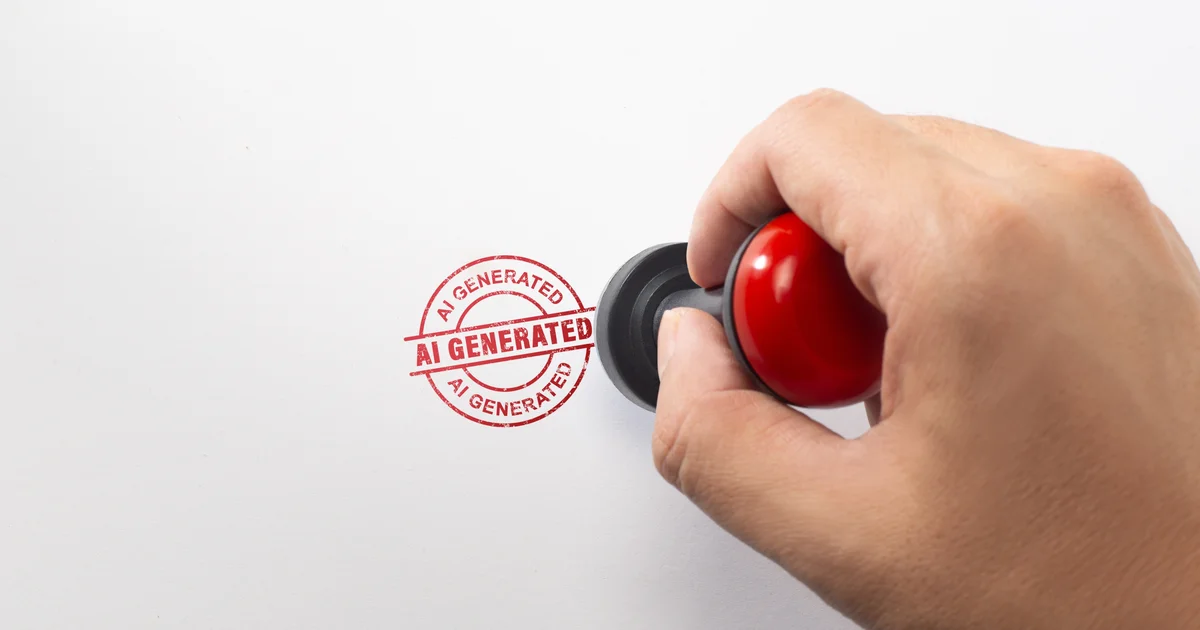
Text written with ChatGPT in Europe is about to carry a signature nobody can see. OpenAI says it will add an invisible watermark to text produced by ChatGPT and Codex in the European Union over the coming weeks, according to its announcement. It is how the company plans to meet the transparency rules in the EU AI Act.
Outside Europe the change is optional. API customers anywhere in the world, Australia included, can switch the watermark on for selected models, but it stays off unless they do.
How textGrain works
OpenAI calls the technology textGrain. It does not add a visible label, hidden characters or odd spacing. Instead, it nudges the way the model chooses between possible words as it writes, leaving a statistical pattern that a detector can pick up but a reader will never notice.
The pattern needs room to show. In OpenAI’s own tests, at a 1% false positive rate, the detector caught about 80% of 200 token passages and about 95% of 400 token passages. Very short text is the hardest case, and the European code that underpins the rules exempts text under 200 tokens.
Easy to weaken with light edits
Editing wears the signal down quickly. In the same evaluations, swapping 10% of a passage’s words for synonyms cut detection from about 92% to 66%. Swapping a quarter of the words brought it down to about 17%. Maths content was weaker from the start.
OpenAI says plainly that textGrain does not guarantee reliable detection. Anyone hoping to use it to catch AI written reports or assignments should read that line twice.
What a detected mark proves
A positive result means an OpenAI system may have generated or processed some of the text. It does not say who used the tool, how much a person changed, who owns the words or whether they are accurate. And it only works in one direction: if no mark is found, that does not prove a human wrote it.
The public cannot run the check either. Access to the detector is limited to approved researchers and expert organisations, case by case. OpenAI’s reasoning is that a public checker would cause harm through missed detections and false accusations.
Anthropic went down a similar path in August, when Claude started marking its output under the same EU rules. Each company’s mark needs its own detector, so there is no universal checker.
Why Australian businesses should care
There is no Australian equivalent of the EU’s Article 50 requiring AI text to be marked, so most local teams will see no change in their own ChatGPT use. The exceptions are businesses with staff, customers or websites in Europe. Text your team produces there may carry the mark, and that is a good prompt to settle an internal policy on when AI is used and when it is disclosed.
Companies building products on the OpenAI API for European customers have a decision to make about switching the watermark on. That applies to customer service tools too, so it belongs in the design of any AI chatbot that serves European users.
For legal and compliance teams, the limits matter as much as the feature. A watermark cannot settle a dispute about authorship, so contracts and audit trails still need their own records, which is the kind of question we work through in our AI consulting work.
Europe sets the pace on transparency
The Article 50 obligations have applied since 2 August, with a transition period until 2 December for systems already on the market. With OpenAI and Anthropic both marking text, the pressure now falls on the rest of the industry before that deadline.
A watermark will not settle whether a person or a machine wrote something. It does show where the rules are heading. Australian businesses that trade with Europe should expect AI output to carry more of these invisible fingerprints, whether or not local law ever asks for them.



