
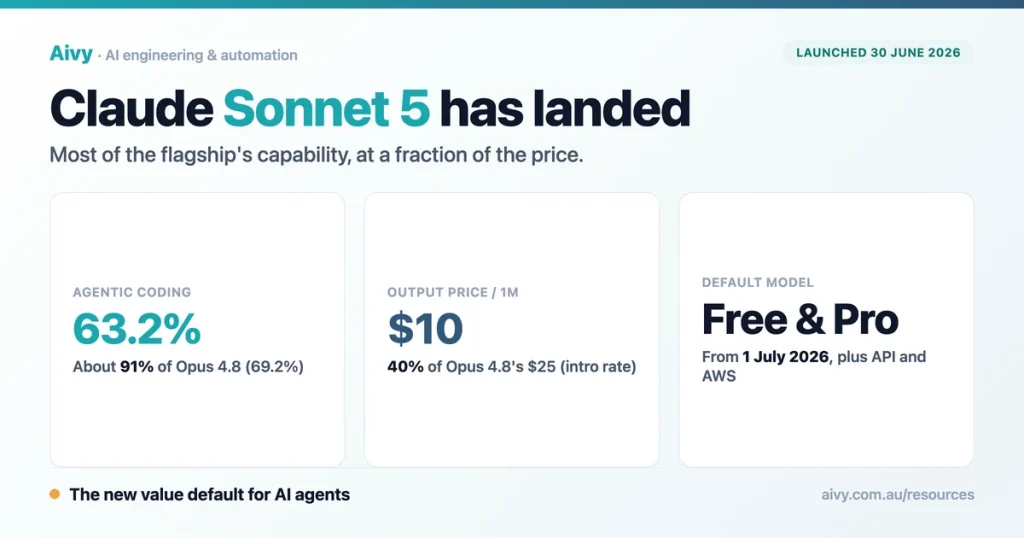




On 30 June 2026, Anthropic released Claude Sonnet 5 and called it the most agentic Sonnet model yet. The pitch is simple and, for once, easy to act on: performance close to the flagship Claude Opus 4.8, at a fraction of the price. From 1 July it became the default model on the free and Pro plans, which means most people already touching Claude are now using it without changing a thing.
I run client success at Aivy, an AI automation agency in Melbourne, and a launch like this changes the maths on real projects we are scoping right now. A mid-tier model that lands within a few points of the top model, while costing well under half as much to run, is exactly the kind of shift that turns an automation idea that was too expensive into one a business will actually sign off. That is the lens we use here.
This piece is part news, part business read. First the data that matters: the agentic coding benchmark, the new pricing, and a tokenizer change that quietly affects your bill. Then the part most write-ups skip, which is what a cheaper agent model means for an Australian company deciding where to spend in the second half of 2026. If you only read the quick pick, you already have the gist.
What launched on 30 June 2026
Claude Sonnet 5 is Anthropic’s new mid-tier model, positioned as a substantial step up from Claude Sonnet 4.6 and close to Claude Opus 4.8 on real work. Anthropic frames it as the most agentic Sonnet yet, meaning it is tuned to plan a task, call tools, run steps and check its own output rather than answer in a single turn. The API model id is claude-sonnet-5.
Availability is broad from day one. It is the default model for free and Pro plans from 1 July 2026, and it is available to Max, Team and Enterprise customers. You can reach it through the Claude API, Claude Code, the Claude Platform and on AWS. For most teams that means it is already in front of them, which is part of why this launch matters more than a typical point release.
Claude Sonnet 5 benchmarks
The headline number is agentic coding, the SWE-bench-style test that asks a model to resolve a real software issue end to end. Claude Sonnet 5 scores 63.2%, against 69.2% for Opus 4.8 and 58.1% for the older Sonnet 4.6. So it closes most of the gap to the flagship and clears its predecessor by a clear margin.
Agentic coding benchmark (SWE-bench style)
Higher is better, axis 0-100%. Source: TechCrunch, citing Anthropic.
69.2%
63.2%
58.1%
Two other results are worth noting. On knowledge work, Anthropic says Sonnet 5 slightly outperforms Opus 4.8, though it has not published an exact figure for that, so treat it as a direction rather than a hard number. On safety, the model recorded 0.0% successful exploits on a Firefox vulnerability test, a sign Anthropic is hardening these agents as they get more autonomous.
Claude Sonnet 5 pricing and token economics
This is where the launch earns its headline. Claude Sonnet 5 runs at an introductory rate of $3 per million input tokens and $14 per million output tokens, and Anthropic made that rate permanent on 11 August 2026. It sits well below Opus 4.8 at $7 input and $35 output, and now undercuts the older Sonnet 4.6 while being a much stronger model.
Output price per 1M tokens
Lower is cheaper. Source: TechCrunch, citing Anthropic (intro rate through 31 Aug 2026).
Put the two facts together and the value is clear. Sonnet 5 costs 40% of Opus 4.8 on output ($14 against $35) while delivering about 91% of its agentic coding score. Anthropic also positions it as cheaper than GPT-5.5 and Gemini 3.1 Pro, though more expensive than Gemini 3.5 Flash, so it sits in the value tier without being the rock-bottom option.
One detail deserves more attention than it usually gets. Sonnet 5 ships with an updated tokenizer, and Anthropic notes the same content uses 1.0 to 1.35x more tokens than previous versions. Because you pay per token, a lower per-token price does not always mean a lower bill on an identical task.
On text that tokenises near the top of that range, part of the headline saving is eaten back. It is still cheaper than Opus 4.8 by a wide margin, but model the real workload before you bank the full discount.
| Model | Input $/1M | Output $/1M | Best for |
|---|---|---|---|
| Sonnet 5 | $3 | $14 | Best value for agents and automation now |
| Opus 4.8 | $7 | $35 | Hardest reasoning and largest jobs |
| Sonnet 4.6 | $4 | $21 | Superseded by Sonnet 5, which now costs less |
| Haiku 4.5 | $1.42 | $7 | High-volume, simple, latency-sensitive tasks |
Prices per 1M tokens in Australian dollars, converted at the Reserve Bank reference rate for 11 August 2026. Source: TechCrunch, citing Anthropic, 30 June 2026.
Where Sonnet 5 fits against Opus 4.8 and Haiku 4.5
The practical question is not whether Sonnet 5 beats Opus 4.8, because it does not on raw capability. It is which model to reach for first. With most of the flagship’s agentic coding result at a fraction of the cost, Sonnet 5 becomes the sensible default for the bulk of agent and automation work, and you call up Opus 4.8 only when a task genuinely needs the extra few points.
At the other end, Haiku 4.5 stays the cheapest option at $1.42 input and $7 output, suited to high-volume, simple or latency-sensitive jobs like classification and routing. So the line-up reads cleanly: Haiku for cheap and fast, Sonnet 5 for the everyday agent that does real work, Opus 4.8 for the hardest reasoning and the largest contexts. Note that the context window for Sonnet 5 was not confirmed in the launch coverage, so we are not quoting a figure here.
What Claude Sonnet 5 means for Australian businesses
For Australian companies, the most useful effect of this launch is on cost, not benchmarks. A capable agent model that runs at well under half the price of the flagship lowers the cost floor for automation that actually does work, like triaging inboxes, drafting quotes, handling first-line support or moving data between systems. Projects that did not quite justify their running cost on a flagship model often do once that cost roughly halves.
In my experience with clients here, the blocker is rarely whether the model is clever enough. It is whether the monthly run cost survives a finance review. Sonnet 5 changes that conversation.
It is also the new default on the free and Pro plans, so staff already using Claude are on it now, which makes it the natural model to standardise on when you formalise an internal workflow. If you are weighing how AI agents differ from plain chatbots, our explainer on agentic AI versus generative AI sets out the distinction in plain terms.
One caution keeps this honest. The tokenizer change means you should price a real sample of your own workload rather than assume the full headline discount, because a workload moved from an older Sonnet can use more tokens for the same text.
Done with eyes open, a cheaper agent model is a genuine opening to automate a process you had parked as too expensive. For the model-level picture across vendors, our Claude vs ChatGPT comparison covers reasoning, writing and pricing, and our Claude Code vs Codex guide looks at the coding agents many teams pair with these models.
For most Australian teams, make Claude Sonnet 5 your default model and structure the rollout around its economics:
• Move everyday agent and automation work to Sonnet 5 now, while the intro rate runs.
• Keep Opus 4.8 on call for the hardest reasoning and the largest jobs only.
• Price a real sample of your workload for the tokenizer change, and budget against the standard rate from 1 September.
If you want help working out which model fits which process, and wiring it into how your business actually runs, that is the work we do every day. Aivy is an AI automation agency in Melbourne, and you can book a free discovery session to map the right setup for your stack.
Claude Sonnet 5 frequently asked questions
What is Claude Sonnet 5?
Claude Sonnet 5 is Anthropic’s mid-tier AI model, released on 30 June 2026 and described as its most agentic Sonnet yet. It delivers performance close to the flagship Opus 4.8 at a much lower price, and its API model id is claude-sonnet-5.
How does Claude Sonnet 5 compare to Opus 4.8?
On the agentic coding benchmark, Sonnet 5 scores 63.2% against Opus 4.8’s 69.2%, roughly 91% of the flagship result. Anthropic says it slightly outperforms Opus 4.8 on knowledge work. Opus 4.8 stays the stronger model for the hardest reasoning and largest tasks.
How much does Claude Sonnet 5 cost?
Sonnet 5 runs at $3 per million input tokens and $14 per million output. Anthropic made that rate permanent on 11 August 2026, cancelling the standard $4 and $21 it had planned. Both figures sit well below Opus 4.8 at $7 and $35.
Is Claude Sonnet 5 cheaper than Opus 4.8?
Yes, by a wide margin. On output it costs 40% of Opus 4.8 price ($14 against $35). Factor in the new tokenizer, which can use more tokens per task, before assuming the full saving.
What changed with the Claude Sonnet 5 tokenizer?
Sonnet 5 uses an updated tokenizer, so the same content can use 1.0 to 1.35x more tokens than previous versions. Because billing is per token, this can offset part of the lower per-token price on identical tasks, so model your real workload.
Where can I access Claude Sonnet 5?
It is available through the Claude API, Claude Code, the Claude Platform and on AWS. From 1 July 2026 it is the default model on the free and Pro plans, and it is available to Max, Team and Enterprise customers.
Should Australian businesses use Claude Sonnet 5 for automation?
For most use cases, yes. Its lower running cost makes more automation projects viable, from support triage to data entry, while keeping capability close to the flagship. Budget against the standard rate from September and test the tokenizer effect on your own content.
Does Claude Sonnet 5 replace Claude Sonnet 4.6?
In practice, yes. Sonnet 5 scores higher on agentic coding (63.2% against 58.1%) and now costs less than Sonnet 4.6, which stayed at $4 input and $21 output. For new work there is little reason to choose the older model.
What is the context window for Claude Sonnet 5?
The launch coverage did not confirm a context window figure for Sonnet 5, so we are not quoting one. Check Anthropic’s official documentation for the current limit before relying on a specific number for your project.
Last updated: 12 August 2026. Figures verified against Anthropic’s launch announcement and TechCrunch reporting at time of writing. Benchmark scores and pricing can change as Anthropic updates the model and its plans.
• Anthropic, Introducing Claude Sonnet 5. Supports: launch and positioning (most agentic Sonnet yet), availability (default on free and Pro from 1 July; Max, Team, Enterprise; API, Claude Code, Claude Platform, AWS), the 0.0% Firefox exploit safety result, and the updated tokenizer (1.0 to 1.35x more tokens).
• TechCrunch, Anthropic launches Claude Sonnet 5 (30 June 2026). Supports: agentic coding scores (Sonnet 5 63.2%, Opus 4.8 69.2%, Sonnet 4.6 58.1%), pricing (Sonnet 5 $3/$14, permanent from 11 August 2026; Opus 4.8 $7/$35; Sonnet 4.6 $4/$21; Haiku 4.5 $1.42/$7, converted at the Reserve Bank rate for 11 August 2026, 1 Australian dollar to 0.7056 US dollars), cheaper than GPT-5.5 and Gemini 3.1 Pro, more expensive than Gemini 3.5 Flash, and the knowledge-work comparison.



