
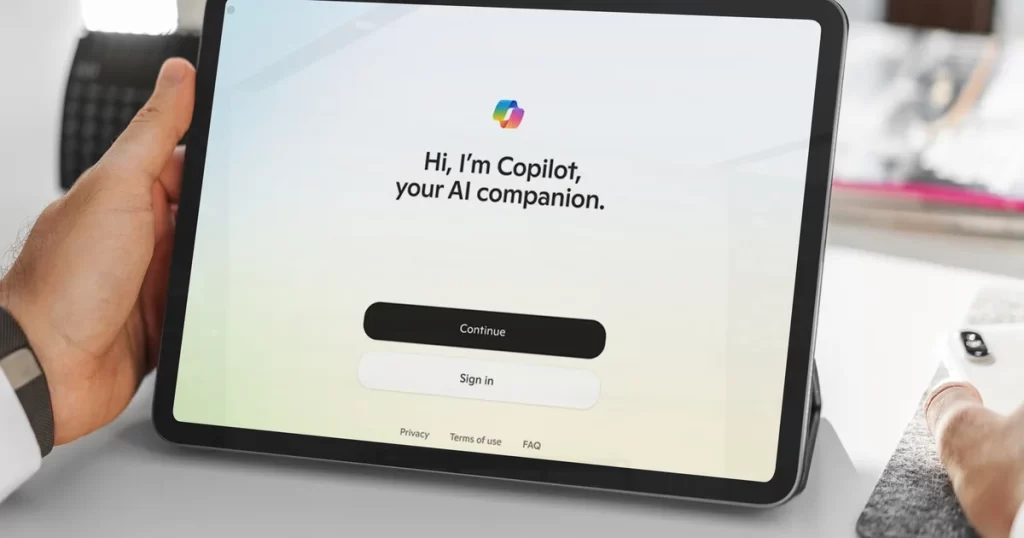




Microsoft markets Copilot as a productivity powerhouse that can draft documents, analyse data, and summarise meetings. But buried in the product’s own Terms of Use is a very different message: “Copilot is for entertainment purposes only. It can make mistakes, and it may not work as intended. Don’t rely on Copilot for important advice.”
The clause, sitting under “Important Disclosures & Warnings” in Microsoft’s legal terms, was highlighted on Hacker News on 31 March 2026. It drew nearly 500 upvotes and a heated debate about what happens when a company’s marketing says one thing and its lawyers say the opposite.
Disclaimer covers millions of users
The entertainment label applies to the standalone Copilot apps on desktop and mobile, the web version at copilot.microsoft.com, conversations through other Microsoft apps, and third-party integrations. It does not cover Microsoft 365 Copilot, which runs under separate enterprise contracts.
That distinction creates a two-tier system. Large organisations using the enterprise version operate under different legal terms. But millions of individual users and small businesses around the world use the consumer version of Copilot for real work every day, and the entertainment disclaimer applies directly to all of them.
Marketing tells a very different story
Microsoft’s public messaging positions Copilot as a serious business tool. CEO Satya Nadella has repeatedly described AI assistants as central to the company’s strategy. Advertising shows Copilot helping professionals with complex tasks, from financial analysis to project management.
The contrast between “your AI companion for productivity” in the marketing and “for entertainment purposes only” in the fine print is hard to square. It has drawn comparisons to the worst of financial services disclaimer culture, where products are sold aggressively while the legal text quietly disclaims almost all responsibility.
Legal shield, not product description
The clause appears designed to limit Microsoft’s legal exposure. If a user relies on Copilot to draft a contract or prepare financial figures and something goes wrong, the entertainment label gives Microsoft a defence: no reasonable person should have treated an “entertainment” product as professional advice.
Similar disclaimers exist elsewhere. Social media platforms and search engines have long distanced themselves from the accuracy of content they surface. But none have classified a tool they actively sell to businesses as entertainment. Microsoft appears to have taken the strategy further than any major technology company before it.

What it means under Australian law
Under Australian Consumer Law, businesses cannot make misleading claims about what a product does. If Copilot is marketed as a professional assistant but legally classified as entertainment, the gap between those two positions could attract attention from the Australian Competition and Consumer Commission (ACCC).
The ACCC has previously acted against companies whose legal terms contradicted their marketing. For Australian businesses that have built Copilot into their daily operations, the clause raises a practical question: if the AI generates an error that costs real money, who is actually responsible?
No rival AI company matches this
Other major AI providers use disclaimers, but none as extreme. OpenAI warns that ChatGPT may produce inaccurate information. Google’s Gemini terms include similar cautions about reliability. Neither company has called its product “entertainment only.”
The pattern reveals a broader tension across the AI industry. These companies need users to trust their products enough to pay for them, but not enough to hold the companies accountable when the products get things wrong.
Trust gap widens across AI
The distance between how AI tools are sold and how they are legally classified keeps widening. Microsoft’s entertainment disclaimer is the sharpest example yet of a major technology company hedging against the reliability of a product it simultaneously promotes as essential business infrastructure.
The clause may provide cover in US courts, but countries with stronger consumer protection laws could push back. Australia’s consumer law regime, which prioritises marketing claims over fine print, is one of the most likely places for that challenge to arise.
As AI assistants move deeper into business workflows, the question of who pays when they fail is becoming impossible to defer. Regulatory pressure in 2026 may force AI providers to choose between their marketing and their legal positions.
Understanding how AI tools present themselves online is increasingly important for businesses investing in these technologies. Learn more about generative engine optimisation and how Aivy helps Australian businesses navigate the evolving AI landscape.



