
← All use cases / Field operations
Industrial equipment · Australia
From a dense equipment catalogue to a qualified lead in four questions
A lifting-equipment supplier carries a deep catalogue: stair climbers, flat-floor movers, tuggers. The right machine depends on what is being moved, where, how heavy it is and how often. Buyers rarely know the category name for their problem, so enquiries arrived as callback requests with none of those answers. We built a working prototype: a guided finder that reaches a named recommendation in about 30 seconds, then sends the enquiry in with the full spec attached.
Explore the actual prototype
- Everything is synthetic: a fictional supplier (“Ironbark Lifting”) with an invented catalogue, no client data.
- Deterministic matching: the recommendation engine runs entirely in your browser, no AI calls, nothing to break.
- Nothing to sign up for: answer the questions and watch the finder narrow the catalogue to one machine. The final send is simulated, so finishing the flow emails no one.
Opens in a new tab · synthetic data only
The problem
- The catalogue is organised by product family. Buyers arrive with a problem: get a 300 kg machine up a flight of stairs, move beds between wings, shift pallets across a warehouse.
- Machines that look interchangeable in a listing split on specifics: indoor or outdoor, stairs or flat floors, a washing machine or a piano, one-off hire or daily use.
- So enquiries arrived thin: a name, a phone number and “please call me”. Specialists spent the first call collecting the basics the website never asked for.
- A long spec form would capture those basics, but nobody completes a long form for a product they cannot yet name.
- Every buyer who leaves without an answer keeps searching, and the next supplier with a clearer answer gets the call.
at most, between “what do you need to move?” and a named recommendation with the reasoning shown. Some paths need only three.
live AI calls in the wizard. The matching matrix is deterministic: the same answers always return the same machine, and there is no per-visitor AI cost to run it.
What the prototype does
One question to start: what do you need to move?
Four plain-language paths: a person up or down stairs, heavy cargo on stairs, furniture and equipment on flat floors, or loads over long distances inside a facility. No product names, no jargon.
Plain language
Follow-ups that adapt to the path
The wizard branches: environment, load weight and how often it happens, the same details a specialist would ask first on the phone. Three to four taps, about 30 seconds end to end.
Adaptive
One recommendation, with the reasoning shown
A single machine from the standard range, a plain-English explanation that references the buyer’s own answers, and a spec summary. Not a filtered grid of twelve maybes.
Rules decide
The enquiry lands with the spec attached
Contact details go through a spam check at the edge, then the sales team receives a structured spec sheet: every answer, the recommended machine and the reasoning. Ready for the supplier’s Zoho CRM, not another blank “call me back”.
Qualified lead
A specialist still closes it
Follow-up lands within one business day. Exact model, pricing and stock are confirmed by a human, with a site walk-through where it matters. The widget recommends; it never quotes prices.
Human closes
A peek inside
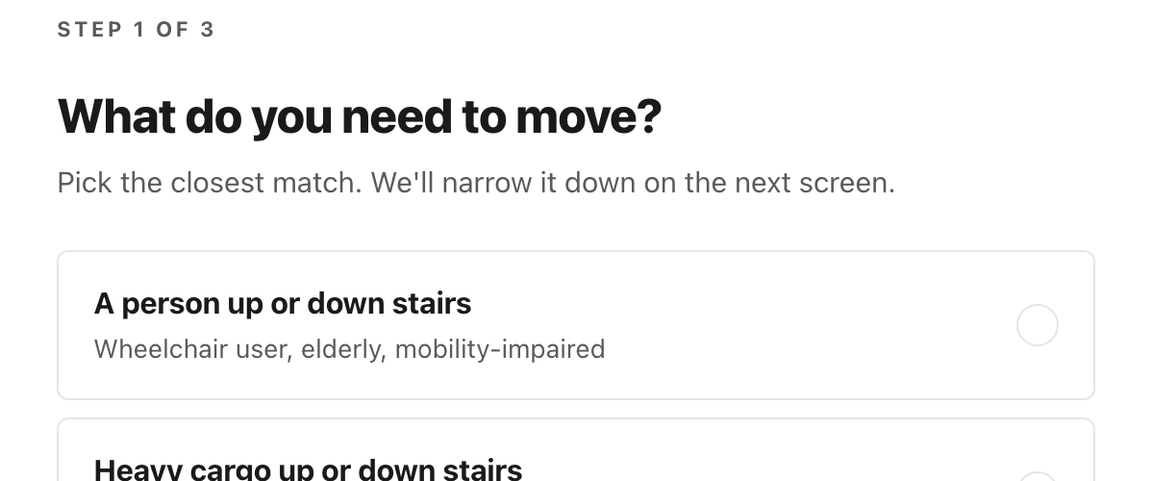
Step 1 of the actual prototype: four plain-language paths in, one recommendation out. No product knowledge required.
How it runs in production
Built to embed
It ships as a product finder widget that drops into the supplier’s existing website, picks up their brand colour and name from a config, and detects when it is running inside another page. Served from Cloudflare’s edge, spam-checked before anything sends.
Your stack stays
The supplier runs their pipeline on Zoho. Enquiries arrive structured, ready to feed the existing CRM and quoting workflow. The finder feeds the pipeline; nothing gets ripped out.
Specialists sign off
The widget qualifies and recommends. A human confirms the exact model, the price and the delivery, exactly as the sales process works today.
What this page doesn’t claim
No invented conversion rates, no anonymous quotes. This is a working prototype we built before the supplier was a client; it is the demo that opened the conversation. The wizard, the deterministic matching matrix (18 machines across four categories) and the spec-sheet lead email all work today. Embedding it on the supplier’s own site and wiring it into their CRM is production scope. When real enquiries flow through it, this page gets real numbers, and not before.
Related services
Selling a catalogue your buyers can’t navigate?
Tell us what the first phone call always has to ask. If it looks like a fit, the next thing you see is a working finder on your own catalogue, not a proposal.