
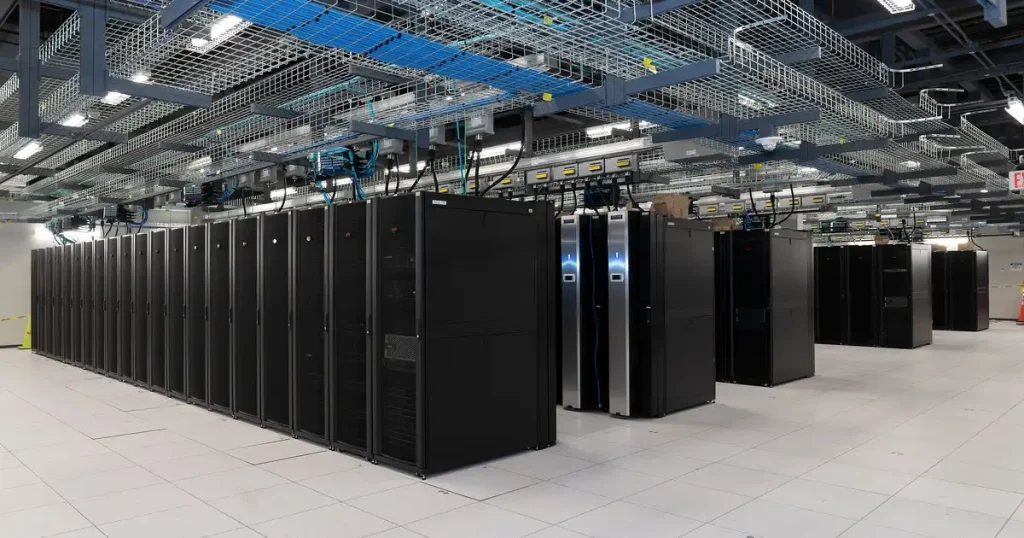




The Australian Energy Market Operator expects data centres to go from about 5 terawatt hours of electricity a year to around 34 by 2036, roughly seven times what they draw today. Over the same period their share of demand on the National Electricity Market rises from about 3 per cent to about 13.
Two things are worth pinning down before that number travels. AEMO is forecasting data centres, not artificial intelligence specifically, and it never separates the two anywhere in the document. And the National Electricity Market covers five eastern regions, not the whole country: Western Australia and the Northern Territory run their own systems.
What AEMO actually forecast
The figures come from the 2026 Electricity Statement of Opportunities, published on 25 August. Under AEMO’s central Step Change scenario, data centre consumption triples to around 15 terawatt hours by 2030 and reaches about 34 by 2036, at which point growth begins to taper.
The driver AEMO names is not AI alone. Its wording is that rapid growth in cloud computing and AI is pushing data centre consumption up across the market. Total electricity consumption is forecast to rise more than 40 per cent over the decade, with data centres one of three drivers alongside industrial development and household electrification.
The queue is bigger and shakier
Network operators reported 225 data centre projects in some stage of the connection process this year, and proposed connection capacity jumped from 38 gigawatts to 67 in twelve months, as reported by iTnews.
The attrition is the more interesting number. About 36 per cent of the projects on last year’s list have since been cancelled, and more than 30 per cent of those cancellations were projects previously classified as committed, which normally means a connection agreement was already signed. A signed agreement is not a built data centre. That attrition is why most of the announced gigawatts will never be built, and why pipeline totals overstate what the grid will carry.

Where the pressure lands
Sydney remains Australia’s primary data centre hub and Melbourne the second, and AEMO expects both to carry a material share of demand growth. Queensland is forecast to contribute relatively little, though the report twice notes that AEMO has since seen more Queensland interest than these numbers capture.
Reliability holds for now. The report finds no forecast reliability gaps before 2030, helped by a record 9.1 gigawatts of new generation and storage connected last financial year. Under a sensitivity where data centre demand runs harder still, reaching 52 terawatt hours, New South Wales, Victoria and South Australia would need earlier investment from 2033 onwards.
What it means for Australian businesses
For most firms this is not a next quarter decision, and it would be dishonest to dress it up as one. AEMO is explicit that a forecast reliability gap does not mean outages are expected. It is an early signal that investment may be needed.
What it does change is the arithmetic behind onshore AI. Every argument for keeping data onshore eventually runs into a power connection in New South Wales or Victoria, and the queue for those connections is now 67 gigawatts long with a documented failure rate. Anyone building an AI strategy around local capacity should treat announced capacity and delivered capacity as different things.
It also compounds a cost story already in play. The Reserve Bank warned this month that the AI build out could push interest rates up, and the electricity side of that build out is what AEMO has just quantified.
The flat load nobody expected to help
There is a counterintuitive finding buried in the report. Data centres run almost flat, at a load factor near 90 per cent, consuming nearly as much at 3am as at midday. That steadiness lifts minimum demand, which is currently one of the harder problems on a grid carrying a lot of rooftop solar.
The flip side is that they give almost nothing back. AEMO observes that operating data centres currently provide little demand response and have not been seen to flex under normal conditions, because operators prioritise uptime for their customers. Shifting non urgent compute to cheaper hours is technically feasible and, so far, not happening here.