





Meta has released Muse Spark Open, a version of its Muse Spark model that anyone can download and run on their own hardware. Meta calls it the most capable open weight model ever released by a US company, in its announcement on 15 October.
Two details make it more than another model launch. It is the first model of its size that Meta says can run on a desk, on two Apple Mac Studios. And the licence is free for most businesses, which puts a serious AI model within reach of firms that cannot send their data to a cloud provider.
What Meta released
Muse Spark Open has 816 billion parameters in total, but only 42 billion work on each word it writes. That design, known as mixture of experts, is what lets a very large model answer quickly. It can take in up to one million tokens at once, enough for a large codebase or a long stack of contracts.
The model takes text, images, video and audio as input and answers in text. Meta trained it on data in more than 100 languages and built it mainly for coding and agent work, meaning long tasks where the AI plans, uses tools and checks its own results over many steps.
The weights can be downloaded from Hugging Face, Amazon SageMaker AI, Google Cloud Model Garden and Microsoft Foundry Models. Businesses that would rather not host it can call it through seven API providers, including Groq, Together AI and OpenRouter.
Two Mac Studios instead of a data centre
Models of this class normally need a rack of data centre GPUs. Meta’s model card says the compressed version needs at least 700 GB of GPU memory, and the full version at least 2 TB. Meta’s answer is two Mac Studios with the M5 Ultra chip, each able to give its graphics chip up to 512 GB of memory.
Linked together, Meta says the two machines behave like one computer with a terabyte of memory. To prove the point, it ran the model entirely on device to fix bugs and add features to an open source iPhone app, and to edit video in DaVinci Resolve by reviewing footage frame by frame.
How it compares with the best open models
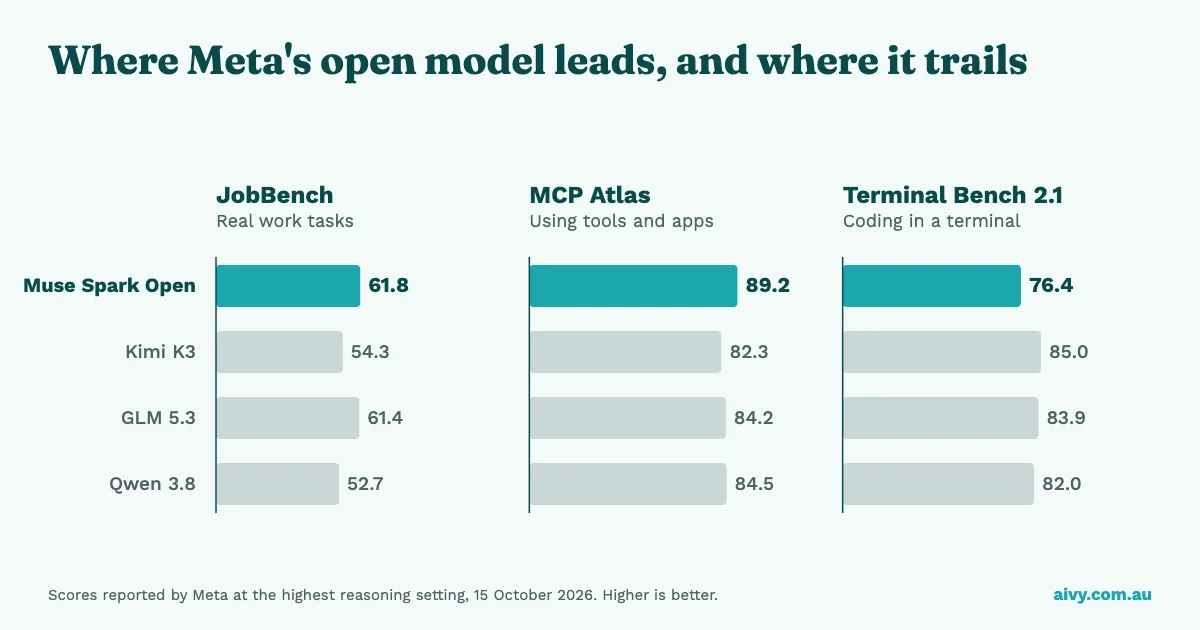
Meta published scores against seven other open models, including three from Chinese labs. The short version: it leads on agent work, reasoning and images, and falls behind on coding.
| Test | Muse Spark Open | Best open rival |
|---|---|---|
| MCP Atlas Using tools and apps |
89.2 | 84.5 Qwen 3.8 |
| JobBench Real work tasks |
61.8 | 61.4 GLM 5.3 |
| HLE Diamond Expert questions, no tools |
26.1 | 22.2 Kimi K3 |
| ZeroBench Hard questions about images |
50.0 | 41.0 Kimi K3 |
| Terminal Bench 2.1 Coding in a terminal |
76.4 | 85.0 Kimi K3 |
That is the context for Meta’s headline. Muse Spark Open is the strongest open model from a US company, not the strongest open model overall. For a business, the gap matters less than where the model can run and who controls it.
How it compares with Opus 5.5 and GPT 6 Astra
Meta only compared Muse Spark Open with other open models. To see where it stands against the closed models many businesses already pay for, we took the figures from Artificial Analysis, which runs the same tests on every model.
| Model | Intelligence Index | Coding | Price |
|---|---|---|---|
| Claude Opus 5.5 | 57.6 | Not published | $28.76 per million output tokens |
| GPT 6 Astra | 52.7 | 88.4 | $71.89 per million output tokens |
| Kimi K3 | 43.6 | 85.0 | $21.57 per million output tokens |
| Muse Spark Open | 38.9 | 76.4 | Free to download |
The gap is real. Claude Opus 5.5 scores almost 19 points higher on the index, and GPT 6 Astra almost 14. What Muse Spark Open offers instead is control: no bill per token if you host it yourself, and nothing leaves your own hardware.
Free, but read the licence
The weights come under the Muse Model License, which Meta describes as having limited commercial terms. Using the model internally or to power features in your own product is free. Meta also claims no ownership of what the model produces.
The catch applies to companies that sell access to AI models as a service. If that business and its affiliates earn more than 20 million US dollars in a year, about $29 million, they must notify Meta and sign a separate agreement. Every product built on the model also has to show the line Built with Muse Spark Open, and Meta’s usage policy bans uses such as unlicensed legal, financial or medical advice.
That makes it more restrictive than a true open source licence. Teams that need fewer conditions can look at Muse Glimmer 30B, a much smaller Meta model released in August under Apache 2.0.
What Australian businesses can do with it
The most practical change is for firms that handle sensitive data. A model running on hardware in your own office never sends client files overseas, which removes one of the main questions under the Privacy Act 1988. We have covered why that matters in our guide to AI data residency in Australia.
Law firms, accountants and medical practices are the obvious candidates: they want AI help with documents but cannot easily justify a cloud provider reading them. The trade off is cost and skill. Two top end Mac Studios are a real hardware investment, and running a model of this size still takes someone who knows MLX or vLLM.
For most firms the sensible first step is to test it through an API provider on a few real tasks, then decide whether owning the hardware is worth it. That is the kind of comparison we run in AI consulting work before any model goes near production data.
Why Meta is giving this one away
Muse Spark Open is an open weight release of Muse Spark 1.2, from the same family behind the Muse assistant in Meta’s apps. Meta still keeps its assistant and its hosted models under its own control.
Giving the weights away keeps developers building on Meta’s tools at a time when Chinese labs lead the open model rankings. For Australian businesses, the result is simpler: there is now a capable model that can run on hardware they own, under terms most of them will never hit.



