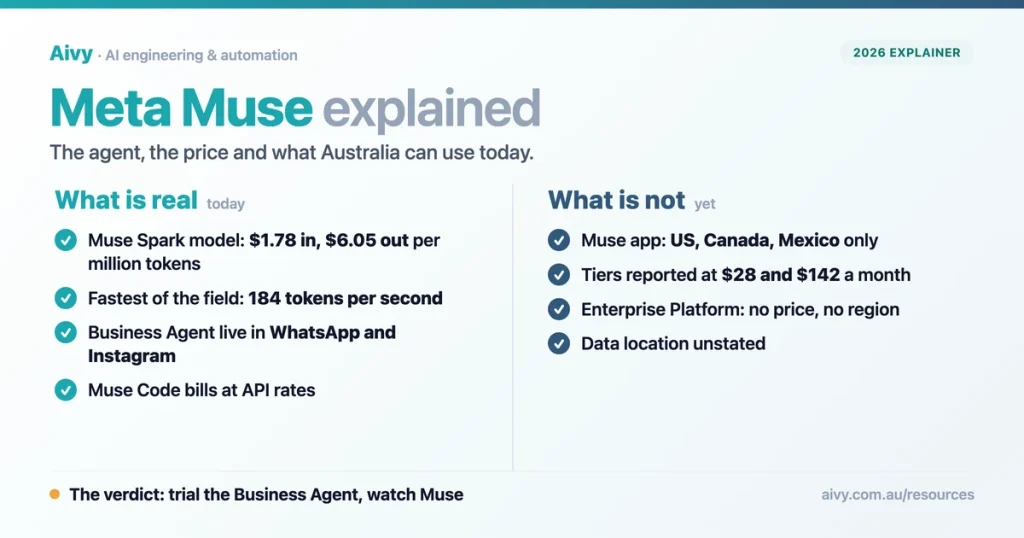
Meta launched Muse on 8 September 2026: a personal AI agent rather than a chatbot, which opens a browser, fills in forms, sends email, books travel and pays for things, then keeps working after you close the app. Since then Meta has added an Enterprise Platform, its first frontier models, Muse Wonder and Muse Wonder Full, on 12 October, and an open weight Muse Spark on 15 October.
I run growth and editorial at Aivy in Melbourne, and Muse is the product clients ask me about most, usually to know whether they should wait for it. I have not been able to run the agent from Australia, because Meta sells it in the United States and Canada only. What follows comes from Meta’s own pages and developer pricing, the Artificial Analysis benchmarks and the launch reporting.
This guide covers what Muse does, how the Muse models score against Claude, GPT 6 and Grok, what each tier costs here, where Muse Code and the Business Agent fit, what the Enterprise Platform changes, and when Australians might get access. The sections below give you the numbers and the difference between an agent and a chatbot that Muse is built on.
Meta Muse at a glance
Meta uses the Muse name for several products, and that confusion is why clients ask me about it. The table separates them: only the models and the Business Agent are usable from Australia, and neither is the agent itself. If staff are already signing up for consumer agents, our AI policy template is where to set the rule. Prices are converted at the Reserve Bank rate of 28 September 2026.
| Product | What it is | Launched | Price | In Australia |
|---|---|---|---|---|
| Muse | Personal agent app: browser, email, bookings, purchases | 8 Sep 2026 | Free, or $28 (Power) or $142 (Max) a month | No date |
| Muse Spark 1.3 | The model under Muse, sold through the Muse API | Sep 2026 | $1.78 in, $6.05 out per million tokens | Yes, via API |
| Muse Code | Terminal coding agent, Meta’s answer to Claude Code | 5 Aug 2026 (beta) | Monthly plans, or API token rates | Not stated by Meta |
| Meta Business Agent | Customer facing agent in WhatsApp, Instagram and Messenger | 3 Jun 2026 | Free to start, paid tiers coming | Yes, global |
| Meta Enterprise Platform | The umbrella for all of the above, for business customers | 28 Sep 2026 | Not announced | Not announced |
Sources: Meta newsroom, Meta Model API pricing, Engadget and TechCrunch, September 2026. Muse plan prices from Meta’s subscriptions help page, read 20 October 2026; Muse Wonder and Muse Spark Open from Meta’s announcements of 12 and 15 October 2026.
What Meta Muse actually does
Meta describes Muse as a personal agent that pursues goals rather than answering questions. It sends emails, books travel, fills in forms, builds plans for longer goals, compares options in a browser and negotiates on your behalf, then keeps working after you close the app and asks before anything sensitive, such as sending a message or paying. It runs on iOS, Android, the web at muse.ai and inside WhatsApp.
The part that matters for a business owner is where it runs. Each user gets what Meta calls a Muse Secure VM, a dedicated virtual machine in Meta’s cloud that holds both the agent and the user’s data. Purchases go through Link, the Stripe wallet, with single use card numbers.
Meta says conversations are not fed to its advertising systems and that users can opt out of training. That is a stronger privacy posture than the free consumer chatbots, which is exactly what a shadow AI audit usually finds people using instead.
- Meta Connect, 23 September: a live video avatar, control of a Mac so Muse can operate desktop apps while you are away, and its own email address so you can copy it into threads. Retail connectors include Walmart, Best Buy, Sephora, Gap and Wayfair, with Expedia, Shopify and Instacart on the list, and TechCrunch reported more than 1,500 connector applications in the first week.
- Muse for Small Business, 29 September, updated 8 October: connectors for Shopify, Stripe, Intuit QuickBooks, Canva and Facebook and Instagram business accounts, with nothing published, sent or spent without the owner’s approval. It is the same agent, so it is also limited to the United States and Canada.
- Muse Wonder, 12 October: Meta says its new frontier model will soon power Muse, rolling out first to subscribers, with no date.
- How Meta makes money: a small fee per transaction rather than the subscription alone, which tells you the consumer agent is built around the shopper. For a customer facing agent that answers on your channels, the relevant product is different, and I cover it below alongside the chatbots Australian businesses already use.
Muse Spark and Muse Wonder against Claude, GPT 6 and Grok
Muse Spark 1.3 is the model under the agent, and you can benchmark it from anywhere. On the Artificial Analysis index of 18 October it scores 48 at max, two points ahead of Grok 4.7 and eight behind Claude Sonnet 5.5, the model our Sonnet 5.5 versus Opus 5.5 guide recommends for most work. In September it sat level with GPT 6 Sol.
Intelligence Index: Muse Spark and Muse Wonder against the October 2026 field
Higher is better, axis 0 to 100. Effort in brackets. Source: Artificial Analysis Intelligence Index, read on 18 October 2026. Based on data from Artificial Analysis (artificialanalysis.ai), which does not endorse, validate or approve any of the analysis or conclusions drawn from it.

Muse Wonder, released on 12 October, closes most of that gap at 52 at max, and Muse Wonder Full reaches 56, level with Sonnet 5.5. Meta calls them its first frontier models and keeps both closed. The open weight Muse Spark Open, out on 15 October, scores 39 at xhigh: a model to run on your own hardware, not a rival to the top of the table.
Speed depends on the setting. At xhigh, Muse Spark 1.3 runs at 288 tokens per second, the fastest here; at max it slows to 139, level with Sonnet 5.5, while Muse Wonder runs at 176. Reviewers also note that Muse Spark is verbose, which pushes token bills up even at a low unit price, as our GPT 6 tier guide shows on the OpenAI side.
Output speed, tokens per second
Higher is faster; bars scaled to the fastest. Effort in brackets. Source: Artificial Analysis, measured on each vendor’s first party API, read on 18 October 2026. Based on data from Artificial Analysis (artificialanalysis.ai), which does not endorse, validate or approve any of the analysis or conclusions drawn from it.
What Meta Muse costs in Australian dollars
Meta’s help pages now confirm the Muse plans: a free tier, Power at 20 US dollars a month with 500 million Muse tokens a week, and Max at 100 with three billion, which is $28 and $142 here at the Reserve Bank’s 28 September rate. The developer side is fully published too: Muse Spark costs $1.78 per million input tokens, $6.05 per million output and $0.21 for cached input.
Muse Wonder, the new frontier model, lists at $5.70 in and $28.49 out per million tokens, the same rate in US dollars as Claude Opus 5.5, with no cheaper Contributor option. On both models the standard tier does not use your prompts for training. Image generation is about one cent per image, and web search grounding is $3.56 per 1,000 queries on top of tokens.
There is also a Contributor tier for Muse Spark at $0.14 in and $0.28 out, roughly twelve times cheaper on input, in exchange for letting Meta train on your data. For anything that touches customer records it is a non starter under the Privacy Act, and I treat it the way we treat free plans in the cost of AI consulting conversation: cheap on the invoice, expensive in the review.
Output price per million tokens, standard API tiers
Lower is cheaper; bars scaled to the dearest. Vendor list prices converted at 1 USD = 1.42 AUD, RBA, 28 September 2026. Sources: Meta Model API pricing, read 20 October 2026, Anthropic pricing and Artificial Analysis model pages.
| Muse pricing line | Price | Data used for training |
|---|---|---|
| Muse app, free | $0 with a token allowance | Opt out available |
| Muse app, paid tiers | $28 (Power) or $142 (Max) a month | Opt out available |
| Muse Spark 1.3, standard API | $1.78 in, $6.05 out, $0.21 cached | No |
| Muse Spark 1.3, Contributor API | $0.14 in, $0.28 out | Yes, by design |
| Muse Image and web search | $0.01 per image; $3.56 per 1,000 searches | Follows the tier |
Converted at 1 USD = 1.42 AUD. If you want to model a workload, our AI ROI calculator takes per token prices.
Muse Code next to Claude Code and Codex
Muse Code is Meta’s terminal coding agent. It shipped in beta on 5 August 2026 with Muse Spark 1.2 and does the same job as Claude Code and Codex: you type a task, it plans the change, edits files, runs commands and checks the result, coordinating background sub agents for the whole session. Meta’s enterprise write up adds user approvals and an operating system sandbox around it.
Two things stand out against the tools in our Claude Code versus Codex comparison. First, price: Muse Code is sold on four flat monthly plans, from Everyday to Maximum, whose prices Meta’s documentation does not print, or at the API rates above, so $6.05 per million output tokens on Muse Spark against $14.25 for Sonnet 5.5. Muse Wonder Full comes only with the Power and Maximum plans.
Second, evidence. Meta has still not published a SWE bench style result for Muse Code that I could find, and its Muse Wonder announcement names no benchmark scores, so the cost advantage is real and the quality claim is still unproven. Our coding assistant ranking will add it once there are numbers.
| Coding agent | Model it runs | Output price per million | Independent benchmarks |
|---|---|---|---|
| Muse Code | Muse Spark 1.3 and Muse Wonder; Wonder Full on the Power and Maximum plans | $6.05 Spark, $28.49 Wonder | None published yet |
| Claude Code | Claude Opus 5.5 by default, Sonnet 5.5 optional | $28.08 Opus, $14.25 Sonnet | Yes: SWE bench Pro, Terminal Bench |
| Codex | OpenAI GPT 6 family; GPT 6 Sol shown | $14.25 | Yes: Terminal Bench and vendor tables |
Output prices converted at 1 USD = 1.42 AUD from the Meta Model API page and Artificial Analysis; Opus 5.5 from our Sonnet 5.5 versus Opus 5.5 guide. Benchmark status as of 20 October 2026.
Meta Business Agent, the part you can use in Australia today
The product with an actual Australian footprint is older than Muse. Meta made the Business Agent available globally on 3 June 2026, inside WhatsApp, Instagram and Messenger. It answers questions about your business, recommends products from your catalogue, books appointments, qualifies leads, closes sales, hands the thread to a person at a threshold you set and sends the owner a morning briefing.
Getting started is free, with paid tiers by business size promised for the coming months, and TechCrunch reports that large businesses pay on token usage. The integrations named at launch were Shopify, Zendesk and Shopee. For an Australian retailer whose customers already message on Instagram, this is the cheapest way to answer at 2am.
The trade off is the same one every Meta product carries: your conversations live inside Meta’s apps, the escalation rules are Meta’s, and the agent is only as good as the catalogue and FAQ you feed it. A Melbourne clinic or a Sydney trades business with a real booking system will get more from a connected agent, the kind we build in our chatbot development work.
The Meta Enterprise Platform, and what it does not say yet
On 28 September Meta announced the Meta Enterprise Platform, in Mark Zuckerberg’s words the next major pillar of the business. It brings together Muse for business users, the Business Agent, the Muse API and Muse Code, run by Chirantan Desai, known as CJ, as Chief Enterprise Platform Officer reporting to Zuckerberg. Desai was chief executive of MongoDB, after senior roles at Cloudflare and ServiceNow.
What the announcement leaves out is the whole buying decision: no enterprise pricing, no named customer, no delivery date, no packaging and no word on regions or data residency, and none had appeared by 20 October. The Muse API is compatible with the OpenAI and Anthropic interfaces, which lowers switching cost for developers, but nothing else in the release is something you can sign today.
| Announced on 28 September | Still missing |
|---|---|
| Four components: Muse, Meta Business Agent, Muse API, Muse Code | Enterprise pricing and packaging |
| CJ Desai as Chief Enterprise Platform Officer, reporting to Zuckerberg | A named customer or partner |
| Muse API compatible with the OpenAI and Anthropic interfaces | Regions and data residency |
| Positioned as the next major pillar of Meta’s business | A delivery date for a unified platform |
Source: Meta Newsroom, Launching Meta Enterprise Platform, 28 September 2026.
When clients ask whether to wait for it, the honest answer from our AI consulting side is that a platform with no price and no region is not yet a platform. The questions we tell people to ask any AI vendor apply to Meta too.
When Australia gets Meta Muse
Muse launched in the United States on 8 September and reached Canada on 18 September. Launch reporting also mentioned Mexico, but no Meta page lists it. It is for adults only, and Meta has named no further countries, so there is still no date for Australia, the UK or the EU. Until then, the agents Australians can already sign up for are Gemini Spark, ChatGPT Dots and Claude Cowork.
Every Australian who has tried the app has hit the same country wall, and a VPN is a poor answer. Muse is tied to a wallet, a phone number and local retailers, and running it against Meta’s terms is not something I would put a business account behind. Apple went the other way, and Siri AI has been available in Australia since its English launch on 15 September.
| Market | Muse status | Since |
|---|---|---|
| United States | Live | 8 September 2026 |
| Canada | Live | 18 September 2026 |
| Mexico | Mentioned in launch reporting, not on any Meta page | September 2026 |
| Australia | No date announced | Waitlist only |
| United Kingdom and EU | No date announced | Waitlist only |
Rollout as checked on 20 October 2026 against Meta’s own pages; adults only in every market.
The bigger question for a company is not access but location. Each Muse instance runs in a virtual machine in Meta’s cloud, and Meta has not said where. A Muse Confidential VM with keys the user holds is promised for later in 2026. Until then, an Australian business would be sending whatever the agent reads, including customer email, offshore, which is a cross border disclosure under the Privacy Act.
- Our guide to which AI tools keep data in Australia covers what offshore processing means in practice.
- The Privacy Act playbook covers the cross border disclosure rules.
- Claude went through the same staged rollout here, and our Claude access guide is the precedent I would expect Meta to follow.
Security: the sandbox, Sentinel and the Amazon standoff
Meta published an unusually detailed account of how it contains Muse, summarised in the table: an isolated Linux container with no real privileges, surrogate tokens while real credentials sit in a vault, a host side gatekeeper called Sentinel that approves every connector action and outbound connection, kernel level tracking of tainted data before it leaves, and a browser sub agent that reads an accessibility tree and cannot run JavaScript.
| Layer | What Meta says it does | Why it matters to a business |
|---|---|---|
| Isolated container | Each agent runs in its own Linux container with no real privileges | A compromised agent cannot reach other users or the host |
| Surrogate tokens | The agent never sees real passwords or tokens; a vault holds them | Prompt injection cannot exfiltrate a credential the agent does not have |
| Sentinel | Approves every connector action and every outbound connection | An allow list, not a deny list, decides what the agent can touch |
| Tainted egress | Kernel level tracking flags sensitive data before it leaves | The user is asked before customer data goes anywhere |
| Browser sub agent | Reads an accessibility tree, cannot run JavaScript | Less surface for a hostile page to hijack the session |
| Bug bounty | Up to $427,000 per finding, $185,000 for a prompt injection | Meta is paying to be told where this breaks |
Source: Meta AI research, security and safety for AI agents with Muse. Bounty converted at 1 USD = 1.42 AUD.
Meta backs this with a bug bounty of up to $427,000 for a valid report and up to $185,000 for a working prompt injection against one user, and says the model is trained specifically to resist injection. That is the right architecture, and it is the same list we run through in an Essential Eight review: least privilege, credential isolation, approval for anything that leaves.
A sandbox is not the whole answer
It is also why September’s OpenAI agent incident with the Medicare site mattered so much. A sandbox is only as good as the sites the agent is allowed to touch.
Which brings us to Amazon. Around 20 September Amazon blocked Muse from shopping on its store, saying it violates its conditions of use: as TechCrunch reported, Muse hides that it is an agent and appears to retain customer credentials. Meta and Amazon are partners elsewhere, so this is not a feud, but it shows an agent’s usefulness depends on who lets it in, a choice Australian retailers will face too.
Muse or ChatGPT, Claude and Copilot for a business
Most of the clients asking about Muse already pay for one of the three business chat products, so the fair comparison is not model against model but product against product. The table is deliberately qualitative: the other three change plans every quarter, and our ChatGPT Business versus Claude Team versus Copilot guide carries the current Australian prices.
| Criterion | Meta Muse | ChatGPT Business | Claude Team | Microsoft Copilot |
|---|---|---|---|---|
| Built for | One person’s life admin and shopping | Teams, shared workspace | Teams, long documents and code | Microsoft 365 users |
| Usable in Australia | Not yet | Yes | Yes | Yes |
| Acts for you (browser, email, payments) | Yes, by default | Dots and ChatGPT Work, limited | Computer use, limited | Inside Microsoft apps |
| Admin and audit controls | Not yet (Enterprise Platform promised) | Yes | Yes | Yes, strongest |
| Where your data sits | Meta cloud, region unstated | OpenAI, US by default | Anthropic; AU via Bedrock for Opus 5.5 and Sonnet 5.5 | Microsoft, AU regions available |
Qualitative comparison from vendor documentation, checked 20 October 2026. Prices and plan names change often; see the linked guide for current figures.
Meta Muse: frequently asked questions
Is Meta Muse available in Australia?
No. As of 20 October 2026 Muse works in the United States and Canada, for adults only. Meta says more countries are coming but has not named Australia or given a date, so Australians are in waitlist mode.
How much does Meta Muse cost?
There is a free tier, and two plans on Meta’s help pages: Power at 20 US dollars a month and Max at 100, about $28 and $142 here. Each comes with a weekly allowance of Muse tokens, 500 million and three billion.
What is Muse Spark?
Muse Spark is the model that powers Muse. Version 1.3 scores 48 at max on the Artificial Analysis index of 18 October, with a one million token context. Muse Wonder, released on 12 October, scores 52, and developers can call both through the Muse API.
What is Muse Wonder?
Meta’s first frontier models, released on 12 October 2026. Muse Wonder is on the Muse API and Muse Code at $5.70 in and $28.49 out per million tokens, and Muse Wonder Full comes with the Power and Maximum Muse Code plans. Meta says Wonder will power the Muse app later, subscribers first.
What is Muse Spark Open?
An open weight version of Muse Spark released on 15 October 2026, with 816 billion parameters, 42 billion active per token, and a one million token context. It is free to download under the Muse Model License and runs on your own hardware or through hosts such as Together AI.
Is Muse Code free?
Not exactly. Muse Code is sold on flat monthly plans, from Everyday to Maximum, or billed at the Muse API rates, about $1.78 per million input and $6.05 per million output tokens on Muse Spark. A cheaper Contributor tier lets Meta train on your prompts and code.
Can Australian businesses use the Meta Business Agent?
Yes. The Business Agent has been available globally since 3 June 2026 inside WhatsApp, Instagram and Messenger. It is free to start, answers customers, books appointments and qualifies leads, with paid tiers and token based pricing for larger businesses.
Does Meta train on Muse conversations?
Meta says Muse conversations are not shared with its advertising systems and that users can opt out of training. On the API, the standard tier does not use prompts or completions for training; the cheaper Contributor tier does, by design.
Is it safe to give Muse my passwords?
Meta’s design keeps real credentials in a vault the agent cannot read, uses surrogate tokens and asks for approval before sensitive actions. That is a strong architecture, but Amazon has already blocked Muse over credential and consent concerns, so treat any agent’s account access as a decision, not a default.
Do I need a developer to use Muse?
Not for the app: Muse is a consumer product you set up on a phone or the web. You do need a developer for the Muse API and Muse Code, and typically for connecting the Meta Business Agent to a booking system or product catalogue.
What is the Meta Enterprise Platform?
It is Meta’s new business unit, announced on 28 September 2026 and led by former MongoDB chief executive CJ Desai, bundling Muse, the Business Agent, the Muse API and Muse Code for companies. Pricing, customers, regions and a launch date had still not been announced on 20 October.
Where Meta Muse lands for Australian businesses in 2026
The lesson from six weeks of Muse news is to separate the layers. The models are real, from cheap to frontier, and any developer can buy them today. The consumer agent is real but not here. The Business Agent is here and free to try. The Enterprise Platform is an org chart with a press release. Deciding on the headline is how businesses end up waiting for the wrong product.
The conversation I keep having in Melbourne goes the same way: a retailer or a clinic has customers on Instagram, wants them answered after hours, and has read that Muse will do it. It will not, because Muse works for the customer, not the business. The Business Agent, connected to the booking system, is the job they describe, and a ten minute readiness check shows whether their data is ready.
If you want a second opinion on where Meta’s stack fits against what you already pay for, we are Aivy, an AI and automation team working with Australian businesses from Melbourne and Sydney. Book a discovery session and bring your channel list; the answer is usually shorter than the Meta announcement.
Switch on the Business Agent if customers already message you on WhatsApp or Instagram, and connect it to your booking or order system before you judge it.
Trial Muse Spark through the API on a workload with no personal data, on the standard tier, and compare the bill per task with what you pay today.
Write agents into your AI policy now, so the day Muse opens in Australia the answer to “can I connect my work email” is already written down.
Last updated: 20 October 2026. Figures verified against Meta’s announcements and developer pricing, Artificial Analysis and the reporting listed below at the time of writing. Availability and prices change quickly; check the Sources before you decide.
• Meta Newsroom, Introducing Muse · launch date, capabilities, Muse Secure VM, free and paid tiers, US only launch, Link wallet, Confidential VM roadmap
• Meta Newsroom, Launching Meta Enterprise Platform · 28 September announcement, four components, CJ Desai appointment and reporting line
• Meta Model API pricing and rate limits · Muse Spark at 1.25, 4.25 and 0.15 US dollars per million tokens on the standard tier, 0.10 and 0.20 on Contributor, plus image, search and training terms
• Artificial Analysis, Muse Spark 1.3 · Intelligence Index 48, 184 tokens per second, 1M context; Sonnet 5.5 (56, 139), GPT 6 Sol (48, 79) and Grok 4.7 (46, 74) from their model pages
• TechCrunch, everything new coming to Muse · Connect 2026 features, retail connectors, 1,500 connector applications, transaction fee model; and the Amazon block
• Engadget, Meta introduces Muse Code · 5 August beta, Muse Spark 1.2, token pricing
• WhatsApp Business, introducing Meta Business Agent · 3 June global launch, capabilities, one million businesses, one billion daily threads, free start and paid tiers
• Axios, Meta debuts Muse · reported 20 and 100 US dollar subscription tiers
• Meta Newsroom, Introducing Muse Wonder and Muse Wonder Full · 12 October release, API and Muse Code availability, Muse to follow for subscribers
• Meta, Build with Muse Spark Open · 15 October release, 816 billion parameters with 42 billion active, 1M context, Muse Model License, hosts
• Meta Help Centre, About Muse subscriptions · Power at 20 and Max at 100 US dollars a month, weekly token allowances
• Meta Newsroom, Muse for Small Business · business connectors, approval before anything is sent or spent, US and Canada availability
• Meta, Muse Code subscriptions · the four plans and which include Muse Wonder Full
• Artificial Analysis, reading of 18 October 2026 · index and speed for Muse Spark 1.3, Muse Wonder, Muse Wonder Full, Muse Spark Open, Claude Sonnet 5.5, GPT 6.1 Sol and Grok 4.7
• Reserve Bank of Australia, exchange rates · 0.7019 USD per AUD on 28 September 2026, used as 1 USD = 1.42 AUD for every converted figure