
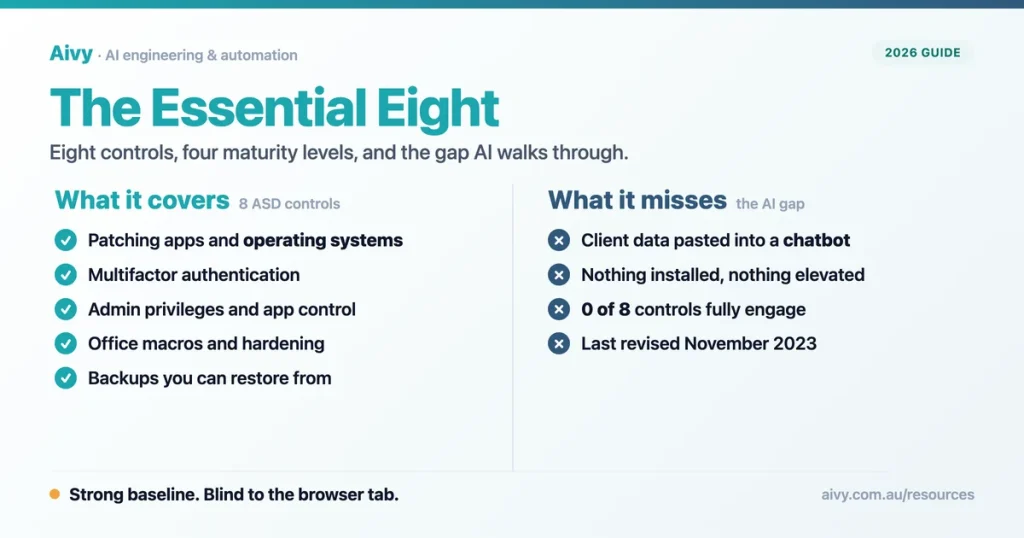
Every few weeks a client sends me a tender or an insurance renewal with the same question buried in it: what is your Essential Eight maturity level? Usually nobody in the business can answer. They know it is an Australian cyber security thing. They know the government cares about it. And somebody now has to put a number in a box by Friday.
I run client work at Aivy, an AI automation agency in Melbourne. Over the past year this question has changed. It used to be an IT problem. Now it comes with a second one attached: staff are pasting client information into chatbots, and nobody is sure whether the eight controls cover that. They mostly do not.
So this guide does two things. First, it explains the eight controls and the four levels in plain terms, and tells you who actually has to comply. Then it covers the part nobody writes about: the gap where AI sits. If you already have shadow AI in the building, that gap is your real risk, not your patching. It sits next to your Privacy Act obligations, not instead of them.
What the Essential Eight is and who wrote it
The Essential Eight is a list of eight things to do, published by the Australian Signals Directorate. The ASD picked them from what it actually sees: real incidents, real clean ups, real penetration tests. The list has been public since February 2017.
None of the eight are exciting. There is no threat hunting and no artificial intelligence on the list. They are simply the eight things that stop most of the attacks the ASD keeps having to help clean up.
Control names as published by the ASD. The second column is our plain language version.
Notice that two of the eight are just patching. That tells you where most break ins come from. If you want the same thinking applied to your workflows instead of your laptops, that is what our professional services automation work covers, and it works best alongside a written AI policy template.
ASD Essentials: what replaces the Essential Eight
On 15 October 2026 the ASD launched ASD Essentials, the successor to the Essential Eight. It is written for Commonwealth entities, critical infrastructure operators and large organisations, and it comes in chapters, one per type of technology environment.
Chapters as listed by the ASD on cyber.gov.au, 15 October 2026. The second column is our plain language version.
The biggest change is the score. As iTnews reports, the new framework leaves the maturity ladder behind. The ASD transition guide says you no longer pick a target level: each action is rated not effective, partially effective or fully effective.
Nothing changes overnight. During the transition the ASD keeps both frameworks on cyber.gov.au, and until regulators say otherwise you keep meeting your current obligations. The AI gap later in this guide will not wait for the new framework, which is why data loss prevention for AI is worth sorting now.
The four maturity levels, from ML0 to ML3
You do not pass or fail the Essential Eight. You get a score from zero to three, and you get one score per control, not one for the whole list. Each level is matched to how skilled an attacker you want to stop.
That is a useful way to think about it. You are not being asked to be perfectly secure. You are being asked to decide how determined an attacker you need to survive, based on how likely you are to be a target and how much a breach would cost you.
The four levels, and the attacker each one is built for
Bar length shows the level on the ASD scale, zero to three. Source: ASD Essential Eight maturity model.
Not really a level. It means there are gaps in what you have.
Stops the opportunist using public tools and stolen passwords. They want any victim, not you.
Stops someone willing to spend time on you specifically, with better tools.
Stops an attacker who adapts. The ASD still says this will not stop someone with enough money and patience.
Most Australian businesses I speak to sit somewhere between zero and one, and have never been assessed. Before you spend money finding out, it helps to know where you are exposed generally, which is what our AI readiness assessment is for. If you also sell into Europe, read this next to the EU AI Act checklist.
Who must comply and who simply gets asked
This is where most people get confused, so here it is simply. Federal government agencies have to do this. It is part of a framework called the PSPF, and Level Two is what is expected. If you are a private business, no law makes you do any of it.
That gap is closing anyway, because your customers have started asking. In my experience the question almost never comes from a regulator. It comes from your insurer at renewal, from a procurement team running a tender, or from a large client updating its supplier list.
Who is actually obliged, and who is only being asked
Obligation applies to Commonwealth entities under the PSPF. Everything else is commercial pressure, not law.
Healthcare feels this first, because patient data raises the stakes and the sector gets targeted. We see the same pattern in healthcare and medical practices that buy tools faster than they write rules, which is how an AI medical scribe ends up in a consulting room before anyone has checked it.
Where generative AI slips past the eight controls
Here is the problem. The ASD says the Essential Eight was built to protect computer networks, and the guidance was last updated in November 2023. Both of those are fine. Neither of them expected the most sensitive thing in your business to leave through a browser tab that nobody installed. Its successor, ASD Essentials, adds guidance on AI, but the eight are what most questionnaires still ask about.
Picture what a staff member actually does when they paste a client contract into a public chatbot. They install nothing. They run no macro. They get no extra privileges. They exploit nothing. Every one of the eight controls can be sitting at Level Two, and not one of them notices. On a work iPhone it is quieter still: Siri AI, switched on in Australia from Settings, can search client email without anyone pasting anything.
Which controls notice a chatbot paste
Aivy analysis, checking each ASD control against a staff member pasting data into a public AI service.
None of this makes the framework wrong. It makes it incomplete for a risk that did not exist when it was written. That is why where your AI data actually lives is now a separate question from your maturity score, and one worth raising in any AI strategy review.
Application control never anticipated a browser tab
Application control is the one people assume covers this, so it is worth being clear about why it does not. It decides which programs are allowed to run on a computer. A website is not a program you run. The browser is the approved program, and it was approved years ago.
You can lock down browser settings and block websites on the office network. Both help. Neither is what the control was designed to do, and neither works when someone opens the same site on their phone. Put a number on it and the picture is uncomfortable.
How much of the Essential Eight covers a chatbot paste
Share of the eight ASD controls, axis 0 to 100%. Aivy analysis of the ASD control set.
A full Level Two setup still leaves the most common AI data leak almost completely uncovered. It is a policy problem, not a patching problem.
Passwords are the one place the eight and AI genuinely overlap, because a shared chatbot login is a shared everything. If you are tightening MFA anyway, our password manager comparison for Australian businesses and the closer Bitwarden review cover what works at small scale.
What the OAIC already says about AI and personal information
The ASD framework is quiet on this. The privacy regulator is not. The OAIC has published guidance on using commercially available AI products, and it is unusually blunt: it recommends that organisations do not put personal information, especially sensitive information, into publicly available AI tools.
That is a recommendation, not a ban, and the difference matters. But it is written down and public, and it is the document that gets read back to you if something goes wrong. Under Australian Privacy Principle 6, using someone’s information for a new purpose has to be a use they would reasonably expect.
Recommendations summarised from OAIC guidance on commercially available AI products. The right column is what we see in client work.
Identity checks are becoming part of this too, now that vendors verify who is behind an account, which we covered in Claude identity verification in Australia. Where documents are the sensitive thing, keeping them inside a controlled pipeline is the whole point of document automation.
Moving from Maturity Level One to Two
Level One to Level Two is where the cost shows up, so it is worth understanding before you promise a number in a tender. Level One is mostly about having the control at all. Level Two is about doing it consistently, faster, everywhere, and being able to prove it.
What I see is that a business can reach Level One on effort and good intentions. Level Two needs tools and someone whose actual job it is, because what gets checked stops being your settings and starts being your habits over months.
What actually changes between Level One and Level Two
Directional summary. Score yourself against the ASD maturity model before committing to a number.
Coverage: the obvious systems
Speed: reasonably prompt
Proof: you believe it is done
Owner: shared and informal
Coverage: everything, including what you forgot
Speed: tighter and measured
Proof: logs and reports show it
Owner: named, funded, ongoing
Before you fund that, work out which of your processes is carrying the risk. That is what our business audit tool maps, and firms in accounting and advisory usually find the answer is client data sitting somewhere nobody chose on purpose.
How Australian buyers actually check your posture
Almost nobody audits you properly. What happens is a questionnaire, filled in by whoever has time. That is worth knowing, because it changes what is worth preparing. The thing that slows you down is evidence you can produce quickly, not being perfect.
The three people who ask want different things. Insurers want a self assessment so they can price you. The same renewal form often asks for your ANZSIC industry code too, and checking that it matches what you actually do takes a minute. Procurement wants a level and a date. Big customers want to know what happens to their data specifically, which these days is an AI question more than a patching one.
Patterns we see in Aivy client work with Australian businesses, not a published survey.
If you are hiring help for this, use the same test as anywhere else: ask what they will actually do in the first month. We wrote that test down in how to choose an AI automation agency, and it works for security partners too. Being local helps, which is why our Melbourne work usually starts by walking through the real workflow.
What I would do in the first 30 days
If a tender or a renewal has just landed on your desk, do not start with a formal assessment. Start with the two things that move your score the most, plus the one thing the framework does not cover. That combination is what a buyer is really asking about.
The order below is deliberate. MFA and patching do most of the work across the eight. The AI question is the one you will be asked next year even if nobody asks this year.
A 30 day starting order
The sequence we use with Australian clients. Not the ASD assessment process, which has its own published guide.
Week 3 is the one people skip, and it is the one that surprises them. If you want to put a figure on what automation is worth before you spend, the AI ROI calculator gives you a starting number, and our Sydney team runs the same session in person.
Frequently asked questions about the Essential Eight
What is the Essential Eight?
The Essential Eight is a list of eight cyber security controls published by the Australian Signals Directorate. It covers updates, multifactor authentication, admin accounts, which programs can run, Office macros, browser settings and backups, scored on four levels.
What is ASD Essentials?
ASD Essentials is the successor to the Essential Eight, launched by the Australian Signals Directorate on 15 October 2026. Its enterprise IT chapter evolves the eight, with new chapters for operational technology and cloud. Both frameworks stay on cyber.gov.au during the transition.
Is the Essential Eight mandatory in Australia?
It is mandatory for federal government agencies, where Level Two is expected under the Protective Security Policy Framework. For private business it is voluntary, although insurers, tenders and large customers often ask for it in practice.
What are the four Essential Eight maturity levels?
Level Zero means there are gaps. Level One stops opportunists using public tools and stolen passwords. Level Two stops someone willing to spend time on you specifically. Level Three stops an attacker who adapts, though the ASD says even that is not absolute.
Which maturity level should my business target?
The ASD frames it as a judgement about how determined an attacker you need to stop, based on how likely you are to be targeted and what a breach would cost. Most Australian businesses without government contracts aim for Level One first.
Does the Essential Eight cover staff using ChatGPT or Claude?
Mostly no. The controls govern software that gets installed, run or given extra privileges on your systems. Someone pasting client data into a public chatbot does none of those things, so most of the eight never come into play.
Is the Essential Eight free to implement?
The guidance is free to read from the ASD. Doing it is not free: multifactor authentication, update management and logging all cost something, and getting to Level Two usually needs a named owner rather than shared goodwill.
Do I need an external assessor?
Not to start. Scoring yourself against the published model tells you where you stand, and that is usually enough for an insurance renewal. A formal assessment matters when a government contract or a specific customer asks for one.
How long does it take to reach Maturity Level Two?
It depends far more on ownership than on tools. Businesses with a named person and a budget often get there in months. Businesses treating it as a side task can sit at Level One indefinitely, because Level Two is about keeping it up.
What should we do about AI if the framework does not cover it?
Treat it separately: a written rule about what can go into which tools, a sanctioned option so staff have somewhere to go, and a periodic check. Giving people a tool they can actually use matters as much as the rule itself.
Where the Essential Eight leaves Australian businesses in 2026
The Essential Eight is still the most useful starting point an Australian business has, and the fact that it is boring is the point. Two update controls, MFA and locking down admin accounts will do more for you than most security spending. What it will not do is tell you anything about the newest way your data walks out the door.
A Melbourne professional services firm we worked with had genuinely good basics. MFA everywhere, tight updates, backups that actually restored. Their real exposure was a shared chatbot account that four people used for client emails. No control in the eight would ever have found it, and no assessment would have marked them down. It took an honest conversation about what their tools actually do to spot it.
If that sounds familiar, the next step is small: find out what people are already using before you decide what to allow. We are Aivy, and we work with Australian businesses on exactly this kind of gap, usually alongside the finance and accounting workflows where the sensitive data tends to sit. If you want a second opinion, book a discovery session and bring your gap list.
Get MFA and updates right first, because they carry most of the weight across the eight. Then answer the question the framework does not ask: what are your staff already putting into AI tools. In every tender we have seen, a believable plan beats an inflated maturity number.
Last updated: 21 October 2026
Sources
Essential Eight maturity model: the eight control names, the ASD as author, the four maturity levels and what each one is calibrated to stop.
ASD Essentials launch: the 15 October 2026 launch, the three chapters, the AI guidance, both frameworks kept on cyber.gov.au and current obligations continuing.
Transitioning from the Essential Eight: no target maturity level, the action ratings, and maturity levels not converting automatically.
iTnews, 15 October 2026: the new framework replacing the Essential Eight and moving away from the maturity ladder.
Protective Security Policy Framework: the framework under which Commonwealth entities carry an Essential Eight obligation.
OAIC guidance on commercially available AI products: the recommendation against putting personal information into public generative AI tools, and the five practices in the table.
Privacy Act 1988: the Australian Privacy Principles, including APP 6 on using information for a new purpose.
Microsoft Essential Eight overview: an example of a major vendor publishing its own mapping to the eight controls.



