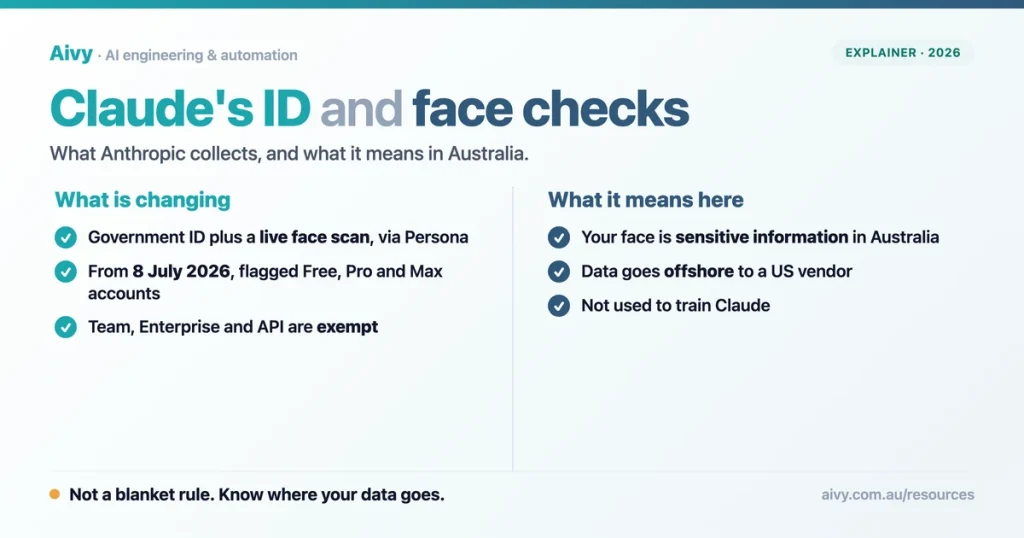
If you use Claude in Australia, you may be asked to prove who you are. Since 8 July 2026, Anthropic’s updated policy has let it request a government photo ID and a live face scan before you keep using parts of the product. The headlines made it sound like every user must hand over a passport on that date. That is not what is happening, and the gap between the headline and the policy is worth understanding before you react to it.
I run editorial at Aivy, an AI consultancy in Melbourne, and Claude is the model most of the businesses I speak with rely on every day. So when a privacy change like this lands, the first question I get is simple: do I have to do this, and where does my face end up. The answer matters more here than overseas, because Australian law treats your face as a special, highly protected category of data.
This guide walks through exactly what Anthropic is introducing, what data Claude ID verification collects, who holds it, and why. Then it covers the part no overseas article will: what a face scan sent offshore means under the Privacy Act, what Australian businesses across industries should check, and what you can do right now. If you only read the quick pick below, you will already have the shape of it.
Update, 2 September 2026: Anthropic has released Claude Fable 5.1 and Mythos 5.1, and Fable 5 has moved to the legacy list, leaving Fable 5.1, Opus 5, Sonnet 5 and Haiku 4.5 as the models Anthropic now lists as current. Mythos 5.1 is limited to Project Glasswing participants at organisations in the United States. None of this changes the verification policy below, which still applies only to Free, Pro and Max consumer accounts.
What Claude’s ID verification actually is, and what it is not
Start with the correction, because most coverage gets it wrong. Anthropic has not announced that everyone must verify on 8 July. Its policy says it may ask you to verify your age or identity in certain circumstances. A company spokesperson told TechCrunch it applies to a small subset of users whose accounts are flagged but not banned, against a base of tens of millions of monthly users. Most of the Melbourne teams I work with will never see a prompt.
The mechanism is real, though, and worth taking seriously. When it triggers, you are asked for a government photo ID and a live selfie, checked by a third party called Persona. Anthropic’s own help page frames the triggers as accessing certain capabilities, routine platform integrity checks, or other safety and compliance measures. For the Sydney teams I advise, the date that mattered was 8 July 2026, when the policy took effect, not a day when checks switched on for everyone.
- A conditional check for a small group of flagged accounts
- A government ID plus a live selfie, run by Persona
- An appeals path to restore a flagged account
- Limited to Free, Pro and Max consumer plans
- A blanket rule that every user must verify on 8 July
- A check on Team, Enterprise or API customers
- Data that Anthropic uses to train Claude
- A confirmed tool for the Fable 5 export ban
What data Claude’s ID verification collects, and who holds it
The privacy policy spells out a category called Verification Data. According to the wording quoted by The Register, that covers an image of your government issued ID and the details on it, such as your ID number and date of birth, your face in photo or video form, facial geometry templates (which the policy itself notes may be considered biometric data in some places), and the result of the check. It is the kind of sensitive data we map carefully on every document automation project.
Two facts about handling matter most. Your ID and selfie are collected and held by Persona, not on Anthropic’s systems, and Anthropic says the data is not used to train its models. It is encrypted in transit and at rest, and not shared for marketing.
The same data handling questions come up constantly in finance and accounting automation, where what a tool keeps matters as much as what it does. What Anthropic does not publish is a retention period: the help page only promises deletion in line with the limits it has set, and the spokesperson would not say when the data is deleted.
| What is collected | What it is | Held by | Trains Claude? |
|---|---|---|---|
| Government photo ID | Passport, driver licence or national ID, plus the details on it (ID number, date of birth) | Persona | No |
| Live selfie | A photo or short video of your face | Persona | No |
| Facial geometry template | A mathematical map of your face, which the policy notes may count as biometric data | Persona | No |
| Verification result | Whether the check passed, for example whether your age meets the threshold | Anthropic and Persona | No |
Sources: Anthropic privacy policy (via The Register) and Anthropic help page. Data is encrypted and is not shared for marketing. No retention period is published.
Who has to complete Claude ID verification, and when
The clearest line in the policy is about who is exempt. The checks apply to consumer plans, Claude Free, Pro and Max. Team, Enterprise and API customers are not covered. That is one of the reasons the commercial path matters so much for the professional services firms we work with: a business plan sits outside this consumer policy entirely.
For consumer users, the trigger is not fully spelled out, which is the single biggest source of frustration online. Anthropic ties prompts to flagged accounts, certain capabilities, and compliance checks, but does not give a precise rule. A limited version of ID checks had reportedly been running since around April 2026, so 8 July formalised an approach that already existed. If you run a customer-facing AI assistant on a consumer account, the lack of a clear trigger is a good reason to move it onto a commercial plan.
Why Anthropic added ID verification to Claude, and the Fable 5 question
Anthropic’s stated reason is narrow. Verification data, it says, is used solely to confirm who you are and to meet legal and safety obligations. The policy explicitly covers age, including whether your age meets the applicable threshold, which puts it alongside the wave of age assurance rules now landing across the UK, the EU and Australia. We track these shifts for clients as part of our broader AI advisory work.
The more interesting question is the timing. In June 2026 a US export control directive forced Anthropic to suspend its Fable 5 and Mythos 5 models for foreign nationals, and some commentators suggested ID checks could become a way to restore access to verified users. Anthropic rejects that link directly.
Its spokesperson said the policy was updated on 17 June as an update to the appeals process and is unrelated to the Fable or Mythos rollout. Worth noting that a government photo ID does not by itself prove citizenship, so it would be a poor tool for enforcing a foreign national ban anyway.
How Claude’s identity verification process works
If you are prompted, the flow is the standard identity check many people have met on other platforms. You upload or photograph a government issued document, then take a live selfie with your phone or webcam. Persona matches the face in the selfie to the photo on the ID and runs its own checks.
Reporting indicates passports, driver licences and national ID cards are accepted, while digital IDs, screenshots and photocopies are not. It is the same pattern we design around for clients in accounting and advisory, where identity steps have to be smooth but solid.
Behind that simple step, Persona generates a facial geometry template, a mathematical map of your face, to confirm the selfie and the ID belong to the same person. Persona is a San Francisco identity company that also verifies users for OpenAI, Roblox, Reddit and Character.AI, so it sits behind a large slice of the consumer internet’s identity checks. If your team is weighing up tools like this, our AI consulting work is largely about questions like where the data flows.
What happens if you refuse Claude’s verification
Here is the honest gap. Anthropic’s help page does not say what happens if you decline. The tech lawyer Tanya Chib flagged exactly this, noting the policy says nothing about what happens if you refuse. The reasonable reading, supported by reporting, is that declining means losing access to the gated capability, and for a flagged account it means the restriction stands, because verification is the way back in.
There is no documented opt-out button or in-product deletion request. The cleanest way to sit outside the consumer policy is to use a Team, Enterprise or API plan, which the policy does not cover. This is one of the practical choices we help ecommerce and retail clients think through: which AI work belongs on a consumer account and which belongs on a commercial one.
Is Claude’s ID verification safe? Where your face data goes
No verification system is risk free, and biometric data carries a risk the rest of your data does not: you cannot reset your face. The track record is sobering. In 2019 the BioStar 2 breach exposed millions of records including unencrypted fingerprints and facial data.
In October 2025 a breach tied to a Discord support vendor exposed roughly 70,000 government IDs submitted for age checks, and in July 2025 the Tea app leaked about 13,000 verification selfies and IDs. This is the kind of exposure we weigh when advising healthcare and medical clients on any tool that touches identity.
The flip side is that mishandling face data now carries real legal weight, at least in some places. Meta paid a $1.99 billion settlement to Texas over facial recognition, and $923 million in Illinois under that state’s biometric law. Clearview AI settled for around $73.49 million. None of that undoes a leak, but it shows regulators treating biometrics as serious money.
What mishandling facial data has cost (selected settlements)
Sources: Texas Attorney General; Patel v. Facebook (Illinois BIPA); Clearview AI settlement. Converted at 1 USD = 1.42 AUD, 11 August 2026.
For Claude specifically, the reassurance from Anthropic is that data sits with Persona, is encrypted, and is not used to train models. The unknown is retention. Without a published deletion timeline, you are trusting a vendor’s general policy, which is the part privacy advocates keep pointing at.
How Claude’s verification compares with ChatGPT, Gemini and the rest
Claude is not an outlier in wanting to check who you are. Almost every major AI assistant has added age or identity checks in the past year, driven by online safety laws and pressure from regulators. The differences are in how aggressive the check is and whether it touches your face, a point we dig into in our ChatGPT, Claude and Copilot comparison for Australia.
The pattern splits two ways. OpenAI’s ChatGPT, Google’s Gemini and Character.AI mostly predict your age in the background and only ask for an ID or selfie if you contest the result. Meta and X’s Grok lean more on a face scan as the gate for sensitive content. Microsoft’s Copilot is the outlier: it asks for a birth date and stops there, with no biometric step. If you want the model level view, our Claude vs ChatGPT guide covers reasoning, writing and pricing.
| Service | Main check | Face scan? | Partner |
|---|---|---|---|
| Claude (Anthropic) | Government ID plus live selfie, for flagged consumer accounts | Yes | Persona |
| ChatGPT (OpenAI) | AI age prediction, ID or selfie on appeal | On appeal | Persona |
| Gemini (Google) | Age estimation from account signals, ID or card to override | On override | Internal |
| Copilot (Microsoft) | Self-declared birth date | No | None |
| Grok (xAI / X) | Selfie age estimation for sensitive content | Yes | In-house |
| Meta AI / Instagram | AI age inference plus facial age estimation | Yes | Yoti |
| Character.AI | In-house age model, ID or selfie when in doubt | On doubt | Persona |
How major AI assistants handle age and identity checks, mid-2026. Google’s external vendor is not confirmed; details shift as rollouts expand.
To keep up with what Anthropic ships next, and how its models and policies move, we maintain a living tracker of Claude model codenames and leaks.
What Claude ID verification means under Australian privacy law
This is where the Australian angle gets sharp. Under the Privacy Act 1988, your facial image and biometric information are classed as sensitive information, the most protected category, and consent is generally required to collect it. As the Privacy Commissioner put it in the Bunnings facial recognition case, we cannot change our face, which is why the law gives it a high level of protection. It is the same standard we hold tools to when advising NDIS providers who handle highly sensitive client data.
The cross-border point is the one to sit with. When a face scan goes to a US vendor, it leaves the country. Australia’s cross-border rule, APP 8, does not ban that, but it requires reasonable steps before disclosure and keeps the Australian entity accountable for what the overseas recipient does. The 2024 reforms added an exception for prescribed safe countries, but to date no country has been prescribed, so the US gets no automatic pass.
Australia’s maximum privacy penalty has teeth since 2022
Maximum corporate penalty for serious or repeated breaches. The post-2022 figure is the greater of $50M, three times the benefit, or 30% of adjusted turnover. Source: OAIC.
And the regulator is active. The OAIC has ruled against Bunnings, Kmart and 7-Eleven over facial recognition, and against Clearview AI, though a February 2026 tribunal decision partly overturned the Bunnings finding on a narrow retail safety exception that is unlikely to map onto an AI sign in.
Since 10 June 2025 there is also a new right to sue for serious invasions of privacy, a genuinely new avenue, though whether it could reach a consent based ID check is untested. This is general information, not legal advice, and our Privacy Act and AI compliance playbook goes deeper.
What Australian businesses and Claude users should do now
If your team uses Claude, the consumer policy may not be your main concern, but the principle is. The moment staff or client identity data could flow through an AI tool to an overseas vendor, your business is the one carrying Australian Privacy Principle obligations, not Anthropic. For anything sensitive, a Team, Enterprise or API arrangement with clear data handling terms beats a consumer account, which is exactly the kind of setup we map in AI consulting engagements.
| Privacy principle | What it asks | Why it bites here |
|---|---|---|
| APP 3 | Collect sensitive information only with consent and when reasonably necessary | A face template is sensitive information, so consent must be genuine and informed |
| APP 8 | Take reasonable steps before sending data overseas, and stay accountable for the recipient | A face scan sent to a US vendor leaves the country, and no country is currently prescribed as safe |
| APP 11 | Protect the data and destroy it when it is no longer needed | Biometric data cannot be reset if it leaks, so security and deletion matter more |
General overview, not legal advice. Confirm your own obligations with a privacy professional. Source: OAIC Australian Privacy Principles.
For individuals, the practical advice is calm. You are likely only prompted if your account is flagged, so its start date was never a reason to panic. Before you submit anything, check what Persona keeps and for how long, confirm the request came from inside Claude rather than a link, and decide whether you actually need the gated feature. Australia’s own myID system is voluntary and cannot be forced on you, which is a useful benchmark for whether a face scan feels proportionate for a chat tool.
If you take three things from this, take these:
• Keep business sensitive work on a Team, Enterprise or API plan, which sits outside the consumer verification policy.
• If you are prompted, read Persona’s retention terms before you upload, confirm the request came from inside Claude, and keep a record of what you sent.
• Map your data flows: know whether any AI tool could send staff or client ID offshore, and update your privacy notice to match.
Frequently asked questions about Claude ID verification
Is Claude ID verification mandatory?
Not for most people. The policy lets Anthropic ask in certain cases, mainly for flagged consumer accounts on Free, Pro and Max. Team, Enterprise and API plans are exempt, and many users may never see a prompt.
What does Claude’s verification collect?
A government photo ID and its details, a live selfie in photo or video form, and a facial geometry template, all checked by a third party called Persona. The result of the check is also recorded.
Who holds my face data, Anthropic or Persona?
Persona. Anthropic says the ID and selfie are collected and held by Persona, not on Anthropic’s own systems, and that the data is not used to train Claude.
Can I refuse Claude’s ID check?
Yes, but expect to lose access to the gated capability, and a flagged account stays restricted. Anthropic does not publish what happens if you decline, so the consequence is not fully clear.
Does it apply to Team, Enterprise or API plans?
No. The policy covers consumer plans only, Free, Pro and Max. Commercial plans are exempt, which is why many businesses prefer them for sensitive work.
Is Claude’s ID verification connected to the Fable 5 ban?
Anthropic says no. Its spokesperson called the update unrelated to the Fable or Mythos rollout. A photo ID does not prove citizenship, so it would be a weak tool for enforcing that ban anyway.
How long does Anthropic keep my ID and face data?
It has not said. The help page only promises deletion in line with unspecified retention limits, and Anthropic declined to give a timeframe when asked by reporters.
Is my biometric data safe with Persona?
It is encrypted and not sold for marketing, but no system is risk free and the retention period is not published. Past breaches of identity systems show biometric data can leak, and a face cannot be reset.
What does Claude ID verification mean for Australians under the Privacy Act?
Your face template counts as sensitive information, and sending it offshore engages APP 8 cross-border rules. This is general information rather than legal advice, so check the specifics with a privacy professional.
Last updated: 2 September 2026. Details verified against Anthropic’s help page and privacy policy and reputable reporting at the time of writing. Policy specifics, especially retention and triggers, may change.
The bottom line on Claude ID verification for Australia
The calm reading is the correct one. Since 8 July 2026 Anthropic has been able to ask some Claude users for a government ID and a face scan, mainly flagged consumer accounts, through a vendor called Persona. It is not a universal passport check, the data sits with Persona rather than Anthropic, and it is not used to train the model. The open questions are retention and what declining really costs you.
What I keep seeing with Australian businesses is the same blind spot. A team rolls out an AI tool to everyone, and nobody asks where a flagged user’s ID would actually go. The Privacy Act answer is not abstract. A face template is sensitive information, it can end up offshore, and the business, not the AI vendor, carries the accountability for that flow.
If you want help working out where AI tools touch personal data in your business, and how to keep that on the right side of the Privacy Act, that is the kind of work we do. Aivy is an AI automation agency in Melbourne.
If that sounds useful, you can book a free discovery session and we will map your data flows out with you.
• Anthropic: Identity verification on Claude · vendor (Persona), storage, encryption, no model training, no published retention
• The Register · privacy policy wording (Verification Data), tier exemption, 8 July date
• TechCrunch · spokesperson quotes, small subset of flagged users, Fable denial
• The Next Web · accepted documents, Persona background, Illinois BIPA
• Anthropic: Fable and Mythos access · model suspension under the export control directive
• Texas Attorney General · Meta $1.99B facial recognition settlement
• OAIC: Bunnings determination · facial image as sensitive information, Commissioner quote
• OAIC: APP 8 cross-border disclosure · accountability, no prescribed countries
• Clayton Utz · February 2026 Bunnings appeal outcome
• Australian Government Digital ID · myID is voluntary and cannot be required