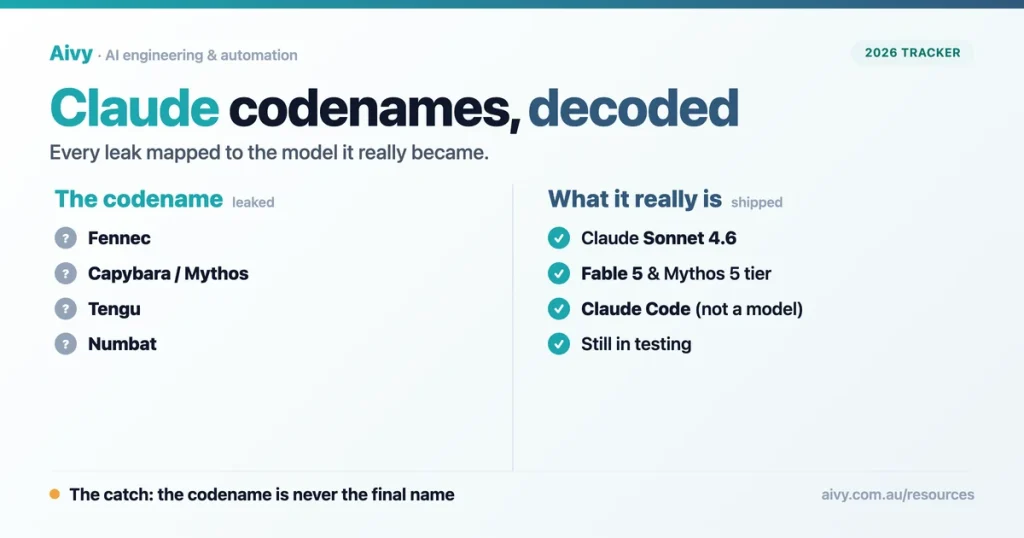
Every few weeks a new Claude codename leaks before Anthropic says a word. Fennec, Mythos, Capybara, Tengu. Each one sets off a round of breathless posts and a spike of searches for a model that often never ships under that name. The most recent jolt hit Australian teams directly when Claude Fable 5 was pulled offline within days of launch by a United States government order. If you are trying to plan around these models, the noise itself is the problem.
I run editorial at Aivy, an AI automation agency in Melbourne, and I have watched clients waste real effort on rumours. One team started re-pricing a workflow around a leaked “Sonnet 5” that was supposed to be half the cost within days. What shipped was Sonnet 4.6, at the old price. Sonnet 5 did arrive, but four months later. The lesson stuck, and it shapes how we read every leak now: the codename is gossip, the released model is the only thing you can build on.
So I built this tracker to cut through it. Below is a decoder that maps each Claude codename to the model it really became, a clear look at what the famous Fennec leak got right and wrong, the current line-up by price and context, and the one question Australian businesses keep asking me, which is simply which Claude models we can actually use today. The quick pick sums up my advice in a few lines.
How Claude’s names and codenames actually work
Anthropic ships Claude in tiers. Haiku is the small, fast, cheap model. Sonnet is the mid tier most businesses run day to day. Opus is the heavy reasoning model. In 2026 a new tier landed above Opus, branded publicly as Fable 5 and Mythos 5. The public names carry a version number, like Sonnet 4.6 or Opus 4.8, so you always know where a model sits.
The codenames are different. They are internal project names, almost always an animal, that show up by accident in cloud config, error logs, source code or draft blog posts before launch. They are never the marketing name. Fennec, Capybara, Tengu and Numbat are all internal labels, and the gap between the codename and the eventual public model is exactly where the confusion starts.
Input and output prices per million tokens. Source: Anthropic. Opus 5.5 and Sonnet 5.5 at the RBA rate of 22 September 2026, the others at the 4 September rate.
This matters because a leaked codename tells you a model exists, not what it will be called, when it will land, or what it will cost. If you want the practical difference between the chat models behind all this, our Claude vs ChatGPT comparison covers how they actually behave on real work. For planning, treat a codename as a heads-up and nothing more.
The codename decoder: every recent Claude leak, mapped
Here is the part the rest of the internet keeps getting wrong. Most posts freeze at the moment of the leak and never update once the real model ships, so the top search results still call models by names that were never used. One row is a giveaway: Tengu is not a chat model at all but the terminal coding tool, which we compare in our Claude Code vs Codex guide. This table maps each recent codename to what it actually became. I keep it current as new leaks land.
| Codename | What it actually is | Status | First surfaced |
|---|---|---|---|
| Fennec | Claude Sonnet 4.6 (leaked as “Sonnet 5”) | Released | Feb 2026, Vertex AI log |
| Capybara / Mythos | The model tier above Opus, shipped as Fable 5 (public) and Mythos 5 (restricted) | Fable 5 live, Mythos 5 restricted | Mar 2026, CMS leak |
| Tengu | Claude Code, the terminal coding tool (not a chat model) | Shipped | Internal codename |
| Numbat | A model reported to be in testing | Unreleased | Source-code leak, 2026 |
| Snow Bunny | A Google Gemini codename, not Anthropic at all | Competitor | Early 2026 |
Status as of 22 June 2026. Codename origins corroborated across leak reports; final mapping confirmed against Anthropic’s released models.
The takeaway from the table is that a codename rarely survives to launch intact, so it is a weak foundation for any build. We pin a project to a released model with a known price and a known context window, never to whatever animal happens to be trending that week.
Fennec: the leak that became Sonnet 4.6
Fennec is the cleanest example of why the codename is not the model. In early February 2026 a model identifier, “claude-sonnet-5@20260203”, surfaced from a Google Vertex AI listing and spread from a screenshot rather than a directly accessible log. The internet decided Anthropic was about to launch “Claude Sonnet 5”, roughly half the price of the previous model, within days. The wrong name then hardened into the search results, which is its own problem when you care about showing up in AI answers with accurate facts.
What shipped on 17 February was Claude Sonnet 4.6. Same family, real upgrade, but not a “5” and not cheaper. The price held at $4 per million input tokens and $21 per million output. The one thing the leak nailed was the headline capability: a one million token context window, and a coding score within about a point of the rumour. Here is the full scorecard.
| What the Fennec leak claimed | What actually shipped | Verdict |
|---|---|---|
| Name “Claude Sonnet 5” | Claude Sonnet 4.6 | Wrong |
| Release within days (early Feb) | 17 February 2026 | Wrong |
| About half the price | Unchanged at $4 / $21 per million tokens | Wrong |
| Coding score around 80.9% | About 79.6% on SWE-bench Verified | Close |
| One million token context | One million token context (beta) | Right |
| Codename “Fennec” is real | Confirmed in the Vertex AI identifier | Right |
Mythos and Capybara: the tier above Opus
The next big leak was not a config string but a content mistake. On 26 March 2026 a misconfigured content system left around 3,000 unpublished Anthropic assets publicly reachable, and Fortune reported on draft posts describing a model codenamed Mythos as a step change in capability. The internal tier name attached to it was Capybara.
The important correction, since plenty of blogs get this wrong, is that Capybara was never a fourth product tier you could buy. It was the internal codename for a new class of model positioned above Opus. The drafts framed it as larger and more capable than the Opus line, aimed at the hardest reasoning, coding and cybersecurity work, the kind of load that also sits behind heavy document automation. Third-party sites selling “Capybara access” are not Anthropic.
That tier became real in June, under two public names. The capability everyone had been reading about in leaked drafts since March finally had a price and an availability model, and that is where the story turned awkward for everyone outside the United States.
Fable 5 and Mythos 5: released, then pulled
On 9 June 2026 Anthropic launched the Mythos tier publicly. Claude Fable 5 went to general availability as the most capable model the public could use, with a one million token context window and a price of $13.87 per million input tokens and $69.35 per million output.
It was briefly the strongest option for coding agents like the ones we weigh in our Cursor vs GitHub Copilot comparison. Claude Mythos 5 is the same underlying capability with its safety classifiers removed, offered only to vetted partners through a government-linked programme called Project Glasswing.
Three days later it was gone. On 12 June the United States government issued an export-control directive ordering Anthropic to cut off Fable 5 and Mythos 5 for any foreign national, citing national security after a reported jailbreak. Anthropic cannot verify nationality at consumer scale, so it disabled both models worldwide to comply. Anthropic publicly disputed the severity of the jailbreak, but the models came down anyway, and the rest of the line-up stayed live.
Can Australian businesses use these models right now
This is the question that actually matters for a team in Melbourne or Sydney, and it is the one almost no global tracker bothers to answer. Since 1 July 2026, Fable 5 is available in Australia again and Mythos 5 is not. The June shutdown had swept up allied countries alongside the intended targets, and Australia lost access with everyone else outside the United States until the export controls were lifted at the end of that month.
The Australian Computer Society covered it directly. Its interim chief executive, Dr Prins Ralston, said Australia will keep benefiting from global platforms and trusted partnerships, but that the long-term goal must be to build stronger AI skills and capability at home.
The sting was the timing, as local cyber and critical-infrastructure defenders had gained Mythos access only about two weeks earlier, then lost it. Coverage in SmartCompany made the same point: few Australian organisations relied on these models directly, so the immediate disruption was small, but the precedent is large. Access can now hinge on export controls and nationality, not just a commercial contract.
The practical answer today is reassuring. The models most Australian businesses already run are unaffected, including the everyday tasks covered in our roundup of AI tools for accountants. Here is what you can and cannot use.
| Model | Tier | Can Australian teams use it today? |
|---|---|---|
| Claude Haiku 4.5 | Haiku | Yes |
| Claude Haiku 5.5 | Haiku, current | Yes, generally available |
| Claude Sonnet 4.6 | Sonnet | Yes |
| Claude Sonnet 5.5 | Sonnet | Yes |
| Claude Opus 4.8 | Opus | Yes |
| Claude Opus 5.5 | Opus, current | Yes, generally available |
| Claude Fable 5.2 | Mythos (above Opus), current since 9 November 2026 | Yes, generally available |
| Claude Mythos 5.2 | Mythos, same model as Fable 5.2 | Only for organisations verified through Anthropic’s cyber or life sciences programmes |
| Claude Fable 5.1 | Mythos (above Opus) | Yes, still on sale |
| Claude Fable 5 | Mythos (above Opus), legacy | Yes, restored 1 July 2026 |
| Claude Mythos 5 | Mythos (restricted) | No, restricted to approved organisations |
Availability as of 2 September 2026, for Claude Opus 5.5 from its release on 22 September 2026 and for Claude Haiku 5.5 from 7 October 2026. Fable 5 returned worldwide on 1 July 2026 with no nationality check and has since moved to Anthropic’s legacy list; Fable 5.2 is generally available from 9 November 2026, and Mythos access stays limited to approved organisations.
Anthropic added Claude Opus 5.5 to its range on 22 September 2026, at $5.62 and $28.08 per million tokens on the RBA rate of that day. Its model documentation now suggests starting there for most workloads and moving up to Claude Fable, now Fable 5.2, only for demanding reasoning and long running agentic work, and Claude Opus 5 moves to the legacy list while staying available.
The current Claude line-up, by price and context
Strip away the codenames and the live menu is simple. Haiku is the cheap workhorse, Sonnet the default for most business automation, Opus the reasoning model, and the Fable tier the frontier, reachable from Australia again since 1 July 2026. The price gap between tiers is steep, which is the single most useful thing to internalise before you pick a model for a task. It is also why model choice quietly drives the running cost of work like finance and accounting automation.
Output price per million tokens, June 2026 line up
List price, June 2026. Source: Anthropic models overview. Model token prices converted at the Reserve Bank of Australia rate of 4 September 2026, one Australian dollar buying 0.7210 United States dollars. Seat and subscription prices converted at 1 USD = 1.42 AUD, 11 August 2026.
Opus 5.5 added on 22 September 2026 and Haiku 5.5 on 7 October 2026; both, and Haiku 4.5, at the RBA rate of 22 September. Haiku 5.5 is shown for prompts up to 100,000 tokens, and costs five times more above that.
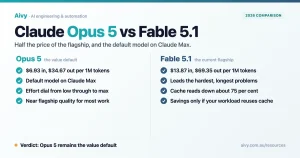
The Fable 5.1 price list deserves a second look. The base price has not moved: input still costs $13.87 and output $69.35 per million tokens, exactly what Fable 5 charged. What dropped is the cached read, about 75% cheaper at $0.35. So Anthropic’s advertised saving, 25% on a typical load and up to 45% on heavy agentic work, only shows up when your workload reuses cache. Without reuse, Fable 5.1 costs double Opus 5, at $6.93 and $34.67.
Context is the other axis, and 2026 was the year it jumped. The older models held about 200,000 tokens. From the Sonnet 4.6 generation onward, the window opened to a full million, which is what lets a model hold an entire codebase or a long contract in its head at once. The frontier tier kept the million-token window, so the difference between tiers now is reasoning and price, not memory.
Context window by model: the jump to 1M
Tokens held in one session. Source: Anthropic models overview.
One caveat keeps the price chart honest. The Fable tier uses a new tokenizer that counts the same text as roughly 30% more tokens than older models, so the headline per-token gap understates the real cost difference. When you model a budget, test on your own content rather than trusting the sticker rate.
Is there a Claude 5? Clearing up the myths
Not in the way the leaks meant it. Nothing ships as plain Claude 5, but the 5 generation is real: Claude Sonnet 5 arrived on 30 June 2026, Claude Opus 5 on 24 July, Claude Opus 5.5 on 22 September and Claude Sonnet 5.5 on 28 September, at $6.93 / $34.67 for Opus 5, $5.62 / $28.08 for Opus 5.5 and $2.81 / $14.04 for both Sonnets. Above both sits the Fable tier, the frontier. What the leaks got wrong was the timing and the tier, not the number.
A “Sonnet 4.8” is doing the rounds too, from a single source-map leak, and has not shipped. The safest habit is to ignore any version number that only appears in a leak, and check the released line-up before you write a model name into a plan, a pitch, or the prompt behind an AI chatbot development build. Today’s line up is Fable 5.1, Opus 5.5, Sonnet 5.5 and Haiku 5.5, with Sonnet 5 and Haiku 4.5 on sale; Opus 5, Fable 5, Sonnet 4.6 and Opus 4.8 are now legacy.
What the leaks teach Australian teams
The useful takeaways are not about gossip, they are about how you build. First, stay model agnostic. Anthropic shipped five models in about four months, so route every AI call through one layer where the model name is a setting, not hard-wired code. When a model changes or vanishes, you swap a value instead of rewriting a workflow.
Second, choose on capability, price and availability, never on a codename. The Fennec hype said cheaper and sooner. The truth was same price, two weeks later, under a different name. For most Australian work, Sonnet 5.5 or Haiku 5.5 are the rational defaults, and the frontier tier is for genuinely hard reasoning. If you want help mapping the right model to each job, that is exactly what our AI consulting work covers.
Third, treat top-tier model access as a supply dependency, not a guarantee. The June suspension proved the most powerful model can disappear overnight for reasons that are political, not commercial. Keep a tested fallback for any critical workflow, and for sensitive or regulated data, weigh a local option. Our guide to running local AI agents walks through when self-hosting makes sense. Do not re-architect around a rumour. Keep a one-page watch list of confirmed releases instead, and act only after you have tested.
Where this leaves your AI stack in 2026
The codenames will keep leaking, and the posts chasing them will keep being wrong about the name, the date and the price. The signal underneath is simpler than the noise. Anthropic is shipping fast, prices are falling between generations, context windows have opened up, and the only thing that should move your roadmap is a model that has actually been released and tested on your work.
A Melbourne firm I work with learned this the calm way. When the Fennec leak broke, they were tempted to redesign a pricing workflow around the rumoured cheaper model. We agreed to wait two weeks. The model shipped under a different name at the old price, their planned redesign would have been wrong on both counts, and they had lost nothing by sitting still.
That is the whole discipline. Treat leaks as weather, not strategy. If you want a hand building an AI setup that survives the next codename without a rebuild, that is the work we do every day. Aivy is an AI automation agency in Melbourne, and you can book a free discovery session to map a model-agnostic stack for your business.
Build today on Sonnet 5.5 for most work and Haiku 5.5 for high volume, with Claude Opus 5.5 held back for the hard reasoning jobs. Sonnet 5.5 keeps the Sonnet 5 price of $2.81 / $14.04, well under Sonnet 4.6, and Opus 5.5 replaces Opus 5 at a lower $5.62 / $28.08. Fable 5.2 is the frontier model, but hold it back for work Opus 5.5 cannot finish.
Route every call through one model-name setting and keep a tested fallback, so a suspension like Fable 5’s costs you a config change, not a rebuild.
Frequently asked questions about Claude model codenames
What is the Claude Fennec model?
Fennec was Anthropic’s internal codename for the model that launched as Claude Sonnet 4.6 in February 2026. It leaked through a Google Vertex AI identifier before release. There is no separate product called Fennec, it is just the pre-launch name for Sonnet 4.6.
Is Claude Sonnet 5 real?
Yes, as of 30 June 2026. The name first surfaced in a leaked identifier that ran ahead of the release, and on 17 February 2026 the model people were expecting shipped as Claude Sonnet 4.6, at the same price as the previous version.
Then on 30 June Anthropic released Claude Sonnet 5 as the new default on the free and Pro plans, at roughly half the running cost of the flagship, much as the original leak had suggested. For what that means for access in Australia, see our guide on whether Australians can use Claude.
What is Claude Mythos?
Mythos is Anthropic’s tier of model above Opus, first exposed in a March 2026 content leak under the internal codename Capybara. It became public in June 2026 as Claude Mythos 5 and its widely available sibling, Claude Fable 5.
What is the Capybara tier in Claude?
Capybara was the internal codename for the Mythos-class model, not a separate product you can buy. Leaked drafts described it as larger and more capable than Opus. Sites selling “Capybara access” are third parties, not Anthropic.
Is there a Claude 5 or Claude Opus 5?
Partly. Nothing ships as plain Claude 5, but Claude Opus 5 is real, at $6.93 input and $34.67 output per million tokens, and since 22 September 2026 Anthropic lists it as legacy, with Claude Opus 5.5 above it at $5.62 and $28.08. Claude Sonnet 5 landed on 30 June 2026 and Claude Sonnet 5.5 on 28 September, both at $2.81 and $14.04 at the RBA rate of 22 September. Above them sits the Fable tier, now led by Claude Fable 5.1; Claude Fable 5 has moved to Anthropic’s legacy list.
Why were Claude Fable 5 and Mythos 5 suspended?
A United States government export-control directive on 12 June 2026 ordered Anthropic to block both models for foreign nationals on national-security grounds. Unable to verify nationality at scale, Anthropic disabled them worldwide. The company publicly disputed the severity of the cited issue.
Can Australian businesses use Claude Fable 5 right now?
Yes. The worldwide suspension that began on 12 June 2026 removed Australian access along with all non-US users, but Anthropic redeployed Fable 5 globally on 1 July 2026, with no nationality check at the door. Mythos 5 is the one still out of reach, restricted to approved organisations.
What is the difference between Fable 5 and Mythos 5?
They share the same underlying capability. Fable 5 is the public version with safety classifiers in place. Mythos 5 has those classifiers removed and is offered only to vetted partners through Project Glasswing. Both were suspended in June 2026.
Are Claude’s codenames official?
No. Codenames like Fennec, Capybara and Numbat are internal project labels that leak by accident, not marketing names. The official names always carry a tier and version, such as Sonnet 4.6 or Opus 4.8. Treat a codename as a rumour, not a release.
Which Claude model should an Australian business use today?
For most tasks, Claude Sonnet 5.5 balances cost and capability, and Claude Haiku 5.5 suits high volume, simpler work. Reach for Claude Opus 5.5 on hard reasoning. Fable 5 is available in Australia again, but it is now legacy: Claude Fable 5.2, released on 9 November 2026, is the current frontier model, and at twice the Opus 5.5 price it is for the hardest jobs only.
Last updated: 10 November 2026. Codename mappings, prices and availability verified against Anthropic documentation and independent reporting at the time of writing. This tracker is updated as new Claude leaks and releases land.
• Anthropic, Claude models overview · current line-up, model IDs, context windows and per-token prices (Haiku 4.5, Sonnet 4.6, Opus 4.8, Fable 5, Mythos 5)
• Anthropic, statement on Fable 5 and Mythos 5 access · the 12 June 2026 US directive, the worldwide suspension and Anthropic’s dispute of the cited jailbreak
• Fortune, Mythos data leak · the 26 March 2026 content-system misconfiguration and the Mythos tier above Opus
• ACS Information Age, Australia loses access · the Australian impact and the quotes from ACS interim CEO Dr Prins Ralston
• Al Jazeera, US orders models disabled for foreign nationals · scope of the directive and the global shutdown for non-US users
• NxCode, the Fennec leak versus reality · the Vertex AI identifier and confirmation that Fennec shipped as Sonnet 4.6
• Anthropic, models overview (read 22 September 2026) · Claude Opus 5.5 at 4 and 20 United States dollars per million tokens with a one million token window, the current line up of Fable 5.1, Opus 5.5, Sonnet 5 and Haiku 4.5, and the legacy list. Converted at one Australian dollar buying 0.7123 United States dollars, the RBA rate of 22 September 2026
• Anthropic, Introducing Claude Sonnet 5.5 (read 28 September 2026) · 2 and 10 United States dollars per million tokens and Haiku 5.5 due in the coming weeks; the models overview read the same day lists Fable 5.1, Opus 5.5, Sonnet 5.5 and Haiku 4.5, with a one million token window for Sonnet 5.5
• Anthropic, Introducing Claude Haiku 5.5 (read 7 October 2026) · released 7 October 2026 at 0.10 and 0.50 United States dollars per million tokens for prompts up to 100,000 tokens and 0.50 and 2.50 above; the models overview read the same day lists Fable 5.1, Opus 5.5, Sonnet 5.5 and Haiku 5.5, all with a one million token window, and still offers Haiku 4.5
• Anthropic, Introducing Claude Fable 5.2 and Claude Mythos 5.2 (read 9 November 2026) · released 9 November 2026 at 8 and 40 United States dollars per million tokens, Mythos 5.2 limited to the Cyber and Life Sciences Verification Programs; the deprecations page read the same day keeps Fable 5.1 active. Converted at the RBA rate of 9 November 2026, 0.6894