
By Monika Tantau · Updated 29 September 2026
Update, 10 November 2026: Anthropic released Claude Fable 5.2 on 9 November at $11.60 and $58.02 per million tokens (RBA rate of that day), a fifth below Fable 5.1, and it now leads the Artificial Analysis index v5 at 64.6. For new work the pair to compare is Claude Opus 5.5 and Fable 5.2; Sonnet 5.5, out since 28 September, sits below both.
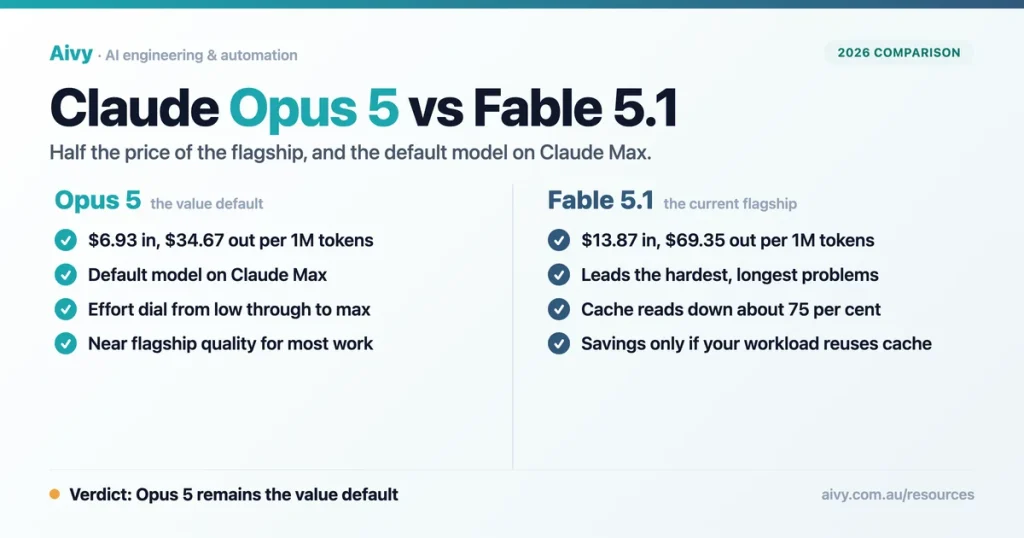
Opus 5 vs Fable 5 comes down to price against the last few points of capability. Claude Opus 5, released on 24 July 2026, came close to Fable 5 in many categories at half the list price: $6.93 in and $34.67 out per million tokens, against $13.87 and $69.35. Both are now on Anthropic’s legacy list, so this guide also shows where Claude Opus 5.5 and Fable 5.2 take over.
What Claude Opus 5 actually is
Opus 5 is Anthropic’s general purpose model, released on 24 July 2026. The company describes it as a thoughtful, proactive model that comes close to the frontier intelligence of the flagship at the time, Claude Fable 5, in many categories, but at half the price. At launch it became the default model on Claude Max and the strongest model available on Claude Pro.
The short version: this is not a new intelligence ceiling. It is most of the ceiling, far cheaper. If you have read our Claude versus ChatGPT breakdown, this is the model that changes the maths on the Claude side. We covered the launch in full in our Claude Opus 5 news piece.
Anthropic released Claude Opus 5.5 on 22 September 2026, at $5.62 and $28.08 per million tokens on the RBA rate of that day, and its model documentation now suggests starting there for most workloads and moving up to Claude Fable, now Fable 5.2, only for demanding reasoning and long running agentic work. Claude Opus 5 moves to the legacy list and stays available.
What it costs, and the effort dial
Pricing is the headline. Opus 5 runs at $6.93 in and $34.67 out per million tokens, the same rate as the older Opus 4.8, and half of Fable 5’s $13.87 in and $69.35 out. It also ships with an effort setting that lets you choose how hard the model works on a task, from low all the way through to max, which is a direct lever on both quality and cost.
| Claude model | Input / Output per 1M | Independent index (AA) | Best for |
|---|---|---|---|
| Haiku 4.5 | $1.39 / $6.93 | Lower tier | High volume, simple, fast |
| Sonnet 5 | $2.81 / $14.04 | Strong mid | Previous Sonnet, same list price |
| Sonnet 5.5 | $2.81 / $14.04 | 56 on v4.3 (max, 28 September) | Most production work, since 28 September 2026 |
| Opus 5.5 | $5.62 / $28.08 | 58 on v4.3 (max) | Best value default, since 22 September 2026 |
| Opus 5 (legacy) | $6.93 / $34.67 | 63 on v4.1.1 (August); 54 on v4.2; 51 on v4.3 (max) | Pipelines already tuned to it |
| Fable 5 (legacy) | $13.87 / $69.35 | 62 on v4.1.1; 53 on v4.2 | Superseded by Fable 5.1 |
| Fable 5.1 | $13.87 / $69.35 | 57 on v4.2 (max); 53 on v4.3 | The single hardest task, since September 2026 |
Index scores are based on data from Artificial Analysis, which does not endorse, validate or approve any of the analysis or conclusions drawn from it; the v4.3 reading is of 22 September 2026, 28 September for Sonnet 5.5, and the scales cannot be read against each other. Opus 5.5, Sonnet 5.5 and Sonnet 5 are priced at the RBA rate of 22 September 2026, the other rows at the 4 September rate.
The effort dial matters here. Running a routine job at low effort keeps the bill down, while reserving high effort for genuinely hard work means you are not paying frontier prices for tasks that never needed them. For teams weighing which Claude tier to standardise on, our guide to choosing between Opus, Sonnet and Haiku walks through the trade offs.
Token spend in practice: what a job really costs
Sticker prices are abstract until you attach them to a workload. Output tokens dominate most bills, so here is the cost of generating one million output tokens on each Claude tier. This is simple arithmetic on the published per token prices, not a benchmark. The comparison changes shape again once you price what a local model costs to run, where the meter stops after the hardware.
Cost to generate 1M output tokens. Opus 5 is half of Fable 5. Fable 5.1 launched at that same $69.35 output rate, so the gap is unchanged. Sonnet 5’s introductory rate became permanent on 11 August 2026, so the $21 standard rate no longer applies. Claude Opus 5.5, Sonnet 5.5 and Sonnet 5 are at the RBA rate of 22 September 2026, the other bars at the 4 September rate.
Put that against a concrete task. Say you run an assistant that drafts and summarises documents and produces roughly 20 million output tokens a month. On Fable 5 that output alone is about $1,387. On Opus 5 it is about $693, for work most teams would struggle to tell apart. That saved $693 is what turns a borderline automation into an obvious one, which is exactly the kind of cost modelling we do when scoping finance and accounting automation.
Fable 5.1 does not change that arithmetic. Its base rate is unchanged at $13.87 in and $69.35 out, still roughly double Opus 5. What fell is cache reads, down about 75 per cent. So Anthropic’s headline saving, about 25 per cent on typical work and up to 45 per cent on heavily agentic work, only appears if your workload reuses cache. Without reuse you pay the old Fable price, which is also what GPT 6 Astra charges.
What the benchmarks say
Anthropic’s own figures frame Opus 5 as a value play rather than a raw leap. It reports that Opus 5 roughly doubles the score of Opus 4.8 on its Frontier-Bench reasoning test at lower cost, lands within half a percent of Fable 5 on the CursorBench coding test at about half the cost per task, and scores roughly three times the next best model on the ARC-AGI 3 reasoning test.
The independent read backed this up in August. On the Artificial Analysis Intelligence Index v4.1.1, accessed 10 August 2026, Opus 5 scored 63 at maximum effort, first of 185 models that day, with Fable 5 on 62. On that reading a model costing half the flagship measured as slightly more capable. The snapshot predates Fable 5.1 and GPT 6 Astra, scored since on the later v4.2 and v4.3 scales. We will fold the remaining official coding scores into our best AI coding assistant guide as Anthropic publishes them.
Fable 5.1 reopens the gap on Anthropic’s own benchmarks. The company reports 55.8 per cent on Terminal Bench 4.0 against 52.3 for Opus 5 and 42.0 for Fable 5, 31.4 per cent on AutomationBench against 26.9, and 1853 on GDPval-AA v2 against 1824. Claude Opus 5.5 then moved past both in its own system card on 22 September: 66.4 per cent on Terminal Bench 4.0 at xhigh effort and 40.0 on AutomationBench. These are the vendor’s own numbers, not an independent read.
Opus 5 vs Fable 5 vs Opus 4.8 vs Sonnet 5
With six Claude tiers in the table below, plus Claude Mythos 5.1 released alongside Fable 5.1 on 1 September, the choice is about matching the model to the job rather than always reaching for the top. The table below is the quick decision guide.
| Pick | When |
|---|---|
| Opus 5.5 | Your default since 22 September 2026. It lists below Opus 5 at $5.62 / $28.08, and Anthropic’s documentation suggests starting there for most workloads. |
| Opus 5 (legacy) | Pipelines already tuned to it. It moved to the legacy list on 22 September, so new work should go to Opus 5.5. |
| Fable 5.1 | The single hardest, longest problems where the last few percent of capability is worth double the price. The flagship from September until Fable 5.2 replaced it on 9 November 2026. |
| Fable 5 (legacy) | Pipelines already tuned to it. Fable 5.2 costs less, so new work should go there. |
| Sonnet 5.5 | High volume production work where $2.81 / $14.04 pricing matters more than the top tier of reasoning. It took over from Sonnet 5 at the same price on 28 September 2026. |
| Opus 4.8 | Existing pipelines already tuned to it. Same price as Opus 5, and new work should default to Opus 5.5, which costs less. |
The honest takeaway is that Opus 5 quietly makes Opus 4.8 redundant for new builds. Same price, more capability. And it narrows the case for Fable 5 to a smaller set of genuinely frontier tasks.
What it means for Australian businesses
For most Australian operators the interesting question is not whether Opus 5 tops a leaderboard. It is whether the same automation now costs less to run at scale. Matching invoices, drafting documents, answering routine customer questions and summarising long reports are all token heavy jobs where halving the price changes what is worth automating. Capability is only half the procurement question. The other half is how much unsafe code a model ships by default, which we measured in our ranking of 16 models on code security.
That is where a cheaper default earns its keep. Work that did not quite justify the spend last month can become viable this month. Teams building finance automation or customer facing AI assistants run high volumes of repetitive tasks, and those are precisely the workloads where a lower per token price compounds across a year.
Which effort level to use, and when
Opus 5’s effort setting is the simplest lever you have on cost and quality. Anthropic ships five levels, low, medium, high, xhigh and max, with high as the default, and matching the level to the job is where most of the savings come from. Set it too high for routine work and you pay for reasoning you did not need; set it too low for hard work and you get shallow answers.
| Effort level | Use it for | Why |
|---|---|---|
| Low | Everyday chat, quick questions, short drafts, simple lookups | Fastest and cheapest. The model answers directly without heavy reasoning. |
| Medium | Everyday business tasks, summaries, standard automation, data extraction | The balanced default for most production work. |
| High | Careful analysis, long documents, most day to day knowledge work | The default. This is what you get if you set nothing at all. |
| Xhigh | Demanding coding, agentic and tool heavy workflows | Anthropic’s recommended step up for code and agents. |
| Max | The hardest problems, where correctness outweighs cost | Unconstrained token spend. Reserve it for jobs that justify it. |
One change if you move up to Claude Opus 5.5: its default effort is medium, not high, so a request that sets nothing reasons less than it did on Opus 5. If you are weighing Claude Sonnet 5.5 against it, which effort to run each one at matters as much as which model you pick.
A simple rule of thumb: talk to it at low, automate at medium, and step up to xhigh to build or code. High is the default, so you only need to set the dial when you want to move off it. For coding work xhigh is where Opus 5 earns its place, which we cover in our best AI coding assistant guide.
For high volume customer tasks, medium keeps costs down while staying reliable, which matters when you are running finance automation at scale.
Whatever the effort level, what about the client’s details?
The effort dial changes how hard the model thinks, not what it receives: a pasted file note still carries the client’s TFN or Medicare number with it. Select the text, press one key, and Nonimo swaps the client identifiers it recognises for placeholders before anything reaches ChatGPT, Claude or Copilot, then puts the real ones back in the reply.
It runs on your own Mac or Windows computer, and not a word of your text goes to Nonimo, only a daily usage count. See how an Australian practice keeps those numbers on its own computer.
Frequently asked questions
How much does Claude Opus 5 cost?
Opus 5 costs $6.93 per million input tokens and $34.67 per million output tokens, the same as Opus 4.8 and half the price of Claude Fable 5.1, which is $13.87 in and $69.35 out. Claude Opus 5.5, released on 22 September 2026, lists lower at $5.62 and $28.08, at the RBA rate of that day.
Is Opus 5 better than Fable 5?
On the Artificial Analysis index read on 10 August 2026, Opus 5 scored 63 at maximum effort, marginally above Fable 5 on 62, at half the price. That reading predates Fable 5.1, which replaced Fable 5 as Anthropic’s flagship and leads on the hardest, longest problems at double the price, and GPT 6 Astra, released 3 September. Fable 5 is now on Anthropic’s legacy list. For most work the better value choice is now Claude Opus 5.5, released on 22 September 2026.
The index has since moved to v4.3, a separate scale that the August scores cannot be read against. On the 22 September reading Claude Opus 5.5 at max leads on 58 for $8.40 a task, Fable 5.1 at max scores 53 for $10.71 and Opus 5 at max 51 for $8.22. Claude Sonnet 5.5, read on 28 September, scores 56 at max for $10.67.
Which plans include Claude Opus 5?
At launch Anthropic made Opus 5 the default model on Claude Max and the strongest model available on Claude Pro. Since 22 September 2026 it sits on Anthropic’s legacy list, which keeps it available, with Claude Opus 5.5 recommended as the starting point for most workloads.
What is the effort setting in Opus 5?
Effort lets you choose how hard the model works on a task, across five levels: low, medium, high, xhigh and max. High is the default. Lower effort is cheaper and faster for routine jobs; xhigh and max are worth reserving for demanding coding, agentic and reasoning work.
Last updated 10 November 2026.
Pricing, positioning, effort setting and plan availability: Anthropic, Introducing Claude Opus 5. Intelligence Index v4.1.1, accessed 10 August 2026 (Opus 5 on 63, top ranked on that August reading): Artificial Analysis, Claude Opus 5. Market context on cheaper capable models: CNBC. Converted at 1 AUD = 0.7210 USD, Reserve Bank of Australia, 4 September 2026.
Claude Opus 5.5 price, the advice to start there and Opus 5 on the legacy list: Anthropic, models overview, read 22 September 2026. Terminal Bench 4.0 and AutomationBench for Claude Opus 5.5, and its default effort: Anthropic, Claude Opus 5.5 system card.
Intelligence Index v4.3 and cost per task, read 22 September 2026: Source: Artificial Analysis (artificialanalysis.ai); based on data from Artificial Analysis, which does not endorse, validate or approve any of the analysis or conclusions drawn from it. Claude Opus 5.5, Claude Sonnet 5.5, Sonnet 5 and the v4.3 cost per task converted at 1 AUD = 0.7123 USD, Reserve Bank of Australia, 22 September 2026. Claude Sonnet 5.5 index and cost per task read 28 September 2026.
Claude Sonnet 5.5 price, speed and cost claims: Anthropic, Introducing Claude Sonnet 5.5, read 28 September 2026.



