
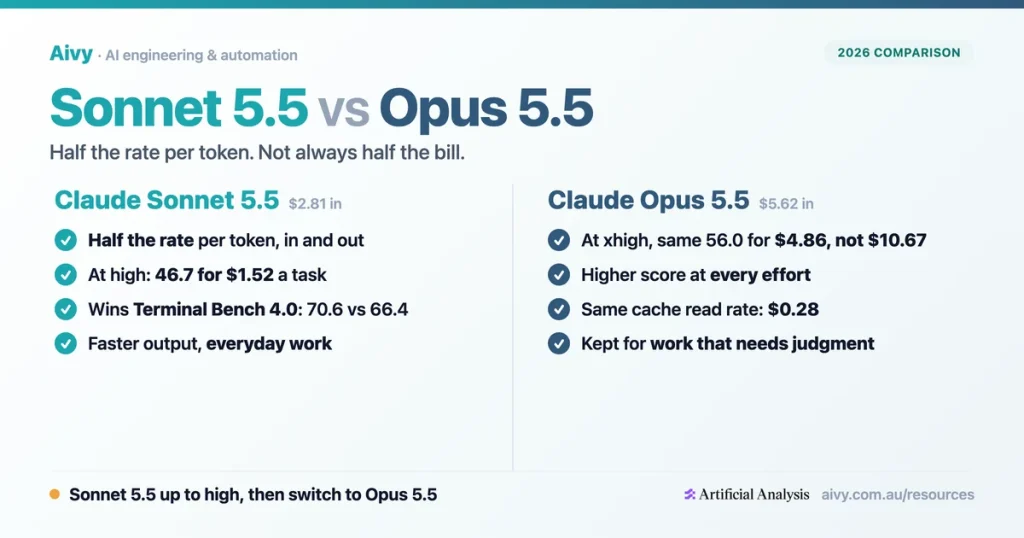
Anthropic released Claude Sonnet 5.5 on 28 September 2026, six days after Claude Opus 5.5, at half the price per token. That makes Sonnet 5.5 vs Opus 5.5 look like an easy call, and for everyday work it mostly is. The catch sits at the top of the effort dial, where the cheaper model needs about 60 per cent more money than Opus 5.5 to reach the same score.
At Aivy I help Australian teams pick the models they pay for by the task, not by the headline rate, so I read every launch table with a calculator open. Anthropic’s own pitch is fair: Sonnet 5.5 for well scoped everyday work, Opus 5.5 for complex work that needs sustained judgment. The independent numbers mostly agree, with one expensive exception.
Below you will find what changed, what each model lists at, the cost of a finished task at every effort setting, both sets of benchmarks and an effort table you can act on. It sits beside our Opus 5.5 vs Fable 5.1 guide. Every dollar figure is converted from United States dollars at the Reserve Bank rate of 22 September 2026.
Key takeaways
- Claude Sonnet 5.5 lists at $2.81 in and $14.04 out per million tokens, half the Opus 5.5 rate of $5.62 and $28.08, and the same as Sonnet 5.
- At its best, Sonnet 5.5 ties Opus 5.5 at xhigh on the Artificial Analysis index, 56.0 each, but costs $7.67 a task against $4.86 on the 18 October reading.
- At high, its API default, Sonnet 5.5 scores 46.7 for $1.24 a task: the setting where it earns its place.
- On Anthropic’s launch table, Sonnet 5.5 beats Opus 5.5 on Terminal Bench 4.0, 70.6 per cent against 66.4, and trails it on every other row.
- In Claude Code, Opus 5.5 stays the default on every plan, so you choose Sonnet 5.5 yourself.
What Claude Sonnet 5.5 is, and what changed from Sonnet 5
Claude Sonnet 5.5 is the second model in Anthropic’s Claude 5.5 family. Anthropic calls it a faster, lower cost complement to Opus 5.5, strongest at well scoped everyday tasks, fixing bugs and polished documents, slides and spreadsheets, with what it calls a sharp eye for design. Claude Haiku 5.5 joined the family on 7 October 2026, built for high volume, latency sensitive work.
Against Sonnet 5, Anthropic claims output more than 30 per cent faster and a cost per task up to 30 per cent lower, at the same price per token, because it needs fewer tokens for the same work. Sonnet 5 now sits on Anthropic’s legacy list and stays available. Our guide to which Claude model fits which job covers the rest of the range.
On paper Sonnet 5.5 and Opus 5.5 share a lot: a one million token context window, 128K tokens of output, a June 2026 knowledge cutoff and the same five effort settings, from low to max. Anthropic’s own comparison separates them on price, a latency label, default effort and thinking. Because those settings carry most of the bill, how each Claude effort level performs is worth a look before you pick.
| Side by side | Claude Sonnet 5.5 | Claude Opus 5.5 |
|---|---|---|
| Status | Current, released 28 September 2026 | Current, released 22 September 2026 |
| Input, per million tokens | $2.81 | $5.62 |
| Output, per million tokens | $14.04 | $28.08 |
| Cache read, per million tokens | $0.14 | $0.28 |
| Cache write, five minutes | $3.51 | $7.02 |
| Context window | 1M tokens | 1M tokens |
| Maximum output | 128K tokens | 128K tokens |
| Latency label | Fast | Moderate |
| Default effort, Claude API | high | medium |
| Default effort, Claude Code | medium | medium |
| Thinking | Adaptive, can be turned down with between_tools | Adaptive, always on |
| Earliest retirement | Not before 28 September 2027 | Not before 22 September 2027 |
Sources: Anthropic models overview, Claude Sonnet 5.5 model page and announcement; Claude Code model configuration. Converted at 1 Australian dollar to 0.7123 United States dollars, 22 September 2026.
The thinking row, if you migrate
Opus 5.5 always thinks. Sonnet 5.5 thinks by default, but a new setting called between_tools turns off thinking before the first answer, and it works only at high effort or below. Anthropic says anyone running Sonnet with thinking off has to switch to it before moving across to Sonnet 5.5.
Sonnet 5.5 price vs Opus 5.5, per million tokens
Sonnet 5.5 lists at $2.81 per million input tokens and $14.04 per million output tokens, exactly half of Opus 5.5 at $5.62 and $28.08, and unchanged from Sonnet 5. Batch processing halves both models’ rates. Our guide to buying Claude in Australia covers the ways to pay for it here.
List rate per million tokens, Claude Sonnet 5.5 and Opus 5.5
Lower is cheaper. All three panels scaled to $28.08. Source: Anthropic, Claude Sonnet 5.5 announcement. Converted at 1 Australian dollar to 0.7123 United States dollars, 22 September 2026.
Input, per million tokens
Output, per million tokens
Cache read, per million tokens
Since 7 October the cache halves too. Anthropic cut Sonnet 5.5 cache reads to $0.14 per million tokens, 5 per cent of its input rate, the same share it charges on Opus 5.5, where a read still costs $0.28. Writing to the cache also costs half as much on Sonnet 5.5: $3.51 against $7.02 per million tokens for five minutes.
That matters for agents. A long agent run rereads the same large context on every step, so cache reads can make up much of the bill. Until 7 October the cheaper model saved nothing on that share; now it saves half, which Anthropic puts at around 20 per cent off Sonnet 5.5 on most agentic tasks. To weigh model spend against the hours it replaces, use our AI ROI calculator.
Cost per task: where half the rate stops being half the bill
The bill is the rate multiplied by the tokens a model burns to finish a job, and the effort setting moves that second number most. Artificial Analysis publishes a cost per task beside every score on its Intelligence Index v4.3, the closest independent figure I have for a real job. On its 18 October reading, Sonnet 5.5 got cheaper at every setting and Opus 5.5 did not move.
Cost per index task by effort setting, in Australian dollars
Lower is cheaper. Bars scaled to $8.40, paired by effort. Lighter shade: medium and low effort. Source: Artificial Analysis, cost per task, Intelligence Index v4.3, read 18 October 2026; on 28 September Sonnet 5.5 cost more at every setting and Opus 5.5 the same. Converted at 1 Australian dollar to 0.7123 United States dollars, 22 September 2026.

On that reading, Sonnet 5.5 costs less per task than Opus 5.5 at every setting, from 9 per cent less at max to 64 per cent less at medium. Comparing at the same setting flatters Sonnet 5.5, though, because Opus 5.5 scores higher at every one of them. The fairer test is what each model charges to reach the same score.
On that test the top of the range still belongs to Opus 5.5. Sonnet 5.5 at max reaches 56.0 for $7.67; Opus 5.5 at xhigh reaches the same 56.0 for $4.86, so Sonnet 5.5 pays about 58 per cent more. Sonnet 5.5 at xhigh scores 51.9 for $2.82, while Opus 5.5 at medium scores 51.2 for $1.88. Our GPT 6 Astra vs Opus 5.5 comparison runs the same sums.
- Lower down is where Sonnet 5.5 earns its place. At high, its API default, it scores 46.7 for $1.24, the cheapest way to a score in the mid forties from either model, and at low it costs $0.49 a task, the cheapest run on the chart.
- Medium is a close call. Opus 5.5 at low scores 42.3 for $0.77, a little above Sonnet 5.5 at medium, 40.7 for $0.67.
- Against Sonnet 5 the saving is real but uneven. On the September readings Sonnet 5.5 cost about 40 per cent less per task at high and at medium, and it has fallen since; at max it now costs $7.67 against $7.15 for Sonnet 5, about 7 per cent more, while scoring 56.0 against 38.2. For finance automation that runs thousands of small steps a month, the high and medium rows are the ones that count.
Sonnet 5.5 benchmark scores on the independent index
On the Artificial Analysis index, Sonnet 5.5 at max scores 56.0, level with Opus 5.5 at xhigh and 1.6 points behind Opus 5.5 at max, still top of the leaderboard on 18 October. That is almost 18 points above Sonnet 5 at max and ahead of Fable 5.1 at max, 53.4, which costs five times as much per token. Our Opus 5 vs Fable 5 comparison covers the pair before.
Intelligence Index v4.3 by effort setting, axis 0 to 100
Higher is better. One row per model and setting; grey rows for context. Lighter shade: medium and low effort. Source: Artificial Analysis, Intelligence Index v4.3, read 28 September 2026; GPT 6.1 Sol read 29 September 2026; all checked again on 18 October 2026 with the same rounded scores. It replaces GPT 6 Sol, 47.5 at max, which the text below keeps.
Below max the gap opens. At every setting from low to xhigh, Opus 5.5 scores between 4.1 and 10.5 points higher than Sonnet 5.5, widest at medium, 51.2 against 40.7. Anthropic’s own read matches: Sonnet 5.5 at max can perform comparably to Opus 5.5 on several tests, while Opus 5.5 remains clearly stronger at complex, open ended work. Beyond Anthropic, only the restricted Gemini 4 Carbon now outscores Opus 5.5 at max.
The three sub scores Artificial Analysis lists for both models at max all favour Opus 5.5: Humanity’s Last Exam, 0.614 against 0.550; SciCode, 0.669 against 0.610; and long context reasoning, 0.847 against 0.827. Its Coding Index has no score yet for either model, so neither wins or loses on coding by that measure as of 28 September.
Speed, the other half of the Sonnet case
On the 18 October reading, Artificial Analysis measured Sonnet 5.5 producing output faster than Opus 5.5 at every effort: 140 tokens per second against 97 at max, 111 against 83 at high and 109 against 82 at medium. Anthropic’s labels agree, Fast against Moderate. For a customer service chatbot, that speed is part of the product.
Anthropic’s own benchmarks: where Sonnet 5.5 beats Opus 5.5
Anthropic’s launch table compares Sonnet 5.5 with Sonnet 5, Opus 5.5 and GPT 6 Sol. These are vendor figures, and Anthropic adds a fair warning of its own: benchmark scores capture only one facet of a model, and Opus 5.5 remains clearly stronger at work that needs sustained judgment. Google’s table for Gemini 4 Argon deserves the same caution: at matched effort Opus 5.5 still beats Argon.
Anthropic’s launch benchmarks, per cent, axis 0 to 100
Higher is better. Vendor figures from Anthropic’s launch table. Opus 5.5 on Terminal Bench is its best result, at xhigh. Sonnet 5.5 on FrontierCode is shown at xhigh, its best; at max it scored 46.2. Source: Anthropic, Claude Sonnet 5.5 announcement.
Terminal Bench 4.0, an agentic coding test run in a command line, is the one row Sonnet 5.5 wins: 70.6 per cent against 66.4, up from 10.3 for Sonnet 5. On CursorBench 4.0, built from real Cursor sessions, it trails Opus 5.5 by 2.3 points, and on the other percentage tests by 1.7 to 3.2. Our Claude Code vs Codex guide covers the agents you would run either model in.
- FrontierCode is the row worth reading twice. It asks whether an agent’s code change would be merged, and it penalises edits outside the task. Sonnet 5.5 scored 52.1 per cent at xhigh but only 46.2 at max: Anthropic says that at max it more often ran Claude Code’s code review skill across many subagents, which in two cases led to a timeout or to edits beyond the task’s scope.
- Two knowledge work tests are scored in Elo, so they sit outside the chart. On GDPval AA v2.1, Sonnet 5.5 scores 1844 against 1846 for Opus 5.5 and 1449 for Sonnet 5; on AA Briefcase v1.1, 1811 against 1822 and 1359. Artificial Analysis ran both on a deployment before release with a bug in structured outputs, which Anthropic expects, if anything, to understate Sonnet 5.5.
For teams choosing a coding assistant, my reading is that Sonnet 5.5 is now good enough for most bug fixing and routine changes, and that the gap to Opus 5.5 shows up on the long, ambiguous work where a wrong turn costs hours.
Which effort to use on Sonnet 5.5 and Opus 5.5
My default for Sonnet 5.5 is high, which is also its Claude API default, and I would only drop to medium or low for short, repetitive steps at volume. There, GPT 6.1 Terra matches it for a fraction of the cost. In Claude Code and the Claude apps it starts at medium instead, so check which setting you are really running before you compare two bills.
| Effort | Sonnet 5.5 index | Sonnet 5.5 per task | Opus 5.5 index | Opus 5.5 per task | What I would do |
|---|---|---|---|---|---|
| low | 35.8 | $0.49 | 42.3 | $0.77 | Short, repetitive steps at volume; Sonnet 5.5 is the cheapest run here |
| medium | 40.7 | $0.67 | 51.2 default | $1.88 | Sonnet 5.5 in Claude Code and the apps; Opus 5.5 at low scores a little higher for a little more |
| high | 46.7 default (API) | $1.24 | 53.6 | $2.56 | Everyday coding, documents and agents: the best Sonnet 5.5 setting |
| xhigh | 51.9 | $2.82 | 56.0 | $4.86 | Switch model: Opus 5.5 at medium scores about the same for two thirds of the cost |
| max | 56.0 | $7.67 | 57.6 | $8.40 | Avoid on Sonnet 5.5: Opus 5.5 at xhigh ties it for about a third less |
Based on data from Artificial Analysis (artificialanalysis.ai), which does not endorse, validate or approve any of the analysis or conclusions drawn from it. Index read 28 September 2026; cost per task read 18 October 2026, when Sonnet 5.5 had fallen at every setting and Opus 5.5 was unchanged. Cost per task converted at 1 Australian dollar to 0.7123 United States dollars, 22 September 2026. Defaults are Anthropic’s Claude API defaults; in Claude Code both models start at medium.
One rule stands out in the table: do not run Sonnet 5.5 at max. It costs a little less per task than Opus 5.5 at max for a lower score, and Opus 5.5 at xhigh matches it for about a third less. Xhigh on Sonnet 5.5 is hard to justify too, since Opus 5.5 at medium scores within a point of it for two thirds of the cost per task.
So the dial works as a ladder with a switch in the middle. Climb Sonnet 5.5 from low to high; when high is not enough, move to Opus 5.5 at medium rather than push Sonnet further, and climb Opus from there. For an online retailer writing thousands of product descriptions, the first rungs are where nearly all the work will sit.
Sonnet 5.5 vs GPT 6.1 Sol and GPT 6 Sol at the same token price
OpenAI’s GPT 6 Sol lists at the same input and output rates as Sonnet 5.5, $2.81 and $14.04 per million tokens, and charges $0.28 for cached input, twice what Sonnet 5.5 has charged since 7 October. At max, Sonnet 5.5 scores 56.0 on the Artificial Analysis index against 47.5 for Sol, 8.5 points ahead. Our guide to GPT 6 Astra, Sol and Luna covers the OpenAI side.
Cost per task tells a closer story. Sol at max cost $1.48 a task on the September reading, about a fifth of Sonnet 5.5 at max on the 18 October one. At a similar spend, Sonnet 5.5 at high scores 46.7 for $1.24, within a point of Sol at max. The fair summary is that Sonnet 5.5 reaches higher, and that at matched spend the two sit close.
On Anthropic’s table, Sonnet 5.5 leads Sol on FrontierCode at xhigh (52.1 against 49.3), on both Elo tests (1844 against 1487, and 1811 against 1483) and on Chartography (61.6 against 53.6). Anthropic notes that some Sol figures may predate an OpenAI fix to image understanding. If your team lives in ChatGPT, our business plans comparison is the better place to start.
- Since 29 September OpenAI has a second model at this price. GPT 6.1 Sol, an upgrade to GPT 6 Sol, lists at $2.81 in and $14.04 out, with cached input at $0.14, the same as Sonnet 5.5 since Anthropic’s 7 October cut. Equal rates hide very different bills, which is why we priced the two setting by setting.
- At xhigh it nearly ties Sonnet 5.5 on the index, 51.0 against 51.9, and finishes a task for $0.55 against $2.82 on the 18 October reading.
- At high it scores 50.2, above Sonnet 5.5 at that setting, for $0.45 a task against $1.24.
- At max Sonnet 5.5 still reaches higher, 56.0 against 51.8, but at $7.67 a task against $1.01.
- OpenAI’s own figure: GPT 6.1 Sol beats Opus 5.5 on AutomationBench by 2.2 points at medium effort for about a third of the cost.
Sonnet 5.5 in the Claude plans and Claude Code
In the Claude apps the answer is short. Anthropic’s Sonnet page says anyone can chat with Claude using Sonnet 5.5 on Claude.ai, on the web, iOS and Android, so it reaches every plan, the free one included. Neither that page nor the launch post says whether it becomes the default model in the apps, so I will not guess.
Claude Code is documented. Sonnet 5.5 needs version 2.1.284 or later, and on the Anthropic API the sonnet alias now points to it. Opus 5.5 remains the default on Pro, Max, Team, Enterprise and the Anthropic API, so you switch with /model. In Claude Code, Sonnet 5.5 starts at medium effort and always runs with its one million token window, with no usage credits needed on any plan.
Watch the alias if you run Claude Code through a cloud provider. On Amazon Bedrock, Google Cloud and Microsoft Foundry the sonnet alias still resolves to Sonnet 4.5, and on Claude Platform on AWS to Sonnet 4.6, so set the full model name. Our comparison of Cursor vs Claude Code covers the other place you might run it.
What Sonnet 5.5 means for Australian businesses
For an Australian business the choice touches four things beyond the benchmarks, and one of them is now confirmed: both models can run in Australia.
- The budget line. Rates move with the Australian dollar, but the ratio holds: Opus 5.5 costs twice Sonnet 5.5 per token on input and output whatever the exchange rate does. For document automation at volume, such as invoices and forms processed ahead of ATO lodgement dates, that halving is the main reason to switch.
- Data handling. Anthropic says Sonnet 5.5, like Opus 5.5 and Sonnet 5, is available with zero data retention, and on Amazon Web Services, Google Cloud and Microsoft Azure as well as its own platform. Retention is not residency, but on Amazon Bedrock both Sonnet 5.5 and Opus 5.5 have an Australian geographic profile that keeps requests in Sydney and Melbourne. Our Privacy Act playbook covers what to ask.
- Safeguards. Sonnet 5.5 is the first Sonnet to launch with cyber safeguards like those on Anthropic’s most capable models: higher risk security requests visibly fall back to Sonnet 5, and in Claude Code biology flagged requests end in a refusal, because there is no fallback model for them. Monitoring in a Sydney or Melbourne operation should log which model answered, not only whether it answered.
- Migration. Anthropic lists five changes that can break code written for Sonnet 5, among them the between_tools setting, forced tool use now returning an error and thinking blocks tied to the model that produced them. Text between tool calls also arrives as thinking blocks, so a streaming app can go quiet. A Melbourne accounting practice with scripts built on Sonnet 5 should test before it swaps.
Sonnet 5.5 vs Opus 5.5: frequently asked questions
Is Claude Sonnet 5.5 better than Opus 5.5?
No, not overall. Opus 5.5 scores higher on the Artificial Analysis index at every matching effort setting and on every row of Anthropic’s launch table except Terminal Bench 4.0. Sonnet 5.5 is faster and costs half as much per token.
How much does Claude Sonnet 5.5 cost in Australia?
Converted at the Reserve Bank rate of 22 September 2026, Sonnet 5.5 costs $2.81 per million input tokens and $14.04 per million output tokens, with cached reads at $0.14 since 7 October. That is half the Opus 5.5 rate and the same as Sonnet 5 per token. OpenAI’s GPT 6.1 Sol lists at the same $2.81, $14.04 and $0.14.
Is Sonnet 5.5 cheaper than Opus 5.5 per task?
Per setting, yes: on the 18 October reading it costs less per task than Opus 5.5 at every effort, by 9 to 64 per cent. But Opus 5.5 scores higher at each one, and Opus 5.5 at xhigh reaches the best Sonnet 5.5 score, 56.0, for $4.86 against $7.67.
Which effort level should I use on Sonnet 5.5?
Start at high, the Claude API default, and drop to medium or low for short, repetitive steps. Avoid xhigh and max: at those settings Opus 5.5 reaches a similar or higher score for less per task.
Is Sonnet 5.5 the default model in Claude Code?
No. Opus 5.5 is the default on Pro, Max, Team, Enterprise and the Anthropic API. Sonnet 5.5 needs Claude Code v2.1.284 or later, and on the Anthropic API the sonnet alias resolves to it.
Is Sonnet 5.5 on the free Claude plan?
Yes. Anthropic says anyone can chat with Claude using Sonnet 5.5 on Claude.ai, on the web, iOS and Android. It has not said whether Sonnet 5.5 is the default model in the apps, so check the model picker in your own account.
Which is better for coding, Sonnet 5.5 or Opus 5.5?
Opus 5.5 leads on CursorBench 4.0 and FrontierCode in Anthropic’s figures, while Sonnet 5.5 wins Terminal Bench 4.0. For everyday bug fixing, Sonnet 5.5 at high is a sensible start; for large, open ended changes, use Opus 5.5.
Does Sonnet 5.5 replace Sonnet 5?
Sonnet 5 moves to Anthropic’s legacy list and stays available. Sonnet 5.5 costs the same per token, scores 56.0 against 38.2 at max on the Artificial Analysis index, and on the September readings cost about 40 per cent less per task at high and medium, with its costs lower again since 18 October.
What does Claude Haiku 5.5 change for Sonnet 5.5?
Haiku 5.5, released on 7 October 2026, takes the high volume work below Sonnet 5.5, such as classification, extraction, routing and summaries, at $0.14 in and $0.70 out per million tokens for prompts up to 100,000 tokens. It scores 43.4 at max on the Artificial Analysis index against 56.0 for Sonnet 5.5, and Anthropic says Sonnet 5.5 and Opus 5.5 remain the better choices for complex agentic coding.
The bottom line: Sonnet for the daily run, Opus for the hard part
The headline says Sonnet 5.5 costs half as much, and per token it does. Per task it is cheaper at every setting, but not per point of score at the top. From low to high it is the fast, cheap workhorse Anthropic describes; at xhigh and max, Opus 5.5 reaches similar scores for less. The practical rule: take Sonnet 5.5 to high, then switch model rather than turn the dial.
If I were setting this up for a team, I would split the work by risk: the highest volume steps, such as classification, on Haiku 5.5, routine drafting, triage and tests on Sonnet 5.5 at high, and the jobs that need judgment on Opus 5.5 at medium or xhigh, then measure on real tasks for a fortnight. Our AI consulting team runs that kind of review with Australian businesses.
Artificial Analysis measures these models again every few weeks, and its 18 October reading cut the cost per task of Sonnet 5.5 at every setting, so check the date at the foot of this page before you rely on the numbers. If you would like a second opinion on which of your workloads belong on which model, you can book a time with us whenever it suits you.
Last updated: 10 November 2026
Sources
Anthropic, introducing Claude Sonnet 5.5. The positioning against Claude Opus 5.5, the speed and cost per task claims against Claude Sonnet 5, list rates and cache rates for both models, the launch benchmark table with its footnotes on Terminal Bench, FrontierCode, the Artificial Analysis runs and GPT 6 Sol, the cyber and biology safeguards, zero data retention, the platforms, the between_tools setting, default effort in the apps, Claude Code and the Claude Platform, and the timing of Claude Haiku 5.5. Published 28 September 2026.
Anthropic, models overview. Latency labels, default effort on the Claude API, context window, maximum output, knowledge cutoff, earliest retirement dates, cache read rates as a share of input, and Claude Sonnet 5 on the legacy list. Retrieved 28 September 2026.
Anthropic, Claude Sonnet 5.5 model page. The five breaking changes for code written for Claude Sonnet 5, between_tools working at high effort or below, cache write rates and the batch discount. Retrieved 28 September 2026.
Claude Code, model configuration. The minimum version for Claude Sonnet 5.5, Claude Opus 5.5 as the default on each plan and provider, what the sonnet alias resolves to on each provider, the medium effort default, the one million token window with no usage credits, and the fallback for flagged requests. Retrieved 28 September 2026.
Anthropic, Claude Sonnet page. Claude Sonnet 5.5 open to anyone on Claude.ai, on the web, iOS and Android. Retrieved 28 September 2026.
OpenAI, API pricing. List rates for GPT 6 Sol, including cached input. Retrieved 28 September 2026.
Artificial Analysis, Intelligence Index v4.3 leaderboard. Index scores and cost per task by effort for Claude Sonnet 5.5, Claude Opus 5.5, Claude Sonnet 5, Claude Fable 5.1 and GPT 6 Sol, the sub scores, the speed comparison and the Coding Index with no score yet for either model, read on the leaderboard and through the Artificial Analysis API on 28 September 2026. Source: Artificial Analysis (artificialanalysis.ai).
Artificial Analysis, Intelligence Index v5, reading of 9 November 2026. Claude Fable 5.2, Opus 5.5 and Sonnet 5.5 at max, for the update note only, with Anthropic’s Fable 5.2 announcement for its release and price. Source: Artificial Analysis (artificialanalysis.ai), which does not endorse, validate or approve any of the analysis or conclusions drawn from it.
OpenAI, introducing GPT 6.1 Sol. The upgrade to GPT 6 Sol at 2 and 10 United States dollars per million tokens with cached input at 0.10, and the AutomationBench claim against Claude Opus 5.5. Published 29 September 2026.
Anthropic, introducing Claude Haiku 5.5. Haiku 5.5 rates for prompts up to and over 100,000 tokens, its positioning against Claude Sonnet 5.5 and Claude Opus 5.5 on complex agentic coding, and the cut to Sonnet 5.5 cache reads from 0.20 to 0.10 United States dollars per million tokens, confirmed in the Claude Platform release notes. Published 7 October 2026.
Artificial Analysis, reading of 7 October 2026. Index score for Claude Haiku 5.5 at max, read through the Artificial Analysis API. Source: Artificial Analysis (artificialanalysis.ai).
Artificial Analysis, reading of 29 September 2026. Index scores for GPT 6.1 Sol at max, xhigh and high, its cost per task at max and xhigh, and the speed of Claude Sonnet 5.5 and Claude Opus 5.5 at max, read through the Artificial Analysis API. Source: Artificial Analysis (artificialanalysis.ai).
Artificial Analysis, reading of 18 October 2026. Cost per task and output speed at every effort for Claude Sonnet 5.5 and Claude Opus 5.5, their index scores, and GPT 6.1 Sol at high, xhigh and max. Source: Artificial Analysis (artificialanalysis.ai).
Amazon Bedrock, Claude Sonnet 5.5 model card, and the Claude Opus 5.5 card. The Australian geographic inference profiles for both models, routing between Sydney and Melbourne. Retrieved 20 October 2026.
Tables and charts using this data are based on data from Artificial Analysis (artificialanalysis.ai), which does not endorse, validate or approve any of the analysis or conclusions drawn from it.
Reserve Bank of Australia, exchange rates. Every United States dollar figure converted at 1 Australian dollar to 0.7123 United States dollars, 22 September 2026, the rate used across our Claude 5.5 coverage.
Index figures reflect the leaderboard as read on 28 and 29 September and 7 and 18 October 2026 and move as models are measured again. Benchmark figures attributed to Anthropic are the vendor’s own.



