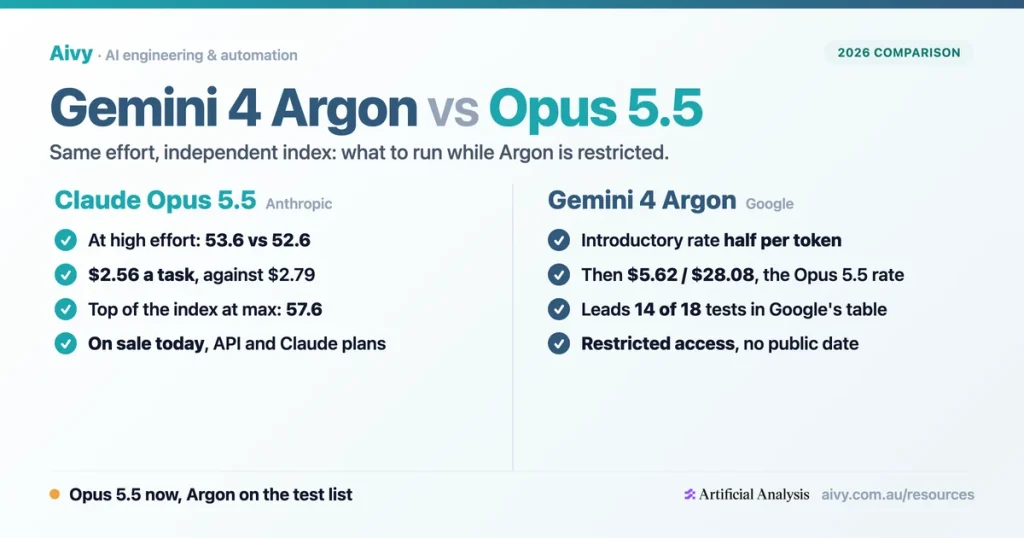
Google announced Gemini 4 Argon on 30 September 2026, eight days after Anthropic released Claude Opus 5.5, and the question from clients arrived the same afternoon: should we wait? Any honest Gemini 4 Argon vs Opus 5.5 comparison starts with access. Opus 5.5 has been on sale since 22 September; Google opened Argon on 13 October, so you can now test both on your own work.
At Aivy I spend most weeks pricing models for Australian teams by the finished job rather than the rate card. Launch weeks are the noisiest part of that work, because every vendor table is built to win. So I read Google’s figures beside the independent Artificial Analysis index, at the same effort setting, and the picture is less one sided than the launch post suggests.
Below you will find scores and cost per task at matched effort, what each model costs per million tokens, what Google’s own table says about Opus 5.5, the jobs where Argon may earn a test, which Opus 5.5 setting to run, and where Gemini 4 Carbon fits. If you are choosing within Anthropic’s range, start with our Sonnet 5.5 vs Opus 5.5 guide.
Key takeaways
- At the same effort, Claude Opus 5.5 scores 51.7 on the Artificial Analysis Intelligence Index v5 against 50.4 for Gemini 4 Argon, and costs $4.93 a task against $10.92.
- Argon’s introductory rate is half the Opus 5.5 rate per token; from 1 December it rises to $5.69 and $28.43, exactly the Opus 5.5 rate.
- Gemini 4 Carbon, announced on 28 October and still restricted, scores 59.4, a point above Claude Opus 5.5 at max; only Claude Fable 5.2 scores higher.
- In Google’s own benchmark table Argon leads Opus 5.5 on 14 of 18 shared tests; Opus 5.5 leads on four, two of them agentic coding.
- Argon opened on 13 October on the paid Gemini API and in the Gemini app for Google AI Pro and Ultra; its introductory rate runs to 30 November.
Gemini 4 Argon vs Opus 5.5 at a glance
The two models sit at opposite ends of a launch. Claude Opus 5.5 has been on sale since 22 September through Anthropic’s API, Amazon Bedrock, Google Cloud and Microsoft Foundry, and on Claude’s Pro, Max, Team and Enterprise plans. Gemini 4 Argon was announced on 30 September and opened on 13 October on the paid Gemini API and in the Gemini app for Google AI Pro and Ultra.
| At a glance | Gemini 4 Argon | Claude Opus 5.5 |
|---|---|---|
| Maker and date | Google, announced 30 September 2026 | Anthropic, released 22 September 2026 |
| Can you use it today? | Open since 13 October | On sale |
| Who gets it first | Paid Gemini API (AI Studio, Android Studio) and the Gemini app on Google AI Pro and Ultra | Claude API, Amazon Bedrock, Google Cloud, Microsoft Foundry; Claude Pro, Max, Team and Enterprise |
| Input and output, per million tokens | $2.84 and $14.22 to 30 November, then $5.69 and $28.43 | $5.69 and $28.43 |
| Maximum output per response | 1M tokens | 128K tokens (300K on the batch API, in beta) |
| Inputs | Google cites long video, charts and documents | Text and images |
| Index score at the same effort | 50.4 at High | 51.7 at high |
| Cost per index task, same effort | $10.92 | $4.93 |
| Data retention | Not covered in Google’s announcement | Zero data retention available |
Sources: Google, Gemini 4 Argon announcement and Gemini API pricing page; Anthropic, Claude Opus 5.5 announcement, model page and Opus page. Index and cost per task: Artificial Analysis v5, read 28 October 2026. Based on data from Artificial Analysis (artificialanalysis.ai), which does not endorse, validate or approve any of the analysis or conclusions drawn from it. Converted at 1 Australian dollar to 0.7034 United States dollars, 28 October 2026.
Two rows matter most for planning. Argon can write up to one million tokens in a single response, nearly eight times the 128K Opus 5.5 allows on its standard API. And Opus 5.5 takes text and images, while Google pitches Argon at long video as well. Our guide to which Claude model fits which job covers where Opus sits in Anthropic’s range.
What Google announced, and how you can use Argon now
Google calls Gemini 4 Argon its new frontier model, built for long, multi step work in software engineering, legal and finance research and cyber defence. Until 13 October it reached only trusted cyber defenders through the Fairwind Program, and for those testers Google released it without its cyber guardrails. Since then it ships in Google AI Pro and Ultra, and the Gemini plans in Australian dollars show what each costs.
Open
Since 13 October on the paid API and Google AI Pro and Ultra
$2.84 / $14.22
Introductory rate per million tokens to 30 November, input and output
$5.69 / $28.43
Rate from 1 December, the same as Opus 5.5
1M
Output tokens per response, up from 64K
Source: Google, Gemini 4 Argon announcement, 30 September 2026, its availability posts of 13 October 2026 and the Gemini API pricing page, read 28 October 2026. Converted at 1 Australian dollar to 0.7034 United States dollars, 28 October 2026.
On 13 October Google opened Argon on the paid tier of the Gemini API, in Google AI Studio and Android Studio, and in the Gemini app for Google AI Pro and Ultra subscribers; Ultra also gets it in Antigravity. There is no free API tier, and the introductory rate runs to 30 November. Our Claude vs Gemini comparison covers the other Gemini models.
The price needs a careful read. Argon costs $2.84 per million input tokens and $14.22 per million output tokens until 30 November, with cached input 95 per cent cheaper than input. Google’s pricing page then moves it to $5.69 and $28.43 from 1 December, the Opus 5.5 rate.
Argon and Opus 5.5 on the independent index, effort for effort
Artificial Analysis scores Argon only at High effort: 50.4 on its Intelligence Index v5. Claude Opus 5.5 at high scores 51.7. That is the fair comparison, the same setting on both models, and Opus 5.5 is still ahead. Index and cost readings here are from 28 October 2026. Since the setting moves the score this much, what each Opus 5.5 effort level costs matters as much as the model.
Intelligence Index v5 by effort setting, axis 0 to 100
Higher is better. Artificial Analysis measures both Gemini 4 models at High effort only, so the like for like pair is Claude Opus 5.5 (high) against Gemini 4 Argon (High). Gemini 4 Carbon, in lighter steel, is in restricted access. Source: Artificial Analysis, Intelligence Index v5, read 28 October 2026.

Up the dial the gap widens: Opus 5.5 at max scores 58.4, and Argon has no reading above High. Only Gemini 4 Carbon, still restricted, scores higher. One step down, Opus 5.5 at medium sits 2.3 points below Argon. Our GPT 6 Astra vs Opus 5.5 comparison shows how far the effort setting moves the same model.
The sub scores are closer. At the same effort, Argon leads on Humanity’s Last Exam, 57.1 per cent against 55.6, and edges SciCode and the Artificial Analysis run of Terminal Bench 4.0, while Opus 5.5 leads on long context reasoning. The composite index also counts tests not shown here, so leading on three of the four tests named here does not settle the ranking.
Independent sub scores at the same effort, per cent, axis 0 to 100
Higher is better. Both models at high effort, scored by the same evaluator. Source: Artificial Analysis, read 1 October 2026.
Speed is now measured too. On the 28 October reading, Argon at High produced about 83 tokens a second, with a first answer token after about 45 seconds, and Opus 5.5 at high about 84 tokens a second after about 35 seconds. For how Opus 5.5 compares with Anthropic’s other top model, see our Opus 5.5 vs Fable 5.1 guide.
Cost per task: where Argon’s cheaper tokens stop being cheaper
A rate card says what a token costs. The bill depends on how many tokens a model spends to finish the job, and Artificial Analysis publishes that as a cost per task beside every index score. At the same high setting, Opus 5.5 finishes an index task for $4.93 and Argon for $10.92, with Argon now costed at its full rate.
Cost per index task by effort setting, in Australian dollars
Lower is cheaper. Bars scaled to $14.27. Both Gemini 4 models are costed at their full token price, the same as Opus 5.5. Source: Artificial Analysis, cost per task on the Intelligence Index v5, read 28 October 2026. Converted at 1 Australian dollar to 0.7034 United States dollars, 28 October 2026.
Artificial Analysis now costs Argon at the same rate per token as Opus 5.5, so the gap in cost per task is a gap in tokens: Argon spends about twice as many to finish the same work at high. Even at its introductory half price it would cost more per task than Opus 5.5. Our AI ROI calculator weighs that spend against the hours a model saves.
The end of the introductory period on 30 November makes this harder for Argon, not easier. From 1 December it costs $5.69 and $28.43, the Opus 5.5 rate, so its cost case rests on Google trimming the tokens it spends. For finance automation running thousands of steps a month, that is the figure to watch.
Gemini 4 Argon price against Opus 5.5, per million tokens
Both APIs bill in United States dollars, and every figure here is converted at the Reserve Bank rate of 28 October 2026, one Australian dollar to 0.7034 United States dollars. On that basis Argon’s introductory rate is half of Opus 5.5 on every line shown, and its rate from 1 December matches Opus 5.5 exactly.
List rate per million tokens: Gemini 4 Argon against Claude Opus 5.5
Lower is cheaper. Each panel is scaled to its own largest bar. Google’s pricing page lists Argon’s cached input at $0.14 to 30 November and $0.28 from 1 December. Sources: Google, Gemini API pricing page, read 28 October 2026; Anthropic, Claude Opus 5.5 model page. Converted at 1 Australian dollar to 0.7034 United States dollars, 28 October 2026.
Input, per million tokens
Output, per million tokens
Cached input read, per million tokens
Opus 5.5 has two other price levers. Anthropic’s batch API halves both lines, to $2.84 and $14.22, the same as Argon’s introductory rate, for work that can wait. A fast mode on the Claude API, in research preview, costs $11.37 and $56.87 for up to two and a half times the speed. Our guide to paying for Claude in Australia covers the billing side.
Google’s cheaper option today is a different model. Gemini 3.8 Flash lists at $1.07 in and $5.33 out per million tokens until 31 December 2026, and Google’s pricing page doubles both from 1 January 2027. It scores well below either model here, but for simple steps at volume that price is hard to ignore. Our ChatGPT vs Gemini comparison covers where Flash fits.
What Google’s own benchmark table says about Opus 5.5
Google’s launch post includes a table that sets Argon beside GPT 6 Astra, Claude Fable 5.1 and Claude Opus 5.5. Eighteen rows carry a figure for both Argon and Opus 5.5, and Argon leads on fourteen of them. Opus 5.5 leads on four: two agentic coding tests, a machine learning engineering test and a science test run in a terminal.
| Benchmark | Gemini 4 Argon | Claude Opus 5.5 | Higher in Google’s table |
|---|---|---|---|
| Vals Index | 68.9% | 67.0% | Gemini 4 Argon |
| AutomationBench | 51.3% | 42.5% | Gemini 4 Argon |
| Vals Finance Agent v2 | 65.4% | 58.6% | Gemini 4 Argon |
| Harvey’s Legal Agent Benchmark | 19.6% | 3.8% | Gemini 4 Argon |
| DeepSWE v1.1 | 77.9% | 74.2% | Gemini 4 Argon |
| FrontierSWE v2 | 55.0% | 62.3% | Claude Opus 5.5 |
| Terminal Bench 4.0 | 57.4% | 66.4% | Claude Opus 5.5 |
| PostTrainBench | 45.3% | 49.3% | Claude Opus 5.5 |
| Terminal Bench Science 0.1 | 57.6% | 63.3% | Claude Opus 5.5 |
| GraphWalks, 256K to 1M | 84.2% | 66.8% | Gemini 4 Argon |
| LVBench, long video | 91.7% | 83.7% | Gemini 4 Argon |
| CWE bench v1 | 68.0% | 67.0% | Gemini 4 Argon |
Source: Google, Gemini 4 Argon announcement, benchmark table, and Google DeepMind’s evaluation methodology note. Vendor figures: Argon at its highest thinking setting; rival figures mostly from public leaderboards or Google’s own runs, at the best setting reported. Twelve of the eighteen rows that carry a figure for both models; Argon also leads on Vibe Code Bench, LABBench 2, RiemannBench, GraphWalks up to 128K, Agent’s Last Exam and Chartography.
Read the table as Google’s best foot forward. Its methodology note says Argon ran at its highest thinking setting, while most rival figures come from public leaderboards or Google’s own runs, at the best setting reported. So this is roughly max against max, not the high against High comparison above. Anthropic’s own launch table for Opus 5.5 has no Gemini column at all.
Sources matter even inside one test. Google lists Opus 5.5 at 42.5 per cent on AutomationBench, from Zapier’s public leaderboard, while Anthropic’s launch post reports 40.0 per cent from a Zapier run during early access, without fallback models. Same test, two numbers, both explained. If you are choosing a coding agent, run both models on your own repository before you trust either table.
Anthropic made a similar point when it launched Opus 5.5: at this level of capability, it said, benchmark margins have become a less reliable guide to real differences. A vendor saying that about its own lead is worth remembering when reading anyone’s table, Google’s included.
Where Gemini 4 Argon may be worth a test
Google’s strongest claims cluster in a few places, and they match the jobs I would test first now that Argon is open: long video, very long documents, legal and finance research, and answers that run to hundreds of thousands of tokens. None of that justifies pausing work you need done now, but it makes a sensible pilot list.
| Job | Argon’s case, per Google | Opus 5.5 today |
|---|---|---|
| Long video review | Leads Google’s long video test, LVBench | Reads text and images, not video |
| Very long documents | Leads both GraphWalks long context tests in Google’s table | One million token context; leads long context reasoning in the Artificial Analysis run |
| Very long outputs | Up to 1M output tokens per response | 128K, or 300K through the batch API in beta |
| Legal and finance research | Leads Harvey’s legal test and Vals Finance Agent v2 | Available now, with zero data retention |
| Terminal and agentic coding | Leads DeepSWE v1.1 | Leads Terminal Bench 4.0 and FrontierSWE v2 |
| Cyber defence | Without cyber guardrails for Fairwind defenders; with them for everyone else | Cyber Verification Program, expanding |
Sources: Google, Gemini 4 Argon announcement and benchmark table; Anthropic, Claude Opus 5.5 announcement and model page; Artificial Analysis, read 1 October 2026.
Legal work shows the largest relative gap in Google’s table, on Harvey’s Legal Agent Benchmark, where Argon scores about five times Opus 5.5. Both scores are low, so read it as a lead on a hard test rather than a solved problem. Our guide to AI tools for Australian lawyers covers what to check before any model touches client files.
Finance research is the other pilot I would plan, for an accounting or advisory practice in particular, since Google reports Argon ahead on Vals Finance Agent v2. While you test Argon, Opus 5.5 does that work today, and Anthropic pitches it for spreadsheets, slides and documents that are ready to use.
Workspace is an open question. Google’s availability posts name the paid API and Google AI Pro and Ultra, not Workspace, so I would not assume Argon will appear inside the tools your team already uses. For document automation today, that leaves Opus 5.5 or a Gemini model you can already call.
Which Opus 5.5 effort to run, and where Argon fits
If you need a frontier model this quarter, Opus 5.5 is the one you can buy, so the useful question is which setting. Anthropic’s API default is medium. My starting point for most business work would be high, which beats Argon’s only measured score for less than half the cost per task, with xhigh kept for the hardest jobs.
| Setting | Index v5 | Cost per task | When I would use it |
|---|---|---|---|
| Claude Opus 5.5, max | 58.4 | $14.27 | Deliberate purchase for the hardest, highest stakes work |
| Claude Opus 5.5, xhigh | 57.0 | $8.60 | Hard reasoning that can wait: contract sets, audits, migrations |
| Claude Opus 5.5, high | 51.7 | $4.93 | My default for business work; beats Argon’s measured score |
| Gemini 4 Argon, High | 50.4 | $10.92 | Test it now on your own jobs; launch price to 30 November |
| Claude Opus 5.5, medium | 48.1 | $3.48 | Anthropic’s API default; test it on short, simple calls |
Based on data from Artificial Analysis (artificialanalysis.ai), which does not endorse, validate or approve any of the analysis or conclusions drawn from it. Index v5 and cost per task read 28 October 2026; Argon costed at its full token price. Claude Opus 5.5 at low scores 34.5 on the index. Converted at 1 Australian dollar to 0.7034 United States dollars, 28 October 2026.
Max is a deliberate purchase. It buys Anthropic’s top score on the index at nearly three times the cost per task of high. For a customer service chatbot where someone waits on each reply, high is plenty; for an overnight review of a large contract set, xhigh is where I would start.
Opus 5.5 also cannot switch thinking off: Anthropic says adaptive thinking is always on, so even the cheapest setting reasons before it answers. For professional services firms moving up from Opus 5, that changes the cost of short, simple calls, so test medium on those before you assume high.
Claude and Google AI plans in Australia
Most people will meet these models in an app before an API. Anthropic says Opus 5.5 is available on Claude’s Pro, Max, Team and Enterprise plans. Since 13 October Argon is in the Gemini app for Google AI Pro and Ultra subscribers, not only Ultra. The prices below are the local ones each company lists for Australia.
| Plan | Australian price | Opus 5.5 or Argon |
|---|---|---|
| Claude Pro | $30.00 a month | Opus 5.5 |
| Claude Max 5x | $199.99 a month | Opus 5.5, with higher usage limits |
| Claude Max 20x | $399.99 a month | Opus 5.5, with higher usage limits |
| Google AI Pro | $32.99 a month | Argon in the Gemini app since 13 October |
| Google AI Ultra | From $149.99 a month | Argon since 13 October, plus AI Studio and Antigravity |
| Google AI Ultra, 20x usage | $329.99 a month | As above |
Claude prices are the monthly in app prices in Australia’s App Store; Google AI prices are from Google’s Australian subscriptions page. Both read 1 October 2026; web prices can differ. Availability from Anthropic’s Claude Opus page and Google’s Gemini 4 Argon announcement.
So the entry ticket is closer than it first looked. Opus 5.5 comes with Claude’s cheapest paid plan, and Argon now comes with Google AI Pro at $32.99 a month, not only with Google AI Ultra, which costs about five times as much. For a team in Melbourne, I would not upgrade to Google AI Ultra for Argon alone.
What Argon and Opus 5.5 mean for Australian businesses
The first question for most Australian teams is where the data goes. On Anthropic’s own API, Opus 5.5 inference runs globally by default, or only in the United States for a 10 per cent premium, and workspace data is stored in the United States. Neither option is Australia, and through Amazon Bedrock, Google Cloud or Microsoft Foundry the answer depends on the provider.
For Opus 5.5, ask your cloud provider whether it runs in an Australian region before you assume it. For Argon, Google’s announcements say nothing about where it processes data or how long it keeps it, so ask before you send personal information.
Under the Privacy Act 1988 that is not a box to tick later. The OAIC’s guidelines for Australian Privacy Principle 8 expect reasonable steps before personal information goes to an overseas recipient, and an organisation can stay accountable for what that recipient does with it. Our Privacy Act playbook turns that into vendor questions.
Retention is the second lever. Anthropic says Opus 5.5, like earlier Opus models, is available with zero data retention. On the Gemini side, Google’s pricing page says paid tier prompts to Gemini 3.8 Flash are not used to improve its products, while free tier prompts are. Our guide to data centres in Australia covers the local cloud capacity behind these questions.
The last point is budget. Both APIs bill in United States dollars, so the Australian figure moves with the exchange rate even when list prices stand still. Teams in Sydney or anywhere else running agents at volume should budget from cost per task in a pilot, and leave room for the end of Argon’s introductory period.
And now Gemini 4 Carbon
Two weeks after Argon, Google announced Gemini 4 Carbon on 28 October 2026 as its strongest model, built for long running engineering and cyber defence. It scored 59.4 at High on the Artificial Analysis Intelligence Index v5, a point above Opus 5.5 at max, and costs $11.03 a task against $14.27. Only a subset of cyber defenders and Google’s Fairwind partners can use it so far.
Google says developers, businesses and consumers will get it soon, with no date, at the same launch price as Argon. Argon went from cyber defenders to the paid API in about two weeks, which is a hint, not a promise. Until Carbon opens, it changes nothing in the advice above: run Opus 5.5, test Argon, and keep a test bench ready for Carbon.
Gemini 4 Argon vs Opus 5.5: frequently asked questions
Is Gemini 4 Argon better than Claude Opus 5.5?
Not on the independent measure at the same effort. Artificial Analysis v5 scores Opus 5.5 at 51.7 at high against 50.4 for Argon at High, and Opus 5.5 reaches 58.4 at max. Google’s own table has Argon ahead on most of the tests it chose.
Is Gemini 4 Carbon better than Claude Opus 5.5?
On the independent index, by a point. Artificial Analysis v5 scores Gemini 4 Carbon 59.4 at high effort against 58.4 for Opus 5.5 at max and 51.7 at high. You cannot use it yet: Google opened it on 28 October 2026 to a subset of cyber defenders and its Fairwind partners, with no date for developers, businesses or consumers. Since 9 November, Claude Fable 5.2 scores higher than both.
Can I use Gemini 4 Argon in Australia today?
Yes, since 13 October 2026. Google opened it on the paid tier of the Gemini API, in Google AI Studio and Android Studio, and in the Gemini app for Google AI Pro and Ultra subscribers. There is no free API tier.
How much will Gemini 4 Argon cost?
Google’s pricing page lists $2.84 per million input tokens and $14.22 per million output tokens until 30 November 2026, converted at the Reserve Bank rate of 28 October 2026. From 1 December, $5.69 and $28.43 apply, the same as Claude Opus 5.5.
Which is cheaper per task, Gemini 4 Argon or Opus 5.5?
Opus 5.5, at the same effort, by more than half. Artificial Analysis v5 puts Opus 5.5 at high at $4.93 a task and Argon at High at $10.92, both at the same rate per token, which suggests Argon uses about twice as many tokens on each task.
Is Gemini 4 Argon better than Opus 5.5 for coding?
It depends on the test. In Google’s own table Argon leads on DeepSWE v1.1, while Opus 5.5 leads on Terminal Bench 4.0 and FrontierSWE v2. Artificial Analysis had no Coding Index score for either model on 28 October 2026.
Will Gemini 4 Argon come to Google AI Ultra in Australia?
Yes, and to Google AI Pro as well. Since 13 October Argon is in the Gemini app for both plans; Google AI Ultra is listed from $149.99 a month in Australia and Google AI Pro at $32.99, so you do not need Ultra for Argon alone.
Should I wait for Gemini 4 Argon or start on Opus 5.5?
Start on Opus 5.5 if the work is due this quarter, and test Argon now that it is open on a short list of jobs: long video, very long documents, legal and finance research. Moving a tested workflow later usually costs less than pausing it now.
Which Gemini can I use today?
Through the API, Gemini 4 Argon since 13 October and the cheaper Gemini 3.8 Flash, which scores 30.5 at High on the Artificial Analysis index v5. Gemini 4 Carbon, announced on 28 October, is not open yet. In the Gemini app, check the model picker on your plan, because Google lists different models by plan.
Can Australian businesses keep data in Australia with these models?
Not through Anthropic’s own API, which offers global or United States inference for Opus 5.5. Through a cloud provider, ask which regions carry the model. Google has not said where Argon will process data.
The bottom line: Opus 5.5 now, Argon on the test list
At the same effort, Claude Opus 5.5 scores higher than Gemini 4 Argon and costs less per task, and you can buy it today. Argon’s half price per token is an introductory offer that ends at the Opus 5.5 rate, and on the independent index its cost per task already erases the discount. Google’s own table is stronger for Argon, which is a reason to test it, not to wait.
Run Claude Opus 5.5 at high for most work and at xhigh for the hardest jobs. Put Gemini 4 Argon on a short test list for long video, very long documents and legal or finance research, and price it at the later rate, not the introductory one.
If I were advising a Sydney law firm this month, I would run contract review on Opus 5.5 at xhigh, keep client files on terms that pass its privacy review, and hold back past matters as a test bench. Now that Argon is open, that bench gives a fair answer within days, and it will be ready for Carbon. Our AI consulting team sets up that kind of bench.
Argon may change this picture as Artificial Analysis measures it at more settings, and so may Gemini 4 Carbon once Google opens it, so check the date at the foot of this page before you rely on the numbers. If you would like a second opinion on which work belongs on which model, you can book a time with us whenever it suits you.
Last updated: 10 November 2026
Sources
Google, Gemini 4 Argon announcement. Restricted rollout through the Fairwind Program, release without cyber guardrails for trusted defenders, the order of wider access, the introductory rate and the rate after it (footnote 1), the cached input discount, the 1M output limit, the long video claim and the benchmark table with Claude Opus 5.5. Published 30 September 2026.
Google, Gemini 4 Argon in the Gemini app. Available from 13 October 2026 to Google AI Pro and Ultra subscribers.
Google, Gemini 4 Carbon announcement. Announced on 28 October 2026 as Google’s strongest model, open first to a subset of cyber defenders and partners in the Fairwind Program, with wider access promised soon and no date, at the same introductory price as Argon. Read 28 October 2026.
Google, build with Gemini 4 Argon. The paid tier of the Gemini API in Google AI Studio and Android Studio, and AI Studio and Antigravity for Google AI Ultra. 13 October 2026. The Gemini API pricing page, read 28 October 2026, gives the introductory rate to 30 November and the full rate from 1 December, with no free tier.
Google DeepMind, Gemini 4 Argon evaluation methodology. Argon run at its highest thinking setting, rival figures at the best reported setting, and the source of each row in Google’s table: public leaderboards, Google’s own runs or system cards. Retrieved 1 October 2026.
Google, Gemini API pricing. Gemini 4 Argon and Gemini 3.8 Flash rates, and whether paid and free tier prompts are used to improve Google’s products. Retrieved 28 October 2026.
Google, Google AI plans for Australia. Monthly prices for Google AI Pro and Google AI Ultra in Australian dollars. Read 1 October 2026.
Anthropic, introducing Claude Opus 5.5. List, cache and fast mode rates, the launch benchmark table and its AutomationBench footnote, the note on benchmark margins, zero data retention and platform availability. Published 22 September 2026.
Anthropic, Claude Opus 5.5 model page. Context window, maximum output and the batch limit, inputs, default effort, adaptive thinking always on, cache read and batch rates. Retrieved 1 October 2026.
Anthropic, data residency. Global or United States inference, the 10 per cent premium for United States only inference and the United States workspace geography. Retrieved 1 October 2026.
Anthropic, Claude Opus page. Opus 5.5 on Claude’s Pro, Max, Team and Enterprise plans, and its use for spreadsheets, slides and documents. Retrieved 1 October 2026.
App Store Australia, Claude listing. Monthly in app prices for Claude Pro, Max 5x and Max 20x. Read 1 October 2026.
Artificial Analysis, Intelligence Index leaderboard. Index v5 scores, cost per task, speed and time to first answer token by effort for Claude Opus 5.5 and both Gemini 4 models at High, and the missing Coding Index readings, read through the Artificial Analysis API on 28 October 2026. Sub scores from the v4.3 leaderboard, read 1 October 2026. Source: Artificial Analysis (artificialanalysis.ai).
Tables and charts using this data are based on data from Artificial Analysis (artificialanalysis.ai), which does not endorse, validate or approve any of the analysis or conclusions drawn from it.
OAIC, Australian Privacy Principle 8 guidelines. Reasonable steps before disclosing personal information to an overseas recipient, and continuing accountability for that recipient. Retrieved 1 October 2026.
Reserve Bank of Australia, exchange rates. Every United States dollar figure converted at 1 Australian dollar to 0.7034 United States dollars, 28 October 2026.
Index and cost figures reflect the leaderboard as read on 28 October 2026, sub scores as read on 1 October 2026, and move as models are measured again. Benchmark figures attributed to Google or Anthropic are the vendor’s own.