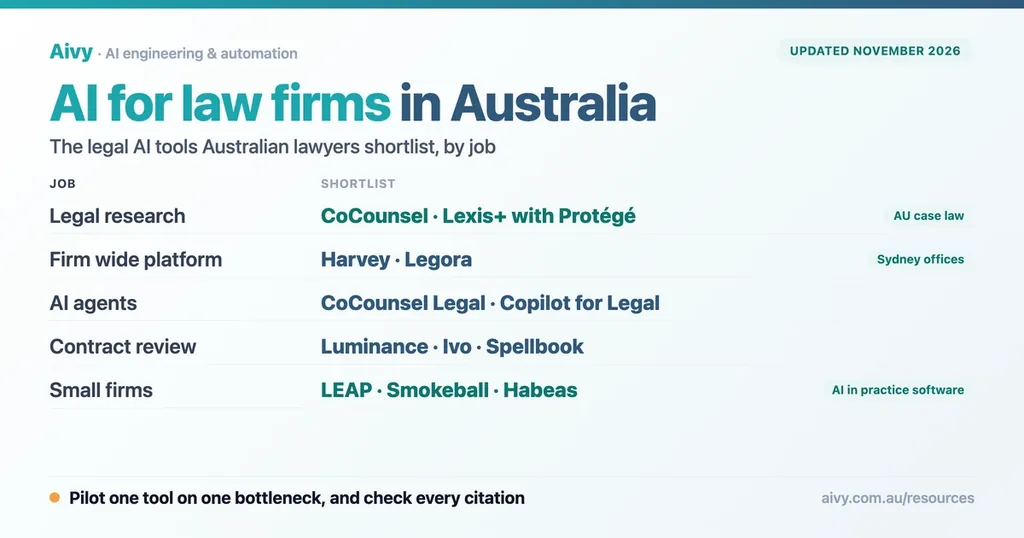
Which AI should an Australian law firm actually use? Clio's 2026 Australian Legal Insights Report found that 98% of local legal professionals already use AI, yet 59% still lean on generic tools. The gap between trying AI and trusting it with a client file is where most firms sit.
I speak with law firms across Melbourne and Sydney every week, and partners ask the same four things: which platforms work, what they cost, how they handle Australian data, and what the courts now expect. Answering that for one specific firm is work for an AI consultant in Melbourne or Sydney, not for a vendor demo.
Below I compare the AI tools for lawyers that Australian firms shortlist in late 2026: legal research, AI agents, contract review, drafting, general assistants and the free options. I rechecked every vendor figure in November, with prices in Australian dollars. If you also advise clinics, see AI tools Australian clinics can actually use in 2026.
Best legal AI for your law firm: a two question shortlist
The right tool depends less on which one is "best" and more on what your firm already runs. A sole practitioner on LEAP and a national firm on Westlaw end up with different shortlists, and both are right. Answer two questions and you get a starting list of two or three names.
How many lawyers work in your firm or legal team?
Which practice management software do you run?
Which research service does the firm already pay for?
What is the first job you want AI to take on?
Small firm on LEAP
- LEAP Matter AI and LawY, already in your subscription
- Habeas for research pinned to Australian paragraphs
- A general assistant for drafting, with nothing confidential pasted in
Small firm on Smokeball
Small firm on Clio
- Clio Work, launched in Australia in August 2026
- Clio Draft for forms and templates
- Habeas for Australian case law research
Small firm, other software
- Habeas for research, from $125 a month
- A business plan of ChatGPT or Claude for internal drafting
- When you next change practice software, pick one with AI built in
Mid sized firm on Westlaw
- CoCounsel Legal, with its agents rolling out here
- Copilot for Legal for drafting in Word
- Spellbook if contracts are most of your work
Mid sized firm on LexisNexis
- Lexis+ with Protégé for research and drafting
- Copilot for Legal for work inside Word
Mid sized firm, no research service
- Habeas for Australian research
- Copilot for Legal if you draft in Microsoft 365
- A pilot of Legora or Harvey once someone can run it
Large firm, one platform
- Harvey or Legora, both with Sydney offices
- CoCounsel Legal if Westlaw is your research home
Contract review at volume
Drafting inside Word
- Copilot for Legal, inside the Microsoft 365 you already license
- Spellbook for contract language
A first shortlist from the vendor facts in this guide, not advice for your firm. Run a pilot on real matters before you sign.
Every name in those answers is in the comparator below, with what it does, where it stands in Australia and what it costs. Filter it by the job you want done. If two questions are too blunt for your firm, that is what a free AI Discovery Session is for.
Legal AI tools compared, by job
CoCounsel Legal
Thomson Reuters
- Best for
- Firms on Westlaw
- Australia
- Local hosting; agents from late October 2026
- Price
- Quote only
Lexis+ with Protégé
LexisNexis
- Best for
- LexisNexis users
- Australia
- Full Australian content; Shepard's citations
- Price
- Quote only
Harvey
Harvey AI
- Best for
- A firm wide platform
- Australia
- Sydney office; onshore processing
- Price
- Quote only
Legora
Legora, formerly Leya
- Best for
- Large firm collaboration
- Australia
- Sydney office with 60+ staff
- Price
- Quote only
LEAP Matter AI and LawY
LEAP
- Best for
- Small and mid sized firms on LEAP
- Australia
- Australian practice software
- Price
- Included; no list price
Smokeball Archie
Smokeball
- Best for
- Small firms
- Australia
- Inside Outlook and Word
- Price
- Plans from $59 per user a month ex GST; Archie from Boost
Actionstep Intelligence
Actionstep
- Best for
- Mid sized firms
- Australia
- Trace and Acumen, August 2026
- Price
- On request; from Performance
Habeas
Australian startup
- Best for
- Sole practitioners and small firms
- Australia
- Australian case law, cited to paragraph
- Price
- $125 or $200 a month; 14 day trial
Ask.Legal
DocPro
- Best for
- Quick answers with cited laws or cases
- Australia
- Commonwealth law plus all states and territories
- Price
- 50,000 free tokens to start
Clio Work
Clio
- Best for
- Firms already on Clio
- Australia
- Australian legal content, August 2026
- Price
- Not published
Clio Draft
Clio
- Best for
- Forms and templates
- Australia
- Part of the Clio suite
- Price
- Not published
Luminance
Luminance
- Best for
- Enterprise contract review
- Claim
- 75% less repetitive review
- Price
- Enterprise; pilots
Ivo
Ivo
- Best for
- In house teams at tech companies
- Australia
- Atlassian and Canva legal teams
- Price
- Per seat
Spellbook
Spellbook
- Best for
- Contracts in Microsoft Word
- Scale
- 5,000+ legal teams
- Price
- Subscription; 7 day trial
Copilot for Legal
Microsoft
- Best for
- Firms on Microsoft 365
- Australia
- Available since 15 October 2026
- Price
- Microsoft 365 licensing
Claude for Legal
Anthropic
- Best for
- Legal workflows built on Claude
- Launched
- 12 May 2026
- Price
- Not published
Josef
Josef
- Best for
- In house legal teams
- Does
- No code legal bots and self serve contracts
- Price
- Not published
ChatGPT, Claude and Gemini
OpenAI, Anthropic, Google
- Best for
- Drafting help and summaries
- Limit
- No legal database or citation checks
- Price
- Free tiers; paid from $13 a month
Vendor pages and the Australian App Store, read 17 November 2026. Prices in Australian dollars.
How Australian law firms use AI in 2026
The profession has stopped debating whether to adopt AI. In the Wolters Kluwer 2026 Future Ready Lawyer Survey, 62% of legal professionals save 6% to 20% of their weekly time with it, and 52% report higher revenue. It covers the United States, Europe and China, so read it as the direction of travel.
Clients and employers are moving too. The Bloomberg Law 2026 survey found 76% of attorneys expect graduates to cite check AI output, and Clio's 2025 Legal Trends Report found more than half of clients ask AI before they call a lawyer.
Here the Victorian Legal Services Board found 37% of Victorian lawyers using AI at work in 2026. Firms use it for research, contract review, first drafts and due diligence, and most check data sovereignty requirements before a client file goes near a model.
BigLaw is restructuring around it. Baker McKenzie announced cuts to around 600 business services roles in February 2026 as its AI use grew, and Harvey now counts more than 3,500 law firms and in house teams as customers. The shift reaches well beyond the professions: what the same AI does for a trade business is drafting and chasing.
Legal AI tools by job: research, contract review, drafting and agents
Most firms buy for one job first. Pick the job to see the tools Australian firms shortlist, what to check before you sign and the figure that matters. Each tool also has a card in the shortlist above.
Legal AI tools by job
Best AI legal research tools in Australia
- CoCounsel Legal runs on locally hosted data with Westlaw Advantage and was assessed at PROTECTED level under IRAP in June 2026. Its agentic version is rolling out to Australian customers from late October 2026.
- Lexis+ with Protégé validates citations through Shepard's and connects to iManage and NetDocuments.
- Harvey says it serves more than 3,500 law firms and in house teams, has a Sydney office and can process Australian data onshore.
- Legora is Harvey's closest rival here, and its Sydney office now has more than 60 staff.
- Ask.Legal is a lighter option for quick questions: its Australian edition covers Commonwealth law and every state and territory. In its own October 2026 study of 40 questions across four jurisdictions, 95% of its answers cited a specific law or case, against 27.5% for Claude.
Corrs, Maddocks, King & Wood Mallesons, Ashurst and Gilbert + Tobin run Harvey; Allens, MinterEllison and HSF Kramer use Legora. Check coverage of the federal and state jurisdictions you practise in during a trial: a Sydney firm and a Perth firm need different state content, the first thing our Sydney AI automation team tests.

AI contract review and document analysis tools
Contract review is where in house teams feel the pressure first. These tools automate clause extraction, risk identification, and redlining at scale, so a lawyer spends the time on the clauses that matter.
- Luminance serves more than 1,000 enterprises and handles drafting, negotiation and compliance monitoring in one system.
- Ivo raised a Series B led by Australia's Blackbird in January 2026. The legal teams at Atlassian and Canva use it inside Word or Google Docs, and it says it never trains on customer data.
- Spellbook says more than 5,000 legal teams use it, and the Canadian Bar Association made it its AI drafting partner in March 2026.
Most hold SOC 2 Type II and ISO 27001 and offer zero data retention, but a certification says nothing about where the servers sit. Confirm data residency before deployment.

AI for drafting legal documents
AI now writes first drafts of contracts, memos, letters and filings from plain language instructions, which changes where a junior lawyer's hours go. Harvey and Lexis+ with Protégé draft on top of their research, Spellbook and Copilot for Legal work inside Word, and Clio Draft handles document automation for law firm workflows.
The models underneath keep moving. On Harvey's Legal Agent Benchmark, Google reports Gemini 4 Argon far ahead of Claude Opus 5.5, though both scores are low, and Gemini 4 Carbon has since reached Ultra subscribers.
Every draft still needs review. Tools miss jurisdiction specific requirements and recent case law, and templates often carry US or UK defaults rather than Australian legislation.

AI agents for law firms
The newest step is agentic AI: tools that research a point, draft the memo and check their own citations before a lawyer sees it. In 2026 every large legal vendor shipped one, and four of the big AI labs built legal products of their own.
| Agent | From | What it does | In Australia |
|---|---|---|---|
| CoCounsel Legal | Thomson Reuters | Deep Research, drafting and review agents over Westlaw | Rolling out from late October 2026 |
| Lexis+ with Protégé | LexisNexis | Custom skills builder and drafting in Word, added October 2026 | Protégé available; no date for the new skills |
| Copilot for Legal | Microsoft | More than 20 legal skills inside Word and Microsoft 365 | Available worldwide since 15 October 2026 |
| Claude for Legal | Anthropic | Legal workflows built on Claude | Launched 12 May 2026 |
| Astra for Law | OpenAI | GPT 6 set up for legal research | United States firms only |
For most firms the choice sits with tools they already pay for. A Westlaw firm gets agents through CoCounsel, and a firm that drafts in Word all day can trial Microsoft's Copilot for Legal without a new contract.
In my experience the firms that get value start with one narrow job, such as a first pass over a data room, and keep a named lawyer responsible for every output. Our guide to the best AI agents in Australia covers the general purpose ones.
Vendor figures and announcements, read 17 November 2026.
Australian legal AI software: LEAP, Smokeball, Habeas and Clio Work
Most Australian firms meet AI first inside software they already run. LEAP's Matter AI answers questions from everything saved in a matter, and LawY adds research with optional checking by a senior lawyer. Smokeball's Archie drafts, reviews and answers questions inside each matter, in Outlook and Word.
Actionstep launched Trace for AI time capture in August 2026. Habeas does research and drafting grounded in Australian law, cited to paragraph level, and Clio Work launched here the same month. Josef builds no code legal bots for in house teams. Not sure where your firm stands? Try a short AI readiness check.
Prices from each vendor's Australian pricing page, read 17 November 2026: Smokeball, Actionstep and Habeas. Archie is a paid add on from Smokeball's Boost plan, and Habeas takes 10% off for Smokeball users.
For a small or solo practice this is usually the cheapest start, and if you already pay for LEAP its AI costs nothing extra. Habeas is the one I would trial for research, because a citation pinned to an Australian paragraph is quick to check.
ChatGPT for lawyers: is it safe for client work?
ChatGPT, Claude, and Gemini draft well and explain law in plain language. They still have no legal database, cannot verify citations and can give plausible but wrong answers. Harvey, CoCounsel and Lexis+ with Protégé ground their answers in verified case law, and the table shows where the gap sits.
| Capability | ChatGPT or Claude | Legal AI tools |
|---|---|---|
| Case law research | ❌ No database | ✓ Full legal databases |
| Citation verification | ❌ Can hallucinate | ✓ Auto validation |
| Document drafting | ✓ Basic drafts | ✓ Legal grade |
| Plain language | ✓ Excellent | ✓ Good |
| Cost | Free to $32.99 a month | From $125 a month to private quotes |
The real question is what you paste in. Answer two questions about the text in front of you.
Does it name a client, or hold anything that identifies one, such as a TFN, a Medicare number or the facts of a matter?
Which account would it go into?
Generally fine
- Use a business account if the firm has one.
- Check any law or citation it gives you in Westlaw, Lexis or the primary source.
Do not paste it
- The Law Society of NSW likens this to putting client information in the public domain.
- Take the identifiers out first, or use a tool the firm has approved.
Only if your AI policy allows it
- Confirm the plan does not train on your data, and where it stores it.
- Remove identifiers the task does not need, and keep a lawyer on the output.
That is what these platforms are for
- Confirm data residency and retention in the contract.
- Every citation still needs a lawyer's check before filing.
Based on the Law Society of NSW guidance updated in January 2026 and the court practice notes below. Not legal advice.
Recent cautionary cases
- United States, March 2026: a federal prosecutor in North Carolina resigned after AI generated fabricated quotations in court filings.
- Australia, September 2026: in Dey (No 2), a migration solicitor admitted that 11 authorities he cited were AI hallucinations, and was ordered to pay costs personally.
- Australia, August 2025: the Victorian Legal Services Board varied a solicitor's practising certificate over a list of authorities generated with AI. He must now work under supervision for two years.
No Australian jurisdiction bans AI outright, but several courts restrict it in court documents, as the next section sets out. The Law Council of Australia stresses that AI output must be verified before submission. For general assistants, see our guide to Claude vs ChatGPT.

Before a client's file goes into ChatGPT
The Law Society of NSW, in its guidance updated in January 2026, says that placing client confidential information into a publicly available AI system is "akin to putting it in the public domain". And a brief or an affidavit rarely travels without a TFN, a Medicare number or an ABN next to the client's name.
Select the passage, press one key, and Nonimo swaps those client identifiers for placeholders on the solicitor's own computer before the text reaches ChatGPT, Claude or Copilot, then puts them back in the reply. Not a word of the file goes to Nonimo; a daily usage count does. See how a law firm covers client identifiers before anyone pastes.
Free AI tools for lawyers in Australia
Not every lawyer needs an enterprise platform. ChatGPT's free tier covers drafting help and document summaries, Claude provides similar capabilities, and Google Gemini comes through Google Workspace accounts. None has legal features.
Those are consumer plans, so read the data terms before anything about a client goes in. Our ChatGPT plans guide compares what each one includes. If you mostly want answers with linked sources, see how Perplexity compares with ChatGPT.
For legal work, use trials instead: Habeas gives 14 days of Australian legal research, Spellbook 7 days, Luminance runs pilots and Harvey gives qualified firms demo access. Free tools lack citation checking, and they raise data privacy questions when handling client information.
AI ethics and court rules for Australian lawyers
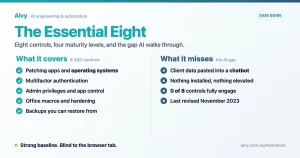
Conduct rules apply whatever the technology. The Australian Solicitor Conduct Rules require competence and diligence, judgment cannot be delegated to an AI system, and every AI generated document must be checked before it leaves the firm. Firms handling government matters also face the Essential Eight maturity levels.
Client confidentiality and data sovereignty
Privilege stays paramount. Ask every vendor where its servers are, whether data is encrypted, whether it trains on uploads, how long it keeps them and whether zero retention is available. Store shared logins in a business password manager so client data never leaks through a reused credential. Our Bitwarden review shows the audit trail a firm can show a client.
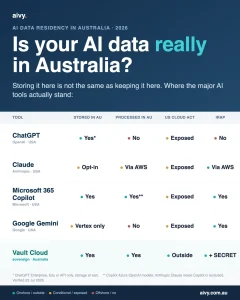
- Many legal AI tools process data on US servers. See which AI tools store data onshore and how the US CLOUD Act can still reach data held offshore.
- Whether an AI note taker may record at all depends on the state, and the transcript lands offshore.
- For the strictest matters, our OpenClaw guide explains how to run AI agents on your own infrastructure.
Court rules and disclosure requirements
Most Australian courts and several tribunals now regulate AI, and some require disclosure. Pick the court or tribunal you file in to see the rule, the date it took effect and what it asks of you.
AI rules by court and tribunal
Supreme Court of NSW
- Rule
- Practice Note SC Gen 23
- In force
- 3 February 2025
- Requires
- No generative AI in the content of affidavits, witness statements or character references, and those documents must say it was not used. Expert reports need leave. Citations must be verified.
The note is under review, so check for a new version before you file.
Federal Court of Australia
- Rule
- Generative AI Practice Note (GPN AI)
- In force
- 16 April 2026
- Requires
- Disclosure where AI was used to summarise material a witness relies on, to create images or audio for the Court, or in any way that could affect admissibility.
The Court can also order disclosure in any case.
Supreme Court and County Court of Victoria
- Rule
- SC Gen 25 and County Court Practice Note PNCCV 1 2026
- In force
- 14 May 2026 and June 2026
- Requires
- Be able to point to the parts of a document produced with AI. Users are responsible for AI content being current, complete and accurate.
Supreme Court of Queensland
- Rule
- Practice Direction 5 of 2025
- In force
- September 2025
- Requires
- Written submissions name the lawyer responsible, who certifies that every reference has been checked.
Supreme Court of South Australia
- Rule
- Generative AI guidelines
- In force
- 1 January 2026
- Requires
- Verify all content, and disclose AI use if the Court directs.
Federal Circuit and Family Court
- Rule
- Practice Direction PD AI
- In force
- 29 May 2026
- Requires
- Applies to every court user, experts included. Misuse can lead to costs orders and referral to the regulator.
Dey (No 2) shows the Court will order costs against the solicitor personally.
Administrative Review Tribunal and Fair Work Commission
- ART
- Generative AI Practice Direction, signed 20 August 2026: verify output, disclose when required and explain AI use if asked.
- FWC
- Guidance note on generative AI, 20 October 2026: state whether and how AI was used; a person, not another AI tool, must check every document; no AI for the facts in witness statements.
From each court's or tribunal's published practice note, direction or guidance, read 17 November 2026.
Before you use AI on a matter
The rules above come down to a handful of habits. This is the list I leave with firms after a pilot, in the order the questions usually come up.
Before AI touches a matter
Tick what your firm already does.
Start with the account and the data questions: they decide which tools you can use at all.
Close to covered. Each unticked line is a question a court, a client or an insurer can ask later.
All covered. Put it in writing in your AI policy so new staff follow it too.
Drawn from the court practice notes above, the Australian Solicitor Conduct Rules and the joint statement on AI in legal practice. Not legal advice.
How to choose legal AI software and what it pays back
Choosing legal AI means balancing capability, cost and compliance. Research platforms prioritise case law, Harvey and Legora aim to be the whole workspace, Luminance and Ivo focus on contracts and Spellbook on drafting. Start with your biggest bottleneck and pilot one tool with one practice group.
What could legal AI pay back at your firm?
Move the sliders. This counts time freed, not new revenue: the hours are only worth money if they are billed or reused.
- Hours freed a year
- 437
- Value of those hours
- $152,950
- Tool cost a year
- $7,740
- Net after tool cost
- $145,210
Starting values: 5 lawyers saving 5% of a 38 hour week over 46 weeks, below the 6% to 20% in the Wolters Kluwer survey; $350 an hour; $129 a month, Smokeball's middle plan. An estimate, not a quote.
The enterprise platforms publish no list prices, so every figure there is a negotiated quote. Factor in training time and workflow changes, and put your own numbers through our AI ROI calculator before you sign.
Questions to ask vendors
- What Australian content does the database include?
- Can we run a pilot with real documents?
- Does it integrate with iManage or NetDocuments, Microsoft 365, our practice management and our billing?
- What training and support is provided?
- What happens to our data if we cancel?
Poor integration limits adoption, and that includes billing and Finance automation services for Xero. Why bans backfire, and what a policy must actually cover, is in our guide to an AI use policy people follow.

Best AI for law firms by use case
| Use case | Best tool | Budget option | Why |
|---|---|---|---|
| Legal research | CoCounsel | Lexis+ with Protégé | Full AU coverage, citations |
| Contract review | Luminance | Ivo | Enterprise scale |
| Document drafting | Harvey | Spellbook | Word integration |
| All in one | Harvey or Legora | Lexis+ with Protégé | Research and drafting |
| AI agents | CoCounsel Legal | Copilot for Legal | Agents in Westlaw or Word |
| Small firm or solo | LEAP, Smokeball or Clio Work | Habeas | AI inside practice software |
| Just starting | Free trials | ChatGPT free | Test first |
Australian practices carry their own load: data sovereignty, local case law and a growing stack of practice notes. A Melbourne firm filing in the County Court and a Perth firm in the Fair Work Commission face different disclosure duties, something our Melbourne AI automation team checks before any pilot.
Firms with the strictest confidentiality duties are also trialling a model running on your own machines. For the wider picture, see AI automation for professional services firms and our finance and accounting automation work.
Frequently asked questions
What is the best AI for law firms in Australia?
It depends on the firm. Large firms usually choose Harvey, Legora or CoCounsel Legal as a firm wide platform. Small firms often start with the AI inside LEAP, Smokeball or Clio, and add Habeas for research grounded in Australian case law. Run a pilot on real matters before signing.
Which AI is best for legal research in Australia?
CoCounsel from Thomson Reuters and Lexis+ with Protégé offer the most comprehensive Australian coverage, with local case law databases and citation checking through KeyCite or Shepard's. Habeas is an Australian built alternative for smaller firms, and Harvey now embeds Australian legislation and case law and can process data onshore.
What AI agents do law firms use?
The main legal agents are CoCounsel Legal, rolling out in Australia from late October 2026, Lexis+ with Protégé and Harvey. Microsoft's Copilot for Legal brings legal skills into Word. Agents can research, draft and check citations in sequence, but a lawyer must still review every output.
What is an AI lawyer and how does it work?
AI lawyer refers to software that assists with legal tasks rather than a replacement for human lawyers. These tools analyse documents, draft text, and research case law using large language models trained on legal content. They work alongside lawyers who verify outputs and apply professional judgment.
Which legal AI is best for contract review?
Luminance, Ivo, and Spellbook lead the contract review market. Luminance claims a 75% reduction in repetitive review work across more than 1,000 enterprises, Ivo works inside Word or Google Docs, and Spellbook, used by more than 5,000 legal teams, integrates directly with Microsoft Word.
What is the best AI for drafting legal documents?
Harvey and Lexis+ with Protégé handle drafting alongside research. Spellbook specialises in contract drafting within Microsoft Word. The best choice depends on document types, practice area, and existing software integrations. Most platforms offer trial periods for evaluation.
Can lawyers use ChatGPT for legal work?
Yes, for summarising documents, brainstorming arguments and drafting first client letters, but not for legal research or citations without verification. In September 2026 an Australian solicitor was ordered to pay $9,600 in costs personally after citing 11 hallucinated authorities, and in NSW generative AI must not write the content of an affidavit.
Do Australian courts allow lawyers to use AI?
Yes, with rules. NSW bars generative AI from the content of affidavits, the Federal Court and the Federal Circuit and Family Court require disclosure in set cases, Victoria expects AI produced parts to be identifiable, and the Fair Work Commission wants AI use stated. The lawyer stays responsible.
Are there free AI tools for lawyers?
ChatGPT, Claude and Gemini all have free tiers suitable for drafting assistance and document summaries. Habeas and Spellbook offer free trials, while Harvey and Luminance run pilots rather than free plans. Free tools lack legal database access and citation verification that paid platforms provide.
How much do legal AI tools cost in Australia?
Harvey, CoCounsel and Luminance publish no list prices, so every quote is negotiated. Smokeball plans start at $59 per user a month excluding GST, with Archie as an add on, and Habeas at $125 a month. LEAP includes its AI in the subscription. Most vendors offer trials before annual commitments.
What AI do small law firms in Australia use?
Most start inside their practice software: LEAP includes Matter AI and LawY, Smokeball offers Archie as an add on, and Clio launched Clio Work here in August 2026. Habeas works from Australian case law. ChatGPT or Claude help with drafting, as long as nothing confidential goes in.
Is AI legal advice reliable in Australia?
AI tools should not provide legal advice. They assist lawyers with research, drafting, and analysis but require professional review. The Law Council of Australia emphasises that lawyers remain responsible for accuracy regardless of tools used. AI generated content must be verified before submission to courts or clients.
Prices in Australian dollars from each vendor's Australian page or the Australian App Store, read 17 November 2026.
Last updated: 17 November 2026
Sources
- Clio, 2026 Australian Legal Insights Report
- Clio, Legal Trends Report
- Wolters Kluwer, 2026 Future Ready Lawyer Survey
- Bloomberg Law, Path to Practice survey 2026
- Thomson Reuters, CoCounsel Legal in Australia, October 2026
- Harvey and Luminance, company pages
- Lawyers Weekly, Legora in Australia
- LawNext, Microsoft launches Copilot for Legal, October 2026
- Smokeball, Actionstep and Habeas Australian pricing pages
- Supreme Court of NSW, Practice Note SC Gen 23
- Federal Court of Australia, GPN AI
- Supreme Court of Victoria, SC Gen 25
- Federal Circuit and Family Court, PD AI
- Joint statement on AI in Australian legal practice and VLSB statement on the Dayal matter
- Australian Lawyer, Dey (No 2) and ABA Journal, federal prosecutor resigns
- Law Council of Australia