Every job management platform sold to Australian trade businesses now has AI on the front page. I went through the four that come up most often in client conversations and read what each vendor actually publishes, feature page by feature page, rather than what the marketing implies. The gap between the two is the reason this guide exists.
I run client success at Aivy, an AI automation agency in Melbourne, and the question I get from electricians, plumbers and builders is always the same one. Can it do my quotes. The honest answer, across all four platforms, is no. Not one of them puts a number on a job. What they automate is the writing, the capture and the chasing, which is worth real money, just not the money you were promised.
Below is what each vendor says its AI does, what the software costs in Australian dollars with the GST position of each one spelled out, and where the law will not let software sign for you. If you read only the quick pick, you already have the structural answer.
What AI in tradie software actually does, and what it does not
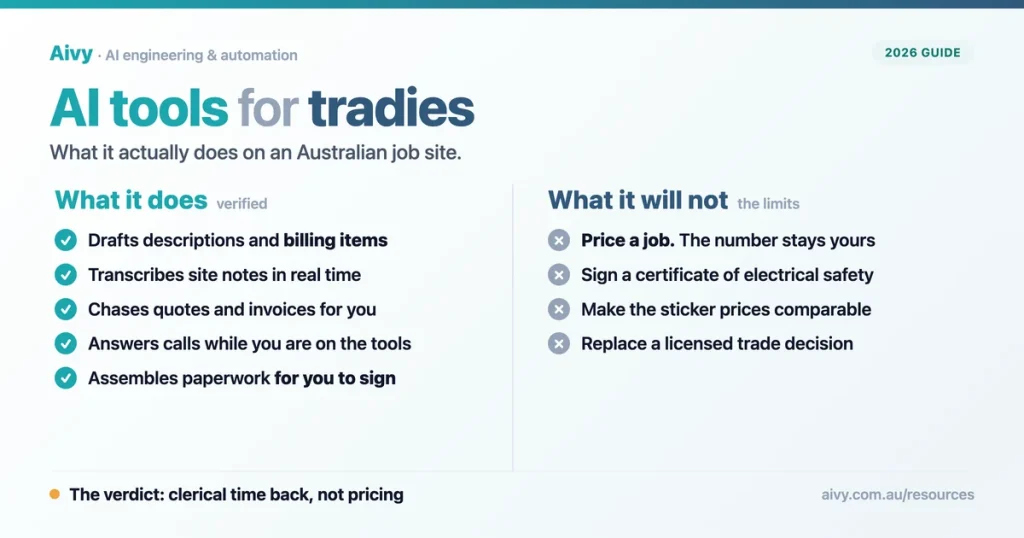
Read the four feature pages side by side and a pattern appears immediately. The work being automated is clerical. Descriptions, transcription, summaries, follow up. Nothing that decides a price, and nothing that carries legal weight.
ServiceM8 makes the boldest claim of the group. Its pricing page says its AI will auto draft a description and the job’s billing items in seconds. That is the closest any of these vendors comes to touching the quote itself, and even there you are getting line items assembled from your own catalogue, not a judgement about what this particular job is worth. We ran the same exercise for another trade that lives on the road, and the pattern held there too.
Tradify is more explicit about the limit. SmartWrite generates automatic descriptions from your quote and invoice line items, which means it polishes a quote after you have built it. Its three published capabilities are spelling and grammar, descriptions from your line items, and tone adjustment. All of it is text work.
| Platform | What the vendor says its AI does | Prices a job? |
|---|---|---|
| ServiceM8 | Auto drafts a job description and the job’s billing items | No, it assembles items you already hold |
| Tradify | SmartWrite: spelling and grammar, descriptions from your line items, tone | No, it writes after you price |
| AroFlo | Five named agents: JustAsk, FieldReady, JobReady, JobScribe, JobBrief | No, none of the five is a quoting agent |
| Fergus | Prepares and writes to the job record once you confirm | No, confirmation is yours |
Each claim taken from the vendor’s own feature or pricing page, read 17 September 2026. Sources listed at the end.
AroFlo is the clearest illustration. On its Lightning page it names five agents, and they cover business questions, technician training, job preparation, documentation and post job customer briefings. JobScribe listens, captures and transcribes job documentation in real time. Useful work, all of it. Not one of the five prices anything.
Why tradie software prices are not comparable
This is the part that costs Australian trade businesses money, and no comparison article I have seen states it plainly. The four vendors publish their prices in units that do not line up, and two of them do not tell you the GST position at all.
ServiceM8 declares both. Its Australian pricing page states that prices are in AUD and include GST. Tradify declares both the other way: AUD per user per month, ex GST. AroFlo and Fergus publish neither a currency code nor a GST position on their pricing pages. You can infer Australian dollars from context, and you would probably be right, but you are inferring.
| Platform | Published entry price | Charged by | Currency and GST stated? |
|---|---|---|---|
| ServiceM8 | $0 free, then $29 | Jobs per month | Yes, AUD incl GST |
| Tradify | $48 | Per user | Yes, AUD ex GST |
| AroFlo | $80, minimum 3 users | Per user | No |
| Fergus | From $53 | Plan, extras on top | No |
Entry prices as published on each vendor’s Australian pricing page, read 17 September 2026. AroFlo’s own page shows the same figure as both per user and per month in different places, so treat it as a starting point rather than a rate. Sources at the end.
The unit matters more than the number. ServiceM8 sells you a volume of jobs and gives you unlimited users above the free tier, so a five person crew on the $29 Starter plan pays $29 and is limited by hitting 50 jobs in a month. Tradify and AroFlo sell you seats, so the same five person crew multiplies.
Here is what a three person crew costs on the published rates. The arithmetic is ours, not the vendors’, and the GST bases differ, so read it as a shape rather than a quote.
Monthly cost for a crew of three, on published entry rates
Bars proportional to the dollar figure, scaled to the $240 top of the range. Vendor pricing pages, read 17 September 2026.
The multiplication is ours, not the vendors’. ServiceM8 Growing includes unlimited users and caps at 150 jobs a month, so it is not a per seat figure. Tradify excludes GST and ServiceM8 includes it. AroFlo does not publish its setup fee and states neither a currency nor a GST position, and Fergus prices are entry points that scale with headcount. Vendor pricing pages, read 17 September 2026.
None of this makes one product better value than another. It makes the comparison harder than a table of numbers suggests, which is exactly why so many crews end up paying for seats they do not use. If you are already weighing what software costs per head, the same trap shows up in what rostering and timesheet software costs per head in Australia.
Which tradie platforms include AI, and which charge extra
Of the two platforms I see most often on Australian job sites, one gives the AI away and the other gates it at the top.
ServiceM8 badges its AI Smart Helper as available in all plans, and it is ticked in every column, including the free plan at $0 a month that allows one user and 30 jobs. You can try the AI without paying anything.
Tradify keeps SmartTools on its Plus plan only, at $62 per user per month before GST. Two things are worth saying carefully there. Plus is not the top tier, since there is a Custom plan above it. And $62 is the full price of the seat, not a surcharge for the AI: the step up from Pro is $10 per user per month.
If you would rather start from where your time actually goes than from a feature list, our business automation audit walks through it in about ten minutes and costs nothing.
Watch the extras, because they are where a monthly figure stops being the monthly figure. ServiceM8 lists additional SMS at 10c each on every plan, and card payment fees running from 2.10% plus 30c down to 1.49% plus 30c depending on tier.
Fergus publishes timesheet users from $26 a month, contractor users at $4 per user per day, SMS at $15 for 100 texts and compliance certificates at $30 for a crew of up to nine. And on the Starter plan ServiceM8 does not sell extra jobs at all, so hitting the cap means waiting or upgrading.
Missed calls are the first thing a tradie should automate
Every tradie I have worked with has the same leak. You are up a ladder or under a house, the phone rings, and that job goes to whoever answers. This is the one area where AI does something a human process was not doing at all, because the alternative was not a worse answer, it was no answer.
ServiceM8 separates the two jobs deliberately. Its documentation states that Office Agent is for office and admin workflows inside ServiceM8, and that call handling belongs to the separate Phone Agent. Office Agent drafts emails and prepares changes for your approval rather than acting alone, access is limited to the business owner security role, and it is being switched on in stages.
I am not going to relitigate the whole category here, because we have already compared the Australian providers properly. If you are weighing this, read how an AI receptionist actually works, and whether to build or buy one, which covers seven Australian options and the build against buy decision. The same reasoning applies to the web chat side of the same enquiry if most of your leads arrive through a form.
The trade paperwork AI is not allowed to sign
This is the boundary that matters, and it is the one software marketing never mentions. Some trade paperwork is a legal instrument, and a licensed person has to stand behind it.
In Victoria, a certificate of electrical safety is required for electrical installation work, and carrying out that work without lodging one is a criminal offence, not an administrative slip. No amount of automation changes who signs. The same logic runs through plumbing compliance certificates and high risk construction work documentation in each state, with the detail differing by jurisdiction.
What automation legitimately does here is the assembly. Pulling the job details, the materials and the photos into a draft so the licensed person reviews and signs rather than types. That is the same pattern as pulling data out of supplier bills and job paperwork, and it is genuinely useful. It is just not the same thing as the software taking responsibility. It is also the shape of most of the compliance work we automate for clients doing AI automation in Sydney.
Let AI draft anything a human will check and sign. Never let it be the last step on a document that carries a licence number. If a vendor’s demo skips the approval screen, ask them where it is.
Invoicing and GST for Australian trade businesses
Invoicing is the least glamorous win and usually the biggest one. The rules are specific enough that software handles them well and boring enough that people put them off.
If you are registered for GST, business.gov.au sets out what a tax invoice must contain and notes that a customer can ask you for one, with a common expectation of payment within 28 days. For sales above $82.50 including GST, a customer registered for GST needs a tax invoice to claim their credit, and above $1000 the invoice needs the buyer’s identity or ABN. These are exactly the fields a template gets right every time and a person forgets on a Friday afternoon.
Where the AI earns its money is not the invoice itself but everything around it. Capturing the costs from the job before they are forgotten, drafting the description so it goes out the same day, and chasing the ones that age. If your books are the bottleneck rather than your invoices, what the same AI does on the books side covers the accounting end.
When you want two tools to talk to each other and nobody sells the integration, that is a different problem with a different answer. We wrote up wiring two tools together when nobody sells the integration for exactly that case.
Choosing AI tools by the size of your trade business
Australia had 2,814,778 actively trading businesses at 30 June 2026, and only 996,203 of them employed anyone. Most trade businesses in this country are very small, and most software comparisons are written for the ones that are not. The ABS counts those businesses by industry class, and finding your own ANZSIC code shows you which slice of those figures actually describes your trade.
For a sole trader, the per seat platforms are poor value and the free tiers are genuinely useful. Start with ServiceM8’s free plan, use the AI on your 30 jobs, and only pay when the cap bites. Our AI return on investment calculator is a faster way to sanity check whether a subscription pays for itself than any vendor’s own worked example.
For a crew of three to ten, the decision turns on whether your constraint is job volume or people. High volume, small office: job based pricing wins. Lots of field staff each needing their own login: per seat pricing is honest about what you are buying, and you should budget by headcount from the start.
Above about ten people, the question stops being which subscription and starts being which systems talk to each other. That is the point where we usually get called, and it is the work we do with businesses across AI automation in Melbourne and beyond. Worth noting that simPRO, which comes up often at this size, does not publish pricing you can read without talking to sales.
AI tools for tradies: frequently asked questions
Is there AI that can quote a job for me?
Not in this category, as at September 2026. ServiceM8 goes furthest by auto drafting a description and the job’s billing items, but it assembles items from your own catalogue. Tradify, AroFlo and Fergus all write around a price you have already set. You still make the pricing judgement.
What is the cheapest way for a tradie to try AI software?
ServiceM8’s free plan at $0 a month, which allows one user and 30 jobs, and includes its AI Smart Helper. That lets you test the AI on real jobs before paying anything. Check the transaction fees if you take card payments through it.
Is tradie software priced per user or per job?
It depends on the platform, and this is the biggest difference between them. ServiceM8 charges by jobs per month and gives unlimited users above its free tier. Tradify and AroFlo charge per user. Fergus charges per plan with extras on top.
Do these prices include GST?
Only some state it. ServiceM8 says prices are in AUD and include GST. Tradify says AUD per user per month, ex GST. AroFlo and Fergus do not state a currency or a GST position on their pricing pages, so confirm before you budget.
Can AI write my safety or compliance paperwork?
It can draft it, but a licensed person has to review and sign. In Victoria a certificate of electrical safety is required for electrical installation work and failing to lodge one is a criminal offence. Treat automation as assembly, never as the last step.
Will an AI phone service answer calls while I am on the tools?
Yes, and it is usually the first automation worth paying for, because the alternative is a missed call rather than a slower one. ServiceM8 separates its Phone Agent from its Office Agent for this reason. Compare the Australian options before committing.
Do I need a developer to use any of this?
No. All four platforms are set up by the business owner, typically in an afternoon. You only need help when you want two systems to exchange data automatically, or when the reporting you want does not exist in the product.
Is AI for electricians different from AI for plumbers or builders?
The software is largely the same, and the compliance paperwork is not. Certificates, licensing and the documents a job must produce differ by trade and by state, so check what your regulator requires before assuming a template covers it.
The bottom line for Australian trade businesses in 2026
Go in expecting clerical time back, not pricing judgement. Every one of these platforms automates the words around a job and none of them decides what a job is worth, and a vendor demo that blurs that line is telling you something about the vendor.
The Melbourne electrician who prompted this guide had been quoted for a five seat plan when his actual constraint was that nobody answered the phone between eight and four. He is now on a job based plan with an answering service in front of it, and the seats he was about to buy are still in his pocket.
Work out your constraint first. If it is missed calls, fix that and nothing else. If it is the paperwork drowning your evenings, the free tiers will tell you within a fortnight whether this category helps. If it is that your systems do not talk to each other, that is our job and you can book a call with us to scope it. We work with Australian trade businesses that would rather spend the evening at home than on the invoices.
Last updated: 18 September 2026. Vendor pricing and feature claims read directly from each vendor’s Australian pages on 17 September 2026. Software pricing changes without notice, so confirm before you buy.
• ServiceM8 Australian pricing · “Prices are in AUD and include GST”; plan tiers from $0 to $349; job caps of 30 to 1500+; “Unlimited Users”; AI Smart Helper “Available in All Plans”; the AI auto drafts a description and the job’s billing items in seconds; SMS and card transaction fees
• Tradify Australian pricing · “AUD per user/month. Ex GST.”; Lite $48, Pro $52, Plus $62; SmartTools on the “Plus plan only”; a Custom tier above Plus
• AroFlo Lightning · the five named agents JustAsk, FieldReady, JobReady, JobScribe and JobBrief, none of them a quoting agent; “JobScribe listens, captures, and transcribes job documentation in real time”
• Fergus Australian pricing · “Plans starting from $53 per month”; Essentials and Professional entry points; timesheet users, contractor users, SMS and certificate extras
• business.gov.au, how to create an invoice · tax invoice requirements if you are registered for GST, the $82.50 threshold including GST, the buyer identity requirement above $1000 and the common 28 day expectation
• Australian Bureau of Statistics, counts of Australian businesses · 2,814,778 actively trading businesses and 996,203 employing businesses at 30 June 2026
• Energy Safe Victoria, certificates of electrical safety · the certificate is required for electrical installation work in Victoria and failing to lodge one is a criminal offence