Every customer service team I speak with in Australia faces the same squeeze: more enquiries, the same headcount, and customers who expect an answer in seconds rather than the next business day. AI chatbots have become the release valve, and the better ones in 2026 resolve enquiries from start to finish instead of deflecting people into a help centre.
I have spent years at Aivy helping Australian businesses choose and build these tools, and I have learned to be sceptical of the vendor demo. A chatbot that shines in a polished sales call can fall apart on your real queue. What matters is fit: team size, channels, existing systems and data sensitivity.
So this is the guide I wish more buyers had: nine strong AI customer service chatbots grouped by the kind of team they suit, the pricing models that quietly decide your annual bill, the Privacy Act questions that matter, and an honest buy or build take. In a hurry? The quick pick has the short answer.
The 9 AI customer service chatbots at a glance
Two questions get you to a starting shortlist, linked to the tool cards below. Each card then jumps to its full review further down.
How many customer conversations does your team handle a month?
What matters most right now?
What sits under your support today?
Freshchat with Freddy AI
HubSpot Customer Agent
- HubSpot Customer Agent needs Service Hub Professional or Enterprise.
Zendesk AI agents
- Zendesk AI agents come with every Suite plan.
- Compare with Intercom Fin on top of Zendesk.
Intercom Fin
- Intercom Fin runs on top of your helpdesk and bills per outcome.
Ada
- Ada for autonomous, multilingual resolution at scale.
- Shortlist Intercom Fin alongside it.
Lorikeet
- Lorikeet, the Australian built option focused on accuracy.
Botpress or a custom build
- Botpress if you have a developer.
- Otherwise read the buy or build section below.
Aivy's starting points from client projects. Trial your top two on your real queue before you sign.
The AI customer service chatbots in this guide
Tidio
From $35.85 a month, Starter
- Best for
- Small Australian teams that want a capable bot live this week
- Known for
- Shopify, Lyro AI, live chat
HubSpot Customer Agent
From $140 a seat a month, Professional
- Best for
- Australian teams already running support on HubSpot
- Known for
- HubSpot CRM, Service Hub, knowledge base
Freshchat
Free up to 10 agents, then $28.18 an agent
- Best for
- Budget conscious SMBs that want omnichannel support
- Known for
- Omnichannel inbox, WhatsApp, Freddy AI
Intercom Fin
$1.47 per outcome
- Best for
- Teams that want to pay for results, not for seats
- Known for
- Runs on your existing helpdesk, outcome pricing
Zendesk AI agents
From $81.58 an agent a month, plus AI by resolution
- Best for
- Support teams already running Zendesk at scale
- Known for
- Zendesk Suite, omnichannel, autonomous agents
Ada
No published price
- Best for
- Large enterprises with very high support volume
- Known for
- Multilingual, no helpdesk included, per conversation
Gorgias
From $14.83 a month, plus AI per interaction
- Best for
- Shopify and ecommerce stores handling order questions
- Known for
- Order aware agents, returns, Shopify
Lorikeet
From $3,114.80 a month, Start
- Best for
- Health and finance teams where accuracy is non negotiable
- Known for
- Australian built, high accuracy, complex support
Botpress
Free tier, then from $222.49 a month
- Best for
- Teams with a developer and a workflow no template fits
- Known for
- Open builder, custom logic, API
Vendor pricing pages, read 17 November 2026. Tools that bill in US dollars are converted at the RBA rate of that day; HubSpot's Australian price was read on 1 October 2026. Annual billing where the vendor shows it.
How Australian support teams are using AI chatbots in 2026

A customer service chatbot in 2026 is not the scripted widget of a few years ago; it behaves more like an autonomous agent. It reads your help centre, past tickets and order data, answers in natural language, and increasingly takes action: processing a return, updating a booking, or escalating to a human with the full context attached.
Across the Australian businesses we work with, chatbots first take over tier one questions: order status, opening hours, password resets, returns. Then they earn their keep after hours, much like an AI receptionist does on the phones, covering the gap between a Melbourne team logging off at 5pm and customers who message at 9pm.
What has shifted is trust. These bots are a customer facing form of agentic AI, the move from software that answers to software that acts, covered in our guide to agentic versus generative AI. Vendors now claim average resolution rates of 65% to 80%, and a weak bot in 2026 annoys people who expect better.
The 2026 bar for a support bot
Tick what your current or shortlisted bot already does. Miss any of these and you have bought the weak version.
Not there yet. Start with the help centre and the handoff; they decide whether customers trust the bot.
Close. The missing piece is usually after hours cover or a clean handoff.
That is the useful version. Now check the pricing model and the privacy questions below.
Aivy's checklist from client rollouts.
AI chatbots for small and growing support teams

If you run a small support team, your priorities are simple: something that works within a week, needs no developer, and has pricing you can predict. The same predictability is worth demanding from anyone quoting you for AI consulting. These three will not satisfy a 50 seat contact centre, but they are the most sensible place to start.
| Tool | Best for | Standout strength | Starting price |
|---|---|---|---|
| Tidio (Lyro AI) | Small teams wanting a bot live fast | Up to 67% of questions resolved, says Tidio | From $35.85 a month (Starter) |
| HubSpot Customer Agent | Teams already on HubSpot CRM | Agent native to Service Hub, Professional and up | Free tools; Professional from $140 a seat |
| Freshchat (Freddy AI) | Budget conscious SMBs | Clean omnichannel inbox plus AI agent | Free up to 10 agents, then $28.18 an agent |
Tidio
- What it is: a familiar live chat widget paired with Lyro, its AI agent, and the tool I most often suggest to businesses buying their first proper chatbot. Point Lyro at your website and help articles and it starts answering; Tidio says Lyro solves up to 67% of customer questions on its own. It plugs into Shopify and the usual email and social channels.
- Price: Starter costs $35.85 a month billed annually, and the Lyro AI Agent starts at $48.21 a month for 50 Lyro conversations.
- Against messaging platforms: if you are weighing it up against broader customer messaging platforms for local businesses, it sits at the lighter, chat first end of that market.
- Who should look elsewhere: teams with complex cases in several steps, or a need for deep custom logic. Tidio is built for speed and simplicity, and that is exactly its value.
HubSpot Customer Agent
- What it is: if your business already runs on HubSpot, its Customer Agent is the path of least resistance. It sits inside Service Hub, so it answers from your knowledge base and ticket history, and keeping support in the same CRM as sales and marketing means cleaner data and one less login.
- The catch: it needs Service Hub Professional or Enterprise, from $140 a seat a month on annual billing plus a one off onboarding fee of $2,160, and each resolved conversation is billed through HubSpot Credits, about $0.70 each.
- Who should look elsewhere: anyone not already committed to HubSpot. A standalone tool will usually be cheaper and faster to deploy.
Freshchat
- What it is: Freshchat, with the Freddy AI agent, is the value option in this group: a tidy omnichannel inbox, with web, WhatsApp, social and email in one place, an AI agent on top, and a free plan for up to 10 agents.
- Price: paid seats start at $28.18 an agent a month on Growth, billed annually, and the Freddy AI Agent costs $72.68 per block of 100 sessions after the first 500.
- Where it falls short: polish and depth. The AI is competent rather than class leading, and larger teams tend to outgrow it. For a lean Australian business watching costs, that trade is often worth making.
AI chatbots built for high ticket volume

Once you are handling thousands of conversations a month, the priorities change: resolution rate at scale, clean handoffs to a large agent team, and pricing that does not punish growth. These three platforms are built for that world. They cost more and take longer to set up, but they are designed to carry serious volume.
| Tool | Best for | Standout strength | Pricing model |
|---|---|---|---|
| Intercom Fin | Teams that want to pay only for results | Sits on your existing helpdesk; outcome pricing | $1.47 per outcome |
| Zendesk AI agents | Teams already running Zendesk | Omnichannel autonomous agents at scale | From $81.58 an agent, plus AI per resolution |
| Ada | Large enterprises with high volume | Fully autonomous, multilingual resolution | No published price; per conversation |
Intercom Fin
- How it charges: Intercom Fin is the tool I point high volume teams towards first, mostly because you pay per outcome rather than per seat: $1.47 for a resolution, a procedure handoff, a disqualification or a self serve routing, and $14.82 for a qualified lead. On another helpdesk there is a minimum of 50 outcomes a month, and nothing is billed when a conversation simply goes to your team.
- Where it fits: Fin runs on top of an existing helpdesk such as Zendesk or Salesforce, so you do not have to rip anything out, and Intercom says it averages a 76% resolution rate across more than 12,000 customers.
- Who should think twice: very small teams, where the per resolution model can work out dearer than a flat plan, and anyone who wants a single platform rather than a stack of specialist tools.
Zendesk AI agents
- What it is: if your team already lives in Zendesk, its AI agents are the obvious move. They handle conversations autonomously across chat, email and messaging with no integration project, and Zendesk is a known quantity for Australian support teams, scaling comfortably into the hundreds of seats.
- Price: Suite Team costs $81.58 an agent a month and Professional $170.57, billed annually. AI agents come with every Suite plan, including 5 automated resolutions per agent a month on Team and 10 on Professional, then $2.97 per resolution pay as you go. Copilot, the assistant for your human agents, is a $74.16 extra.
- Worth knowing: Zendesk bought Forethought and sells its AI agents to teams on other helpdesks. It is an expensive choice if you adopt Zendesk only for the bot.
Ada
- What it is: the enterprise end, built for fully autonomous, multilingual resolution at high volume, and used by large global brands for exactly that. If you run a serious contact centre and resolution rate is the metric that matters, Ada belongs on your shortlist.
- Two cautions: Ada typically charges per conversation, including ones it does not resolve, and it does not include a helpdesk, so you still need one underneath it. For most mid sized Australian teams, Ada is more platform than they need.
Specialist AI chatbots: ecommerce, regulated industries and custom builds
Some teams need more than a general purpose chatbot. If you sell online, work in a regulated industry, or have a workflow that no template quite fits, the right tool is a specialist one. An NDIS provider is typical: a bot asked what a support costs has to answer from the official price limits, not from memory.
Real estate is another: a bot answering rental and buyer enquiries has to book inspections and hand a real prospect to the agent, and the AI tools built for real estate agents are designed around exactly that handover.
Do most of your enquiries come from online orders, for example on Shopify?
Which is closer to your situation?
A specialist pays off: Gorgias
- Gorgias sees the order, so it can close the loop.
A specialist pays off: Lorikeet
- Lorikeet is built for accuracy in high stakes support.
Build on Botpress
- Botpress gives you full control of the logic.
You do not need a specialist
- Start with Tidio or, at volume, Intercom Fin.
Aivy's rule of thumb from client projects.
| Tool | Best for | Standout strength | Pricing model |
|---|---|---|---|
| Gorgias | Shopify and ecommerce stores | Order aware shopping and support agents | From $14.83 a month; AI per interaction |
| Lorikeet | Regulated industries (health, finance) | Australian built; high accuracy complex resolution | From $3,114.80 a month (Start) |
| Botpress | Teams that need a custom built bot | Open builder platform, full control of logic | Free, then from $222.49 a month |
Gorgias
- What it is: built for online retail, and hard to beat on Shopify. Its agents are order aware: they can see a purchase, process a return, check a shipment and answer ‘where is my order’ without a human stepping in.
- Price: Gorgias prices its helpdesk by ticket volume, never per agent: Starter is $14.83 a month on monthly billing only, and Basic $74.16 a month billed annually. Its AI Agent costs $1.48 per automated interaction on a monthly contract, or $1.33 on an annual one.
- Who it suits: for ecommerce and retail businesses in Australia, that order context separates a bot that frustrates shoppers from one that closes the loop. Outside retail, the focus becomes a constraint and a general tool will serve you better.
Lorikeet
- What it is: the Australian built option on this list, and the one I raise first with clients in regulated industries. It is designed for complex, high stakes support where a wrong answer has real consequences, and it focuses hard on accuracy rather than just speed.
- Price and hosting: Start is $3,114.80 a month and Scale $7,564.52, billed annually, plus $1.47 per chat, email or SMS resolution; escalations to a person are not charged. Its pricing page lists data residency as US or custom, so get Australian hosting confirmed in writing.
- Who it suits: healthcare practices (see our deeper guide on the AI tools Australian clinics can actually use in 2026), financial services and other businesses where data control and correctness are not negotiable. It is not the pick for a small shop that wants quick FAQ deflection.
- Clinics, one step back: a bot answers from your booking system, so if you are still choosing that system, compare what Cliniko, Halaxy and Nookal really cost per practitioner first.
Botpress
- What it is: a platform for building your own chatbot rather than a finished product, with full control over the conversation logic, the integrations and the data. For a team with a technical resource and an unusual workflow, that control is the whole point.
- Price: a free tier with 100 conversations a month, then Plus at $222.49 a month and Team at $1,112.43, billed annually, with more conversations sold in packs as you grow.
- The trade: effort. Botpress rewards teams willing to design and maintain their bot, and frustrates teams who expected something that works straight away. If you want a custom result without doing the building yourself, that is where an agency comes in.
How AI chatbots actually charge you: per resolution, per agent, per conversation

Pricing is where chatbot decisions quietly go wrong. Two tools can look similar in a demo and then produce wildly different invoices, because they charge on completely different models. Before you compare features, understand the five models in the table below, because the model often matters more than the sticker price.
| Pricing model | How it works | Tools that use it | Watch out for |
|---|---|---|---|
| Per resolution | You pay per outcome, such as a resolution or a procedure handoff | Intercom Fin; the AI in HubSpot, Zendesk, Gorgias, Lorikeet | Some bill handoffs too; Fin has a 50 outcome monthly minimum on other helpdesks |
| Per agent or seat | Flat monthly fee per human agent licence | Zendesk, Freshchat | The AI itself is now often billed on top |
| Per conversation | You pay for every chat, resolved or not | Ada, Botpress | Unresolved chats still cost you money |
| Tiered subscription | Fixed monthly plan with usage caps | Tidio, Gorgias (helpdesk) | Overage fees once you pass the cap |
| Usage based with a free tier | Pay for what you consume; free to start | HubSpot credits, Freshchat sessions | Costs get less predictable at scale |
- Per resolution: led by Intercom Fin and now used for the AI in HubSpot, Zendesk, Gorgias and Lorikeet, this is really outcome pricing: among the fairest on paper and the easiest to forecast once you know your monthly volume. Our AI ROI calculator helps put figures on it. At high volume it is excellent value; a small team with few conversations can find a flat plan cheaper.
- Per agent: the Zendesk and Freshchat model charges by the human seat. It is predictable, but in 2026 it rarely covers the AI, which both bill on top. Per seat pricing bites the same way in workforce tools, which is why rostering software costs more than the sticker price once minimums apply.
- Per conversation: Ada and Botpress charge for every chat whether or not it is resolved. At enterprise volume with a high resolution rate that is fine; for everyone else, paying for the bot’s misses as well as its wins is a real risk to model carefully.
- Tiered and usage based: Tidio, and Gorgias for its helpdesk, sell a fixed monthly plan with usage caps, simple until you exceed the cap and overage applies. Usage based AI, like HubSpot’s credits, is cheap to start and harder to predict at scale.
What would the AI cost you a month?
Only the AI resolutions, at each vendor's published rate. It leaves out seats, platform fees, minimums and the resolutions Zendesk includes per agent.
- Conversations resolved by the bot
- 500
- Intercom Fin, per outcome
- $734
- Gorgias AI Agent, monthly contract
- $742
- Zendesk, pay as you go resolutions
- $1,483
Starting values: 1,000 conversations and a 50% resolution rate, below the 65% to 80% vendors claim. Fin US$0.99, Gorgias US$1.00 and Zendesk US$2.00, from their pricing pages read 17 November 2026, at the RBA rate of that day (1 Australian dollar to 0.6742 US dollars).
The honest takeaway for an Australian business: pick the pricing model that matches your volume first, then compare price.
Data residency, the Privacy Act and what Australian teams should check

A customer service chatbot sees a lot of personal information: names, contact details, order histories, and sometimes far more sensitive material. In Australia that puts it squarely inside the Privacy Act 1988, and it makes a few questions non negotiable before you sign anything.
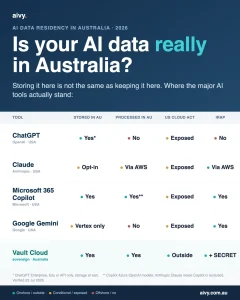
The first is data residency. Many of the best known chatbots are US based, and so is their default storage. That is not automatically a problem, but for health or financial data know where customer data lives and whether Australian residency is available. Accountability stays with you, and the Australian Privacy Principles still apply.
- Australian hosting: Intercom offers it for new workspaces on its Advanced and Expert plans, Zendesk includes its data centre location option free on Professional and above, though you have to switch it on, and Lorikeet lists custom data residency. If you want to know what sits behind an Australian region, our guide to where Australia's data centres are and who runs them explains it.
- Who is caught: the Australian Privacy Principles bind businesses with more than $3 million in annual turnover, plus some smaller ones such as health service providers. From 10 December 2026, privacy policies must also explain automated decisions that could significantly affect someone, which can catch a bot that decides refunds, cancellations or eligibility.
- Training: some vendors use your conversation data to improve their own models. Find out whether that happens and whether you can opt out, particularly for transcripts with sensitive details.
- Telling people it is a bot: if you serve customers in Europe, Article 50 of the EU AI Act has required a chatbot to tell people they are dealing with an AI since 2 August 2026; our EU AI Act checklist for Australian businesses covers what to change.
- Handoff: a good bot recognises a sensitive or distressed customer and escalates with context, rather than looping them.
Questions to put to any vendor before you sign
Tick each one you already have answered in writing.
Do not sign yet. Residency and training are the two answers that are hardest to fix later.
Nearly there. Get the remaining answers into the contract, not just the sales call.
Ready. Keep the answers with your privacy records.
From the Australian Privacy Principles and the Privacy and Other Legislation Amendment Act 2024.
How to choose the right AI chatbot for your team

With nine tools on the table, the choice can feel harder than it is. In practice it comes down to four questions, and once you have answered them the field narrows quickly.
- Volume: it decides your pricing model. A handful of conversations a day points to a simple tiered plan; thousands a month make per resolution or enterprise pricing worth the complexity.
- Systems you already pay for: if you live in Zendesk, HubSpot or Shopify, the native or specialist option usually wins on integration alone, and the setup time you save is real money.
- Complexity: most teams handle fairly standard enquiries, and a capable general tool will serve them well. Genuinely difficult, regulated, high stakes or unusual support needs a specialist.
- Data sensitivity: for healthcare and financial businesses, data sensitivity can outrank every other factor.
- A tenth option: if most of your customers already message you on Instagram or WhatsApp, Meta’s Business Agent, free to start and with more capacity in the paid Meta One business plans since September, is explained in our guide to Meta Muse and its business tools.
The tabs below map the most common situations to a sensible pick and a budget alternative. Treat them as a starting point, not gospel: your channels, your team and your customers always have the final say.
Best pick by situation
Small team, first chatbot
- Best pick
- Tidio
- Budget option
- Freshchat
- Why
- Fast setup and strong resolution without a developer
High support volume
- Best pick
- Intercom Fin
- Budget option
- Zendesk AI agents
- Why
- Outcome pricing keeps cost tied to value
Shopify or ecommerce store
- Best pick
- Gorgias
- Budget option
- Tidio
- Why
- Reads orders and handles returns natively
Regulated industry (health, finance)
- Best pick
- Lorikeet
- Budget option
- None that I would trust with the same risk
- Why
- Australian built, accuracy and data control focus
Already on Zendesk or HubSpot
A workflow off the shelf cannot handle
- Best pick
- Custom build
- Budget option
- Botpress
- Why
- Full control of logic, data and integrations
Aivy's picks from client projects; prices in the tool cards above.
Buy an off the shelf chatbot or build your own
For most teams, one of the nine tools above is the right answer. Off the shelf chatbots are mature, quick to deploy and, for standard support, hard to justify replacing with something bespoke. If your needs are ordinary, buy. Do not let anyone, including an agency, talk you into building what you could simply license.
| Your situation | Off the shelf chatbot | Custom build |
|---|---|---|
| Standard FAQ and ticket deflection | Best fit | Overkill |
| Tight budget, need it next week | Best fit | Slower, higher upfront cost |
| Unusual workflow or internal systems | Limited by templates | Best fit |
| Strict data residency or compliance | Depends on the vendor | Full control |
| Deep integration with internal tools | Often capped | Best fit |
There is a real line, though, where building wins. I have seen it with a Melbourne removals company we work with: quotes depend on volume, dates and access, bookings change constantly, and an off the shelf bot kept forcing their process into a template. So we built one, a bot the team calls Soto, around their actual workflow.
- What made it worth it: control over the logic, over how the bot connects to their booking system, and over where the data sits, not cleverness for its own sake.
- When to build: your workflow is genuinely unusual, integration with internal systems goes beyond what templates allow, or data residency and compliance demand it.
- If you run removals yourself: our look at AI tools and custom builds for Australian removalists runs the same buy or build sums for a whole moving business.
- Beyond chat: the same buy or build logic applies to documents, as our guide to AI document automation tools shows.
At Aivy we do both, and we will tell you honestly which one your situation calls for. If an off the shelf tool fits, we will say so. If it does not, custom AI chatbot development is the kind of work we do for Australian businesses every week.
The bottom line for Australian support teams
If there is one lesson from comparing these nine tools, it is that there is no single best AI chatbot, only the best one for your team. The right pick falls out of four things: your conversation volume, the systems you already run, how complex your support really is, and how sensitive your data is.
| Client | Where they landed | What decided it |
|---|---|---|
| Small online retailer | Tidio, resolving the bulk of enquiries within a week | Speed and a standard queue; nothing heavier needed |
| Financial services firm | An Australian built option, with a far more careful rollout | Accuracy and data control |
Same month, same question, opposite answers. So start with your own team, not the feature list: map your volume, your stack and your compliance needs, then let the tool follow, and the shortlist almost writes itself.
If you would rather not work through it alone, we are Aivy, an AI automation agency working with Australian businesses, happy to help you choose, or to build something that fits when nothing off the shelf does.
AI customer service chatbots: frequently asked questions

What is an AI customer service chatbot?
An AI customer service chatbot is software that answers customer enquiries in natural language, drawing on your help centre and past tickets. The better tools in 2026 resolve common questions end to end and escalate complex ones to a human with context.
How much does an AI customer service chatbot cost in Australia?
It varies by model. HubSpot, Freshchat and Botpress have free plans; HubSpot’s Service Hub Professional, which its Customer Agent needs, starts at $140 a seat a month on annual billing. The others charge per seat, per outcome or per conversation, from $1.47 per outcome on Fin to $81.58 an agent a month on Zendesk. Match the model to your volume.
What is the best AI chatbot for a small business?
For most small Australian teams, Tidio is the easiest strong start: it goes live within a week, needs no developer, and Tidio says Lyro solves up to 67% of customer questions. Freshchat is a sensible budget alternative if cost is the deciding factor.
Can an AI chatbot replace customer service agents?
Not entirely. AI chatbots handle routine, repetitive enquiries well, which frees agents for complex, sensitive or high value conversations. The teams that succeed treat the bot as the first tier of support, not a full replacement for human staff.
Are AI customer service chatbots safe to use under the Privacy Act?
They can be, but it depends on the vendor. Chatbots handle personal information, so for most businesses over $3 million turnover they fall under the Privacy Act 1988. Ask where data is stored, whether Australian residency is available, and whether transcripts train the vendor’s models. From 10 December 2026, significant automated decisions need explaining in your privacy policy.
Do I need a developer to set up an AI chatbot?
Usually not. Tools like Tidio, Freshchat and HubSpot’s Customer Agent are designed for non technical teams and connect to your website and help centre directly. You only need development help for custom builds or deep integration with internal systems.
What is the difference between per resolution and per agent pricing?
Per resolution pricing charges by outcome, mostly when the bot solves a query, though some vendors such as Intercom Fin also bill handoffs. Per agent pricing charges a flat fee for each human seat, and the AI is now often billed on top. Per resolution often suits high volume teams, while per agent suits stable, larger teams.
Which AI chatbot is best for a Shopify store?
Gorgias is the strongest pick for Shopify and ecommerce. Its agents are order aware, so they can check shipments, process returns and answer order questions without a human. Tidio is a lighter, lower cost alternative for smaller stores.
Should I buy an AI chatbot or build a custom one?
Buy when your support is standard, which it usually is: off the shelf tools are cheaper and faster. Build when your workflow is genuinely unusual, integration needs are deep, or data residency rules demand full control over the system.
Last updated: 17 November 2026
Sources
- Tidio pricing: Starter from US$24.17 a month and the Lyro AI Agent from US$32.50 a month for 50 conversations, with two months free on annual billing (read 17 November 2026). Lyro's “up to 67%” resolution claim is Tidio's own.
- HubSpot Service Hub pricing: Professional at $140 a seat a month on annual billing, a $2,160 one off onboarding fee and Customer Agent billed in HubSpot Credits, in Australian dollars, read 1 October 2026. On 17 November the page showed US dollars only (US$90 a seat and US$1,500 onboarding).
- Freshchat pricing: free for up to 10 agents, Growth US$19 an agent a month billed annually, Freddy AI Agent US$49 per 100 sessions with 500 free sessions per account (read 17 November 2026).
- Fin pricing: US$0.99 per resolution, procedure handoff, disqualification or self serve routing, US$9.99 per qualification, 50 outcomes a month minimum on any helpdesk, billed in US dollars only (read 17 November 2026). The 76% average resolution rate across more than 12,000 customers is Intercom's own claim.
- Zendesk pricing: Suite Team US$55 and Suite Professional US$115 an agent a month billed annually, 5 and 10 automated resolutions per agent a month included, US$2.00 per pay as you go resolution, Copilot US$50 an agent a month (read 17 November 2026).
- Gorgias pricing: Starter US$10 a month on monthly billing only, Basic US$50 a month billed annually, AI Agent US$1.00 per automated interaction on a monthly contract and US$0.90 on an annual one (read 17 November 2026).
- Lorikeet pricing: Start US$2,100 and Scale US$5,100 a month billed annually, US$0.99 per chat, email or SMS resolution on Start, escalations not charged, data residency listed as US or custom (read 17 November 2026).
- Botpress pricing: free tier with 100 conversations a month, Plus US$150 and Team US$750 a month billed annually (read 17 November 2026).
- Ada: no published price; per conversation billing from Ada's sales material. Intercom's Australian hosting, Zendesk's data centre location option, the Forethought acquisition and Meta's Business Agent from the vendors' own pages, read 1 October 2026.
- OAIC, Australian Privacy Principles: who the principles cover, including the $3 million turnover threshold and health service providers.
- Privacy and Other Legislation Amendment Act 2024: the automated decision provisions for privacy policies and their 10 December 2026 commencement.
- Regulation (EU) 2024/1689, the EU AI Act: Article 50 transparency duties for AI systems that interact with people, applying from 2 August 2026 under Article 113.
- Reserve Bank of Australia, exchange rates: every US dollar price on this page converted at 1 Australian dollar to 0.6742 US dollars, 17 November 2026.