
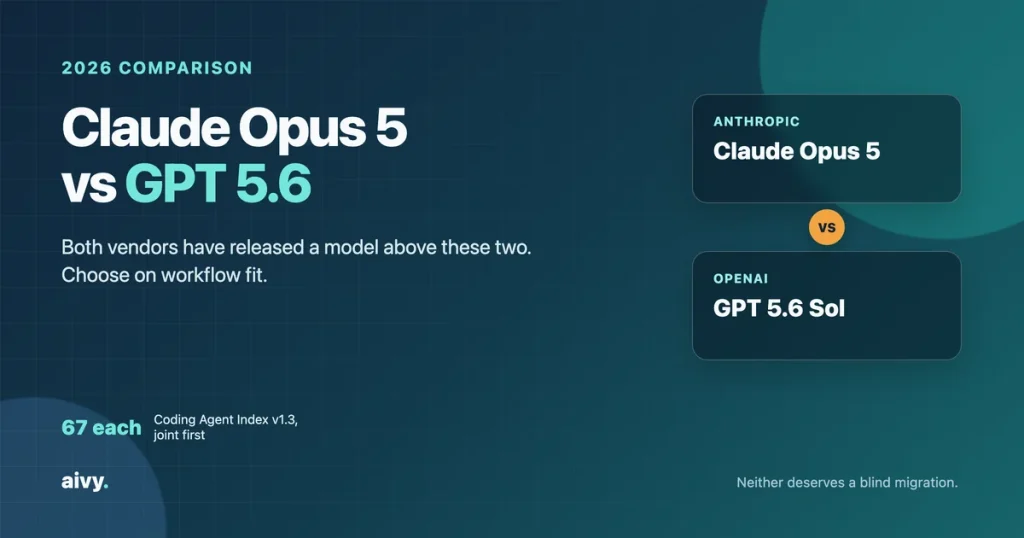
Claude Opus 5 and GPT 5.6 Sol arrived fifteen days apart, and for most of 2026 they were the pair most likely to surface when a team asked for the strongest available AI. Both vendors have since released a model above them. That sounds like a simple comparison. It is not. Both are frontier models, but they package capability differently: Anthropic positions Opus 5 as a practical default for careful, long running work, while OpenAI makes Sol the high end tier in a broader three model family.
The useful question is therefore not which model wins a launch chart. It is which one gives your team the most reliable result on the work you actually need to ship. Coding agent work, document analysis, browser research, pricing, plan access and the controls around a workflow all matter. Our broader GPT 5.6 vs Claude Fable 5 comparison handles the Fable question. This page deliberately answers the narrower Opus 5 versus GPT 5.6 question.
For Australian businesses, that distinction is especially useful. A model can look excellent in a benchmark and still be the wrong choice if its plan does not expose the relevant capability, the token bill makes the workflow uneconomic, or the task contains personal information that needs a proper privacy review. Before a pilot, use our AI readiness assessment to make the decision criteria explicit. This guide then turns verified independent evidence from each vendor into a practical choice.
Claude Opus 5 and GPT 5.6 at a glance
These are not directly symmetrical products. GPT 5.6 is a family, and Sol is its flagship tier. Claude Opus 5 is a single model with selectable effort levels. Keeping that distinction visible prevents a common bad comparison: matching the most expensive setting from one vendor against a cheaper or differently configured setting from the other.
Prices in Australian dollars at the RBA rate of 22 September 2026. Index row: Artificial Analysis v4.1.1 of 10 August 2026 for Opus 5 and GPT 5.6 Sol, and v4.3 for the newer models, read 22 September 2026, and 29 September for GPT 6.1 Sol, which replaces GPT 6 Sol here at the same price; the scales do not compare. Based on data from Artificial Analysis. Artificial Analysis does not endorse Aivy, this article or the conclusions drawn from its data.
Those numbers are a point in time signal, not a procurement decision. The Artificial Analysis Intelligence Index v4.1.1, read on 10 August 2026, aggregates nine evaluations, and its individual test mix will not mirror a particular codebase, customer service process or legal document set. Use it to narrow the shortlist, then consult our GPT 5.6 tier guide before you compare Sol with a lower cost OpenAI option.
Between these two, Opus 5 has the clearer independent edge on the 10 August index reading. For a workflow already built around Codex, ChatGPT Work or OpenAI’s Responses API, Sol remains the lower friction operational choice, though GPT 6 Astra now sits above it and is open to everyone.
The decision is less about a single winner
Vendor benchmark pages reward close reading. At launch Anthropic said Opus 5 was its new default on Claude Max and its strongest model on Claude Pro; Claude Code now defaults to Claude Opus 5.5 instead.
OpenAI said at Sol’s launch that it was its best coding model and could coordinate multiple agents in ultra mode, but on 3 September 2026 it released GPT 6 Astra as its most capable model for the hardest end to end work. Those statements describe product intent and are useful context, but they are not interchangeable independent tests.
The more durable comparison is between task shapes. Opus 5 is the sensible first candidate when the brief is ambiguous, the work needs careful checking, or you need an agent to keep the thread through several steps. Sol is a strong first candidate when the workflow is tool rich, benefits from programmatic tool calling, or needs to run inside the OpenAI stack already used by the team.
That is why a binary migration is usually premature. Start with the model already closest to the systems, tools and controls you operate. If you need help designing the pilot, our AI consulting team can turn the workload into a pass or fail measure. A model that saves ten minutes of prompting but needs twice the human review has not actually won.
Use evidence in this order
Use it to shortlist.
Use it to choose.
Use it to control risk.
Opus 5 vs GPT 5.6 for complex coding
For coding, the answer depends on whether you mean an assistant in an editor or an agent that can inspect, modify, test and hand over a repository. Artificial Analysis put GPT 5.6 Sol at 80 on its Coding Agent Index and Claude Opus 5 at xhigh in joint first place.
It has since recomposed that index as v1.3, where Claude Code with Opus 5 and Codex with Sol are joint first, both on 67. That makes both serious candidates for terminal and tool use work, but it does not guarantee the same result for every language, framework or repository.
Opus 5 remains a credible coding default. Anthropic describes its focus as verifying work and iterating carefully, and its launch material emphasises debugging, root cause analysis and longer horizon software work. For broader selection criteria, compare the models in our best AI coding assistant guide. If the codebase has unfamiliar conventions, a hard review bar or a human who wants the agent to explain its choices, that working style can matter more than a small leaderboard gap.
Opus 5 and GPT 5.6 Sol as read in July and August 2026. The Claude Opus 5.5 column is the Artificial Analysis reading of 22 September 2026, the Claude Sonnet 5.5 column that of 28 September 2026. Based on data from Artificial Analysis. Artificial Analysis does not endorse Aivy, this article or the conclusions drawn from its data.
Coding agent result snapshot
Artificial Analysis recorded Opus 5 at xhigh with Claude Code as joint first, with GPT 5.6 at Sol 80, Terra 77 and Luna 75 in Codex. On the v1.3 index that replaced it, Opus 5 and Codex with Sol are joint first, both on 67. These are harness specific results, not a promise for every repository. Read 30 July 2026.

Keep the trial concrete. Ask both models to resolve the same real but non sensitive issue, inspect the diff, run the test suite and document trade offs. Measure completion rate, review time, regression rate and total cost. A benchmark is useful for choosing the test candidates. It should not replace the test.
Research, documents and long running work
Both models are now positioned for more than chat. OpenAI highlights document work, browsing, computer use and programmatic tool calling. Anthropic highlights planning, verification and adaptive reasoning. The practical dividing line is not whether either can draft a proposal or summarise a spreadsheet. Both can. It is whether the workflow has enough guardrails to catch a plausible but wrong answer before it reaches a customer or a decision maker.
For a long internal analysis, Opus 5’s lead over Sol on the August index makes it a strong starting point within this pair. For a structured multi tool workflow inside OpenAI, Sol’s ecosystem features may remove more operational friction. If the work starts with documents, our document automation solutions page explains where extraction and review controls belong. In either case, require citations for externally sourced claims and preserve the inputs and outputs needed to audit what happened.
The three controls for long running work
Keep source material attached.
Name the human decision point.
Keep inputs and output history.
Anthropic released Claude Opus 5.5 on 22 September 2026, at $5.62 and $28.08 per million tokens on the RBA rate of that day, and its model documentation now suggests starting there for most workloads and moving up to Claude Fable 5.1 only for demanding reasoning and long running agentic work. Claude Opus 5 moves to the legacy list and stays available.
Since 22 September 2026, OpenAI also lists GPT 6 Sol at $2.81 and $14.04 per million tokens and GPT 6 Luna at $0.14 and $0.70, at the RBA rate of 22 September. OpenAI positions Sol for complex coding and agentic workflows and Luna as its most efficient model for focused, high volume tasks. There is no GPT 6 Terra. Claude Sonnet 5.5 and GPT 6.1 Sol now match the Sol rate, yet their cost per task is far apart.
Price and access are different decisions
At list price, Sol is now the cheaper of the two. OpenAI cut it by more than 20 per cent on 21 August 2026, so Sol costs $5.62 per million input tokens and $28.08 output, against $7.02 and $35.10 for Opus 5. Claude Opus 5.5, released on 22 September, lists at the same $5.62 and $28.08 as Sol, and Claude Sonnet 5.5, released on 28 September, at the same $2.81 and $14.04 as GPT 6 Sol and as GPT 6.1 Sol, released the next day.
That cut is promotional and runs at least until 21 November 2026, which makes it a weak basis for a long contract. For many teams, retries, overly long prompts and avoidable review work still outweigh the gap.
Output price ladder, per million tokens
Sources: Anthropic and OpenAI API pricing pages, read 22 September 2026, converted at the RBA rate of that day. Claude cache writes in the table are the five minute rate. Cache hits cost 10 per cent of input on most models, Claude Sonnet 5.5 included, 5 per cent on Claude Opus 5.5 and GPT 6.1 Sol, and 2.5 per cent on Claude Fable 5.1. GPT 6.1 Sol from its model page, read 29 September 2026. In the ladder, it takes the GPT 6 Sol bar at the same $14.04.
Access is a separate check. Sol is available through the OpenAI API, Codex and eligible ChatGPT plans, while Opus 5 is available on the Claude API and Anthropic’s products. Do not assume a consumer subscription includes the API model, a particular effort setting or the same data controls. Use our AI ROI calculator to estimate the business case before designing a production workflow.
The total cost is more than the token price
Token price is the visible part of the bill. The total cost of a model driven workflow also includes prompt design, tool calls, retries, human review, exceptions and the engineering required to make the process safe. A cheaper rate can lose if the result creates more review work. A more capable rate can lose if the task did not need that capability in the first place.
The current published numbers give a useful starting point, rather than a universal answer. Sol now lists $5.62 per million input tokens and $28.08 output, under Opus 5 at $7.02 and $35.10. On Artificial Analysis’ weighted Intelligence Index task suite, measured before the August cut, Opus 5 at max averaged $3.32 per task and Sol at max $1.75. That is a useful efficiency signal, not a completed cost model for your business.
Weighted cost per Intelligence Index task
Lower is better. Artificial Analysis weighted benchmark calculation on Intelligence Index v4.1.1, not a forecast for your own workflow. Read 10 August 2026.
On the rebuilt v4.3 index, read 22 September 2026
A different task suite, so these do not line up with the bars above. Converted at the RBA rate of that day and scaled to $10.71. GPT 6 Sol cost per task read 23 September 2026, Claude Sonnet 5.5 read 28 September 2026 and GPT 6.1 Sol read 29 September 2026.
For output heavy reports, analysis or generated artefacts, the list rate difference deserves attention. For input heavy tasks, it does not separate the two models. For code agents, the better efficiency measure is completed work that passes review, because a cheap failed attempt is still waste. Use the AI ROI calculator to frame the business case, then run the same task set on both models and record accepted outputs, human minutes and token use together.
What changes for Australian teams
Australian teams should start with the workflow, not the country label. If personal information moves across borders, the Privacy Act question is about the disclosure and safeguards around the whole system, not simply where a model company is headquartered. Our guide to AI data residency in Australia sets out the questions to ask. De identify inputs where possible, minimise retention, document the supplier path and get legal advice for regulated or high risk uses.
Then consider the operational layer. A Melbourne team using AI consulting to automate a real business process needs a clear fallback, monitoring and a human escalation point. The better model is the one that continues to meet those controls after the demo. That is usually a more valuable test than asking for one impressive answer in a blank chat window.
Australian deployment checklist
What crosses borders?
What happens on an error?
Who can stop the workflow?
Where Fable 5 fits in this decision
Claude Fable 5.1 is now Anthropic’s current premium model, and Fable 5 sits on the legacy list. That tier is relevant only when your evaluation says a higher priced Claude option could justify its additional capability over Opus 5. Keeping that choice separate protects the exact Opus 5 versus GPT 5.6 decision on this page and gives each next step a clear job.
The pricing tells the real story. Fable 5.1 lists the same $14.04 per million input tokens and $70.20 output as Fable 5, so the base rate has not moved. Only cache reads fell, by 75 per cent, to about $0.35. Anthropic’s headline saving of 25 to 45 per cent therefore appears only when your workload reuses cache. Without reuse, Fable 5.1 costs double Opus 5. We put that trade against GPT 6 Astra in a like for like cost per task read.
The v4.3 index, read on 22 September 2026, prices that step up. Claude Fable 5.1 at max with fallback scores 53.4 against 50.8 for Claude Opus 5 at max, and costs $10.71 per index task against $8.22. Its measured output runs at 65 tokens per second against 54. Claude Opus 5.5 at max now outscores both, on 57.6 at $8.40 a task, so the premium tier is no longer the top score.
Choose the comparison that matches your next decision
This exact model choice.
Cross vendor premium choice.Claude model guide
Selection within Claude.
How to choose Opus 5 or GPT 5.6
For new work, start with Claude Opus 5.5, Anthropic’s suggested starting point since 22 September 2026, first on the independent index at max effort. Of the two models on this page, Opus 5 scores higher. Start with Sol if your process already lives in the OpenAI stack or needs its tool and multi agent features, though GPT 6 Astra now leads OpenAI’s range. Consider Fable 5.1 only when Opus 5.5 at higher effort falls short. In every case, run a limited trial before changing a working workflow.
Make the trial fair. Use the same prompt, tools, data policy and human reviewer. Keep it small enough to reverse. Score each run on task completion, factual accuracy, useful initiative, time to acceptable output, token cost and the number of human interventions needed. After ten to twenty representative tasks, the answer will be more useful than a universal ranking.
For business automation, also test failure behaviour. What happens when a source is unavailable, a tool returns conflicting data, a record should not be changed or the model is uncertain? Our guide to choosing an AI automation agency covers the controls worth requiring. The safest model choice is often the one with the clearest route to pause, ask and hand the work back to a person.
How the model fits into your existing stack
A model choice is rarely made in an empty browser tab. Your existing prompts, APIs, observability, access controls and team habits shape the cost of moving. A technically stronger model can still be the worse first choice if it creates a new integration, a new approval path and a new set of unknowns for a workflow that already performs well.
If your team already has a working Claude process, start by asking whether Opus 5 improves the accepted result without changing the surrounding controls. If the team already uses Codex or the OpenAI API, start by testing Sol in that same operating context. A greenfield or mixed environment is the cleanest place to run a matched comparison, because neither model gets an advantage from the existing stack.
Integration fit is not an excuse to avoid testing the alternative. It is a way to make the test fair. Our AI solutions hub shows the surrounding workflow layer to consider. Keep the task, data policy, reviewer and success criteria constant, then measure whether the better result is worth any added operational complexity.
The practical choice for Australian teams
There is no need to turn this into a loyalty test. Of these two, Opus 5 held the stronger independent general intelligence score on the 10 August reading, while Sol lists the lower output rate, $28.08 against $35.10. Neither is its vendor’s flagship any more. GPT 5.6 Sol is a compelling option for teams that benefit from OpenAI’s coding, tool use and multi agent features. Both deserve respect. Neither deserves a blind migration.
A sensible Australian team keeps the first experiment narrow: for example, one internal research or code review workflow with de identified inputs, a named reviewer and a written pass criterion. If the new model produces better accepted work at a lower total cost, expand it. If it merely produces a more impressive demo, keep the system you already trust.
The practical rollout rule
One contained workflow.
Quality, time and total cost.
Keep human escalation.
If you want that pilot designed around a real process rather than a generic benchmark, Aivy is an AI automation agency for Australian teams. We can help define the task, controls and measures before you commit to a platform.
Claude Opus 5 vs GPT 5.6: frequently asked questions
Is Claude Opus 5 better than GPT 5.6?
On Artificial Analysis Intelligence Index v4.1.1, read on 10 August 2026, Opus 5 at max effort leads Sol at max reasoning, 63 to 61. On the newer v4.3 scale, read 22 September 2026, Opus 5 at max leads again, 50.8 to 47.0. Both are near the top on independent coding measures. Since then OpenAI has released GPT 6 Astra and Anthropic Claude Opus 5.5, so neither model here is its vendor’s top end. “Better” depends on the task and how each model is configured.
Which is better for coding, Opus 5 or GPT 5.6 Sol?
Between these two, the Artificial Analysis Coding Agent Index v1.3 puts Claude Code with Opus 5 and Codex with Sol joint first, both on 67. Test both on your codebase because benchmark performance does not capture your architecture, test coverage or review process.
Is Opus 5 cheaper than GPT 5.6 Sol?
No, not since 21 August 2026. Sol is $5.62 per million input tokens and $28.08 output, against $7.02 and $35.10 for Opus 5, though that Sol pricing is promotional until at least 21 November 2026. Claude Opus 5.5 lists at the same rate as Sol, and Claude Sonnet 5.5 at the same rate as GPT 6 Sol and GPT 6.1 Sol, $2.81 and $14.04. Total workflow cost also depends on retries, token use and human review.
What are Sol, Terra and Luna?
They are the three GPT 5.6 capability tiers. Sol is the flagship, while Terra and Luna are lower cost options. GPT 6 Sol and GPT 6 Luna, released on 22 September 2026, are separate models that reuse two of the names; there is no GPT 6 Terra. GPT 6.1 Sol, released on 29 September, upgrades GPT 6 Sol. This comparison is specifically Opus 5 versus GPT 5.6 Sol.
Should an Australian business switch models now?
Not purely because of a launch. Trial the alternative on a contained workflow, confirm the plan and data controls, then migrate only if it improves a measured business outcome.
Can I use ChatGPT or Claude subscriptions for API work?
Do not assume so. Consumer or team subscriptions and API billing are separate products with different access and data terms. Check the current plan documentation before committing a build.
Does the independent leaderboard settle the decision?
No. It is valuable evidence, but it tests a defined collection of tasks. Your own task success, review burden and system controls should decide a production rollout.
Where can I get help testing these models?
If you want a neutral pilot plan around a real process, book a short call with Aivy. We can help define the task, guardrails and measures before you commit to a platform.
Last updated: 30 September 2026. Model access, prices and rankings change quickly. Check the linked primary sources before making a production commitment.
Sources and further reading
Anthropic, Introducing Claude Opus 5: launch positioning, availability and API pricing.
OpenAI developer documentation, GPT 5.6 Sol: model and API reference.
Artificial Analysis, Opus 5 benchmark analysis: independent intelligence, coding agent and cost context for Opus 5.
Artificial Analysis, GPT 5.6 benchmarks: independent Sol, Terra and Luna coding agent and cost context.
METR, GPT 5.6 Sol pre deployment evaluation: independent evaluation context.
Simon Willison, GPT 5.6 family analysis: technical launch analysis and documentation notes.
Anthropic, Claude pricing: Claude Opus 5.5, Opus 5 and Fable 5.1 list and cache prices, read 22 September 2026, and Claude Sonnet 5.5 at 2 and 10 United States dollars, 0.20 for cache reads and 2.50 for cache writes, read 28 September 2026.
Claude Code, model configuration: Pro, Max, Team, Enterprise and API default to Claude Opus 5.5 from Claude Code 2.1.280.
OpenAI, API pricing: GPT 5.6 and GPT 6 list and cache prices, read 22 September 2026.
OpenAI, Introducing GPT 6.1 Sol: the upgrade to GPT 6 Sol released on 29 September 2026 at 2 and 10 United States dollars per million tokens, cached input at 0.10.
Artificial Analysis, reading of 29 September 2026: GPT 6.1 Sol index score and cost per task at max. Based on data from Artificial Analysis, which does not endorse, validate or approve any of the analysis or conclusions drawn from it.
Source: Artificial Analysis (artificialanalysis.ai) : Intelligence Index v4.3, cost per task and output speed by reasoning effort, read 22 September 2026. Based on data from Artificial Analysis. Artificial Analysis does not endorse Aivy, this article or the conclusions drawn from its data.
Model token prices and costs per task converted at the Reserve Bank of Australia rate of 22 September 2026, one Australian dollar buying 0.7123 United States dollars. Seat and subscription prices converted at 1 USD = 1.42 AUD, 11 August 2026.



