
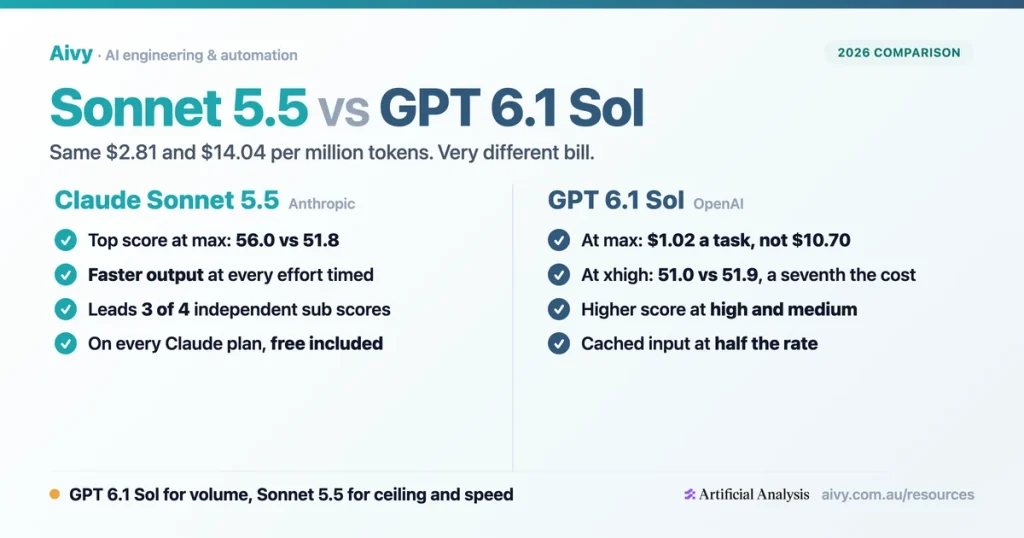
Claude Sonnet 5.5 arrived on 28 September 2026 and GPT 6.1 Sol a day later, at the same list price: $2.84 per million input tokens and $14.22 output. That makes it look like a pure quality call. It is not. Once you count what each model spends to finish a task, the two bills split wide apart.
At Aivy I help Australian teams choose the models they pay for by the finished job rather than the rate card, so a launch week means a calculator and the independent leaderboards open side by side. Both vendors pitch their model as the sensible everyday choice below their flagship. The independent numbers back each of them, for different jobs.
Below you will find what each model costs, the cost per task at every effort setting, independent scores and speeds, what each vendor claims and an effort table you can act on, plus a short note on Gemini 4 Argon, the third model at this price. It sits beside our Sonnet 5.5 vs Opus 5.5 guide.
Claude Sonnet 5.5 and GPT 6.1 Sol side by side
Claude Sonnet 5.5 is the second model in Anthropic's Claude 5.5 family, a faster, lower cost complement to Claude Opus 5.5 for everyday work and bug fixing. GPT 6.1 Sol is OpenAI's upgrade to GPT 6 Sol, which OpenAI says nearly matches GPT 6 Astra on agentic coding and professional work at a fifth of Astra's token prices.
What kind of work would run on this model?
Are you starting new work or keeping a pipeline that already runs?
Claude Sonnet 5.5 at high
- Claude Sonnet 5.5, faster to start and to write from xhigh down
- Check GPT 6.2 Sol too, now at the same price
Test GPT 6.2 Sol at medium
- GPT 6.2 Sol, the successor, at Sonnet's list price
- GPT 6.1 Terra if the job is simple enough for half the rate
GPT 6.1 Sol at medium, then plan the move
- GPT 6.1 Sol, the cheapest per task of this pair at every effort
- Run a matched pilot on GPT 6.2 Sol before you switch
Price Claude Opus 5.5 at xhigh first
- Claude Opus 5.5 reached Sonnet 5.5's max score for less per task
- Sonnet 5.5 at max only if speed of output decides it
A shortlist from the readings on this page, October and November 2026. GPT 6.1 Sol has since been superseded, so run a matched pilot before you commit.
The models at this price point, as we read them
Claude Sonnet 5.5
Anthropic, 28 September 2026
- API price
- $2.84 / $14.22
- Index v4.3
- 56.0 at max, 46.8 at high
- Per task
- $7.77 at max, $1.26 at high
- Best for
- Fast replies where someone is waiting
GPT 6.1 Sol
OpenAI, 29 September 2026
- API price
- $2.84 / $14.22
- Index v4.3
- 51.8 at max, 50.2 at high
- Per task
- $1.03 at max, $0.45 at high
- Status
- Superseded by GPT 6.2 Sol on 17 November
GPT 6.2 Sol
OpenAI, 17 November 2026
- API price
- $2.97 / $14.83, Sonnet's rate
- Index
- 57 at max, newer reading, 17 November
- Per task
- $1.50 at max
- In ChatGPT
- Work and Codex, Plus and above
Claude Opus 5.5
Anthropic
- API price
- $5.69 / $28.45
- Index v4.3
- 57.6 at max, 56.0 at xhigh
- Per task
- $4.92 at xhigh
- Best for
- The hard case Sonnet 5.5 at max would cost more on
Gemini 4 Argon
Google, 30 September 2026
- API price
- $2.84 / $14.22 introductory, then $5.69 / $28.45
- Index v4.3
- 52.6 at High
- Per task
- $2.30
- Access
- Paid Gemini API since 13 October
GPT 6.1 Terra
OpenAI, 26 October 2026
- API price
- $1.42 / $7.11, half of Sol
- Best for
- Simpler volume work below Sol
Gemini 3.8 Flash
Google
- Index v4.3
- 40.9 at High
- Per task
- $4.96
- Access
- The Gemini you could use in October
API price per million tokens, input / output, in Australian dollars at the RBA rate of 26 October 2026; GPT 6.2 Sol at the rate of 17 November 2026. Index and cost per task: Artificial Analysis, read 26 October 2026 (v4.3) and 17 November 2026 for GPT 6.2 Sol, which is not on the same scale. Based on data from Artificial Analysis, which does not endorse, validate or approve any of the analysis or conclusions drawn from it.
Our guide to GPT 6 Astra, Sol and Luna covers the rest of OpenAI's range. Past price, the two models differ on limits, defaults and where they run.
| Limits and access | Claude Sonnet 5.5 | GPT 6.1 Sol |
|---|---|---|
| Context window | 1M tokens | 1.05M tokens |
| Maximum output | 128K tokens | 128K tokens |
| Effort settings | low, medium, high, xhigh, max | low, medium, high, xhigh, max |
| Default effort on the API | high | medium |
| In the apps at launch | Claude.ai on web, iOS and Android, free plan included | ChatGPT Work and Codex on Plus, Pro, Business, Enterprise and Edu |
| Data residency on the vendor API | Global, or United States only | United States or European Union |
Defaults matter. OpenAI runs GPT 6.1 Sol at medium effort unless you ask for more, while the Claude Platform runs Sonnet 5.5 at high, and Claude Code and the Claude apps start it at medium. Compare two bills only at matching settings. Our guide to which Claude model fits which job covers the rest of Anthropic's range.
Sonnet 5.5 vs GPT 6.1 Sol price per million tokens
Both APIs bill in United States dollars, and both list the same standard rates: $2.84 per million input tokens and $14.22 per million output tokens, converted at the Reserve Bank rate of 26 October 2026. Batch processing halves both. Since 26 October OpenAI also sells GPT 6.1 Terra at half these rates, $1.42 and $7.11.
| Price and billing | Claude Sonnet 5.5 | GPT 6.1 Sol |
|---|---|---|
| Released | 28 September 2026 | 29 September 2026 |
| Input, per million tokens | $2.84 | $2.84 |
| Output, per million tokens | $14.22 | $14.22 |
| Cached input read, per million | $0.14 | $0.14 |
| Cache write, per million | $3.56 (five minutes), $5.69 (one hour) | $3.56 (30 minutes), $7.11 (12 hours) |
| Prompts over 272K input tokens | Standard rate | Input and cache at 2x, output at 1.5x, for the whole request |
One row in that table moves real money. Once a prompt passes 272,000 input tokens, OpenAI doubles the input rate and raises output by half for the whole request, while Anthropic bills Sonnet 5.5 at its standard rate across the full one million tokens.
The cache line used to differ. Since 7 October Anthropic charges $0.14 per million cached input tokens on Sonnet 5.5, as GPT 6.1 Sol does, so a long agent run rereading the same context pays the same per token on either card; the gap is in tokens spent. Our AI ROI calculator weighs that spend against the hours it saves.
Google's figure needs care. Gemini 4 Argon launched at the same $2.84 and $14.22 as an introductory price, and Google says $5.69 and $28.45 will apply once that period ends, the Opus 5.5 rate. Treat any launch rate as temporary, and our guide to paying for Claude in Australia covers the billing side for Anthropic.
Cost per task: where the same price stops being the same bill
A rate card says what a token costs; the bill depends on how many tokens a model burns to finish the job, and the effort setting moves that number most. Artificial Analysis publishes a cost per task beside every score on its Intelligence Index v4.3, the closest independent figure I have. Every reading below is from 26 October 2026.

At max, Sonnet 5.5 costs $7.77 a task and GPT 6.1 Sol $1.03, roughly a seventh. At xhigh it is $2.86 against $0.56, about a fifth. At high, $1.26 against $0.45. Sonnet 5.5 burns far more tokens per task at every setting. For finance automation that runs thousands of small steps a month, that multiplier is most of the story.
Lower down, the gap narrows but holds. At medium, Sonnet 5.5 costs $0.69 a task against $0.30, and at low, which Artificial Analysis now scores for Sonnet 5.5 too, $0.49 against $0.19. Below Sol, GPT 6.1 Terra cuts the bill again.
What would a month of tasks have cost at high effort?
Move the sliders. This multiplies the October cost per index task, with no human review or tool fees.
- Claude Sonnet 5.5 at high
- $1,386
- GPT 6.1 Sol at high
- $495
- GPT 6.1 Sol at max
- $1,133
- Monthly gap at high
- $891
Starting values: 1,000 tasks a month, one in ten rerun. Artificial Analysis, read 26 October 2026, at the RBA rate of that day. An index task is not your task, so price a pilot before you budget. An estimate, not a quote.
Cost per task is only half the comparison, because the two models do not score the same at each setting. The fair test is what each one charges to reach a given score. For the same sums at the top of the market, our GPT 6 Astra vs Opus 5.5 comparison runs them against OpenAI's flagship.
Sonnet 5.5 vs GPT 6.1 Sol benchmark scores, measured independently
On the Artificial Analysis Intelligence Index v4.3, Sonnet 5.5 at max scores 56.0 against 51.8 for GPT 6.1 Sol at max, a lead of 4.2 points. Only Claude Opus 5.5 at max, 57.6, scored higher on the leaderboard when I read it. Below max the order changes, and that is the part most comparisons skip.
At xhigh the two nearly tie, 51.9 against 51.0. At high GPT 6.1 Sol leads, 50.2 against 46.8, and at medium by 7.0 points. So GPT 6.1 Sol at max, 51.8 for $1.03, beats Sonnet 5.5 at high on both counts: a higher score and a lower bill. Our Claude vs ChatGPT comparison covers the same trade in the apps.
Opus 5.5 changes the top of this picture. If you need a score of 56, Opus 5.5 at xhigh reaches it for about two thirds of Sonnet 5.5 at max. So paying for Sonnet 5.5 at max rarely makes sense on cost alone; its stronger argument is speed, covered in the next section.
| Sub score at max effort | Claude Sonnet 5.5 | GPT 6.1 Sol |
|---|---|---|
| Terminal Bench 4.0, Artificial Analysis run | 63.6% | 56.1% |
| SciCode | 61.0% | 54.2% |
| Humanity's Last Exam | 55.0% | 52.9% |
| Long context reasoning | 82.7% | 83.0% |
The sub scores point the same way: Sonnet 5.5 leads on terminal work, scientific coding and Humanity's Last Exam, while GPT 6.1 Sol edges long context reasoning. The Coding Index has no score yet for either model, so neither wins on coding by that measure.
Output speed and waiting time at each effort
Speed is the clearest win for Sonnet 5.5. In the Artificial Analysis reading of 26 October, Sonnet 5.5 produced about 141 tokens a second at max against 69 for GPT 6.1 Sol, roughly twice as fast, and it stayed ahead at every effort where both were timed. Speed readings move from day to day, so treat these as a snapshot.
Output speed is not the whole wait. At max, Sonnet 5.5 took longer to its first answer token, because it reasons for longer before replying. From xhigh down it was much quicker to start. For a customer service chatbot, high effort is where that speed shows.
| Seconds to first answer token | Claude Sonnet 5.5 | GPT 6.1 Sol |
|---|---|---|
| max | about 462 | about 367 |
| xhigh | about 30 | about 163 |
| high | about 12 | about 74 |
This matters more for interactive work than for overnight batches. GPT 6.1 Sol Ultrafast reached the API on 8 October at six times the Standard rate, $17.07 in and $85.34 out per million tokens, with United States and European data residency. Our Claude Code vs Codex guide covers the two agents these models mostly run in.
What Anthropic and OpenAI claim for their own models
Both launch posts carry vendor benchmarks, and they barely overlap. Anthropic compares Sonnet 5.5 with GPT 6 Sol, the previous version, while OpenAI reports GPT 6.1 Sol mostly as gains over GPT 6 Sol, GPT 6 Astra and Claude Opus 5.5. So this section keeps each claim with its vendor and puts no two figures on the same scale.
GPT 6.2 Sol, released on 17 November, keeps GPT 6.1 Sol's price; our GPT 6.2 Astra vs Claude Fable 5.2 comparison includes its independent scores.
Each vendor's launch claims, kept apart
Anthropic on Claude Sonnet 5.5
- Terminal Bench 4.0
- Sonnet 5.5 at 70.6%, against 10.3% for Sonnet 5
- FrontierCode 1.1, main set
- Sonnet 5.5 at 52.1% at xhigh and 46.2% at max, against 49.3% for GPT 6 Sol
- GDPval AA v2.1, Elo
- Sonnet 5.5 at 1844, against 1487 for GPT 6 Sol
OpenAI on GPT 6.1 Sol
- DeepSWE v1.1
- GPT 6.1 Sol matches GPT 6 Astra at roughly a fifth of the cost
- AutomationBench 1.0.6
- GPT 6.1 Sol 2.2 points above Opus 5.5 at medium effort, at roughly a third of the cost
- OSWorld 2.0, offline set
- GPT 6.1 Sol within 2.1 points of GPT 6 Astra at max, at roughly a seventh of the cost
What each vendor flags
- Anthropic
- Some GPT 6 Sol figures may predate an OpenAI fix to image understanding
- OpenAI
- Its competitor figures come from public reports
- Both
- Neither post tests the other company's new model
Anthropic, Claude Sonnet 5.5 announcement; OpenAI, GPT 6.1 Sol announcement. Vendor figures, kept apart because the two posts use different tests and comparison models.
Read those as each vendor's best foot forward, which is why the independent index carries more weight here. If you are choosing a coding assistant, run both on your own repository.
One footnote matters for coders. Anthropic says Sonnet 5.5 scored lower on FrontierCode at max than at xhigh because it more often ran Claude Code's review skill across many subagents, twice causing a timeout or edits beyond the task. More effort is not always better; how Claude Code works shapes the result as much as the model does.
Which effort to run on Sonnet 5.5 and GPT 6.1 Sol
My default for GPT 6.1 Sol would be medium, its API default, moving up when the task needs more care; even at xhigh it costs less per task than Sonnet 5.5 at high. For Sonnet 5.5 I would start at high, the Claude Platform default, and think twice before max.
Index score and cost per task at each effort
max effort
- Claude Sonnet 5.5
- 56.0, $7.77 a task
- GPT 6.1 Sol
- 51.8, $1.03 a task
- What I would do
- Sonnet 5.5 leads, but Opus 5.5 at xhigh scores 56.0 for $4.92
xhigh effort
- Claude Sonnet 5.5
- 51.9, $2.86 a task
- GPT 6.1 Sol
- 51.0, $0.56 a task
- What I would do
- Near tie: GPT 6.1 Sol for about a fifth of the cost
high effort
- Claude Sonnet 5.5
- 46.8, $1.26 a task, its API default
- GPT 6.1 Sol
- 50.2, $0.45 a task
- What I would do
- GPT 6.1 Sol scores higher for about a third of the cost
medium effort
- Claude Sonnet 5.5
- 40.8, $0.69 a task
- GPT 6.1 Sol
- 47.8, $0.30 a task, its API default
- What I would do
- GPT 6.1 Sol, clearly: higher score, lower bill
low effort
- Claude Sonnet 5.5
- 35.9, $0.49 a task
- GPT 6.1 Sol
- 42.1, $0.19 a task
- What I would do
- GPT 6.1 Sol for short, repetitive steps at volume
Based on data from Artificial Analysis (artificialanalysis.ai), which does not endorse, validate or approve any of the analysis or conclusions drawn from it. Index and cost per task read 26 October 2026, converted at 1 Australian dollar to 0.7031 United States dollars that day. Defaults are each vendor's API default.
Read the tabs in turn and GPT 6.1 Sol wins on cost per score at every setting from low to xhigh. Sonnet 5.5 earns its place elsewhere: the higher score at max, faster output and Anthropic's tooling. For an online retailer writing thousands of product descriptions, GPT 6.1 Sol at medium is the obvious place to start.
A mixed setup is often the sensible answer. Route bulk extraction and drafting to GPT 6.1 Sol, keep Sonnet 5.5 at high for interactive work, and send the rare hard case to Opus 5.5. For document automation on invoices and forms, that split keeps the high volume steps on the cheaper bill.
Gemini 4 Argon: the third model at the same token price
Google announced Gemini 4 Argon on 30 September, a day after GPT 6.1 Sol, at the same introductory token price as both models here. It first went to trusted cyber defenders through Google's Fairwind Program, then opened to developers on the paid Gemini API on 13 October. Our Argon and GPT 6 Astra comparison covers it since.
Artificial Analysis scored it 52.6 at High, between Sonnet 5.5 and GPT 6.1 Sol at max, for $2.30 a task on 26 October. Google's own figures, such as 77.9 per cent on DeepSWE v1.1 and 51.3 per cent on AutomationBench, are the vendor's. At the same launch price, Google's Gemini 4 Carbon now outranks GPT 6 Astra.
The cheaper Gemini on that reading, Gemini 3.8 Flash, scored 40.9 at High for $4.96 a task. Our Claude vs Gemini comparison covers where Google fits for Australian teams.
Sonnet 5.5 and GPT 6.1 Sol in the Claude and ChatGPT apps
In the apps the launches differ more. Anthropic says anyone can chat with Claude using Sonnet 5.5 on Claude.ai, on the web, iOS and Android, which includes the free plan. OpenAI put GPT 6.1 Sol in ChatGPT Work and Codex for Plus, Pro, Business, Enterprise and Edu users, and said at launch it was not yet in the regular chat.
| Plan | Australian price | Sonnet 5.5 or GPT 6.1 Sol |
|---|---|---|
| Claude Free | $0 | Sonnet 5.5 in chat |
| Claude Pro | $30.00 a month | Sonnet 5.5, plus Claude Code |
| Claude Max 5x | $199.99 a month | Sonnet 5.5, plus Claude Code |
| ChatGPT Go | $13.00 a month | Not in OpenAI's launch list for GPT 6.1 Sol |
| ChatGPT Plus | $29.99 a month | GPT 6.1 Sol in ChatGPT Work and Codex |
| ChatGPT Pro 100 | $154.99 a month | GPT 6.1 Sol in ChatGPT Work and Codex |
Neither launch post makes the new model the app default, so check your model picker. In Claude Code, Sonnet 5.5 needs version 2.1.284 or later, and the sonnet alias points to it on the Anthropic API; on Amazon Bedrock and Google Cloud it still resolves to Sonnet 4.5, so set the full model name.
Our guide to what Codex is covers the OpenAI side. On price the entry plans sit level, Claude Pro and ChatGPT Plus at about $30 a month in Australia's App Store, and for seats rather than single subscriptions, our business plans comparison covers Team, Business and Microsoft Copilot.
What Sonnet 5.5 vs GPT 6.1 Sol means for Australian businesses
The first question is where the data goes. On Anthropic's API, Sonnet 5.5 inference runs either globally or, for a 10 per cent premium, only in the United States, with workspace data stored there. OpenAI lists United States and European residency for GPT 6.1 Sol, also at a 10 per cent premium. Neither lists Australia.
That matters under the Privacy Act 1988. The OAIC's guidance on Australian Privacy Principle 8 says that before an organisation discloses personal information to an overseas recipient, it must take reasonable steps to ensure the recipient does not breach the principles, and it can stay accountable if the recipient does. Our Privacy Act playbook covers what to ask a vendor.
Before client data goes through either model
Tick what your team has already settled.
Settle the data questions before price decides anything.
Close. Close the gaps before a production rollout.
Ready for a matched pilot on your own work.
Drawn from the OAIC's APP 8 guidelines and the vendor documents cited on this page. A starting point, not legal advice.
Retention is the other lever. Anthropic says Sonnet 5.5 is available with zero data retention, as Opus 5.5 and Sonnet 5 are. OpenAI's launch post does not cover retention for GPT 6.1 Sol, so check your own agreement. For an accounting practice sending client files through either model, those terms decide more than the score.
The last point is budget. Both APIs bill in United States dollars, so the Australian figure moves with the exchange rate even when the list price does not, while the ratio between the two models stays put. Teams in Melbourne or Sydney running agents at volume should budget on cost per task from a pilot, not on the rate card.
Sonnet 5.5 vs GPT 6.1 Sol: frequently asked questions
Is Claude Sonnet 5.5 better than GPT 6.1 Sol?
At max effort it scores higher on the Artificial Analysis index, 56.0 against 51.8. At xhigh the two nearly tie, and at high and medium GPT 6.1 Sol scores higher. Sonnet 5.5 also produced output faster in the readings of 26 October.
How much do Sonnet 5.5 and GPT 6.1 Sol cost in Australia?
Both list at $2.84 per million input tokens and $14.22 per million output tokens, converted at the Reserve Bank rate of 26 October 2026. Since Anthropic's cut of 7 October, cached input costs $0.14 on both. GPT 6.2 Sol, which replaced GPT 6.1 Sol on 17 November, keeps the same rate in United States dollars.
Which is cheaper per task, Sonnet 5.5 or GPT 6.1 Sol?
GPT 6.1 Sol, at every effort Artificial Analysis measured for both. At max it costs $1.03 a task against $7.77 for Sonnet 5.5, and at xhigh $0.56 against $2.86, on the reading of 26 October 2026.
Which is better for coding, Sonnet 5.5 or GPT 6.1 Sol?
Neither had an Artificial Analysis Coding Index score when we read it. Sonnet 5.5 leads that site's Terminal Bench 4.0 run at max, 63.6 per cent against 56.1, but the vendors' coding claims use different tests, so try both on your own code.
Can I use GPT 6.1 Sol on the free ChatGPT plan?
Not at launch. OpenAI made it available to Plus, Pro, Business, Enterprise and Edu users in ChatGPT Work and Codex, and said it was not yet in Chat. Its successor, GPT 6.2 Sol, is also in ChatGPT Work and Codex on Plus and above. Developers can call both through the OpenAI API.
Is Sonnet 5.5 on the free Claude plan?
Yes. Anthropic says anyone can chat with Claude using Sonnet 5.5 on Claude.ai, on the web, iOS and Android. It has not said whether Sonnet 5.5 is the default model in the apps, so check the model picker in your account.
Can Australian businesses keep data in Australia with these models?
Not through either vendor's own API: Anthropic offers global or United States inference for Sonnet 5.5, and OpenAI lists United States and European residency for GPT 6.1 Sol. Through a cloud provider, ask which regional endpoints carry the model.
Which effort should I use on Sonnet 5.5 and GPT 6.1 Sol?
Start GPT 6.1 Sol at medium and Sonnet 5.5 at high, and raise effort only when the output falls short. At xhigh and max, check cost per task first, because that is where the gap between the two is widest. Our Claude effort level guide shows when to switch model instead.
Where does Gemini 4 Argon fit?
Google announced it on 30 September at the same introductory token price, and Artificial Analysis scored it 52.6 at High. After a restricted start for trusted cyber defenders, it opened to developers on the paid Gemini API on 13 October 2026.
The bottom line on Sonnet 5.5 and GPT 6.1 Sol
Equal rate cards hide very different bills. GPT 6.1 Sol was the better volume default: it scores higher than Sonnet 5.5 at high and medium, nearly ties it at xhigh, and costs less per task at every setting measured. Sonnet 5.5 earns its place for the higher ceiling at max, faster output or Anthropic's tooling.
| Job | Where I would start | Why |
|---|---|---|
| Ticket triage, drafts, extraction | GPT 6.1 Sol at medium, now GPT 6.2 Sol | Lowest cost per task at a higher score |
| Live chat and interactive work | Claude Sonnet 5.5 at high | Quicker to start and to write |
| The hardest escalations | Claude Opus 5.5 at xhigh | Sonnet 5.5's max score for less per task |
If I were setting this up for a Sydney support team, I would put ticket triage and draft replies on the Sol model at medium, keep Sonnet 5.5 at high for the live chat, and send the hardest escalations to Opus 5.5, then measure all three on real tickets. Our AI consulting team runs that kind of review.
The Artificial Analysis readings move as models are measured again, so check the date beside each figure before you rely on it. If you would like a second opinion on which workloads belong on which model, you can book a time with us whenever it suits you.
Last updated: 17 November 2026
Sources
- Anthropic, introducing Claude Sonnet 5.5: positioning against Claude Opus 5.5, list and cache rates, the launch benchmark table with its footnotes on FrontierCode and GPT 6 Sol, zero data retention and the default effort in the apps, Claude Code and the Claude Platform (published 28 September 2026).
- Anthropic, pricing: Claude Sonnet 5.5 at 2 and 10 United States dollars per million tokens, cache reads at 0.10 and cache writes at 2.50 for five minutes and 4 for one hour, and Claude Opus 5.5 at 4 and 20 (read 26 October 2026; Sonnet 5.5 rates unchanged on 17 November 2026).
- Anthropic, Claude Sonnet 5.5 model page: context window, maximum output, cache write rate, default effort and release date (read 1 October 2026).
- Anthropic, data residency: global or United States inference, the 10 per cent premium for United States only inference and the United States workspace geography (read 1 October 2026).
- Anthropic, Claude Sonnet page: Claude Sonnet 5.5 open to anyone on Claude.ai, on the web, iOS and Android (read 1 October 2026).
- Claude Code, model configuration: the minimum Claude Code version for Sonnet 5.5 and what the sonnet alias resolves to on each provider (read 1 October 2026).
- OpenAI, introducing GPT 6.1 Sol: positioning against GPT 6 Astra, the vendor results on DeepSWE, AutomationBench and OSWorld, availability in ChatGPT Work and Codex, API rates and the Ultrafast option (published 29 September 2026).
- OpenAI, GPT 6.1 Sol model page: context window, maximum output, effort settings and default, cache rates, the surcharge above 272K input tokens and United States and European data residency (read 1 October 2026).
- OpenAI, GPT 6.1 Terra model page: list price of 1 and 5 United States dollars per million tokens for the model OpenAI released on 26 October 2026 (read 26 October 2026).
- OpenAI, API pricing: the 12 hour cache write for GPT 6.1 Sol, added on 20 October 2026, and its Ultrafast rates (read 22 October 2026); GPT 6.2 Sol at 2 and 10 United States dollars per million tokens (read 17 November 2026).
- OpenAI, Ultrafast mode: Ultrafast for GPT 6.1 Sol open to all API users, with United States and European data residency (read 22 October 2026).
- OpenAI, introducing GPT 6.2 Astra and Sol: release of GPT 6.2 Sol on 17 November 2026, in ChatGPT Work and Codex on Plus and above (read 17 November 2026).
- Google, Gemini 4 Argon: restricted rollout through the Fairwind Program, the introductory rate and the rate after it, and the vendor results on DeepSWE and AutomationBench (published 30 September 2026).
- Google, build with Gemini 4 Argon: Gemini 4 Argon on the paid tier of the Gemini API in Google AI Studio and Android Studio, and in AI Studio and Antigravity for Google AI Ultra, from 13 October 2026 (read 17 November 2026).
- Artificial Analysis, Intelligence Index v4.3 leaderboard: index scores, cost per task, output speed and time to first token by effort for Claude Sonnet 5.5 and GPT 6.1 Sol, plus Claude Opus 5.5, Gemini 4 Argon and Gemini 3.8 Flash, read through the Artificial Analysis API on 26 October 2026; the sub scores and the empty Coding Index, read on 1 October 2026; GPT 6.2 Sol and Claude Sonnet 5.5 at max on the current index, read 17 November 2026. Source: Artificial Analysis (artificialanalysis.ai). Tables and charts using this data are based on data from Artificial Analysis, which does not endorse, validate or approve any of the analysis or conclusions drawn from it.
- App Store Australia, ChatGPT listing: monthly subscription prices for ChatGPT Go, Plus and Pro 100 (read 1 October 2026).
- App Store Australia, Claude listing: monthly subscription prices for Claude Pro and Claude Max 5x (read 1 October 2026).
- OAIC, Australian Privacy Principle 8 guidelines: reasonable steps before disclosing personal information to an overseas recipient, and accountability for that recipient (read 1 October 2026).
- Reserve Bank of Australia, exchange rates: every United States dollar figure from October converted at 1 Australian dollar to 0.7031 United States dollars, 26 October 2026; the GPT 6.2 Sol and Sonnet 5.5 rates and costs of 17 November at 0.6742, the rate of that day.
- Index, cost and speed figures reflect the Artificial Analysis reading of 26 October 2026, the sub scores that of 1 October, and move as models are measured again. Benchmark figures attributed to Anthropic, OpenAI or Google are the vendor's own.



