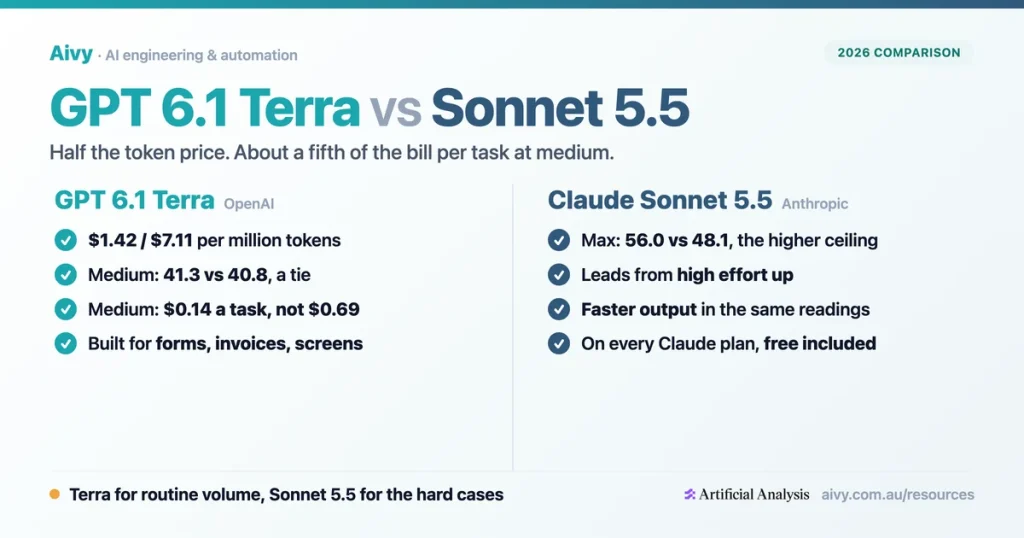
OpenAI released GPT 6.1 Terra on 26 October 2026 at $1.42 per million input tokens and $7.11 per million output tokens, half the list price of Claude Sonnet 5.5. That makes GPT 6.1 Terra vs Claude Sonnet 5.5 the obvious question for anyone running models at volume: is the cheaper model good enough for the work you actually send it?
At Aivy I set up AI workflows for Australian businesses, and most of what they run is not hard reasoning. It is invoices, forms, support replies and screens to click through, thousands of times a month. For that kind of work the model that is good enough at the lowest bill wins, so I compared the two at every effort setting rather than only at their best.
Below you will find the rate cards, independent scores and cost per task at each effort, what each vendor claims, where the cheaper GPT 6 Luna and Claude Haiku 5.5 fit, and what it all means for data held in Australia. If you are weighing Sonnet 5.5 against OpenAI’s middle model instead, our Sonnet 5.5 vs GPT 6.1 Sol comparison covers that pairing.
Key takeaways
- GPT 6.1 Terra lists at $1.42 in and $7.11 out per million tokens, half the $2.84 and $14.22 of Claude Sonnet 5.5.
- At low and medium effort the two score almost the same on the Artificial Analysis index, and Terra costs about a fifth as much per task.
- From high effort up Sonnet 5.5 pulls ahead, 56.0 against 48.1 at max, while costing up to 13 times as much per task.
- Past high effort, GPT 6.1 Sol at high beats Terra at max on score and cost. OpenAI’s budget model is GPT 6 Luna, not Terra.
GPT 6.1 Terra and Claude Sonnet 5.5 side by side
GPT 6.1 Terra replaces GPT 5.6 Terra as OpenAI’s fast, efficient model for visual reasoning, computer use and clearer writing, and it sits between GPT 6 Luna and GPT 6.1 Sol. OpenAI’s whole line up is laid out in our Astra, Sol and Luna explainer. Claude Sonnet 5.5 is Anthropic’s middle model, below Claude Opus 5.5, aimed at well scoped everyday work.
| Side by side | GPT 6.1 Terra | Claude Sonnet 5.5 |
|---|---|---|
| Released | 26 October 2026 | 28 September 2026 |
| Input, per million tokens | $1.42 | $2.84 |
| Output, per million tokens | $7.11 | $14.22 |
| Cached input read, per million | $0.07 | $0.14 |
| Cache write, per million | $1.78 (30 minutes) | $3.56 (5 minutes) |
| Prompts over 272K input tokens | Input and cache at 2x, output at 1.5x, for the whole request | Standard rate up to 1M tokens |
| Context window | 1.05M tokens | 1M tokens |
| Maximum output | 128K tokens | 128K tokens |
| Input types | Text and image | Text and image |
| Effort settings | none, low, medium, high, xhigh, max | low, medium, high, xhigh, max |
| Default effort on the API | medium | high |
| Data residency on the vendor API | United States or European Union | Global, or United States only |
Sources: OpenAI, GPT 6.1 Terra announcement and model page; Anthropic, pricing page, models overview and data residency docs. Converted at 1 Australian dollar to 0.7031 United States dollars, Reserve Bank rate of 26 October 2026.
The rows that move a real bill are the cache and long prompts. Both charge 5 per cent of their input rate for cached reads, so Terra keeps its half price edge there. Past 272,000 input tokens, though, OpenAI doubles Terra’s input rate and raises output by 50 per cent across the entire request, while Sonnet 5.5 stays at its standard rate up to a million tokens.
Watch the default effort before you compare invoices. Terra runs at medium on the API unless told otherwise; Sonnet 5.5 runs at high on the Claude Platform and at medium in the Claude apps. A team that leaves both on their defaults is comparing Terra at medium with Sonnet at high, a different fight. For choosing between Opus, Sonnet and Haiku, see our model guide.
GPT 6.1 Terra vs Sonnet 5.5 price per million tokens
OpenAI bills GPT 6.1 Terra in United States dollars, as Anthropic does Sonnet 5.5, so I have converted each price at the Reserve Bank’s rate for 26 October 2026. The chart adds GPT 6.1 Sol, Claude Haiku 5.5 and GPT 6 Luna as reference points: Terra costs half as much as the middle pair and ten times as much as the budget pair.
List price per million tokens: GPT 6.1 Terra, Claude Sonnet 5.5 and three reference models
Lower is cheaper. Each panel is scaled to its own largest bar. Standard rates, no batch or cache discounts. Sources: OpenAI model pages and Anthropic pricing page, read 27 October 2026. Converted at 1 Australian dollar to 0.7031 United States dollars, Reserve Bank rate of 26 October 2026.
Output, per million tokens
Input, per million tokens
Half price is OpenAI’s own claim, and against Sonnet 5.5 it holds on input, output and cached reads alike. Against Haiku 5.5 and Luna, Terra is ten times dearer per token, which is why it is not OpenAI’s answer to Haiku. To weigh that rate gap against the hours a workflow saves, try our AI ROI calculator.
Four details sit in the fine print. Batch and Flex processing halve Terra’s rates, as the Batch API does for Sonnet 5.5. Pinning processing to a region adds 10 per cent on both. Fast mode doubles Terra’s price. And the 272,000 token surcharge applies to Terra, Sol and Luna alike, so it only matters if you feed whole document sets into a single request.
Terra vs Sonnet 5.5 at the same effort: independent scores
Artificial Analysis now scores GPT 6.1 Terra at all five effort settings, so the two can be compared like for like. When I read its Intelligence Index v4.3 on 27 October 2026, Terra edged Sonnet 5.5 at low and medium and fell behind from high upwards. Our explainer on Claude effort levels covers what each setting changes.
Intelligence Index v4.3 at the same effort setting, axis 0 to 100
Higher is better. Both models measured at each of the five effort settings. Source: Artificial Analysis, Intelligence Index v4.3, read 27 October 2026.

At low the two score 36.2 and 35.9, at medium 41.3 and 40.8: a tie, for practical purposes. At high Sonnet 5.5 leads by 2.9 points, at xhigh by 6.5 and at max by 7.9, where its 56.0 was beaten only by Claude Opus 5.5 at max on the whole leaderboard. The ceiling belongs to Sonnet 5.5; the middle of the range is shared.
One reading surprised me. With reasoning switched off, Terra scored 33.5 and cost more per task than at low effort, so I see little reason to run it that way. If you mostly meet these models inside the chat apps rather than the API, see how the two apps stack up in our Claude vs ChatGPT guide.
Cost per task: Terra’s gap is wider than its rate card
A rate card prices a token; a bill prices a finished job, and that depends on how many tokens each model spends. Artificial Analysis records what each test run cost alongside the score it earned. At the same effort, Sonnet 5.5 costs between five and thirteen times as much as Terra per task, far more than the twofold gap in list price.
Cost per index task at the same effort setting, in Australian dollars
Lower is cheaper. Bars scaled to the largest, $7.77. Source: Artificial Analysis, cost per task on the Intelligence Index v4.3, read 27 October 2026. Converted at 1 Australian dollar to 0.7031 United States dollars, Reserve Bank rate of 26 October 2026.
So Terra is not only cheaper per token; it also spends fewer tokens to finish. At medium, Terra’s own default, it costs $0.14 a task against $0.69 for Sonnet 5.5, about a fifth. For finance and accounting automation that pushes thousands of invoices a month through a model, that gap is most of the business case.
The gap widens with effort. At max, Sonnet 5.5 costs $7.77 a task against $0.57 for Terra, roughly thirteen times as much, for 7.9 more index points. Whether those points are worth paying for depends on the job, which is why I price a pilot on real documents before choosing, the way our document automation projects start.
Which effort to run GPT 6.1 Terra and Sonnet 5.5 at
My default for Terra would be low or medium, where it matches Sonnet 5.5 for a fraction of the bill, and I would stop at high. Above that, GPT 6.1 Sol at high scores 50.2 for $0.45 a task, more than Terra at max for less money, so stepping up a model beats turning up the dial.
| Effort | Terra index | Terra per task | Sonnet 5.5 index | Sonnet 5.5 per task | What I would do |
|---|---|---|---|---|---|
| low | 36.2 | $0.08 | 35.9 | $0.49 | Terra: same score for about a sixth of the cost |
| medium | 41.3 (default) | $0.14 | 40.8 | $0.69 | Terra, the default for routine work |
| high | 43.9 | $0.19 | 46.8 (default) | $1.26 | Sonnet 5.5 leads by 2.9 points; Terra for volume, Sonnet 5.5 where errors cost |
| xhigh | 45.4 | $0.28 | 51.9 | $2.86 | Sonnet 5.5, or GPT 6.1 Sol at high instead of Terra |
| max | 48.1 | $0.57 | 56.0 | $7.77 | Sonnet 5.5 for the ceiling; skip Terra here |
Based on data from Artificial Analysis (artificialanalysis.ai), which does not endorse, validate or approve any of the analysis or conclusions drawn from it. Index and cost per task read 27 October 2026. Defaults are each vendor’s API default. Converted at 1 Australian dollar to 0.7031 United States dollars, Reserve Bank rate of 26 October 2026.
On the Anthropic side, high is where I would begin with Sonnet 5.5, its Claude Platform default, where it beats Terra by 2.9 points and costs $1.26 a task. That suits work where a wrong answer is expensive, such as draft advice to clients at an accounting practice. For the routine steps in the same workflow, Terra at medium does the job for $0.14.
Speed matters less here. In the same readings Terra produced about 91 tokens a second at every effort and Sonnet 5.5 between 104 and 141, so Sonnet writes faster. Terra started answering sooner at medium, though, in about 1.5 seconds against 3.1. For a customer service chatbot, that first second is what people notice.
What OpenAI and Anthropic claim for Terra and Sonnet 5.5
Each launch post carries its own benchmarks, and they rarely test the same thing. OpenAI compares Terra with GPT 5.6 Terra, GPT 6 Astra and Claude Opus 5.5; Anthropic compares Sonnet 5.5 with Sonnet 5 and GPT 6 Sol. Neither tests the other’s new model, so the table keeps every figure with the vendor that reported it. Google’s 28 October post for Gemini 4 Carbon does the same, setting Carbon beside GPT 6 Astra in its own table.
| Benchmark | Whose figure | What the vendor reports |
|---|---|---|
| Agents’ Last Exam | OpenAI | Terra at medium 15 points above GPT 5.6 Terra at about a third of the cost, and on par with GPT 6 Astra |
| Agents’ Last Exam, max effort | OpenAI | About 9x lower cost per task than Claude Opus 5.5 |
| Terminal Bench 4.0 | OpenAI | Terra at 50.3% at max, against 21.5% for GPT 5.6 Terra |
| Terminal Bench 4.0 | Anthropic | Sonnet 5.5 at 70.6%, against 10.3% for Sonnet 5 |
| OSWorld 2.1 | OpenAI | Terra at medium above the best score of GPT 5.6 Terra; no figure published |
| OSWorld 2.1 | Anthropic | Sonnet 5.5 at 80.1%, against 57.0% for Sonnet 5 |
| Factual errors, internal test | OpenAI | 16.7% at low effort, from 53.6% for GPT 5.6 Terra; 4.3% at max |
Sources: OpenAI, GPT 6.1 Terra announcement, 26 October 2026; Anthropic, Claude Sonnet 5.5 announcement, 28 September 2026. Vendor figures from separate test setups, not comparable as a head to head.
The two Terminal Bench 4.0 rows look comparable and are not quite: each vendor ran its own model in its own setup. Even so, OpenAI says plainly that GPT 6.1 Sol and GPT 6 Astra remain the better choice for the most complex coding. If coding is your main load, our Claude Code vs Codex comparison is the better guide.
Where OpenAI sounds most confident is computer use: filling forms, reading screens and acting on them, which is where I see a lot of small business automation heading. Terra is available in Codex as well as ChatGPT Work, and our explainer on what Codex in ChatGPT does covers how that agent works.
The budget tier: GPT 6 Luna and Claude Haiku 5.5
If price is the only test, neither model in this comparison is the cheapest. GPT 6 Luna and Claude Haiku 5.5 both list at $0.14 in and $0.71 out per million tokens, a tenth of Terra, and Haiku 5.5 charges more once a prompt passes 100,000 tokens. Our roundup of AI document automation tools shows where cheap models usually sit in a stack.
| Model and effort | Index score | Cost per task |
|---|---|---|
| GPT 6 Luna, medium | 29.9 | $0.02 |
| Claude Haiku 5.5, low | 29.5 | $0.03 |
| Claude Haiku 5.5, medium | 34.5 | $0.07 |
| GPT 6 Luna, xhigh | 34.6 | $0.06 |
| GPT 6.1 Terra, low | 36.2 | $0.08 |
| GPT 6 Luna, max | 38.1 | $0.10 |
| Claude Haiku 5.5, xhigh | 41.2 | $0.18 |
| GPT 6.1 Terra, medium | 41.3 | $0.14 |
Ordered by score. Based on data from Artificial Analysis (artificialanalysis.ai), which does not endorse, validate or approve any of the analysis or conclusions drawn from it. Intelligence Index v4.3 and cost per task, read 27 October 2026. Converted at 1 Australian dollar to 0.7031 United States dollars, Reserve Bank rate of 26 October 2026.
Per task, the gap shrinks. Terra at low scores 36.2 for $0.08, above Luna at xhigh and Haiku 5.5 at medium for about the same money. Near a score of 41, Terra at medium costs $0.14 against $0.18 for Haiku 5.5 at xhigh. Luna and Haiku 5.5 only win clearly on work simple enough that a score near 30 does the job.
That makes the split practical: Luna or Haiku 5.5 for classification, routing and short extraction, Terra for documents and screens that need judgement, Sonnet 5.5 for the hard cases. If you are not sure which bucket your tasks fall into, our free business audit maps them.
GPT 6.1 Terra and Sonnet 5.5 in ChatGPT and Claude plans
In the apps the launches differ. OpenAI put GPT 6.1 Terra in ChatGPT Work and Codex for Plus, Pro, Enterprise and Edu users, and its launch post does not mention the free plan or Go. Anthropic, for its part, opened Sonnet 5.5 to every Claude.ai user, free accounts included, across web, iOS and Android.
| Plan | Australian price | GPT 6.1 Terra or Sonnet 5.5 |
|---|---|---|
| ChatGPT Go | $13.00 a month | Not named in OpenAI’s launch post |
| ChatGPT Plus | $29.99 a month | GPT 6.1 Terra in ChatGPT Work and Codex |
| ChatGPT Pro 100 | $154.99 a month | GPT 6.1 Terra in ChatGPT Work and Codex |
| Claude Free | $0 | Sonnet 5.5 in chat |
| Claude Pro | $30.00 a month | Sonnet 5.5 |
| Claude Max 5x | $199.99 a month | Sonnet 5.5 |
Monthly prices as shown in the Australian App Store listings on 27 October 2026; buying on the web can cost a different amount. Availability from OpenAI’s GPT 6.1 Terra announcement and Anthropic’s Claude Sonnet page.
OpenAI also says a plan stretches further with Terra: the same usage allowance covers more tasks than with GPT 5.6 Terra, and substantially more than with GPT 6.1 Sol or GPT 6 Astra. For someone hitting limits on Plus, moving routine work to Terra may delay an upgrade. Our guide to ChatGPT plans in Australia sets out the tiers.
Seat buyers should note one gap: OpenAI’s launch post names Enterprise and Edu but not Business, so check your workspace before you plan around Terra. Our business plans guide sets out what Business, Team and Copilot seats include in Australia.
What GPT 6.1 Terra vs Sonnet 5.5 means for Australian businesses
For most Australian teams the first question is where data is processed. OpenAI offers GPT 6.1 Terra with data residency in only two places, the United States and Europe. It does offer an Australian region, but that region stores data without processing it, and Terra is not supported there. Anthropic runs Sonnet 5.5 globally by default or, for 10 per cent more, only in the United States.
Neither vendor’s own API processes these models in Australia. If you reach Sonnet 5.5 through Amazon Bedrock or Google Cloud, the endpoint sets the region, so confirm with that provider that an Australian one carries the model.
Overseas processing is allowed, but it carries duties. Under Australian Privacy Principle 8, as the OAIC explains it, you take reasonable steps before personal information leaves the country and may answer for how the overseas recipient handles it. An invoice carries names, addresses and bank details, so this applies squarely to Terra’s headline use. Our Privacy Act playbook for AI lists what to ask.
Retention is the other lever. Anthropic offers Sonnet 5.5 with zero data retention; OpenAI grants zero data retention on approval and by default keeps abuse monitoring logs for up to 30 days. Teams in Sydney or Melbourne running invoices through either model should get those terms in writing before they go live.
GPT 6.1 Terra vs Claude Sonnet 5.5: frequently asked questions
Is GPT 6.1 Terra better than Claude Sonnet 5.5?
Not overall. At low and medium effort they score about the same on the Artificial Analysis index, 41.3 against 40.8 at medium. From high effort up Sonnet 5.5 leads, reaching 56.0 at max against 48.1, so it is the stronger model when the work is hard.
How much does GPT 6.1 Terra cost in Australia?
About $1.42 per million input tokens and $7.11 per million output tokens, after converting OpenAI’s United States dollar price at the Reserve Bank’s 26 October 2026 rate. Cached input costs $0.07 per million, and Batch and Flex halve the rates.
Which is cheaper per task, GPT 6.1 Terra or Sonnet 5.5?
Terra, at every effort setting Artificial Analysis measured. At medium it costs $0.14 a task against $0.69 for Sonnet 5.5, and at max $0.57 against $7.77, because Terra costs less per token and also uses fewer tokens.
Is GPT 6.1 Terra OpenAI’s version of Claude Haiku?
No. Terra costs ten times as much per token as Claude Haiku 5.5. OpenAI’s model at Haiku’s price is GPT 6 Luna, at $0.14 and $0.71 per million tokens, and Terra sits between Luna and GPT 6.1 Sol.
Can I use GPT 6.1 Terra on the free ChatGPT plan?
The launch post lists Plus, Pro, Enterprise and Edu and says nothing about the free plan, so look for Terra in your own account before counting on it. Developers can reach it directly through the OpenAI API.
Which is better for coding, Terra or Sonnet 5.5?
For hard coding, Sonnet 5.5, and OpenAI itself says GPT 6.1 Sol and GPT 6 Astra beat Terra on the most complex tasks. On Terminal Bench 4.0, OpenAI reports 50.3 per cent for Terra at max and Anthropic 70.6 per cent for Sonnet 5.5, from separate runs.
Does GPT 6.1 Terra or Sonnet 5.5 process data in Australia?
No, not on either vendor’s own API. Terra’s residency options are the United States and Europe, while Sonnet 5.5 runs globally or, at a 10 per cent premium, only in the United States. A cloud provider may differ, so check its regions first.
Which effort should I use on GPT 6.1 Terra?
Start at medium, the API default, and drop to low for simple extraction. If the output falls short at high, try GPT 6.1 Sol at high before pushing Terra to xhigh or max, because Sol scores more there for less per task.
The bottom line on GPT 6.1 Terra and Sonnet 5.5
Half the rate card turns into a fifth of the bill or less. At low and medium effort GPT 6.1 Terra scores as well as Claude Sonnet 5.5, which makes it the better default for routine work at volume. Sonnet 5.5 keeps the higher ceiling, worth paying for on the hard cases. If your team is in Melbourne, we can test both on your own work.
Run GPT 6.1 Terra at medium for invoices, forms, extraction and computer use, keep Claude Sonnet 5.5 at high where a mistake costs more than the bill, and move up to GPT 6.1 Sol rather than pushing Terra past high.
If I were setting up accounts payable for a wholesaler, I would put invoice capture and data entry on Terra at medium, send anything that fails validation to Sonnet 5.5 at high, and compare both against a month of real invoices before committing. That side by side trial is a usual first step in our AI consulting work.
One caution: Terra launched on 26 October, and scores get revised as Artificial Analysis measures again, so treat these figures as a starting point and test on your own documents. When you are ready to plan the move, book a call with us and we will map your workloads to a model.
Last updated: 27 October 2026
Sources
OpenAI, introducing GPT 6.1 Terra. Positioning against GPT 5.6 Terra, the half price claim, the vendor results on Agents’ Last Exam, MMMU Pro, OSWorld 2.1, factual errors and Terminal Bench 4.0, the note on complex coding, availability in ChatGPT Work and Codex, and plan usage. Published 26 October 2026.
OpenAI, GPT 6.1 Terra model page. Rates, cache rates, the surcharge above 272K input tokens, Batch, Flex, Fast mode and regional processing, context window, maximum output and effort settings. Retrieved 27 October 2026.
OpenAI, GPT 6 Luna model page. Rates used as a reference point. GPT 6.1 Sol rates from its own model page. Retrieved 27 October 2026.
OpenAI, data controls. United States and European data residency for GPT 6.1 Terra, the Australian region for storage only, zero data retention on approval and 30 day abuse monitoring logs. Retrieved 27 October 2026.
Anthropic, introducing Claude Sonnet 5.5. Positioning, the launch benchmark table, the default effort in the Claude apps and zero data retention. Published 28 September 2026.
Anthropic, pricing. Rates and cache rates for Claude Sonnet 5.5, Haiku 5.5 and Opus 5.5, standard pricing across the 1M context, the Batch discount and the 10 per cent premium for United States only inference. Retrieved 27 October 2026.
Anthropic, models overview. Context window, maximum output and default effort for Claude Sonnet 5.5. Retrieved 27 October 2026.
Anthropic, data residency. Global or United States inference and endpoint based regions on Amazon Bedrock and Google Cloud. Retrieved 27 October 2026.
Anthropic, Claude Sonnet page. Claude Sonnet 5.5 open to anyone on Claude.ai, on the web, iOS and Android. Retrieved 27 October 2026.
Artificial Analysis, Intelligence Index v4.3 leaderboard. Index scores, cost per task, output speed and time to first answer for GPT 6.1 Terra at every effort, Claude Sonnet 5.5, GPT 6.1 Sol, GPT 6 Luna and Claude Haiku 5.5, read through the Artificial Analysis API on 27 October 2026. Source: Artificial Analysis (artificialanalysis.ai).
Tables and charts using this data are based on data from Artificial Analysis (artificialanalysis.ai), which does not endorse, validate or approve any of the analysis or conclusions drawn from it.
App Store Australia, ChatGPT listing. Monthly prices for ChatGPT Go, Plus and Pro 100. Read 27 October 2026.
App Store Australia, Claude listing. Monthly prices for Claude Pro and Claude Max 5x. Read 27 October 2026.
OAIC, Australian Privacy Principle 8 guidelines. Reasonable steps before disclosing personal information to an overseas recipient, and accountability for that recipient. Retrieved 27 October 2026.
Reserve Bank of Australia, exchange rates. Every United States dollar figure converted at 1 Australian dollar to 0.7031 United States dollars, 26 October 2026.
Index, cost and speed figures reflect Artificial Analysis as read on 27 October 2026 and move as models are measured again. Benchmark figures attributed to OpenAI or Anthropic are the vendor’s own.