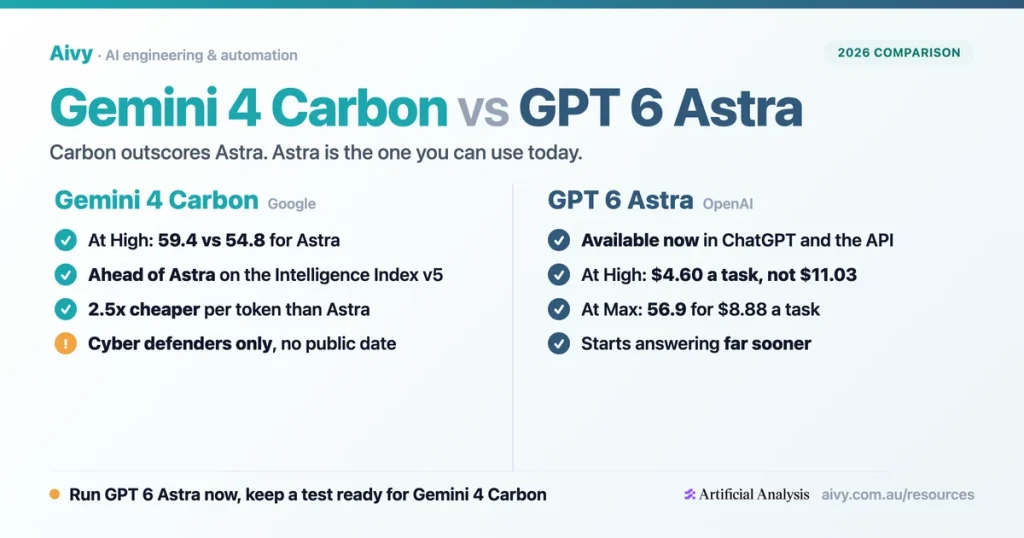
Google released Gemini 4 Carbon on 28 October 2026 and it went straight to the top of the Artificial Analysis index, ahead of every OpenAI model. That makes Gemini 4 Carbon vs GPT 6 Astra the obvious question this week. The catch is access: only a small group of cyber defenders can use Carbon, while Astra is already in ChatGPT and on the API.
At Aivy I help Australian businesses pick and run AI models, and most of them want two answers: which model is strongest, and which one they can actually put to work this month. With Carbon those answers point in different directions, so I have kept the scores, the bills and the access question side by side rather than blending them.
Below you will find independent scores at the same effort, cost per task, speed, list rates converted to Australian dollars, what each vendor reports on cyber security, and the ChatGPT and Google AI plans that matter to Australian buyers. If you want the Google model you can buy today instead, our Argon and Astra comparison covers that pairing in full.
Key takeaways
- Gemini 4 Carbon cannot be bought today: Google has opened it only to selected cyber defenders and Fairwind partners, with no date for anyone else.
- At High effort Carbon scores 59.4 on the Artificial Analysis Intelligence Index v5, 4.6 points above GPT 6 Astra’s 54.8.
- Astra costs 2.5 times as much per token, yet finishes an index task for $4.60 at High against $11.03 for Carbon.
- Astra at Max reaches 56.9 for $8.88 a task, the closest you can get to Carbon this month.
Gemini 4 Carbon vs GPT 6 Astra at a glance
Carbon is Google’s new frontier model, released two weeks after Gemini 4 Argon and pitched at cyber security and very long engineering tasks that Google says can run for days. Astra is OpenAI’s most capable model, out since 3 September, with Sol and Luna below it, as laid out in our Astra, Sol and Luna explainer.
| At a glance | Gemini 4 Carbon | GPT 6 Astra |
|---|---|---|
| Released | 28 October 2026 | 3 September 2026 |
| Who can use it | Restricted cyber defenders and Fairwind partners | Available ChatGPT, API, Azure, Bedrock |
| Input, per million tokens | $2.84 introductory, then $5.69 | $14.22 |
| Output, per million tokens | $14.22 introductory, then $28.43 | $71.08 |
| Cached input, per million | 95% off input: $0.14, then $0.28 | $1.42 |
| Long prompts | Not covered in the announcement | Over 272K input tokens: 2x input, 1.5x output |
| Context and output limits | Not stated in the announcement | 1.05M context, 128K output |
| Effort settings measured | High only | Low, medium, high, xhigh, max |
| Intelligence Index v5 | 59.4 at High | 54.8 at High, 56.9 at Max |
Sources: Google, Gemini 4 Carbon announcement; OpenAI, GPT 6 Astra announcement and model page; Artificial Analysis, read 28 October 2026. Converted at 1 Australian dollar to 0.7034 United States dollars, Reserve Bank rate of 28 October 2026.
Two rows decide this comparison before any benchmark does. The first is access, covered next. The second is that Google has published far less detail on Carbon than OpenAI has on Astra: no context window, no output limit and no long prompt pricing yet. Our AI readiness assessment helps you list what your own use case needs to know.
Who can use Gemini 4 Carbon and GPT 6 Astra today
Google is opening Carbon in stages. This week a subset of cyber defenders gets it, then trusted partners in its Fairwind Program, and developers, businesses and consumers only after Google has gathered feedback and tuned its guardrails. The announcement gives no date and does not name the Gemini app, Google AI plans or Workspace. Google is also taking part in the United States government’s voluntary pre release testing.
| How you get it | Gemini 4 Carbon | GPT 6 Astra |
|---|---|---|
| Chat app | Not yet not named for the Gemini app or Google AI plans | Yes Plus in ChatGPT Work and Codex; Pro in chat too |
| Developer API | Not yet developers are on the waiting list Google calls soon | Yes OpenAI API, billed per token |
| Cloud platforms | Not yet no cloud date given | Yes Microsoft Azure and Amazon Bedrock |
| Business workspaces | Not yet Workspace not mentioned | Yes Business and Enterprise; Enterprise admins switch it on |
| Who has it this week | A subset of cyber defenders, then trusted Fairwind partners | Anyone on an eligible plan or API account |
Sources: Google, Gemini 4 Carbon announcement, 28 October 2026; OpenAI, GPT 6 Astra announcement and ChatGPT Help Center, read 28 October 2026.
Only GPT 6 Astra can be used by an ordinary Australian business today. Argon followed the same path, from cyber defenders on 30 September to Google AI Pro and Ultra on 13 October, so a similar wait for Carbon is a hint, not a promise.
If your team wants a Google model now, Gemini 4 Argon is the one on sale, and our Argon and Opus 5.5 guide sets out where it fits.
Planning around a model you cannot reach is how projects stall, which is why our AI consulting work starts from what is available on the day.
Intelligence Index v5: Carbon leads at the same effort
Artificial Analysis updated its index to version 5 just before Carbon arrived, so these scores do not compare with older v4.3 charts. When I read it on 28 October, Carbon was measured only at High effort. The fair pairing is therefore Carbon at High against Astra at High, and Astra’s other settings are labelled so you can see the whole range.
Intelligence Index v5 by effort setting, axis 0 to 100
Higher is better. Gemini 4 Carbon has only been measured at High, so the like for like pair is Carbon High against Astra High (in bold). Gemini 4 Argon added as the Google model you can use today. Source: Artificial Analysis, Intelligence Index v5, read 28 October 2026.

At the same effort Carbon leads by 4.6 points, 59.4 against 54.8. Even with Astra at Max, its highest setting, Carbon stays 2.5 points ahead. Claude Opus 5.5 at max sits between them on 58.4, and our Astra and Opus 5.5 comparison covers that duel.
One gap in the data matters. Artificial Analysis has not yet published Carbon’s coding or agentic index, where Astra scores 77.1 and 48.2 at High, so there is no independent sub score to set side by side. Until there is, the headline index is the only like for like measure.
Cost per task: Astra finishes the job for less
A list rate prices a token, while a bill prices finished work. Artificial Analysis records what it cost to run its whole index, so you can see the price of each score. Here the order flips: Carbon is cheaper per token, yet Astra at High finished a task for $4.60 against $11.03 for Carbon, well under half the cost.
Cost per index task by effort setting, in Australian dollars
Shorter bars cost less, with the longest at $11.03. Artificial Analysis prices Gemini 4 Carbon and Argon at Google’s later rate of $5.69 in and $28.43 out per million, not the introductory rate. Source: Artificial Analysis, cost to run the Intelligence Index v5, read 28 October 2026. Converted at 1 Australian dollar to 0.7034 United States dollars, Reserve Bank rate of 28 October 2026.
The reason is volume. Astra’s rates are exactly 2.5 times Carbon’s on input and output alike, so the bills above imply Carbon used roughly six times as many tokens as Astra at High. That is the price of a model built to keep working. Before you budget either one, run your own volumes through our AI ROI calculator.
Two caveats cut the other way. At Google’s introductory rate the same tokens would cost about $5.51 a task, my arithmetic rather than a measurement. And Astra at Max costs $8.88, 19 per cent less than Carbon, for 2.5 fewer points. For finance and accounting automation at volume, that difference compounds every month.
Gemini 4 Carbon price per million tokens against Astra
Both companies quote their API rates in American currency; every figure here is translated into Australian dollars at the Reserve Bank’s 28 October 2026 rate. Carbon launches at the same introductory rate as Argon, $2.84 per million input tokens and $14.22 per million output tokens, rising to $5.69 and $28.43 afterwards. Astra lists at $14.22 and $71.08.
List rate per million tokens: GPT 6 Astra against Gemini 4 Carbon
Shorter bars cost less; output and input are drawn on separate scales. Standard pay as you go rates only. Google gives no end date for Carbon’s introductory pricing. Sources: Google’s Gemini 4 Carbon announcement and OpenAI’s GPT 6 Astra model page, read 28 October 2026. Converted at 1 Australian dollar to 0.7034 United States dollars, Reserve Bank rate of 28 October 2026.
Output, per million tokens
Input, per million tokens
For Argon, Google’s pricing page ends the introductory rate on 30 November 2026. Carbon is not on that page yet and its post gives no end date, so I would budget at the later rate. Cached input on Carbon is 95 per cent cheaper than fresh input, a large saving for document automation that sends the same instructions over and over.
Astra has small print too. Send it a prompt longer than 272,000 tokens and the whole call is billed at double input and one and a half times output, whereas Batch and Flex jobs come in at half price. Google has said nothing yet about long prompts on Carbon, so ask before you plan agents that read whole document sets, of the kind in our guide to AI agents.
Which Astra effort to run while Carbon is locked
Since Carbon cannot be bought, the useful question is how close Astra gets and at what price. The table sets each Astra effort against Carbon at High. High is where I would start most teams: it scores 54.8 for $4.60 a task, and Carbon at the same effort costs 2.4 times as much for its extra points.
| Astra effort | Index v5 | Cost per task | Carbon High ahead by | Carbon costs | Where I would use it |
|---|---|---|---|---|---|
| Medium | 51.5 | $3.88 | 7.9 points | 2.8x | Routine drafting, support replies, extraction |
| High | 54.8 | $4.60 | 4.6 points | 2.4x | The default for most business work |
| Xhigh | 55.3 | $5.20 | 4.1 points | 2.1x | Harder analysis where a small lift is worth paying for |
| Max | 56.9 | $8.88 | 2.5 points | 1.2x | Long, high stakes jobs; closest to Carbon’s score |
Based on data from Artificial Analysis (artificialanalysis.ai), which does not endorse, validate or approve any of the analysis or conclusions drawn from it. Index v5 and cost per task read 28 October 2026. Carbon has only been measured at High. Converted at 1 Australian dollar to 0.7034 United States dollars, Reserve Bank rate of 28 October 2026.
Medium is worth testing for routine drafting and replies, where $3.88 a task adds up slowly. Max earns its price on long, careful jobs such as reviewing contracts for a professional services firm, where a missed clause costs more than the model.
For coding work, our Claude Code and Codex comparison covers the agent around the model.
Speed and wait time: what Artificial Analysis measured
Both models have speed figures in the same reading, which was not the case for Argon at launch. At High effort Carbon wrote faster once it started, about 100 tokens a second against 63 for Astra, but it took far longer to begin answering, about 97 seconds against 38.
Measured speed and wait at High effort
Median output speed and median time to the first answer token. Source: Artificial Analysis, read 28 October 2026.
100 tok/s
Gemini 4 Carbon output speed
63 tok/s
GPT 6 Astra output speed
97 s
Carbon wait to first answer
38 s
Astra wait to first answer
For background jobs that long wait barely matters; for a person watching a screen it does. Astra at Medium began answering in about 4 seconds, which suits a customer service chatbot far better. Treat Carbon’s speed as provisional, since it was timed on a restricted launch with very little traffic.
Astra also offers a Fast mode on the API, about twice the speed for twice the price. In Codex, OpenAI pairs Astra with a faster computer use harness, which our explainer on Codex in ChatGPT describes.
Cyber benchmarks: what Google and OpenAI each report
Cyber security is the ground both launches fight on. Google calls Carbon state of the art across finding, exploiting and patching flaws. OpenAI rates Astra as Critical for cyber capability under its own Preparedness Framework. Unusually, two tests appear in both posts, though neither company ran the other’s model and the conditions were not the same.
| Benchmark | Gemini 4 Carbon, per Google | GPT 6 Astra, per OpenAI | What to keep in mind |
|---|---|---|---|
| SEC bench Pro (finding vulnerabilities) | 88.2% | 85.4% | Same name, separate runs by each vendor |
| ExploitGym (turning flaws into exploits) | 54.8% | 42.4% | Google ran without guardrails; OpenAI without the 6 hour limit |
| CWE bench (patching) | 71.0% | Not reported | Google’s figure only |
| ExploitBench | Not reported | 100% | OpenAI’s figure only, without production safeguards |
| SRE Bench (reverse engineering) | Not reported | 88.0% in one attempt | OpenAI’s figure only |
Sources: Google, Gemini 4 Carbon announcement, 28 October 2026; OpenAI, GPT 6 Astra announcement, 3 September 2026. Vendor figures from separate test setups, not a head to head.
Carbon posts the higher number on both shared tests, which tells you the direction rather than the size of any gap. The bigger difference is policy. Google withholds the whole model while it tunes guardrails; OpenAI ships Astra but refuses advanced tasks such as proof of concept exploits, with wider access through its Daybreak programme. Our ranking of secure coding assistants shows what that means for code.
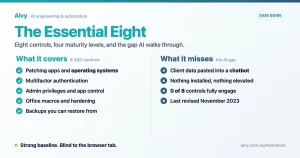
For most Australian businesses the practical step is defensive. Use whichever model you can reach to review code and patch known weaknesses, and keep that work tied to the controls you already report against, such as the Essential Eight.
Coding, agents and safety claims from each launch
Outside security the two posts barely share a yardstick. Google leans on trust: Carbon makes about half as many unsupported claims as Argon, and serious misalignment alerts in its own coding teams fell by almost 80 per cent. OpenAI leans on computer use and office work. Each row below is labelled with the company that published it.
| Claim | Whose figure | What the vendor reports |
|---|---|---|
| WebDev Arena | Carbon at 1768 Elo, 89 points up, fourth on the board | |
| Secure code, internal test | More than twice Argon’s success rate | |
| Gray Swan indirect prompt injection | 0.0% of attacks succeeded, against 0.7% for Argon | |
| Terminal Bench 4.0, cheating | 0.0% successful cheating, with attempts down to 0.4% | |
| Terminal Bench 4.0, accuracy | OpenAI | Astra at 57.9% |
| DeepSWE v1.1 | OpenAI | Astra at 74.1% |
| OSWorld 2.0, computer use | OpenAI | Astra at 72.6% |
| Internal hallucination test | OpenAI | Astra at 4.2%, against 12.2% for GPT 5.6 Sol |
Sources: Google, Gemini 4 Carbon announcement; OpenAI, GPT 6 Astra announcement. Each vendor’s own figures, not comparable as a head to head.
The two Terminal Bench 4.0 rows measure different things: Google reports how often Carbon cheated, OpenAI how often Astra succeeded. Neither vendor tests the other’s model. For a wider view of which assistants suit developers here, see our AI coding assistant guide.
Carbon’s 0.0 per cent against prompt injection is the claim I would test first once it opens. Agents that read emails and web pages are the main target of those attacks, a risk that grows as teams move from chat to agentic AI.
GPT 6 Astra and Gemini plans at Australian prices
In ChatGPT, where Astra appears depends on the plan. Plus includes it in ChatGPT Work and Codex but not the main chat; the Pro tiers add it in chat as GPT 6 Pro. Google’s plans include Argon today, and nothing has been said about Carbon. Our guide to ChatGPT plans in Australia breaks the tiers down further.
| Plan | Australian price | What it gives you here |
|---|---|---|
| ChatGPT Go | $13.00 a month | No GPT 6 Astra |
| ChatGPT Plus | $29.99 a month | GPT 6 Astra in ChatGPT Work and Codex, not the main chat |
| ChatGPT Pro 100, 200 and 500 | $154.99 to $769.99 a month | GPT 6 Astra in chat, ChatGPT Work and Codex |
| Google AI Pro | $32.99 a month | Gemini 4 Argon; Carbon not announced |
| Google AI Ultra | From $149.99 a month ($329.99 top tier) | Highest Argon access; Carbon not announced |
ChatGPT prices from the Australian App Store listing and Google prices from Google’s Australian subscriptions page, both read 28 October 2026, GST included. Astra availability from the ChatGPT Help Center.
So paying for Google AI Ultra today buys Argon, not Carbon, and I would not upgrade on the hope that Carbon follows. If you are weighing the two app ecosystems rather than these two models, our ChatGPT and Gemini comparison looks at the apps as a whole.
Data residency and the Privacy Act for Carbon and Astra
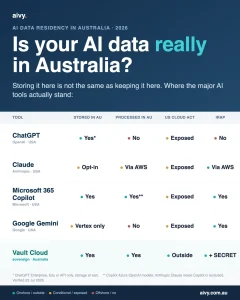
OpenAI spells out the Astra position in its data controls: data can rest in an Australian region, but Astra is processed in the United States or Europe, and eligible API customers can ask for zero data retention. Carbon has no such page. Its launch post is silent on hosting regions and retention, so plan as if the data leaves the country.
Neither model can be confirmed to process data in Australia. Treat both as overseas disclosure and plan your privacy steps accordingly.
Sending personal information offshore is lawful, but the OAIC’s guidance on Australian Privacy Principle 8 puts the onus on you: check the recipient first, and expect to carry responsibility if it mishandles the data. A clinic pasting patient notes into either model is the obvious case. Our Privacy Act playbook for AI lists the questions to ask.
The deeper issue of foreign access to data held by American providers is covered in our guide to AI data residency and the CLOUD Act.
What an Australian team should do this quarter
My advice is simple: run Astra now and plan the Carbon test. Nothing stops you using Astra today, and Carbon’s lead at the same effort is real but bought at 2.4 times the cost per task. If you are choosing an assistant brand rather than a model, our Claude and Gemini comparison covers the wider choice.
| If you are | What I would do now |
|---|---|
| Already on ChatGPT Plus or Pro | Use Astra in ChatGPT Work and Codex today; nothing to wait for |
| Building on an API | Run Astra at high, budget at its cost per task, and keep the model name in config |
| Paying for Google AI Pro or Ultra | Use Argon now and watch for a Carbon notice on your plan |
| A security team doing defensive work | Ask Google about the Fairwind Program; that is the only door open |
| Handling personal information | Settle where each model processes data before any pilot |
| Waiting to see who wins | Do not wait: pilot Astra now and rerun the same test when Carbon opens |
Keep the model name in configuration rather than in code, so swapping to Carbon later is a setting, not a rebuild. If you are unsure which of your tasks need a frontier model at all, our free business audit sorts them.
Gemini 4 Carbon vs GPT 6 Astra: frequently asked questions
Is Gemini 4 Carbon better than GPT 6 Astra?
On the Artificial Analysis Intelligence Index v5, yes: Carbon scores 59.4 at High against 54.8 for Astra at High and 56.9 at Max. Astra still finishes an index task for less, and it is the only one of the two you can use today.
Can I use Gemini 4 Carbon in Australia today?
Not unless you are one of the cyber defenders or Fairwind partners Google has chosen. Google says access for developers, businesses and consumers is coming soon but gives no date, and it has not named Google AI plans, Workspace or any country.
How much does Gemini 4 Carbon cost?
At launch, $2.84 for a million tokens in and $14.22 for a million out, later rising to $5.69 and $28.43, converted from Google’s United States dollar prices at the Reserve Bank’s 28 October 2026 rate. Cached input is 95 per cent cheaper.
Which is cheaper, Gemini 4 Carbon or GPT 6 Astra?
Per token, Carbon: Astra costs 2.5 times as much. Per finished task, Astra: Artificial Analysis measured $4.60 for Astra at High against $11.03 for Carbon, because Carbon used far more tokens to finish the same work.
Is GPT 6 Astra available in Australia?
Yes. It is in ChatGPT Work and Codex on Plus at $29.99 a month, in chat as well on the Pro tiers from $154.99, and on the OpenAI API, Microsoft Azure and Amazon Bedrock at $14.22 in and $71.08 out per million tokens.
Which is better for cyber security work?
On the vendors’ own figures Carbon scores higher on SEC bench Pro and ExploitGym, but each ran its own test. In practice Astra is the one you can use, for defensive tasks such as code review and patching, while Carbon is limited to approved defenders.
Which is faster, Carbon or Astra?
It depends what you time. At High effort Carbon wrote about 100 tokens a second against 63 for Astra, but took about 97 seconds to start answering against 38, in Artificial Analysis readings from 28 October 2026.
Should I wait for Gemini 4 Carbon?
Not for current work. Start on Astra, or on Argon if you prefer Google, and keep a test set ready to rerun when Carbon opens. Argon reached Google AI plans about two weeks after its defender preview, but Google has promised nothing similar for Carbon.
Does either model keep data in Australia?
Neither can be confirmed. OpenAI processes Astra in the United States or Europe, and its Australian region only stores data. Google has not published regions or retention terms for Carbon, so treat both as overseas processing under Australian Privacy Principle 8.
The bottom line on Gemini 4 Carbon and GPT 6 Astra
Carbon is the strongest model on the independent index, and Astra is the strongest you can actually use. The scores favour Google at the same effort; the cost per task and the access favour OpenAI. If your team is in Melbourne, we can set up an Astra pilot now and rerun it the day Carbon opens.
Run GPT 6 Astra at High for serious work and at Medium for routine replies, budget at its measured cost per task, and keep a test set ready for Gemini 4 Carbon. Do not pay for a plan on the promise of Carbon.
If I were running a mid sized law firm, I would put contract review on Astra at Max this month, measure accuracy and cost per matter, and leave a slot in the plan to run the same files through Carbon. Teams in Sydney often want that comparison in writing before they commit.
A word of care on the numbers. Carbon has been public for a day, it has one measured effort setting, and Google may adjust both access and price before wide release. I will revisit this page as that changes. If you would like a second pair of eyes on your own shortlist, talk to our team and bring a sample of real work.
Last updated: 10 November 2026
Sources
Anthropic, Introducing Claude Fable 5.2 and Claude Mythos 5.2 and Artificial Analysis, Intelligence Index v5, reading of 9 November 2026: Claude Fable 5.2, Gemini 4 Carbon and GPT 6 Astra on the v5 index, for the update note only. Source: Artificial Analysis (artificialanalysis.ai), which does not endorse, validate or approve any of the analysis or conclusions drawn from it.
Google, Gemini 4 Carbon announcement. Positioning, staged access for cyber defenders and the Fairwind Program, the introductory and later prices, cached input at 95 per cent off, SEC bench Pro, ExploitGym, CWE bench, WebDev Arena, Gray Swan, Terminal Bench 4.0 and the alignment figures. Published 28 October 2026.
Google DeepMind, Fairwind Program. The partner programme through which Carbon access is being phased. Retrieved 28 October 2026.
Google, Gemini API pricing. Argon’s introductory rate ending on 30 November 2026; Carbon not yet listed. Retrieved 28 October 2026.
Google, Google AI plans for Australia. Google AI Pro at $32.99 and Ultra from $149.99 a month, both with Gemini 4 Argon. Read 28 October 2026.
OpenAI, GPT 6 Astra announcement. Availability, the cyber and launch benchmark tables, the Critical cyber rating, Daybreak and zero data retention. Published 3 September 2026.
OpenAI, GPT 6 Astra model page. Rates, cache rates, the surcharge above 272K input tokens, Batch, Flex and Fast mode, context window, maximum output and effort settings. Retrieved 28 October 2026.
OpenAI Help Center, GPT 6 and other models in ChatGPT. Where Astra appears on Plus and Pro plans. Read 28 October 2026.
OpenAI, data controls. The Australian region for storage only and the processing regions for Astra. Retrieved 28 October 2026.
Artificial Analysis, Intelligence Index v5 leaderboard. Index scores, cost per task, output speed and time to first answer for Gemini 4 Carbon, GPT 6 Astra at each effort, Gemini 4 Argon and Claude Opus 5.5, read through the Artificial Analysis API on 28 October 2026. Source: Artificial Analysis (artificialanalysis.ai).
Tables and charts using this data are based on data from Artificial Analysis (artificialanalysis.ai), which does not endorse, validate or approve any of the analysis or conclusions drawn from it.
App Store Australia, ChatGPT listing. Monthly prices for ChatGPT Go, Plus and the Pro tiers. Read 28 October 2026.
OAIC, Australian Privacy Principle 8 guidelines. Reasonable steps before disclosing personal information to an overseas recipient, and accountability for that recipient. Retrieved 28 October 2026.
Reserve Bank of Australia, exchange rates. Every United States dollar figure converted at 1 Australian dollar to 0.7034 United States dollars, 28 October 2026.
Index, cost and speed figures reflect Artificial Analysis as read on 28 October 2026 and move as models are measured again. Benchmark figures attributed to Google or OpenAI are the vendor’s own.