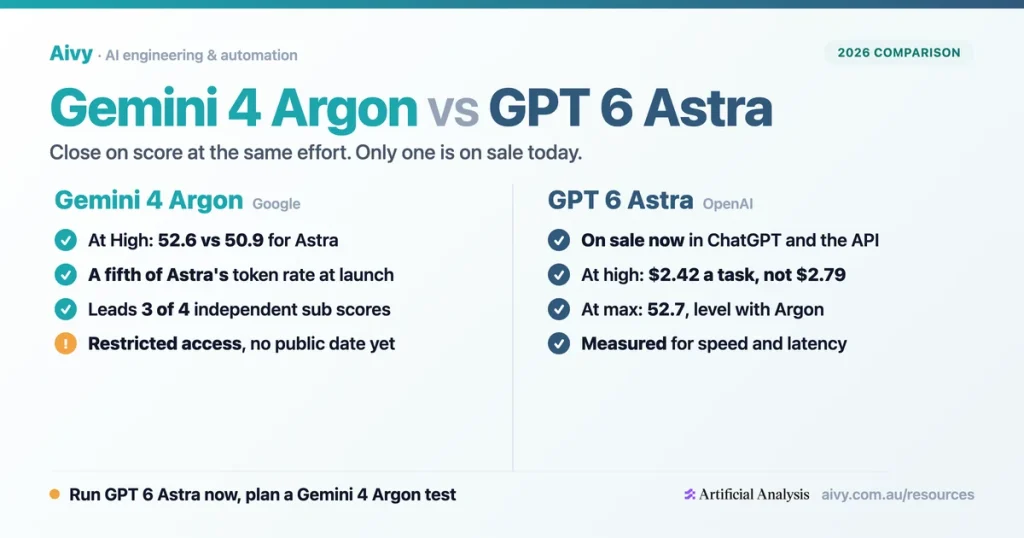
Google announced Gemini 4 Argon on 30 September 2026 as its new frontier model and opened it on 13 October, so Gemini 4 Argon vs GPT 6 Astra is now a real choice. On the latest Artificial Analysis index it is not a close one: at the same effort, OpenAI’s flagship since 3 September scores higher and finishes a task for less than half the money.
At Aivy I help Australian teams pick models by what a finished job costs rather than by launch headlines. Both models are on sale now, so this is a buying guide: what Google and OpenAI have published, what the independent leaderboard measured, and where Argon still earns a test.
Below you will find both rate cards in Australian dollars, scores and cost per task compared at the same effort, independent sub scores, each vendor’s own claims, how each handles cyber risk, the Australian data question, a table of what to do now and where Gemini 4 Carbon fits. For OpenAI’s flagship against Anthropic’s, see our GPT 6 Astra vs Claude Opus 5.5 comparison.
Key takeaways
- Gemini 4 Argon opened on 13 October on the paid Gemini API and Google AI Pro and Ultra; GPT 6 Astra is on sale in ChatGPT and on the OpenAI API.
- At the same effort (High), Astra scores 54.8 on the Artificial Analysis Intelligence Index v5 against 50.4 for Argon.
- Astra also finishes a task for less than half the money at high, $4.60 against $10.92.
- At its introductory price, to 30 November, Argon costs a fifth of Astra per token; from 1 December the rate doubles.
- OpenAI’s Australian endpoint stores data here but processes it elsewhere; Google has published nothing on Argon’s regions.
Gemini 4 Argon vs GPT 6 Astra at a glance
GPT 6 Astra is OpenAI’s most capable model, pitched for the hardest end to end work: reasoning, coding, computer use, research and document creation. Gemini 4 Argon is Google’s new frontier model, built for long, multi step workflows in software engineering, legal and finance work and cyber defence. Our guide to GPT 6 Astra, Sol and Luna covers the rest of OpenAI’s range.
| Side by side | Gemini 4 Argon | GPT 6 Astra |
|---|---|---|
| Released | Announced 30 September 2026 | 3 September 2026 |
| Who can use it now | Open Paid Gemini API and the Gemini app on Google AI Pro and Ultra, since 13 October | ChatGPT Plus, Pro, Business and Enterprise; OpenAI API, Microsoft Azure, Amazon Bedrock |
| Input, per million tokens | $2.84 to 30 November, then $5.69 | $14.22 |
| Output, per million tokens | $14.22 to 30 November, then $28.43 | $71.08 |
| Cached input, per million | $0.14 to 30 November, 95 per cent off input; implicit caching only | $1.42 |
| Prompts over 272K input tokens | Not covered in Google’s announcement | Input and cache at 2x, output at 1.5x, for the whole request |
| Maximum output | 1M tokens | 128K tokens |
| Context window | Not stated in the announcement | 1.05M tokens |
| Index v5, 28 October | 50.4 at High, the only effort measured | 54.8 at high, 56.9 at max |
Sources: Google, Gemini 4 Argon announcement, 30 September 2026; OpenAI, GPT 6 Astra announcement and model page; index from Artificial Analysis v5, read 28 October 2026. Converted at 1 Australian dollar to 0.7034 United States dollars, 28 October 2026.
Three rows stand out. Argon’s launch rate is a fifth of Astra’s on both input and output, and its cached input is a tenth of Astra’s. Argon can write up to one million tokens in a single answer, against 128,000 for Astra. And the prompt length rule is asymmetric on paper: OpenAI publishes a surcharge above 272,000 input tokens, while Google’s announcement says nothing either way.
The index row matters most. At the same High effort Astra now scores 4.4 points more than Argon, and both can be checked this afternoon on your own work, Astra in ChatGPT or the API and Argon on the paid Gemini API or Google AI Pro and Ultra. For the app route, Gemini plans compared side by side show what Pro costs here and what Ultra adds.
Who can use Gemini 4 Argon and GPT 6 Astra today
Google opened Argon on 13 October, after a first rollout to trusted cyber defenders through its Fairwind Program. It is on the paid tier of the Gemini API, in Google AI Studio and Android Studio, and in the Gemini app for Google AI Pro and Ultra subscribers; Ultra also gets it in Antigravity. There is no free API tier, and the introductory rate runs to 30 November.
| Plan | Australian price | Gemini 4 Argon or GPT 6 Astra |
|---|---|---|
| ChatGPT Go | $13.00 a month | Not in OpenAI’s launch list for Astra |
| ChatGPT Plus | $29.99 a month | GPT 6 Astra |
| ChatGPT Pro 100 | $154.99 a month | GPT 6 Astra, plus GPT 6 Astra Pro |
| ChatGPT Pro 200 and Pro 500 | $300.00 and $769.99 a month | GPT 6 Astra, plus GPT 6 Astra Pro |
| Google AI Pro | $32.99 a month | Gemini 4 Argon in the Gemini app since 13 October |
| Google AI Ultra | From $149.99 a month, or $329.99 for the higher tier | Open Argon in the Gemini app, AI Studio and Antigravity since 13 October |
ChatGPT prices are the monthly subscriptions listed in Australia’s App Store; Google prices are from Google’s Australian subscriptions page. Both read 1 October 2026. Business and Enterprise are priced per seat and not shown. Availability from OpenAI’s Astra announcement and Google’s Argon announcement.
OpenAI said Astra would reach all ChatGPT Plus, Pro, Business and Enterprise users within days of its 3 September launch, with usage inside existing plan allowances. Pro, Business and Enterprise also get GPT 6 Astra Pro. Enterprise administrators must switch Astra on for their workspace, since access was off by default at launch. Our ChatGPT vs Gemini comparison covers the two apps day to day.
On price the two premium tiers are not far apart: Google AI Ultra starts at $149.99 a month in Australia and ChatGPT Pro 100 is $154.99 in Australia’s App Store. Both now buy the model, and so does the cheaper Google AI Pro, which has Argon in the Gemini app. For a team weighing seats rather than single plans, our business plans comparison covers Team, Business and Copilot.
Intelligence Index scores at the same effort
Both models can think harder for a higher score and a bigger bill, so a fair comparison holds the effort setting level. Artificial Analysis measures Argon only at High effort. Against Astra at high, the same setting, Argon scores 50.4 on the Intelligence Index v5 to Astra’s 54.8, so Astra leads by 4.4 points. Index and cost readings here are from 28 October 2026.
Intelligence Index v5 by effort setting, axis 0 to 100
Higher is better. Artificial Analysis measures both Gemini 4 models at High effort only, so the fair pair is the Argon row against GPT 6 Astra (high). Gemini 4 Carbon, in light teal, is in restricted access. Source: Artificial Analysis, Intelligence Index v5, read 28 October 2026.

Turn Astra down and the gap closes: at medium Astra scores 51.5, still a point above Argon at High, and only at low, 43.0, does it fall below. So on v5 Argon does not reach Astra’s score at any setting from medium up; only Gemini 4 Carbon, still restricted, scores higher than Astra at max.
The light teal bar is the one to watch. Gemini 4 Carbon scores 59.4 at High, above Astra at max, but only cyber defenders and Google’s partners can use it. If Google is your platform, our Claude vs Gemini comparison covers where the current models fit for Australian teams.
Cost per task: where Astra pulls further ahead
A score is only half the decision. Artificial Analysis publishes what each model spent to complete its index, a cost per task that counts every token, thinking included. At the same High effort, Astra costs $4.60 a task against $10.92 for Argon, which Artificial Analysis now costs at its full rate. Astra scores higher and costs less than half as much per finished task.
Cost per index task by effort setting, in Australian dollars
Lower is cheaper. Bars scaled to $11.03. Both Gemini 4 models are costed at their full token price, 4 and 20 United States dollars per million. Source: Artificial Analysis, cost per task on the Intelligence Index v5, read 28 October 2026. Converted at 1 Australian dollar to 0.7034 United States dollars, 28 October 2026.
Even at max, Astra costs $8.88 a task for 56.9, less than Argon at High for 6.5 points more. Astra at medium, $3.88, is the cheapest OpenAI option in the chart and still scores above Argon. Our AI ROI calculator turns figures like these into a monthly bill against the hours saved.
One caveat cuts the other way. Argon’s introductory rate to 30 November is half the rate Artificial Analysis uses, so until then the same work would cost about $5.46 a task, my arithmetic rather than a measurement, still more than Astra at high. For finance automation budgets that run for years, plan on the full rate from 1 December.
Gemini 4 Argon price vs GPT 6 Astra per million tokens
Both APIs bill in United States dollars, converted here at the Reserve Bank rate of 28 October 2026. Astra lists at $14.22 per million input tokens and $71.08 per million output tokens. Argon costs $2.84 and $14.22 until 30 November, then $5.69 and $28.43 from 1 December, the same rate as Claude Opus 5.5.
List rate per million tokens: GPT 6 Astra and Gemini 4 Argon
Lower is cheaper. Each panel is scaled to its own largest bar. Argon’s introductory rate runs to 30 November. Sources: Google, Gemini API pricing page, read 28 October 2026; OpenAI API pricing, read 26 October 2026. Converted at 1 Australian dollar to 0.7034 United States dollars, 28 October 2026.
Output, per million tokens
Input, per million tokens
Per token, Argon is five times cheaper than Astra at launch and two and a half times cheaper after it. Cached input widens that: Google prices cached tokens at 95 per cent off input, $0.14 per million at launch, against $1.42 for Astra. For document automation that rereads the same templates all day, cache pricing shapes the bill as much as the headline rate.
Astra carries one clause Argon’s announcement does not mention. Prompts above 272,000 input tokens are billed at twice the input and cache rates and one and a half times output, for the whole request. Long running agents hit that line quickly, so check your real prompt lengths. Our guide to agentic AI explains why agent prompts grow.
For a team that pays per token, the Argon launch rate already exists at OpenAI. GPT 6.1 Sol, released on 29 September, lists at the same $2.84 and $14.22 and scores 54.5 for $1.81 a task at max on the same v5 index, above Argon for a sixth of its cost per task. It is the fair benchmark for Argon’s price.
Independent sub scores at High effort
The index is a blend of separate tests. On the parts Artificial Analysis published on 1 October, Argon led on three of the four that both had scored at High, including Humanity’s Last Exam, 57.1 per cent against 53.1. Those readings predate v5, which puts Astra ahead overall, so read them as where Argon is strong, not as the ranking.
Independent sub scores at High effort, per cent, axis 0 to 100
Higher is better. Both models at High effort, scored by the same evaluator before the v5 index. Source: Artificial Analysis, read 1 October 2026.
Argon’s clearest lead is SciCode, scientific programming, at 61.8 against 55.4. On Artificial Analysis’s own Terminal Bench 4.0 run, agent work in a command line, it leads 57.1 to 54.0. Astra edges long context reasoning, 80.0 against 79.7, effectively a tie. For professional services firms reading long contracts, that last line matters more than the rest.
One gap in the data needs saying plainly. The Artificial Analysis Coding Index scores Astra at 77.1 at high, but has no score for Argon yet, so nobody can say from that index which one codes better. The sub scores above are the closest independent evidence available so far.
What Google and OpenAI claim for their own models
Both launch posts carry the vendor’s own benchmark results, and they barely overlap. Google reports Argon’s results in its own launch post; OpenAI’s table, published four weeks earlier, could not include Argon. So the table keeps each figure with its vendor, and I only set two numbers side by side where both name the same test and version.
| Benchmark | Whose figure | What the vendor reports |
|---|---|---|
| DeepSWE v1.1 | Gemini 4 Argon at 77.9%, which Google calls the state of the art | |
| DeepSWE v1.1 | OpenAI | GPT 6 Astra at 74.1%, its best at any effort |
| AutomationBench | Gemini 4 Argon ranked first at 51.3% | |
| AutomationBench | OpenAI | GPT 6 Astra at 41.4% |
| Terminal Bench 4.0 | OpenAI | GPT 6 Astra at 57.9% |
| LVBench, long video | Gemini 4 Argon at 91.7% | |
| GPQA Diamond | OpenAI | GPT 6 Astra at 96.0% |
Sources: Google, Gemini 4 Argon announcement, 30 September 2026; OpenAI, GPT 6 Astra announcement, 3 September 2026. Vendor figures, each from the vendor’s own run. Neither post gives an AutomationBench version, so those two rows are not a like for like comparison.
DeepSWE v1.1 is the one shared test with a version: Google reports Argon at 77.9 per cent and OpenAI reports Astra at 74.1. Those are two vendors running their own models, not one evaluator running both, so read the gap as indicative. OpenAI’s table put Gemini 3.8 Flash at 73.8 on that test. Our coding assistant ranking covers which tools wrap these models.
Google also says Argon leads the Vals Index, which weights finance, coding, legal and tax work by their share of United States GDP, and Harvey’s legal agent benchmark. Neither claim comes with a figure for Astra. If coding agents are the job, our Claude Code vs Codex guide covers the agent Astra runs in.
Speed and latency: what has been measured so far
Speed can now be compared. Artificial Analysis has timed Argon at High since it opened, and both models show the pattern of reasoning models: the higher the effort, the longer you wait before the first word appears.
63
Tokens per second, GPT 6 Astra at high
38 s
To the first answer token, GPT 6 Astra at high
4 s
To the first answer token, GPT 6 Astra at medium
45 s
To the first answer token, Gemini 4 Argon at High, at 83 tokens a second
Median output speed and time to first answer token as measured by Artificial Analysis, read 28 October 2026. Speed readings move from day to day.
At max, Astra took about 251 seconds to start answering, and at xhigh about 130. That suits overnight batch work and suits a live conversation poorly. For a customer service chatbot where someone waits on every reply, medium effort is the realistic setting, and its four second start is the number to test against.
Google’s announcement points Argon at long, multi step tasks where its one million token output limit lets it work through a problem in one pass. That tells you what Google built it for. At High it starts about seven seconds later than Astra at high but writes faster once it starts, 83 tokens a second against 63.
Cyber capability and safeguards from Google and OpenAI
Both companies say their model is a step change in cybersecurity, and both restrict it because of that. The difference is in the approach. Google gave trusted defenders the full model without cyber guardrails before opening a guarded version to everyone on 13 October. OpenAI released Astra widely, with the most dangerous cyber tasks refused for everyone, and plans to loosen that for vetted defenders.
| Cyber risk | Google, Gemini 4 Argon | OpenAI, GPT 6 Astra |
|---|---|---|
| How the vendor describes it | Trained to find, validate and patch critical vulnerabilities on its own | Meets the Critical threshold in cybersecurity under OpenAI’s Preparedness Framework |
| Who gets the full capability | Trusted defenders and Google’s own teams, without cyber guardrails | Wider access planned through OpenAI Daybreak, with less restrictive safeguards |
| What everyone else gets | Open since 13 October with guardrails; Google says the model will refuse harmful requests | A version that refuses advanced tasks such as proof of concept exploits |
| Runtime monitoring | Watches its chain of thought and actions, and stops execution when needed | Misalignment monitoring in production; tasks can pause in ChatGPT and stop in the API |
| Headline vendor result | CWE bench v1 at 68%, tied for first | ExploitBench at 100%, tested without production safeguards |
Sources: Google, Gemini 4 Argon announcement, 30 September 2026; OpenAI, GPT 6 Astra announcement, 3 September 2026. Each vendor’s own description and results.
For most Australian businesses this decides less than it seems, because the everyday version of either model will refuse exploit work. Where it matters is in how often legitimate work gets interrupted. OpenAI says its extra safety checks can pause or stop genuine tasks, including defensive security work. Our ranking of the most secure AI coding assistant covers what the code itself looks like.
If your security team works to the Essential Eight, Google’s trusted defender route is the only way to Argon without its cyber guardrails, and to Gemini 4 Carbon, both by invitation. Everyone else should plan around Astra’s refusals and Argon’s public safeguards, and run any security automation past a person before it touches production systems.
Australian data residency and the Privacy Act
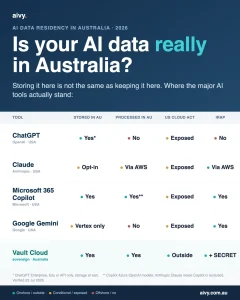
The first question for most Australian teams is not the score but where the data goes. OpenAI lists an Australian endpoint for its API that stores content at rest in Australia. It does not process requests here, it needs approval through OpenAI’s sales team, abuse monitoring controls and a Modified Retention amendment, and models released since 5 March 2026 carry a 10 per cent uplift.
For GPT 6 Astra on OpenAI’s API, plan on processing outside Australia even with the Australian endpoint. For Gemini 4 Argon, Google has published nothing on regions, retention or residency yet, so assume nothing until it does.
That matters under the Privacy Act 1988. The OAIC’s guidance on Australian Privacy Principle 8 says that before an organisation discloses personal information to an overseas recipient, it must take reasonable steps to ensure the recipient does not breach the principles, and it stays accountable if the recipient does. Our Privacy Act playbook covers what to ask a vendor.
OpenAI says Astra supports zero data retention for eligible API customers, and the model is also offered through Microsoft Azure and Amazon Bedrock, so ask those providers which regions carry it. For a healthcare practice handling patient records, confirm those terms in writing before any pilot.
Which one an Australian team should run
On v5 the decision is clearer than at launch. Astra scores higher than Argon at every setting from medium up and costs less per finished task, so it is the model to put to work this quarter. Argon is worth a test where Google’s own figures are strongest, such as long video and very long outputs, and where prompts are long and answers short, so its lower token price counts.
| Your situation | What I would do now |
|---|---|
| You need a frontier model in production this quarter | GPT 6 Astra, starting at high: 54.8 on the index for $4.60 a task |
| You pay per token at high volume | Price GPT 6.1 Sol now, at the same token rate as Argon’s launch price (54.5 for $1.81 a task at max), and run an Argon trial now |
| You already build on Google | Gemini 4 Argon on the paid API since 13 October (50.4 for $10.92 a task), and Gemini 3.8 Flash for simple steps |
| Your prompts run past 272K tokens | Model Astra’s surcharge on real prompt lengths; ask Google how Argon bills long prompts before you plan |
| You run a security team | Ask Google about the Fairwind Program, the only route to Argon without guardrails and to Carbon; otherwise expect Astra to refuse exploit work |
| You send personal information | Settle where processing happens before comparing scores, for either vendor |
Based on data from Artificial Analysis (artificialanalysis.ai), which does not endorse, validate or approve any of the analysis or conclusions drawn from it. Index v5 and cost per task read 28 October 2026. Converted at 1 Australian dollar to 0.7034 United States dollars, 28 October 2026.
Two things would change this table: regional terms from Google for Argon, and Gemini 4 Carbon opening beyond its restricted programme, since it already scores above Astra at max. Put a review in the diary rather than locking in a budget. Our AI readiness assessment helps decide which workloads are ready for either.
For teams in Sydney or elsewhere already running OpenAI models, the practical step today is to measure Astra at high and medium on your own tasks, so you have a baseline to test Argon against now, and Carbon when it opens. Without that baseline, a new launch only adds one more leaderboard number to argue about.
And now Gemini 4 Carbon
Two weeks after Argon, Google announced Gemini 4 Carbon on 28 October 2026 as its strongest model, built for cyber defence and long running engineering. It scored 59.4 at High on the Artificial Analysis Intelligence Index v5, above Astra at 56.9 on max, but costs $11.03 a task against $8.88. Only a subset of cyber defenders and Google’s Fairwind partners can use it so far.
Google says developers, businesses and consumers will get it soon, with no date, at the same launch price as Argon, a hint rather than a promise given Argon opened in two weeks. Until then the advice here stands: run Astra and test Argon. Our Gemini 4 Carbon vs GPT 6 Astra comparison covers the newer pairing.
Gemini 4 Argon vs GPT 6 Astra: frequently asked questions
Is Gemini 4 Argon better than GPT 6 Astra?
Not on the independent index. At the same High effort, Artificial Analysis v5 scores Astra 54.8 against 50.4 for Argon, and Astra reaches 56.9 at max. Since 13 October you can test Argon on your own work through the paid Gemini API or Google AI Pro and Ultra.
Is Gemini 4 Carbon better than GPT 6 Astra?
On the independent index, yes: Artificial Analysis v5 scores Gemini 4 Carbon 59.4 at High against 56.9 for Astra at max, though it costs $11.03 a task against $8.88. You cannot use it yet: Google opened it on 28 October 2026 to a subset of cyber defenders and its Fairwind partners, with no date for anyone else. Since 9 November, Claude Fable 5.2 scores higher than both.
Can I use Gemini 4 Argon in Australia today?
Yes, since 13 October 2026. Google opened it on the paid tier of the Gemini API, in Google AI Studio and Android Studio, and in the Gemini app for Google AI Pro and Ultra subscribers. There is no free API tier.
How much does Gemini 4 Argon cost?
Google’s pricing page converts to $2.84 per million input tokens and $14.22 per million output tokens until 30 November 2026. From 1 December it rises to $5.69 and $28.43, at the Reserve Bank rate of 28 October 2026.
Which is cheaper, Gemini 4 Argon or GPT 6 Astra?
Per token, Argon, at a fifth of Astra’s rate until 30 November. Per finished task at the same effort, Astra by a wide margin: $4.60 against $10.92 at high in the Artificial Analysis v5 readings of 28 October 2026.
Is GPT 6 Astra available in Australia?
Yes. OpenAI made it available to ChatGPT Plus, Pro, Business and Enterprise users and through its API, Microsoft Azure and Amazon Bedrock. ChatGPT Plus is $29.99 a month in Australia’s App Store.
Which is better for coding, Gemini 4 Argon or GPT 6 Astra?
It is not settled. Argon has no Artificial Analysis Coding Index score yet, while Astra scores 77.1 at high. Each vendor reports its own DeepSWE v1.1 result, 77.9 per cent for Argon and 74.1 for Astra.
Which is faster, Gemini 4 Argon or GPT 6 Astra?
Astra starts sooner, Argon writes faster. Artificial Analysis measured Astra at about 63 tokens a second at high, with roughly 38 seconds to the first answer token, and Argon at about 83 tokens a second after roughly 45 seconds, both read on 28 October 2026.
Can Australian businesses keep data in Australia with either model?
Not fully. OpenAI’s Australian endpoint stores data at rest in Australia but processes it elsewhere, and needs approval. Google has published nothing on regions for Argon yet. Plan on offshore processing and assess it under Australian Privacy Principle 8.
Should I wait for Gemini 4 Argon?
No need: it has been open since 13 October 2026. On today’s numbers run Astra for work you need now, test Argon on the jobs Google’s figures favour, and budget Argon at its full rate from 1 December.
The bottom line: run Astra now, test Argon
On the v5 numbers, GPT 6 Astra scores higher than Gemini 4 Argon at the same effort and finishes a task for less than half the money. Argon’s lower token price only pays where prompts are long and answers short. So Astra wins the decision on the data, not just on access, and Gemini 4 Carbon is the Google model that could change it.
Put GPT 6 Astra to work at high or medium effort where you need a frontier model today. Run a short Gemini 4 Argon pilot on long video or very long outputs, budget it at the full rate from 1 December, and keep Gemini 4 Carbon on your watch list.
If I were advising a Melbourne law practice drafting long advice documents, I would run Astra at high on a sample of matters now, record cost per document and review time, and use that sample to test Argon now and Carbon later. Our AI consulting team sets up that kind of side by side trial and reads the results with you.
Gemini 4 Carbon may change this quickly once Google gives a date, and the Artificial Analysis readings move as models are measured again, so check the date at the foot of this page before relying on any figure. If you would like a second opinion on where each model fits, you can book a time with us whenever it suits.
Last updated: 10 November 2026
Sources
Google, Gemini 4 Argon announcement. Restricted rollout through the Fairwind Program and the order of wider access, the introductory rate, the rate after it and the cached input discount, the one million token output limit, the vendor results on DeepSWE v1.1, the Vals Index, AutomationBench, LVBench and CWE bench v1, and the cyber safeguards. Published 30 September 2026.
Google, Gemini 4 Argon in the Gemini app. Available from 13 October 2026 to Google AI Pro and Ultra subscribers.
Google, Gemini 4 Carbon announcement. Announced on 28 October 2026 as Google’s strongest model, open first to a subset of cyber defenders and partners in the Fairwind Program, with wider access promised soon and no date, at the same introductory price as Argon. Read 28 October 2026.
Google, build with Gemini 4 Argon. The paid tier of the Gemini API in Google AI Studio and Android Studio, and AI Studio and Antigravity for Google AI Ultra. 13 October 2026. The Gemini API pricing page, read 28 October 2026, gives the introductory rate to 30 November and the full rate from 1 December, with no free tier and implicit caching only.
OpenAI, GPT 6 Astra announcement. Availability in ChatGPT, the API, Microsoft Azure and Amazon Bedrock, GPT 6 Astra Pro, the launch benchmark table, the Critical cybersecurity rating and safeguards, and zero data retention. Published 3 September 2026, read 1 October 2026.
OpenAI, GPT 6 Astra model page. Input, cached input and output rates, the surcharge above 272K input tokens, context window, maximum output and effort settings. Retrieved 1 October 2026.
OpenAI, your data and data residency. The Australian endpoint with regional storage but no regional processing, the approval and Modified Retention requirements, and the 10 per cent uplift. Retrieved 1 October 2026.
Artificial Analysis, Intelligence Index leaderboard. Index v5 scores, cost per task, output speed and time to first answer token by effort for Gemini 4 Argon, Gemini 4 Carbon, GPT 6 Astra and GPT 6.1 Sol, and the Coding Index, read through the Artificial Analysis API on 28 October 2026. Sub scores from the v4.3 leaderboard, read 1 October 2026. Source: Artificial Analysis (artificialanalysis.ai).
Tables and charts using this data are based on data from Artificial Analysis (artificialanalysis.ai), which does not endorse, validate or approve any of the analysis or conclusions drawn from it.
Google, Gemini Developer API pricing. Gemini 4 Argon rates to 30 November and from 1 December, and no listing yet for Gemini 4 Carbon. Retrieved 28 October 2026.
Google, Google AI plans for Australia. Monthly prices for Google AI Pro and the two Google AI Ultra tiers in Australian dollars. Read 1 October 2026.
App Store Australia, ChatGPT listing. Monthly subscription prices for ChatGPT Go, Plus, Pro 100, Pro 200 and Pro 500. Read 1 October 2026.
OAIC, Australian Privacy Principle 8 guidelines. Reasonable steps before disclosing personal information to an overseas recipient, and accountability for that recipient. Retrieved 1 October 2026.
Reserve Bank of Australia, exchange rates. Every United States dollar figure converted at 1 Australian dollar to 0.7034 United States dollars, 28 October 2026. GPT 6 Astra and GPT 6.1 Sol rates from OpenAI’s API pricing page, read 26 October 2026.
Index, cost and speed figures reflect the leaderboard as read on 28 October 2026, sub scores as read on 1 October 2026, and move as models are measured again. Benchmark figures attributed to Google or OpenAI are the vendor’s own.