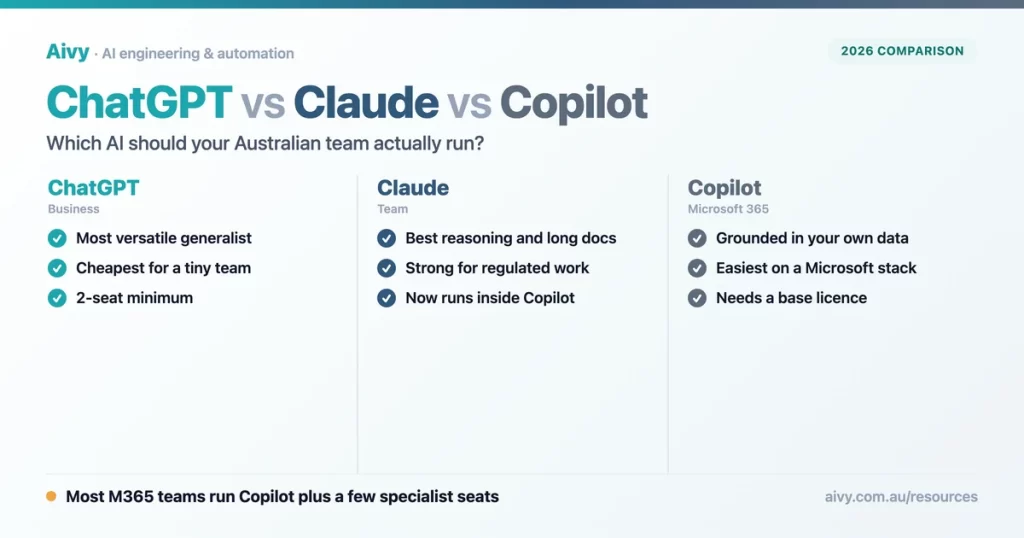
Almost every Australian business owner I speak to has the same three names on a sticky note: ChatGPT, Claude and Microsoft Copilot. They have decided AI is worth paying for. What they cannot work out is which one to actually roll out to the team, because the marketing pages all promise the same things and their prices do not line up. The wrong call wastes money on seats nobody opens.
I run client success at Aivy, an AI automation agency in Melbourne, and we use all three with clients, so I am not in any vendor’s camp. The honest answer is that they are built for different jobs: Copilot lives inside your Microsoft apps and reads your own company data, ChatGPT is the versatile generalist your staff already know, and Claude is the one for deep reasoning and long documents.
This guide compares the three the way I would brief a client: what each one really does, what they cost in Australian dollars once you add GST and the licences hiding underneath, where your data goes under the Privacy Act, and which one fits which kind of business. The price tags hide traps for Australian buyers, and the detail is there for when you need to defend the spend to a board or an accountant.
ChatGPT Business, Claude Team and Copilot at a glance
The three products solve the same problem from three different starting points. ChatGPT and Claude are standalone assistants you buy per seat. Copilot is an add-on that plugs into the Microsoft 365 you already pay for and reads your company data through it. That difference, more than any benchmark, drives the decision and the true cost, and it is the one we walk through with the businesses we work with in Sydney every week.
| Aspect | ChatGPT Business | Claude Team | Microsoft Copilot |
|---|---|---|---|
| Maker | OpenAI | Anthropic | Microsoft |
| Shape | Standalone assistant | Standalone assistant | Add-on to Microsoft 365 |
| Best at | Versatile generalist | Reasoning, long docs | Your own company data |
| Seat price (annual) | $28/mo | $34/mo with GST ($30.91 without) | $31+ plus base licence |
| Minimum seats | 2 | 2 | None (needs M365) |
| Trains on your data | No (business tier) | No | No |
| AU data residency | Enterprise only | Not yet (US hosted) | Rolling out (not Claude) |
August 2026 note: the US export controls that pulled Claude Fable 5, Anthropic’s flagship at the time, were lifted on 30 June 2026 and Anthropic restored global access the next day, so it is selectable again alongside the everyday picks below. For the background, see why Fable 5 was pulled. List prices, August 2026, from vendor pricing pages. Data residency notes explained in detail below; details change, so verify before you buy.
What changed in 2026: Claude now runs inside Microsoft Copilot
Before you compare them as rivals, know the plot twist. Since January 2026, Microsoft lets you switch Copilot to run on Anthropic’s Claude models instead of OpenAI’s, chosen from a menu. So “Copilot versus Claude” is no longer a clean either or: you can have Claude through Copilot. For a Microsoft business that is genuinely useful, because it means model choice without a second subscription.
Here is the catch that matters in Australia, and that almost no global comparison mentions. When a Copilot request routes to Claude, it leaves Microsoft’s Australian processing and goes to Anthropic’s servers, which sit mainly in the United States. That breaks the onshore data handling Microsoft otherwise offers, and the Claude option is switched on by default for Australian commercial tenants. If keeping data onshore matters to you, that is a setting your IT admin should review, not assume.
OpenAI announced on 9 July 2026 that GPT 5.6 is now the preferred model in Microsoft 365 Copilot across Word, Excel and PowerPoint; the comparison below predates that upgrade and we will fold in the details as the rollout lands. Meta is courting business buyers too, but Meta Muse is not sold in Australia yet, so it stays off this shortlist.
What ChatGPT, Claude and Copilot each do best
ChatGPT Business is the versatile generalist. It is the assistant most of your staff already use at home, it has the broadest set of connectors and custom assistants, and it handles writing, analysis, images and general questions with the least training required. For a team that just wants a capable, familiar AI without a project to set it up, it is the path of least resistance.
Claude Team is the specialist for thinking work. It holds very long documents in context, writes in a more natural voice, and is consistently strong on reasoning, analysis and code. In my experience it is the one analysts, writers, lawyers and developers reach for when the task is a hundred page contract or a genuinely hard problem, not a quick email.
Microsoft Copilot is different in kind. Its power is not raw model intelligence, it is that it works inside Word, Excel, Outlook and Teams and reads your own organisation’s files, emails and chats through Microsoft Graph, only showing each person what they already have permission to see. For a business that runs on Microsoft 365, that grounding in your own data is something neither standalone tool does out of the box.
If you want the deeper model-level head to head behind two of these, our Claude vs ChatGPT comparison digs into reasoning, writing and pricing in detail. This guide is the team-rollout decision that sits on top of it.
| Capability | ChatGPT Business | Claude Team | Microsoft Copilot |
|---|---|---|---|
| Image generation | Yes (GPT Image) | Mockups only | Yes (Word, PowerPoint) |
| Voice | Yes | No | Limited |
| Custom assistants | Custom GPTs, agents | Projects, Skills | Copilot Studio agents |
| Connectors | 60+ apps | Drive, GitHub, M365, MCP | Microsoft Graph + connectors |
| Autonomous agents | Yes (Agent Mode) | Agent teams, subagents | Yes (Copilot Studio) |
| Grounded in your data | Via connectors | Via connectors | Native (Graph) |
Business and Team tiers, June 2026, from vendor pages. Claude generates mockups and prototypes (Claude Design), not photos. Features change quickly.
Related reading: weighing Google’s model too? Our ChatGPT vs Gemini comparison covers that contender.
Anthropic released Claude Opus 5.5 on 22 September 2026, at $5.62 and $28.08 per million tokens on the RBA rate of that day, and its model documentation now suggests starting there for most workloads and moving up to Claude Fable, now Fable 5.2, only for demanding reasoning and long running agentic work. Claude Opus 5 moves to the legacy list and stays available.
Since 22 September 2026, OpenAI also lists GPT 6 Sol at $2.81 and $14.04 per million tokens and GPT 6 Luna at $0.14 and $0.70, at the RBA rate of 22 September. OpenAI positions Sol for complex coding and agentic workflows and Luna as its most efficient model for focused, high volume tasks. There is no GPT 6 Terra.
On 29 September OpenAI followed with GPT 6.1 Sol, an upgrade to GPT 6 Sol at the same API price. ChatGPT Business users got it that day in ChatGPT Work and Codex, as did Plus, Pro, Enterprise and Edu, but it is not yet in Chat, so staff who stay there will not see it. OpenAI announced no change to seat prices alongside it. Each vendor now sells an agent on top as well, compared in our ranking of the best AI agents.
What ChatGPT, Claude and Copilot really cost
On the sticker, the two standalone tools look close and Copilot sits just behind. It misleads. ChatGPT Business lands near $28 a seat a month before GST on annual billing, and Claude Team at $34 with GST, $30.91 before it. Copilot Business shows about $27 to $31 on Microsoft’s Australian page, but every Copilot user also needs a paid Microsoft 365 licence underneath, so the real cost is higher.
If cost per token drives the decision, it is worth comparing Claude Opus 5 with Fable 5 before you commit. Fable 5 has since moved to Anthropic’s legacy list, and Claude Fable 5.2 is the current flagship since 9 November, at $11.60 per million input tokens and $58.02 output, a fifth below Fable 5.
All-in cost per seat per month (indicative)
Ex-GST, annual billing. Copilot includes a Microsoft 365 base licence; the others are standalone. Sources: vendor AU pricing pages, June 2026; Claude Team from Anthropic’s Australian price, read 27 October 2026.
Two more things matter. Both standalone tools start at two seats, so entry costs about $57 a month for ChatGPT and $62 for Claude, before GST, paid yearly. And Copilot Business is on a promotional rate that runs to 30 September 2026, $26.91 a user a month paid yearly against a full $31.40, so budget for a rise. Our AI ROI calculator puts figures on the payback before you commit.
| Plan | Seat (annual) | Min seats | Base licence? |
|---|---|---|---|
| ChatGPT Business | $28/mo | 2 | No |
| Claude Team (standard) | $34/mo with GST ($30.91 without) | 2 | No |
| Copilot Business | $31.40 (promo $26.91) | None | Yes, M365 |
| Enterprise tiers | Contact sales | 20 to 150+ | Varies |
List prices, June 2026; Claude Team at Anthropic’s Australian price, read 27 October 2026. Enterprise pricing is not public for ChatGPT; Claude Enterprise lists $28.49 a seat a month plus usage, converted from US dollars. Copilot Business is capped at 300 users; larger orgs use the enterprise Copilot SKU.
GST, your ABN and the real price of an AI subscription
OpenAI and Anthropic bill from overseas, and Anthropic’s Australian prices include GST; Microsoft bills locally and shows GST on the invoice. If you are registered for GST and the subscription is wholly for business use, the offshore vendor does not charge GST, and the reverse charge rules do not apply either, because the ATO limits them to purchases that are not fully creditable. The net GST cost is nil.
The practical move is to enter your ABN at checkout so each vendor treats the purchase as a business supply. Anthropic adds 10 per cent unless you register an ABN, so its $34 Team seat is $30.91 before GST. After that, what differs is the seat cost plus, for Copilot, the Microsoft 365 licence underneath. This is general information, not tax advice, so confirm the treatment with your accountant.
If the bigger question is where AI could save your business the most, our AI business audit gives you five numbers in a couple of minutes.
Data residency and the Privacy Act: where your data goes
For Australian businesses, especially in health, finance, law and government, the sharpest question is not which model is smartest. It is where your data goes, because the Privacy Act 1988 and the Australian Privacy Principles apply to any use of AI that involves personal information. The OAIC is explicit that using a tool does not transfer your obligations to the vendor, and it recommends not entering personal or sensitive information into publicly available generative AI at all.
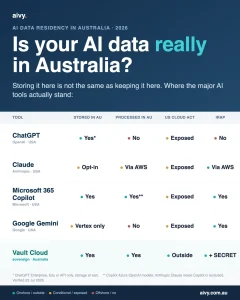
All three exclude your business data from training by default on their paid business tiers, which is the main reason to pay for a business plan rather than let staff use free consumer apps. Residency is where they split. Onshore data handling is largely an enterprise or API tier feature for ChatGPT and Claude, so the standard Team and Business seats most readers compare here process data in the United States, although ChatGPT Enterprise now lists Australia as an at-rest residency region.
Microsoft is rolling out Australian in country processing for Copilot, which is the strongest onshore story of the three, with the important exception we covered: it does not apply when Copilot is routed to Claude. On consumer plans there is a newer wrinkle too: Claude’s ID and face verification can apply to flagged Free, Pro and Max accounts, while Team and Enterprise are exempt.
| Security and compliance | ChatGPT Business | Claude Team | Microsoft Copilot |
|---|---|---|---|
| Trains on your data | No | No | No |
| SOC 2 Type II | Yes | Yes | Yes |
| ISO 27001 and 42001 | Yes | Yes | Yes |
| SSO / SAML | Yes | Yes | Yes (Entra) |
| SCIM provisioning | Enterprise only | Enterprise only | Yes (Entra) |
| AU data residency | At-rest, Enterprise tier | Not on Team (US) | Rolling out, not via Claude |
Business and Team tiers, June 2026. Certifications apply at platform level; strictest controls (CMK, residency) are Enterprise-tier. Verify per plan before you buy.
None of these tools is “Privacy Act compliant” as a product. Compliance is an outcome of how you configure and use it: your residency choice, your training settings, your access controls, and a privacy impact assessment before you roll out. For the full picture of your obligations, our Privacy Act and AI compliance playbook walks through what the OAIC expects, including the new disclosure rule that starts on 10 December 2026.
One Claude update worth noting since this was written. On 30 June 2026 Anthropic made Claude Sonnet 5 the default model on its consumer plans, a cheaper model built for running agents that Team and Enterprise customers can also use, so it is worth understanding how Claude’s models differ on cost and speed.
Claude Sonnet 5.5 followed on 28 September 2026. Anthropic says anyone can chat with it on Claude.ai, on web, iOS and Android, and pitches it as a faster, cheaper partner to Claude Opus 5.5 for everyday work, documents and spreadsheets. It has not said whether Sonnet 5.5 replaces Sonnet 5 as the default on the consumer plans.
It does not change the plan prices below, but it does lift the value you get per seat. For how access, ID checks and data residency work for Australian users, see our guide on whether Australians can use Claude.
Why Microsoft 365’s grip on Australia favours Copilot
There is a reason Copilot keeps winning shortlists it arguably should not on raw model quality. Most Australian businesses already live in Microsoft 365, so turning on Copilot is a toggle and a line item, not a new vendor, a new security review or a new login, which is exactly why finance teams weighing Copilot tend to start there.
That distribution and governance advantage, the same admin centre and the same compliance tooling, is the single most decision relevant fact for a Microsoft shop, and it is why Copilot is often the easiest yes. The same logic reaches meetings, since the transcription bundled into Teams Premium is a paid add-on, though one of the few with an Australian data region.
The catch is that buying seats is not the same as using them. Independent 2026 data tells a sobering story: among people who have access, only about a third of Copilot licences see real use, against roughly four in five for ChatGPT, and paid Copilot has reached only a small slice of all Microsoft 365 seats. The lesson I take to clients is simple. Distribution gets Copilot in the door, but adoption has to be earned with training and real use cases, or you are paying for shelfware.
Licences bought vs licences actually used
Share of people with access who actively use the tool. Axis 0-100%. Source: Recon Analytics, AI Choice 2026.
Give staff the choice, and most still reach for ChatGPT
Share of workers who pick each tool when all three are available at work, 2026. Axis 0-100%. Source: Recon Analytics, AI Choice 2026. Buying licences is not the same as people using them.
Which AI plan suits your kind of Australian business
Instead of a single winner, here is the framework I use with clients. Map your situation to the row that fits. The pattern that wins most often for a funded team is not picking one at all. Add reliability to the picture: on 4 September Claude and ChatGPT went down together for a hundred minutes.
Marketing teams weighing where AI fits first may also want our roundup of the best AI marketing tools in Australia.
| If you are… | Lead with | Why |
|---|---|---|
| Deep in Microsoft 365 | Copilot | Grounds in your own data, easy rollout |
| A 2 to 4 person team | ChatGPT | Lowest friction, staff already know it |
| On Google Workspace or mixed | ChatGPT or Claude | Copilot’s value needs the M365 stack |
| Document or contract heavy | Claude | Long context, careful reasoning |
| Handling sensitive personal data | Copilot (Claude off) | Keeps standard processing onshore |
Not sure your business is even ready to roll AI out across a team yet? Our AI readiness assessment scores where you stand in a couple of minutes, before you commit a year of seats.
If your priority is automating customer conversations rather than equipping staff, see our guide to the best AI customer service chatbots in Australia.
Does a business plan keep a client’s TFN out?
A Business, Team or Copilot plan changes what the vendor may do with your data under contract, but a TFN pasted into the prompt still reaches the vendor. Select the text, press one key, and Nonimo swaps the client identifiers it recognises for placeholders before anything reaches ChatGPT, Claude or Copilot, then puts the real ones back in the reply.
It runs on your own Mac or Windows computer, and not a word of your text goes to Nonimo, only a daily usage count. See how an Australian practice covers client identifiers before they are pasted.
Can you run ChatGPT, Claude and Copilot together?
Yes, and most teams getting real value from AI in 2026 do. The common Australian pattern for a Microsoft business is Copilot for the whole team inside the Office apps, plus a handful of Claude or ChatGPT seats for the analysts, writers and developers who push harder. Because Claude is now selectable inside Copilot, some businesses get their reasoning model through Copilot rather than buying separate seats, as long as they have made the data routing decision deliberately.
The mistake I see is buying one tool for everyone and assuming that is the strategy. It rarely is. A bookkeeper, a salesperson and a developer want different things from AI, and the cost of a few extra specialist seats is trivial next to the time they save. Route the work to the tool that suits it, and treat the rollout as a change project, not a software purchase, which is the part we help Australian businesses get right.
ChatGPT vs Claude vs Copilot: frequently asked questions
Is ChatGPT, Claude or Copilot the best for business?
It depends on your stack. Copilot suits Microsoft 365 businesses that want AI grounded in their own data, ChatGPT is the most versatile and cheapest entry for small teams, and Claude is best for reasoning and long documents. Many Australian businesses run Copilot plus a few specialist seats. Every personal ChatGPT tier and its local price is in our guide to ChatGPT plans.
How much do they cost in Australia?
ChatGPT Business is around $28 a seat a month before GST on annual billing, and Claude Team $34 with GST, $30.91 before it. Copilot Business shows about $27 to $31, but it needs a paid Microsoft 365 licence underneath, so the real all-in cost is closer to $60 to $90 a seat.
Do I pay GST on ChatGPT or Claude in Australia?
Anthropic’s Australian prices include GST, which it adds unless you register an ABN; OpenAI does not add it. Where the subscription is wholly for business use it is fully creditable, so the reverse charge does not apply and there is nothing to remit or reclaim: the net GST is nil. Enter your ABN at checkout. Microsoft bills locally with GST shown. Confirm treatment with your accountant.
Does Copilot keep my data in Australia?
Microsoft is rolling out Australian in-country processing for standard Copilot interactions, the strongest onshore story of the three. The exception is important: if you route Copilot to the Claude model, that request goes to US servers, and it is on by default for Australian tenants.
Can I use Claude inside Microsoft 365 Copilot?
Yes. Since January 2026 you can switch Copilot to run on Anthropic’s Claude models from a menu, giving model choice without a second subscription. For Australian tenants it is enabled by default and routes to US servers, so review the setting if data residency matters.
Do these tools train on my business data?
Not on their paid business tiers. ChatGPT Business, Claude Team and Microsoft Copilot all exclude your data from training foundation models by default. That contractual protection is the main reason to pay for a business plan instead of letting staff use free consumer apps.
What is the cheapest option for a small Australian team?
For a two to four person team, ChatGPT Business is now the cheaper entry: it and Claude Team both start at two seats, at about $28 and $30.91 a seat a month before GST on annual billing. Copilot only makes sense if you already pay for Microsoft 365. A team already on Google Workspace gets Gemini inside Business Standard, and how Gemini plans compare for businesses covers that route.
Are these tools compliant with the Privacy Act?
No tool is compliant by itself. The Privacy Act obligations stay with your business, so compliance depends on how you configure and use it: data residency, training settings, access controls and a privacy impact assessment. Treat vendor features as enablers, not guarantees. Setting those controls up is a common first job for AI consultants in Australia, because the defaults rarely match what a business owes its clients.
Last updated: 10 November 2026 (Claude Fable 5.2); previously 28 October 2026 (Claude Team at Anthropic’s Australian prices) and 30 September 2026 (GPT 6.1 Sol, GPT 6 Astra and Claude Fable 5.1 noted). Prices, plans and data handling verified against vendor pages and independent sources at time of writing. These products change quickly, especially pricing and residency, so confirm current details before you buy.
The bottom line: choosing an AI plan for your AU team
There is no universal winner, and any vendor who tells you otherwise is selling a seat. If you run on Microsoft 365, Copilot is the easiest team-wide win because it grounds in your own data, as long as you make the Claude routing decision on purpose and invest in adoption. ChatGPT is the versatile, low-friction generalist and the cheapest start for a tiny team. Claude is the one for deep reasoning, long documents and regulated work.
A professional services firm in Sydney I worked with settled it the sensible way. They put Copilot across the whole team for email and documents, gave three analysts Claude seats for the heavy reasoning, and turned off the in-Copilot Claude model so their client data stayed onshore. The total spend barely moved against payroll, and the productivity they unlocked was the whole point. The tools are cheap. The wrong rollout is not.
If you want help choosing and rolling these tools out properly, that is what we do every day. Aivy is an AI automation agency that helps Australian businesses roll AI out properly, and you can book a free discovery session to map the right setup for your stack, budget and data obligations.
Trial before you commit a year of seats, then commit to the pattern, not the brand:
• On Microsoft 365: lead with Copilot for the team, and decide the Claude routing on purpose.
• Tiny team or not on Microsoft: lead with ChatGPT Business.
• Reasoning, long documents or regulated work: add Claude Team seats for power users.
• Sensitive personal data: keep processing onshore and back it with a privacy impact assessment.
• Anthropic, Introducing Claude Fable 5.2 and Claude Mythos 5.2: Claude Fable 5.2 released on 9 November 2026 at 8 and 40 United States dollars per million tokens, converted at the RBA rate of that day, 0.6894
• Microsoft 365 Copilot pricing (Australia): Copilot Business price, promo, base licence
• OpenAI ChatGPT Business pricing: $28-36 seat, 2-seat minimum, no training, residency by tier
• Anthropic Claude Team plan: two seat minimum, models, admin
• Anthropic, Claude pricing: Claude Team at $34 a seat a month on annual billing or $43 monthly, GST included, as shown to Australian visitors, and Enterprise at 20 US dollars a seat (read 27 October 2026)
• OAIC, privacy and commercially available AI products: Privacy Act obligations, advice on personal data
• Recon Analytics, AI Choice 2026: activation 83% ChatGPT vs 36% Copilot
• IDM Magazine: Claude inside Copilot and the Australian data-residency gap · ATO, reverse charge on offshore purchases
Model token prices converted at the Reserve Bank of Australia rate of 4 September 2026, one Australian dollar buying 0.7210 United States dollars. ChatGPT seat prices converted at 1 USD = 1.42 AUD, 11 August 2026; Claude Enterprise at the RBA rate of 27 October 2026, one Australian dollar buying 0.7021 United States dollars. Copilot figures are Microsoft Australian list prices.
• Anthropic, models overview: Claude Opus 5.5 at 4 and 20 United States dollars per million tokens, the advice to start there for most workloads, Claude Opus 5 on the legacy list (read 22 September 2026)
• Anthropic, Claude Sonnet and Introducing Claude Sonnet 5.5: Sonnet 5.5 open to anyone on Claude.ai, 2 and 10 United States dollars per million tokens, and its positioning against Claude Opus 5.5 (read 28 September 2026)
• OpenAI, Introducing GPT 6.1 Sol: availability in ChatGPT Work and Codex for Plus, Pro, Business, Enterprise and Edu users from 29 September 2026, not yet in Chat, and API pricing of 2 and 10 United States dollars per million tokens (read 29 September 2026)
• OpenAI, GPT 6 Sol model page and its GPT 6 Luna twin: 2 and 10, and 0.10 and 0.50, United States dollars per million tokens (read 22 September 2026)
The 22 September figures, and the Claude Sonnet 5.5 price, are converted at the Reserve Bank of Australia rate of 22 September, one Australian dollar buying 0.7123 United States dollars.