There is a fair chance someone in your office pasted a client’s details into ChatGPT this week. Not because they were careless, but because AI writes a better letter in two minutes and the client file was open on the other screen. Data loss prevention for AI is the job of keeping names, tax file numbers and bank details out of those prompts, without taking the tools away from the people who rely on them.
At Aivy I spend most of my week helping Australian businesses put AI into real work, and one question comes up in almost every first conversation: how do we let the team use it without client data walking out the door? Accountants ask it, law firms ask it, brokers and NDIS providers ask it. Usually in the same breath as the question about which AI to buy.
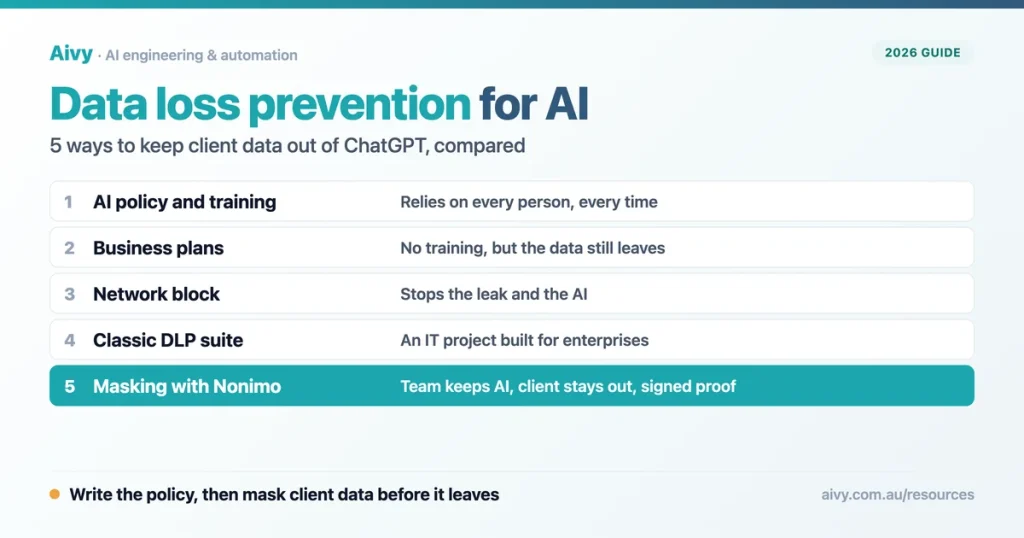
This guide compares the five methods Australian businesses actually use: a policy, the business plans of the big assistants, blocking at the network, a classic DLP suite and masking the data before it leaves. Each one is judged on the same five criteria, side by side in one table. If you first want to understand what gets pasted and why, start with our guide to shadow AI.
Key takeaways
- An AI policy and staff training are the foundation, but they rely on every person remembering every time.
- The business plans of ChatGPT, Copilot and Claude stop the vendor training on your data, yet the client detail in a prompt still reaches the vendor.
- Blocking AI sites stops the paste on the office network and stops the AI with it; phones and home connections sit outside the block.
- A classic DLP suite is built for large organisations with a security team, and it is an IT project in its own right.
- Masking client data before it is sent, which is what Nonimo does, keeps the team on AI and gives you a signed report as proof.
Why data loss prevention for AI is a different problem
Classic data loss prevention was designed for files leaving by email, USB stick or cloud upload. The leak with AI is smaller and far more frequent: a paragraph copied out of a client file and pasted into a chat box, because someone wants a cleaner summary before a meeting. Nothing about it looks like an attack. It usually comes from your best people trying to work faster.
The survey numbers say this is normal behaviour, not a fringe one. A YouGov survey of 1,055 Australian employees for ELMO Software found 87% use AI at work, 29% use a mix of approved and unapproved tools, and 12% are unsure which tools are approved at all. In professional services firms, where every document carries a client, that gap is exactly where the risk sits.
Workers who report using unapproved AI tools, by country
Share of knowledge workers, axis 0 to 100%. Source: Okta, AI Agents at Work 2026, conducted by Apprize360 in March 2026, as reported by The Register. Canada, France and Germany are given as approximate figures.
Australia came second of the seven countries in that study, behind only the United States. That is the context for every method below: whatever you choose has to work for people who already use AI daily and who will route around anything that slows them down. If you want a quick read on where your own business stands, our AI readiness assessment takes a few minutes.
Method 1: an AI policy and staff training
Every other method on this list needs a written policy underneath it, so it comes first. A good one names the approved tools, says which client details never go into a prompt, and tells people what to do instead. The OAIC itself says organisations should establish policies and procedures for their use of AI, and our AI policy template is a practical place to start.
The OAIC is just as clear about the limit. Its guidance on commercially available AI products says any controls or prohibitions on entering personal information “will need to be accompanied by robust training and auditing measures”. A policy states the rule. It does not check whether anyone followed it at five on a Thursday afternoon, with a client on hold.
In my experience, training lifts awareness for a few weeks and then fades as deadlines bite. That is not a failing of your staff, it is how habits work. Treat the policy as the foundation and add a control that still works when nobody is thinking about privacy. Our AI consulting team can help you write a policy that people actually read.
Method 2: business plans for ChatGPT, Copilot and Claude
The second method is to move everyone onto a business plan. OpenAI says it does not train its models on data from ChatGPT Business or Enterprise by default. Microsoft says prompts under enterprise data protection are not used to train foundation models, and Anthropic’s commercial terms say it may not train models on customer content. We compare the plans themselves in ChatGPT Business vs Claude Team vs Copilot.
| Business plan | Trains on your data? | Does the client detail still reach the vendor? |
|---|---|---|
| ChatGPT Business and Enterprise | Not by default | Yes, inside every prompt |
| Microsoft 365 Copilot with enterprise data protection | Not used to train foundation models | Yes, processed by Microsoft as a data processor |
| Claude business plans | Customer content may not be used for training | Yes, inside every prompt |
Sources: OpenAI business data page, Microsoft Learn on enterprise data protection, Anthropic commercial terms. Read 1 October 2026.
Not training on your data is a different promise from not receiving it. The client’s name, tax file number and bank details still travel to the vendor inside the prompt. OpenAI lets eligible Enterprise customers store content at rest in Australia, but the inference it offers in region is in the United States or Europe. That makes it a cross border disclosure question, which our guide to AI data residency in Australia works through.
Method 3: blocking ChatGPT and other AI sites on the network
Blocking ChatGPT, Claude and Gemini at the firewall is the fastest control to switch on, and it does stop the paste on that network. It also stops the AI. Every useful job the team was doing with it, from summarising a contract to drafting a reply to a complaint, goes back to being slow, and the people who relied on it notice by lunchtime.
The bigger problem is reach. A network block covers devices on the office network and nothing else. A phone on mobile data, a laptop on home internet or a personal account at the kitchen table sits outside it, which is how blocking turns visible use into invisible use. Our guide to the Essential Eight and where AI breaks it explains why perimeter controls struggle here.
90%
of executives confident they can see which AI tools staff use
52%
of knowledge workers admit using unapproved AI tools
24%
say they use unapproved AI tools regularly
Source: Okta, AI Agents at Work 2026, 292 executives and 492 knowledge workers across seven countries including Australia, as reported by The Register.
I understand why owners reach for a block: it costs nothing and it feels decisive. But a gap between what leaders believe and what staff do is the very thing a block tends to widen, because the use moves somewhere nobody is looking. If the real question is which assistant to approve, start from Claude vs ChatGPT rather than from the firewall.
Method 4: a classic enterprise DLP suite
Enterprise data loss prevention suites inspect content as it moves and block or flag anything that matches a rule. NIST describes the category as protecting data in use, in motion and at rest through content inspection, within a centralised management framework. In a large organisation with a security team to run it, that is a serious control, and it covers far more than AI.
For a practice of 10 to 200 people it is usually the wrong size. Someone has to write the rules, tune them until they stop flagging the wrong things, roll the software out to every machine and read the alerts every day. It is a project, not a setting. Our free AI business audit helps you see where your IT hours would pay back more.
And when a classic DLP rule catches a client detail on its way to ChatGPT, the typical response is to block or warn. The leak stops, but so does the work, and the person goes looking for another way. That is the gap the fifth method closes. For healthcare practices handling Medicare numbers all day, the difference shows up on every shift.
Method 5: masking client data before it leaves, with Nonimo
The fifth method keeps the AI and takes the client out of the prompt. Nonimo replaces names, tax file numbers, Medicare numbers, bank details, phone numbers and street addresses with placeholders such as [PERSON_1] before the text reaches ChatGPT, Claude, Copilot or any other AI tool. The AI works on the case, not the people, and the real details go back into its reply. Nonimo is built by the team behind Aivy.
| In your client file | What the AI reads |
|---|---|
| Client name | [PERSON_1] |
| Tax file number | [TFN_1] |
| Medicare card number | [MEDICARE_1] |
| BSB and account number | [BSB_1] and [BANK_ACCOUNT_AU_1] |
| Mobile number | [PHONE_1] |
| Street address | [ADDRESS_1] |
Placeholder format as shown on the Nonimo website, read 1 October 2026. The real values come back when you copy the AI’s reply.
It fits the way people already work. On Mac and Windows, the desktop app masks with one key: select the text, press it, paste. Word, Excel, PowerPoint, PDF and CSV files get a masked copy saved beside the original. Nonimo is also available as a browser extension, and there the change is automatic: what you paste into ChatGPT or Claude is masked before it leaves, and the names come back in the answer.
The engine is deterministic: there is no AI model in the detection, and the same input gives the same output. Masking happens on your own computer, and not a word of your text goes to Nonimo. Details that leave no doubt, such as a tax file number that passes its check digit, are replaced straight away; anything recognised from context is replaced on screen, where one click undoes it.
It knows 22 Australian identifiers by name, from ABNs and Director IDs to NDIS numbers, Centrelink reference numbers and strata plan numbers. And it leaves proof. Nonimo counts what it masks, never the text, and gives you a signed report for the month that a client or an auditor can check on the Nonimo website. For accounting practices answering client questionnaires about AI, that report is the useful part.
Nonimo is free during the beta, on Mac and Windows, and you do not need a card to start. Download Nonimo and try it on a real client document before you decide on anything else in this guide.
Data loss prevention for AI, compared side by side
Here are the five methods against the five questions an Australian business actually asks before it picks one. The cells for methods one to four come from the vendor, regulator and survey sources listed at the end of this guide; the Nonimo row describes what the product does today. If you want to weigh the hours your team saves against the cost of any of them, our AI ROI calculator does the sums.
| Method | Stops the leak? | Team keeps using AI? | Proof for a client or auditor | IT effort and cost to start |
|---|---|---|---|---|
| 1. Policy and training | Only if everyone remembers, every time | Yes | A written policy, not a record of what was sent | Low: staff time to write and train |
| 2. Business plans | No: the detail still reaches the vendor | Yes | Contract terms, not a record of what was kept out | Low: a paid seat for every user |
| 3. Network block | On the office network only | No | Firewall logs of blocked sites | Low: one firewall rule |
| 4. Classic DLP suite | Where its rules match and its software runs | Often blocked or warned at the send | Central alerts and reports | High: a project, with rules to write and tune |
| 5. Masking with Nonimo | Client details become placeholders before sending | Yes, the same tools | A signed monthly report the recipient can verify | Low: install an app or extension, free during the beta |
Read it by column rather than by row. Masking is the method that keeps the team on AI and keeps the client out of the prompt at the same time, and it is also the one that hands you proof you can pass on. The others each solve part of the problem, which is why the best setups combine a policy with masking rather than choosing one row.
Which data loss prevention method suits an Australian SMB
For most Australian businesses under a few hundred staff, the answer is a combination rather than a single choice. Write the policy, because the OAIC expects one and your people need the rule in plain words. Then put masking underneath it, so the rule holds on the day someone forgets. Keep a business plan if you want its contract terms, and treat it as a complement rather than the control.
Choose a classic DLP suite if you already run one for email and files and have a security team to extend it. Choose a network block only for machines that should never touch AI at all, such as a shared front counter PC. Choose masking for everyone who works with client files and wants to keep using ChatGPT, Claude or Copilot. In real estate agencies, that is usually the whole office.
Your sector matters less than you might think, because the identifiers change but the habit does not. An NDIS provider pastes a progress note with an NDIS number, an accountant pastes a rental schedule with a tax file number, a broker pastes a claim with a policy number. Each one is a client detail in a prompt, and each is covered by the same method.
What the Privacy Act expects when your team uses AI
If your business is covered by the Privacy Act 1988, the OAIC’s guidance on commercially available AI products applies to every prompt that contains personal information. Its best practice recommendation is blunt: organisations should not enter personal information, particularly sensitive information, into publicly available AI chatbots. Our Privacy Act and AI compliance playbook covers the wider obligations.
| Principle | What it covers | Where a prompt touches it |
|---|---|---|
| APP 6 | Use and disclosure for the purpose the information was collected | Putting personal information into an AI product can be a disclosure to its provider |
| APP 8 | Cross border disclosure | A provider processing prompts overseas |
| APP 11 | Security of the personal information you hold | Reasonable steps so an AI tool does not expose your holdings to extra risk |
Source: OAIC, Guidance on privacy and the use of commercially available AI products, published 21 October 2024 and updated 17 January 2025. A summary, not legal advice.
Masking does not switch those principles off, and no tool does. What it changes is what is disclosed in the first place, because the chatbot reads placeholders instead of names and tax file numbers. That is the practical way to follow the OAIC’s recommendation without banning the tools your people rely on. Law firms carry an extra duty of confidentiality on top, which our guide to AI tools for lawyers covers.
Data loss prevention for AI: frequently asked questions
What is data loss prevention for AI?
It is the set of controls that stop sensitive information, such as client names, tax file numbers and bank details, from being sent to AI tools like ChatGPT. It ranges from a written policy to software that masks the details before a prompt is sent.
Is ChatGPT safe for client data?
It depends on the plan and on what gets pasted. Business plans stop OpenAI training on your data by default, but client details in a prompt still reach OpenAI, which is why the OAIC recommends keeping personal information out of publicly available AI tools.
Does ChatGPT Business train on my data?
Not by default. OpenAI says it does not use data from ChatGPT Business, Enterprise or its API platform to train its models unless you opt in, although the content still travels to OpenAI to be processed.
Is blocking ChatGPT enough to stop data leaks?
Usually not. A block covers the office network only, so phones on mobile data and home connections sit outside it, and it removes the productivity your team was getting from AI in the first place.
Does a small business need a DLP tool for AI?
Most need a control, not necessarily a classic DLP suite. A written AI policy plus a tool that masks client details before they are sent covers the common leak, the copy and paste into a chatbot, without an IT project.
Is Nonimo free?
Yes, during the beta. The desktop app for Mac and Windows and the browser extension can be used without paying, and you do not need a card to start.
Does Nonimo work with Copilot and Claude?
Yes. The desktop app works with ChatGPT, Claude, Copilot and any other AI tool, because it masks the text before you paste it anywhere. The browser extension masks automatically as you paste into ChatGPT or Claude.
What does the signed Nonimo report show?
Counts of what was masked, by category of data, for the period you choose. It never contains the text or the details themselves, and the person you send it to can check on the Nonimo website that it is genuine and unaltered.
Does masking client data satisfy the Privacy Act?
It helps you follow the OAIC’s recommendation, because the AI receives placeholders instead of personal information. Your obligations under the Australian Privacy Principles still apply, so treat masking as one of your reasonable steps, alongside a policy and your provider contracts.
The bottom line on data loss prevention for AI
The lesson from all five methods is that the leak happens at the paste, so the control has to work at the paste too. A policy tells people the rule. A business plan improves the contract. Blocking and classic DLP stop the work along with the risk. Masking the data before it leaves, the way Nonimo does it, is the method that keeps your team on AI while the client stays on your side of the screen.
If I were setting this up for a twelve person accounting practice in Melbourne, I would write a one page AI policy in the first week, install Nonimo on every machine in the second, and pull the first signed report at the end of the month. The next time a client sends a questionnaire asking how the practice uses AI, the answer is a document, not a promise.
If you would like help choosing the mix for your business, or writing the policy that sits on top of it, book a time with us. We are Aivy, and we work with Australian businesses every week on putting AI to work safely.
Write the policy, then mask client data before it leaves with Nonimo. Keep business plans for their contract terms, and leave network blocking and classic DLP suites to organisations with a security team to run them.
Last updated: 1 October 2026
Sources
OAIC, Guidance on privacy and the use of commercially available AI products. The best practice recommendation not to enter personal information into publicly available AI chatbots, the advice to establish policies and procedures for AI use, the need for training and auditing behind any prohibition, and the APP 6, APP 8 and APP 11 obligations. Published 21 October 2024, updated 17 January 2025, read 1 October 2026.
ELMO Software, Shadow AI on the rise as workplace guardrails lag behind. 87% of Australian employees using AI at work, 29% using a mix of approved and unapproved tools, 12% unsure which tools are approved. YouGov, 1,055 Australian employees aged 18 to 64, fieldwork 5 to 13 January 2026.
The Register, on Okta’s AI Agents at Work 2026. Unapproved AI use by country (United States 67%, Australia 60%, United Kingdom 55%, Canada about 50%, France and Germany about 30%), 90% of executives confident in their visibility, 52% of knowledge workers using unapproved tools and 24% doing so regularly. Apprize360, 292 executives and 492 knowledge workers, March 2026.
OpenAI, business data privacy, security and compliance. No training on ChatGPT Business, Enterprise or API data by default, data residency at rest in Australia for eligible customers, and in region inference in the United States or Europe. Read 1 October 2026.
Microsoft Learn, enterprise data protection in Microsoft 365 Copilot. Prompts and responses not used to train foundation models, with Microsoft acting as a data processor. Read 1 October 2026.
Anthropic, Commercial Terms of Service. Anthropic may not train models on customer content from its commercial services. Read 1 October 2026.
NIST Computer Security Resource Center, data loss prevention. Definition of the category: protecting data in use, in motion and at rest through content inspection within a centralised management framework. Read 1 October 2026.
What this guide says about Nonimo comes from the Nonimo website (home, security and organisations pages) and its product documentation, read on 1 October 2026. Nonimo is built by the team behind Aivy.