The question usually arrives the same way. Someone on the board asks whether the company has an AI policy, the room goes quiet, and a week later a document appears that was copied from an American template and cites laws that do not apply here. I have read a lot of those documents, and most of them would not survive ten minutes of scrutiny, which is the same failure mode we see in professional services firms that inherit a policy from head office.
I work at Aivy, an AI automation agency in Melbourne, and this comes up in almost every engagement. What surprises people is the answer to the first question they ask: no, there is no Australian law that requires you to have an AI policy. There is, however, a stack of law that a good policy helps you comply with, and one hard deadline in December.
So this guide does three things. It sets out what is actually mandatory in Australia versus what is voluntary, because that distinction gets blurred constantly. It shows you what belongs in the policy. And it tells you what the free government template gives you and where you will still have work to do. If you want the wider picture first, start with our AI solutions overview.
Sources: Department of Industry (National AI Plan, December 2025), ABS Business Characteristics Survey (published 25 June 2026), Privacy and Other Legislation Amendment Act 2024.
Australia has no law requiring an AI policy
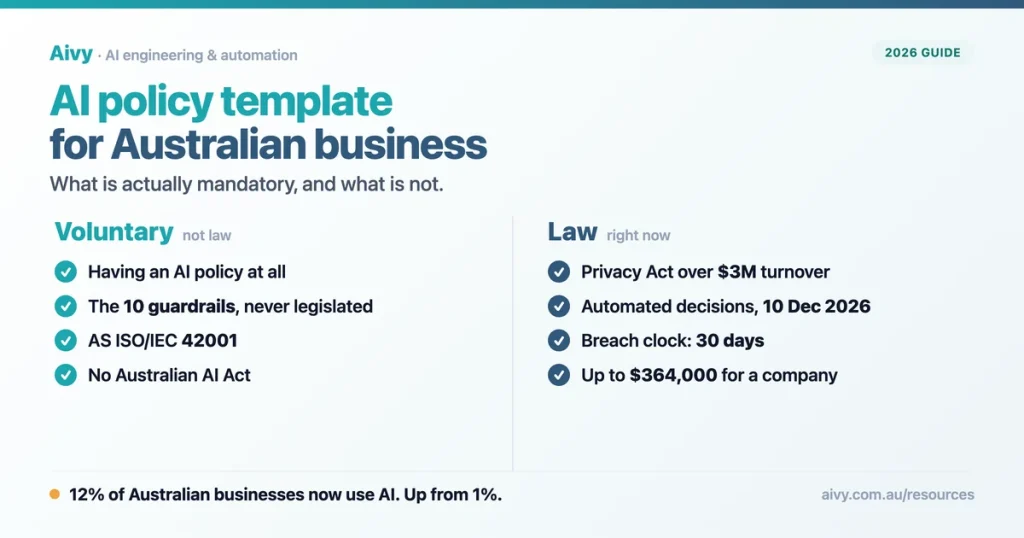
Let me be blunt about this, because a lot of vendor content implies otherwise. In September 2024 the government consulted on ten mandatory guardrails for high risk AI. Those guardrails never became law, which is why an EU AI Act checklist reads so differently from an Australian one.
The National AI Plan, published on 2 December 2025, settled the direction. Its regulatory approach, in the government’s own words, will continue to build on Australia’s existing legal and regulatory frameworks, with established laws remaining the foundation for addressing AI related risks. Regulators keep responsibility within their own domains. There is no Australian AI Act.
What exists instead is voluntary. The Voluntary AI Safety Standard sets out ten guardrails and says plainly that they do not seek to create new legal obligations for Australian organisations. Since October 2025 the National AI Centre has folded that into simpler Guidance for AI Adoption built around six essential practices. Voluntary does not mean irrelevant: it is the yardstick most boards reach for, and the one we use in AI automation work in Sydney.
| What | Status in Australia |
|---|---|
| Having an AI policy | Not required by law. Recommended by the National AI Centre |
| The 10 guardrails | Voluntary. Never legislated |
| Privacy Act and the APPs | Law, if you turn over more than $3 million |
| Automated decision disclosure | Law from 10 December 2026 |
| AS ISO/IEC 42001 | Voluntary standard, adopted in Australia in February 2024 |
What the law does require of an AI policy
The Privacy Act 1988 applies to you if your annual turnover exceeds $3 million, and once it does, several Australian Privacy Principles bite the moment staff start feeding information into an AI tool. Obligations also shift without new legislation, which is what happened with the employer obligation that changed without a new law.
APP 1 requires open and transparent management of personal information, which in practice means having documented practices rather than improvisation. APP 6 limits what you can do with information collected for another purpose, and it is a two part test that gets misread: the secondary use must be one the individual would reasonably expect and related to the original purpose.
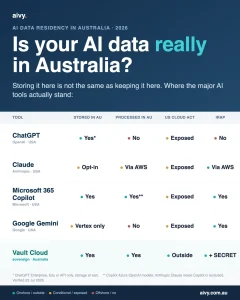
APP 8 is the one that catches people using overseas tools, and it is the reason we keep a running list of which AI tools keep your data in Australia. The OAIC’s guidance says it is generally expected that an entity will enter an enforceable contractual arrangement with the overseas recipient requiring it to handle the information in line with the APPs. Whether that is enough depends on the circumstances, and in certain circumstances you remain accountable for what the overseas recipient then does.
If information does leak, the notifiable data breach clock is 30 days to assess. Our Privacy Act compliance playbook works through those obligations in detail.
Australian businesses using AI
Per cent of businesses reporting AI use. Source: ABS Business Characteristics Survey, published 25 June 2026, based on around 7,000 businesses.
Axis 0 to 100 per cent. Twelvefold growth in three years, and most of it arrived before anyone wrote a policy.
Automated decisions: the 10 December 2026 deadline
This is the one hard date in the whole piece. From 10 December 2026, new provisions inserted into the Privacy Act by the Privacy and Other Legislation Amendment Act 2024 require entities to say something specific in their privacy policy about automated decisions.
If you have arranged for a computer program to make a decision, or to do something substantially and directly related to making one, that could reasonably be expected to significantly affect a person’s rights or interests, your privacy policy has to disclose the kinds of personal information used and the kinds of decisions made. Credit and eligibility scoring in accounting and advisory work is the obvious candidate.
Two things people get wrong here. It is not limited to fancy AI, a spreadsheet that scores applicants counts. And there is no grandfathering, so a system you deployed in 2023 is in scope on the day it starts. Our Privacy Act playbook works through the wider obligations that land with it.
What it costs to get privacy wrong.
A penalty unit rose to $364 on 1 July 2026. For a body corporate, the maximum civil penalty is five times the figure written in the provision, so a 200 unit provision becomes 1,000 units, or $364,000. The serious interference provisions run far higher.
What goes in an AI policy, section by section
A policy people actually read is short. One page of rules beats twenty pages of principles that nobody opens twice. The National AI Centre’s own template is built around five blocks, and they are a sensible skeleton, in the same way our AI business audit is a skeleton rather than a verdict.
Those blocks are the core principles for responsible use, the expected behaviours and internal rules, roles and responsibilities, governance and approval points, and guidance for monitoring and review. Start there rather than from a blank page. Under expected behaviours, one rule worth adding in 2026 covers what Siri AI does on a work iPhone, since it can search mail, messages and calendars once switched on.
Where I would push further is on specificity. Principles are easy to agree and impossible to breach. Rules are the opposite, which is exactly why they work. If your rules will govern customer facing tools, the chatbot development side needs naming explicitly.
| Section | The question it must answer |
|---|---|
| Approved tools | Which ones may we use, and who approves a new one |
| Red lines | What must never be pasted into a public model |
| Human review | Which decisions always need a person, and who |
| Output ownership | Who owns what the tool produces, and what we record |
| Client data | What we may do with information that is not ours |
| Disclosure | When we tell a customer that AI was involved |
| Review | Who owns this document and when we revisit it |
What the free AI policy templates leave out
The government template is genuinely useful and it is free, which makes the usual paid alternatives hard to justify. What it does not do is give you the numbers. It will not tell you which APPs apply, where the $3 million threshold sits, how long the breach clock runs or what the December date actually requires.
| The free template gives you | You still have to write |
|---|---|
| Core principles for responsible use | The approved tool list, and who signs off a new one |
| Expected behaviours and internal rules | The red lines: what never goes into a public model |
| Roles and responsibilities | Which APPs apply to you and the $3 million threshold |
| Governance and approval points | Output ownership, recorded as human contribution |
| Guidance for monitoring and review | The 10 December 2026 automated decision wording |
Left column: the five blocks in the National AI Centre template published on 22 April 2026.
Output ownership is the gap I see most often. Policies routinely declare that the company owns everything the tool produces, which is a statement of intent rather than a statement of law. Australian copyright law has long required human authorship, so the safer approach is to record the human contribution rather than assert ownership you may not have.
The second gap is the approved tool list. A policy without one is a philosophy. If your team is already pasting client material into whatever they found last week, the policy is not your first problem, and our guide to shadow AI is the better starting point.
The third is scope creep across borders. If you sell into Europe, the EU rules reach you regardless of where you sit, which we cover in the EU AI Act checklist for Australian businesses.
How to roll an AI policy out without it being ignored
Write it with the people who will break it. In my experience the fastest way to get a policy quietly ignored is to have legal draft it alone and email it around on a Friday.
Give every rule an owner and a fallback. “Do not upload client data” fails the first time someone genuinely needs to; “do not upload client data, use the approved tool instead, and if it cannot do the job ask this person” survives, because it gives people somewhere to go.
Then diarise the review. Model line-ups, pricing and vendor terms all changed materially in the last six months, and a policy naming specific tools ages faster than one written in principles. If you want a second pair of eyes on the draft, that is the sort of thing our AI consulting work covers, and you can also start with the free AI readiness assessment.
Frequently asked questions
Is an AI policy legally required in Australia?
No. There is no Australian law requiring a business to have one, and the ten mandatory guardrails consulted on in 2024 were never legislated. The National AI Centre recommends having a policy, and existing laws such as the Privacy Act still apply to how you use AI.
Where can I get a free AI policy template?
The National AI Centre publishes a free AI policy guide and template as a Word document on ai.gov.au. It gives you the structure and the core sections, though you will still need to add your approved tool list and your own red lines. Our guide to shadow AI helps you work out what that list should already contain.
What should an AI policy include?
At minimum: which tools are approved and who authorises new ones, what may never be entered into a public model, which decisions require human review, who owns the output, how client data is handled and when the document gets reviewed.
Does the Privacy Act apply to my business?
Generally yes if your annual turnover is more than $3 million, and in some cases regardless of turnover, such as health service providers. Once it applies, the Australian Privacy Principles govern how you collect, use, disclose and secure personal information, including through AI tools. In healthcare and medical practices it applies regardless of turnover.
What happens on 10 December 2026?
New Privacy Act provisions require your privacy policy to disclose the kinds of personal information used by computer programs that make, or substantially help make, decisions significantly affecting people’s rights or interests, and the kinds of decisions involved.
Do the voluntary AI guardrails apply to my company?
Only if you choose to adopt them. The Voluntary AI Safety Standard states that it does not seek to create new legal obligations. Many organisations use it, or the newer six essential practices, as a self-assessment framework rather than a compliance requirement.
Who should own the AI policy?
Someone with authority to say no, typically an operations or risk lead rather than IT alone. The National AI Centre’s guidance puts deciding who is accountable as the first of its six essential practices, and in practice a policy without a named owner does not get reviewed.
How often should we review it?
Every six months is a reasonable default in this market, and immediately after any material change such as adopting a new tool or a vendor changing its terms. Policies that name specific products date faster than those written around behaviours.
AI governance for Australian business in 2026
The regulatory picture here is unusual and worth understanding plainly. Australia decided not to write an AI law, so nothing obliges you to produce this document. What obliges you is everything else: privacy, consumer law, workplace law, and from December, a specific disclosure about automated decisions.
How Australia got here, and what is still ahead
Only the last item is law. Everything before it is voluntary guidance. Source: Department of Industry and the Privacy and Other Legislation Amendment Act 2024.
That is the layer our AI consulting work usually starts with.
An AI policy is simply the cheapest way to meet those obligations in one place, and to give your team an answer better than a shrug. The businesses I see doing this well wrote one page, named an owner and revisited it twice a year. If you want a number to take with it, the AI ROI calculator gives you the other half of the board conversation.
If you would rather have someone check the draft against what actually applies to you before it goes to the board, we are Aivy, an AI and automation team working with Australian businesses, and you can book a discovery call.
Last updated: 4 August 2026. This guide is general information, not legal advice.
• Department of Industry: Voluntary AI Safety Standard and National AI Plan · the 10 guardrails are voluntary and do not seek to create new legal obligations; the National AI Plan of 2 December 2025 confirms the regulatory approach builds on existing frameworks, with established laws as the foundation
• National AI Centre, Create an AI policy · the free AI policy guide and template and its five core sections
• OAIC, APP 8 guidelines · the expectation of an enforceable contractual arrangement with an overseas recipient
• Privacy and Other Legislation Amendment Act 2024 · the automated decision provisions and their 10 December 2026 commencement
• ABS Business Characteristics Survey · 12 per cent of Australian businesses reported using AI in 2024-25, up from 1 per cent in 2021-22
• ACCC, fines and penalties · the value of a penalty unit rose to $364 on 1 July 2026