
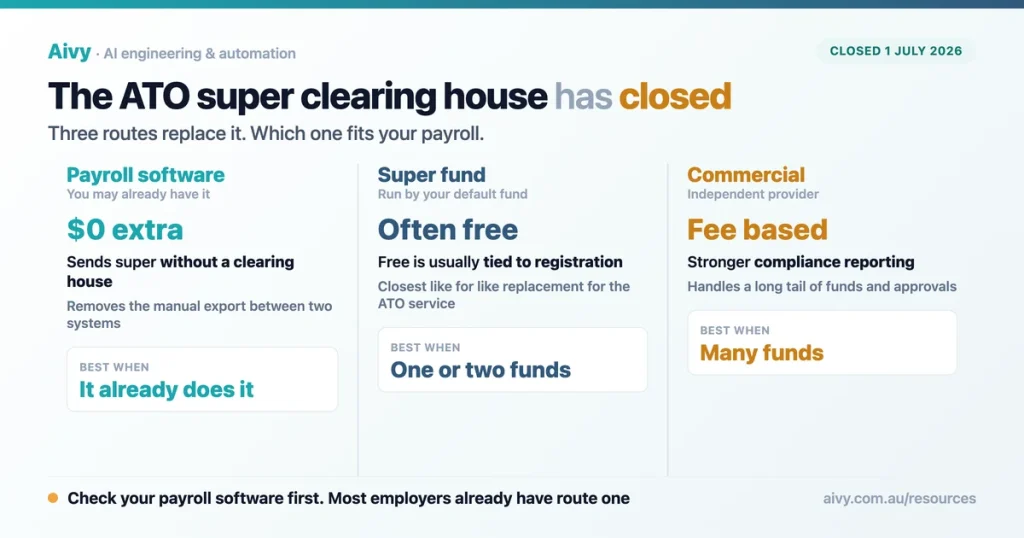
The Small Business Superannuation Clearing House shut on 1 July 2026. If you were one of the many Australian employers who used the free ATO service to pay super to several funds at once, that option is gone, along with the login and the transaction history behind it. This is not a warning about something coming. It already happened.
I run growth at Aivy, an AI automation agency in Melbourne, and most of the advice still circulating on this is stale. It was written before July and tells you how to prepare for a closure that has been and gone. What Australian employers need now is different: which replacement to actually use, what it costs, and what breaks in the payroll handover.
This guide covers the three routes open to you, what each one charges, and how to choose between them based on your payroll size and how many funds your staff belong to. It stays deliberately on the operational side. For the rule itself, the ATO is the source and I link it below rather than paraphrase it. If admin load is the real problem, our guide to AI tools for Australian accountants covers the wider stack.
Why the free clearing house went away
The ATO retired the service because it was built for a quarterly world. Super used to be payable four times a year, and a batch tool that ran on that rhythm was fine. Payday Super moves contributions to the same cadence as wages, and the old service was not designed for that frequency.
The wind down was staged rather than sudden, and the people who felt it first were the bookkeepers and accounting practices running payments on behalf of clients. New employers could not register from 1 October 2025. From midnight AEST on 30 June 2026, existing users lost the ability to log in, submit payment instructions or view records. The ATO published its own transition guidance for employers who had not moved.
| Date | What changed |
|---|---|
| 1 October 2025 | New employers could no longer register for the service |
| Midnight AEST 30 June 2026 | Login, submissions and record access switched off |
| 1 July 2026 | Service closed. Transaction history no longer retrievable |
Dates per the ATO’s published closure and transition guidance, checked 9 August 2026.
The three replacement routes employers have
The ATO’s own guidance points employers in three directions rather than naming a successor, which is the correct thing for a regulator to do and also the reason there is no obvious answer. You can use payroll software that already sends super, a clearing house operated by a super fund, or an independent commercial clearing house.
Most small employers discover they already have the first one and never switched it on. If your payroll product handles SuperStream messages, the clearing house was a habit rather than a necessity. Before you shop for anything, check what you are already paying for, the same principle we apply when auditing tool spend for professional services firms.
| Route | Typical cost | Best when |
|---|---|---|
| Payroll software | Already in your licence | You run payroll in software that sends super |
| Super fund clearing house | Often free to registered employers | Staff cluster in one or two funds |
| Commercial clearing house | Fee based, varies by provider | Many funds, high turnover, audit needs |
Payroll software that already sends super
This is the cheapest route by a distance, because you are not buying anything. If your payroll system is SuperStream capable, it can package the contribution data and the payment together without a separate clearing house step. The saving is not only the fee, it is the removal of a manual handover between two systems.
The handover is where the errors live. Every time someone exports a file from payroll and uploads it somewhere else, there is a chance of a stale fund number, a missed new starter or a duplicated batch. Under a payday cadence you do that far more often, so a small error rate compounds. We wrote about the wider cost of that pattern in our guide to rostering and payroll platform costs, and it is exactly what finance automation is for.
How often the handover runs, quarterly against payday
Contribution events per year on a weekly, fortnightly and monthly pay cycle, against the old quarterly model. Higher means more chances to get it wrong.
A weekly payroll goes from four contribution events a year to fifty two. Any step you do by hand now happens thirteen times as often, which is the real argument for letting payroll send super directly.
Clearing houses run by super funds
Several Australian super funds operate their own clearing house and offer it free to employers registered with them. You pay staff super to multiple funds through one portal, and the fund carries the cost because it wants to be your default fund. For a small employer whose team sits mostly in one fund, this is usually the closest replacement to what the ATO service did.
The trade off is that you are inside one fund’s software, and the experience for contributions going out to other funds is not always as good as for its own. Check how it handles new starters with an unfamiliar fund, and whether it gives you a receipt you can reconcile. Reconciliation is where this quietly becomes an accounting problem rather than a payroll one, which is why Xero integration comes up in almost every one of these conversations.
| Ask before you commit | Why it matters |
|---|---|
| Is it free if we are not your default fund? | The free offer is usually tied to being registered with them |
| How long do payments take to reach other funds? | Under a payday cadence, settling time is the whole game |
| What happens with a new starter’s fund? | Onboarding friction is where batches fail |
| Can we export a reconcilable receipt? | Your accountant will need it at year end |
Commercial clearing houses and what they charge
Independent clearing houses sit at the other end. They charge a fee, and in exchange tend to offer stronger compliance reporting, better handling of many funds and more control over batching and approvals. The ATO’s own guidance describes them as generally offering more advanced features with fees attached.
Whether that is worth paying for is a function of complexity rather than size. Twelve staff spread across ten funds with regular turnover is a harder problem than forty staff in two funds. If you are in the first situation, the reporting alone can justify the fee. If you are in the second, you are probably buying features you will not use, which is the same trap we describe in our guide to what AI consulting actually costs.
| Factor | Points to fund clearing house | Points to commercial |
|---|---|---|
| Number of funds | One or two dominant | Many, long tail |
| Staff turnover | Low and stable | High, seasonal or casual |
| Audit and reporting | Basic receipts are enough | You need an evidence trail |
| Approvals | One person pays | Maker and checker required |
What Payday Super changes about your deadline
The reason any of this matters is timing. Under the old model, contributions followed a quarterly deadline and a clearing house that batched them up made sense. Aligning super with each pay event removes the slack that quarterly batching provided, so a process that took two days to settle is no longer harmless.
That makes settlement speed a selection criterion rather than a detail, in the same way it does for any recurring accounts payable run. Ask each candidate how long money takes to land in the receiving fund, not how long it takes to leave you. The ATO sets out the employer obligations on its Payday Super resources, and it is worth reading the rule from the regulator rather than from a vendor blog.
Run one full pay cycle through whichever replacement you have chosen, before you need it to work under pressure. Confirm the money arrived in every fund, not just that the batch was accepted. A batch that is accepted and then partially rejected is the failure mode that catches people out, and you want to find it on a quiet week.
The records you cannot get back
One consequence of the closure is easy to miss until an audit. Transaction history held in the old service stopped being retrievable after it closed, so if you did not download your records before 30 June 2026, that history is not sitting somewhere waiting for you.
If you are in that position, your evidence now comes from your own bank statements, your payroll reports and the receiving funds. It is recoverable, but it is manual, and it is the sort of reconstruction that eats a bookkeeper’s week. Keeping an exportable audit trail from here on is the lesson, and it is the same discipline we argue for in our compliance playbook and support with document automation.
| If you need to prove a past contribution | Where to look now |
|---|---|
| The payment left your account | Bank statements for the period |
| The amount was correct | Payroll reports and payslips |
| It reached the employee’s fund | The receiving fund, employee by employee |
Choosing by payroll size and fund spread
The decision rule is simpler than the market makes it look. Start with what your payroll software already does. If it sends super, stop there. If it does not, count how many distinct funds you pay into. One or two points to a fund operated clearing house. A long tail points to a commercial one.
Size matters less than spread, which is the part people get wrong. A twenty person hospitality business with high casual turnover can be a harder case than a fifty person office with a stable team, because every new starter brings a fund. If you want a structured look at where your payroll admin time actually goes, our readiness assessment is a reasonable starting point, and our ROI calculator puts a number on the manual hours.
| Your situation | Start with |
|---|---|
| Payroll software already sends super | Use it, change nothing |
| Staff mostly in one or two funds | Your default fund’s clearing house |
| Many funds, casual heavy roster | A commercial clearing house |
| Still exporting files by hand | Fix the handover before the tool |
Frequently asked questions about super clearing houses
Has the ATO clearing house closed?
Yes. The Small Business Superannuation Clearing House closed on 1 July 2026. Access to logins, submissions and records ended at midnight AEST on 30 June 2026, and new registrations had already stopped on 1 October 2025.
What replaced the SBSCH?
Nothing single replaced it. The ATO points employers to three options instead: payroll software that already sends super, a clearing house operated by a super fund, or an independent commercial clearing house.
Is there still a free super clearing house in Australia?
Often yes, through super funds. Several funds provide a clearing house at no cost to employers registered with them, though the free offer is typically tied to that registration rather than being open to anyone.
Do I need a clearing house at all?
Not if your payroll software sends super directly under SuperStream. Many small employers used the ATO service out of habit rather than necessity, and removing the extra step also removes a manual handover.
Can I still get my old transaction history?
No. Transaction history stopped being retrievable when the service closed. If you did not download records before 30 June 2026, you will need to reconstruct evidence from bank statements, payroll reports and the receiving funds.
What does Payday Super change for employers?
It aligns super contributions with each pay event rather than a quarterly deadline, which removes the slack that quarterly batching allowed. Settlement speed becomes a real selection criterion. Read the obligations on the ATO’s own pages.
How do I choose between a fund and a commercial clearing house?
Count the distinct funds you pay into rather than your headcount. One or two dominant funds usually favour a fund operated service. A long tail of funds, or high casual turnover, favours a commercial provider with stronger reporting.
Do I need a developer to set this up?
No. This is configuration and testing rather than code. The part worth getting help with is the reconciliation between payroll, your bank and the receiving funds, which is the kind of join our document automation guide covers.
Where this leaves Australian employers
The closure was not really about a clearing house. It was about a payment rhythm changing, and a free tool built for the old rhythm being retired rather than rebuilt. The employers who will find this easy are the ones whose payroll already sends super, because for them nothing structural changed at all.
A Melbourne hospitality operator we spoke with had used the ATO service for years and assumed their payroll product could not do it. It could. The whole migration took an afternoon and removed a monthly export they had been doing by hand since 2019. The hard part was not the software, it was nobody having checked.
If you want someone to look at your payroll and super handover before the next pay run, that is ordinary work for us. We are Aivy, an AI and automation team working with Australian businesses, and most of what we do sits exactly in these joins between systems. Our consulting team can take a look, or you can book a discovery session.
Last updated: 9 August 2026. Closure dates and the three replacement routes are taken from the ATO’s published guidance and were checked on that date. This is general information about software and process choices, not financial or legal advice, and it does not attempt to restate your obligations. For those, read the ATO directly.
Sources
ATO, how to transition from the Small Business Superannuation Clearing House: the three replacement routes open to employers, namely existing payroll software, super fund operated clearing houses and commercial clearing houses, and the characterisation of commercial providers as fee based with more advanced features.
ATO Small Business Newsroom, the clearing house is closing: the closure date of 1 July 2026, the end of new registrations on 1 October 2025, the loss of access at midnight AEST on 30 June 2026, and the warning that transaction history would not be retrievable afterwards.



