
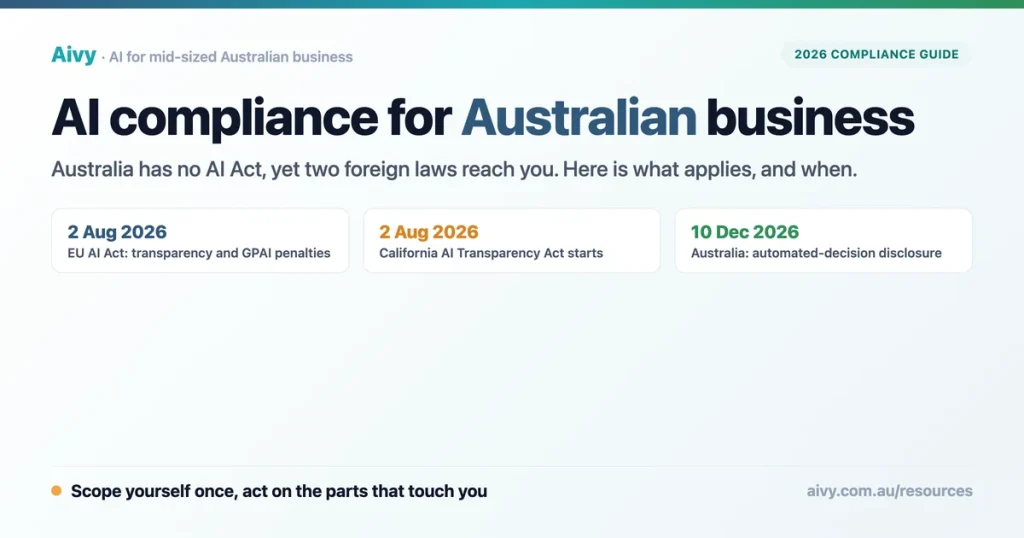
Most owners I speak to around Melbourne and Sydney have heard there is “no AI law in Australia yet” and quietly filed AI compliance under “not my problem”. That is half right and it is the dangerous half. There is no Australian AI Act.
There is also no border around the laws that other places have already passed, and some of those reach straight into an Australian business that never sells a thing in Europe or California. We see this constantly with the teams we work with in Melbourne and Sydney.
I run editorial and growth at Aivy, an AI consultancy that helps mid-sized Australian businesses put AI to work without walking into avoidable risk. The question I get most often is simple: does any of this actually apply to me, and if so, what do I have to do. The honest answer is that it depends on three things, and you can check all three in about ten minutes.
This guide lays out the three dates that matter for an Australian business, explains who each one catches in plain English, and gives you a downloadable checklist you can work through with your team. I have kept it deployer first, because most mid-sized firms use AI tools rather than build their own models, and the duties are very different for the two.
Why two foreign AI laws land on Australian businesses on the same day
2 August 2026 is a genuine pinch point. It is the general application date of the EU AI Act, the day most of the regulation starts to apply, including the transparency duties that affect anyone running a chatbot or a content generator. By coincidence of timing, it is also the day California’s AI Transparency Act becomes operative after a recent delay. Two of the world’s most consequential AI laws switch on together, and they stay on.
Australia sits outside both, on paper. We chose a technology-neutral path that leans on the laws we already have rather than a dedicated AI Act. But “outside” is not the same as “untouched”. Both foreign laws are written to follow the activity, not the company’s postcode, so an Australian business can be in scope without any European or Californian office at all.
Three deadlines, one timeline
Dates from the EU AI Act Article 113 timeline, California AB 853, and the OAIC. *The 2 Dec 2027 high-risk date is the postponement under the Digital Omnibus, approved by the European Parliament (16 June 2026) and the Council (29 June 2026) published in the Official Journal as Regulation (EU) 2026/1744 on 24 July 2026 and in force since 27 July.
If you are reading this after 2 August 2026, none of it has expired. Both laws are now in force, this checklist still tells you exactly which obligations apply to you, and two more dates are still ahead: the Australian automated-decision disclosure on 10 December 2026, and the EU high-risk rules now set for December 2027. Scoping yourself is just as useful the day after a deadline as the week before.
Australia has no AI Act, so what actually binds you right now
This is the part the headlines get wrong. Australia’s National AI Plan, released in December 2025, confirmed a technology-neutral approach. The previously floated mandatory guardrails for high-risk AI were not adopted. The new Australian AI Safety Institute, backed by a 29.9 million dollar commitment, monitors and advises but has no power to fine you. The Voluntary AI Safety Standard and its ten guardrails are exactly that, voluntary.
What does bind you is the law you already live under. The Privacy Act 1988 and the Australian Privacy Principles apply to any personal information you put into an AI tool and to any AI output that contains personal information. Since those obligations sit in privacy law rather than an AI statute, the work lands in an AI policy that turns the duties into staff rules.
Australian Consumer Law still bans misleading content, whether a human or a model wrote it. If you want the deeper version of the domestic picture, we wrote a full Privacy Act 1988 AI compliance playbook that pairs with this checklist, and our AI consulting and strategy team helps map it to your business.
The verdict for Australia
Binds you today: the Privacy Act 1988 and the Australian Privacy Principles, for any personal information you put into an AI tool and any AI output that contains personal information. Australian Consumer Law, which still bans misleading content whether a human or a model wrote it.
Does not bind you: the Voluntary AI Safety Standard and its ten guardrails. The mandatory guardrails for high-risk AI that were previously floated were not adopted.
Cannot fine you: the Australian AI Safety Institute, backed by a 29.9 million dollar commitment, monitors and advises only.
Does the EU AI Act reach your Australian business
The EU AI Act applies beyond Europe by design. Article 2 catches non-EU businesses three ways. You are in scope if you place an AI system or a general-purpose AI model on the EU market, if you have an establishment in the EU that uses AI, or, the one that surprises people, if the output your AI produces is used in the EU even though you operate only from Australia.
That third trigger is broad. A Brisbane firm that screens European job applicants, or an agency whose AI writes content read by EU customers, can be caught. So the first job is not to read 113 articles of regulation. It is to answer three questions honestly. If the honest answer is that you are not sure, AI advisory services can work through them with you before the deadline.
Provider or deployer: the difference that changes your duties
The single most useful distinction in the EU AI Act is provider versus deployer, because the duties are worlds apart. A provider builds an AI system or puts it on the market under its own name. A deployer simply uses a vendor’s tool in the course of business. Most mid-sized Australian firms are deployers, and that is the lighter end of the obligations.
There is a trap worth flagging. If you white-label a tool under your own brand, or substantially modify it, you can quietly become a provider and inherit the heavier risk-management, documentation and conformity duties. A quick way to see where you sit across every tool you use is our free AI readiness assessment. The table below is the plain-English version of who does what.
| If you are a… | You typically… | Core duty under the EU AI Act |
|---|---|---|
| Deployer (most firms) | Use a vendor AI tool as is | Use it per instructions, keep human oversight, be transparent about AI to your users |
| Provider | Build, brand or substantially change a system | Risk management, technical documentation, conformity assessment, plus all transparency duties |
What is already live: AI literacy and prohibited practices
Two parts of the EU AI Act have applied since 2 February 2025, and they catch deployers, not just builders. The first is an AI literacy duty: you must make sure staff and anyone operating AI on your behalf understand it to a reasonable level. The second is the ban on certain prohibited practices, such as some forms of social scoring, manipulative or exploitative AI, and untargeted scraping of facial images.
For an Australian deployer in scope, AI literacy is the easy win you can start today. A short, documented training session for the team that uses AI tools is the kind of evidence that matters if anyone ever asks. It also tends to improve how well staff actually use the tools, which is the reason I push clients to do it regardless of the law.
The 2 August 2026 deadline, and the postponement you must check
Here is where current beats stale. Plenty of older articles tell you that high-risk AI rules hit on 2 August 2026. For most readers that is now wrong. What genuinely applies from that date is the rest of the regulation’s general obligations, including the Article 50 transparency duties: telling people when they are dealing with an AI system, and marking AI-generated audio, images, video or text as artificially produced.
The power to fine general-purpose AI model providers also becomes exercisable from this date. If you run a customer-facing bot, our AI chatbot development work bakes these disclosures in by default.
The high-risk system obligations, the heavier set tied to areas like recruitment and credit, have been postponed under the EU’s Digital Omnibus.
It reached political agreement in May 2026 and was then approved by the European Parliament on 16 June 2026 and the Council on 29 June 2026, shifting standalone high-risk duties to December 2027. It was published in the Official Journal as Regulation (EU) 2026/1744 on 24 July 2026 and took effect on 27 July, so December 2027 is now the operative date.
| EU AI Act obligation | Applies from | Where it stands |
|---|---|---|
| Article 50: tell people when they are dealing with an AI system | 2 August 2026 | General application date |
| Article 50: mark AI-generated audio, images, video or text as artificially produced | 2 August 2026 | General application date |
| Power to fine general-purpose AI model providers | 2 August 2026 | Becomes exercisable from this date |
| High-risk system obligations, tied to areas like recruitment and credit | December 2027 | Postponed under the Digital Omnibus, in force since 27 July 2026 |
The postponement was approved by the European Parliament on 16 June 2026 and the Council on 29 June 2026. Sources: EU AI Act Article 113 timeline and the European Commission AI regulatory framework.
California’s AI Transparency Act: the second foreign law most owners miss
California’s AI Transparency Act becomes operative on the same day, 2 August 2026, after an amendment moved it from January. It targets a “covered provider”, defined as a generative AI system with more than one million monthly users or visitors that is publicly accessible within California. There is no requirement that your company be based in the United States, so a popular Australian AI product can be caught.
If that is you, the duties are concrete. You must publish a free AI detection tool, embed an invisible disclosure in AI-generated image, audio and video that carries your system name and a timestamp, and offer users a visible “AI generated” label. You also have to write disclosure-maintenance terms into licensee contracts and be able to cut off a licensee within 96 hours of finding they switched disclosures off.
The same transparency instinct sits behind both this law and the EU’s Article 50, which is why getting your content-labelling right solves two problems at once. Law firms and consultancies feel this first, which is why we cover it for professional services firms and in our guide to AI tools for Australian lawyers.
Your domestic clock: the 10 December 2026 automated decision disclosure
The one hard Australian date on this list comes from the Privacy and Other Legislation Amendment Act 2024. From 10 December 2026, new transparency obligations under Australian Privacy Principle 1 require entities to disclose in their privacy policy where a computer program uses personal information to make decisions that could significantly affect a person’s rights or interests.
In practice, if you use AI or automation in hiring, credit, insurance, eligibility or pricing, you will need a clear paragraph in your privacy policy explaining that. The OAIC also recommends not entering personal, and especially sensitive, information into publicly available generative AI tools, and running a privacy impact assessment before you deploy. Finance teams feel this first, which is why we cover it in our guide to AI tools for Australian accountants and for healthcare and medical practices that handle sensitive records.
The verdict: the one hard Australian date
Date: 10 December 2026, under the Privacy and Other Legislation Amendment Act 2024.
What you must do: disclose in your privacy policy where a computer program uses personal information to make decisions that could significantly affect a person’s rights or interests.
Who it catches: anyone using AI or automation in hiring, credit, insurance, eligibility or pricing.
Also recommended by the OAIC: do not enter personal, and especially sensitive, information into publicly available generative AI tools, and run a privacy impact assessment before you deploy.
The checklist: work out exactly what applies to you
I built the checklist below so a non-lawyer owner can work through it with their team. The one-page summary puts all three deadlines on a single sheet, colour coded by jurisdiction, with a short “does this apply to me” strip. The downloadable version goes further: a second page with a full, tick-box action list for each law, so you can assign owners and tick items off. Save it, print it, or hand it to whoever owns risk in your business.

Free, no sign-up. Want us to run it against your business in 30 minutes? Book a readiness call.
If you only do the high-value items first, start here. Map every AI tool you use and mark whether you are a deployer or a provider. Confirm whether any output reaches the EU. Confirm whether any public AI feature is reachable from California. Run a short AI literacy session and keep the record. Review what your chatbot and any AI-generated content disclose. Update your privacy policy for automated decisions. Then size your exposure, which is the next section.
Sizing your real financial exposure under each law
The numbers are worth knowing because they are calculated on worldwide turnover, not local revenue. Under the EU AI Act, prohibited practices carry the top tier, then high-risk and operator non-compliance, then misleading information to authorities. The lower amount applies for SMEs and start-ups.
California works differently, at a fixed civil penalty per violation, with each day of non-compliance counted as a separate violation. If you want to put a dollar figure on the upside of getting ready, our free AI business audit is a quick way to see where AI sits in your operations.
EU AI Act maximum fines by breach type
Euro ceiling or percentage of worldwide turnover, whichever is higher. Source: EU AI Act Article 99.
California’s penalty is $7,100 per violation, and because each day counts separately, a disclosure you never fix becomes an accruing problem rather than a one-off fine. None of this is meant to frighten you into buying anything. It is meant to help you decide, calmly, which checks are worth doing this quarter. For most Australian deployers, the transparency and privacy items are both cheap and the ones most likely to apply.
Where this leaves mid-sized Australian businesses
The takeaway is not “panic”, it is “scope yourself once and act on the parts that touch you”. A business with no EU output and no public generative AI feature has a short list: the 10 December 2026 privacy update and good basic governance. A business that screens EU applicants or runs a popular AI chatbot has real work to do, and it is very doable with a plan, whether the date is still ahead or already behind you.
I worked with a mid-sized Melbourne services firm that assumed none of this applied because they are “just an Australian company”. Twenty minutes of scoping showed their AI screening tool was assessing candidates in two EU countries. They were a deployer, the fixes were modest, and they finished calm rather than caught out. That is the entire point of doing this early, or catching up quickly if you are late.
If you want a hand, that is what we do. We are Aivy, an AI consultancy for mid-sized Australian businesses, and we help teams scope their exposure and put the practical controls in place. You can book a 30-minute AI compliance readiness call and we will walk your specific situation against this checklist.
Frequently asked questions about the EU AI Act in Australia
Does the EU AI Act apply to Australian businesses?
Yes, it can. The EU AI Act applies to an Australian business if it places an AI system on the EU market, has an EU establishment that uses AI, or produces AI output that is used in the EU. You can be in scope with no European office at all.
What happens on 2 August 2026 under the EU AI Act?
2 August 2026 is the EU AI Act’s general application date. Most provisions start, including Article 50 transparency duties to tell people they are dealing with AI and to label AI-generated content, plus the power to fine general-purpose AI model providers.
Is there an Australian AI Act businesses must comply with?
No. Australia has no dedicated AI Act. Its National AI Plan takes a technology-neutral approach, relying on existing laws like the Privacy Act 1988 and Australian Consumer Law, plus a voluntary AI safety standard rather than mandatory AI-specific rules.
Does California’s AI Transparency Act apply to Australian companies?
It can. The law covers any generative AI system with more than one million monthly users that is publicly accessible in California, with no requirement to be based in the United States. A widely used Australian AI product could be a covered provider.
What is the 10 December 2026 Australian privacy deadline?
From 10 December 2026, new Australian Privacy Principle 1 obligations require businesses to disclose in their privacy policy where automated decision-making using personal information could significantly affect a person. It comes from the Privacy and Other Legislation Amendment Act 2024.
What are the EU AI Act fines for non-compliance?
Fines run up to 35 million euro or 7% of worldwide turnover for prohibited practices, up to 15 million euro or 3% for high-risk or operator breaches, and up to 7.5 million euro or 1% for misleading authorities, whichever amount is higher.
Do I need to label my chatbot as AI in Australia?
If the EU AI Act reaches you, yes, Article 50 requires telling people they are interacting with an AI system from 2 August 2026. Even where it does not, clear AI disclosure is good practice and supports Australian Consumer Law and privacy obligations.
Last reviewed 13 August 2026. This article is general information, not legal advice. For your specific obligations, confirm against the primary sources below or seek professional advice.
Last updated: 13 August 2026
Sources
- EU AI Act, Article 113 application timeline for what applies on 2 February 2025, 2 August 2026 and 2 August 2027, and for the Article 50 transparency start date.
- Regulation (EU) 2024/1689 on EUR-Lex for the Article 2 extraterritorial scope and the Article 99 fine ceilings.
- European Commission AI regulatory framework for the Digital Omnibus postponement of high-risk obligations to December 2027, published as Regulation (EU) 2026/1744 on 24 July 2026 and in force since 27 July.
- California AB 853 for the 2 August 2026 operative date and the covered-provider transparency and detection-tool duties. Converted at 1 USD = 1.42 AUD, 11 August 2026.
- OAIC APP 1 guidance for the 10 December 2026 automated decision-making disclosure obligation.
- Australian Government National AI Plan for Australia’s technology-neutral approach and the role of the AI Safety Institute.



