
Somewhere in your business this week, someone pasted a client’s details into ChatGPT to save themselves twenty minutes. They were not being reckless. They had a deadline, the approved tool was slower or did not exist, and nobody had ever told them where the line sat. That behaviour has a name now, it has been measured in Australia twice this year, and from 10 December 2026 it runs into a Privacy Act obligation that most businesses have not read.
I run growth at Aivy, an AI automation agency in Melbourne, and this is the conversation I have most often with operations and compliance leads. It almost never starts as a security question. It starts with someone noticing an unfamiliar AI subscription on an expense claim, or a document that reads like nobody in the building wrote it. By the time it surfaces, the practice is usually months old and far more widespread than anyone expected.
This guide covers what shadow AI actually is and why it behaves differently from shadow IT, how common it is in Australian workplaces according to two surveys that disagree, what a breach involving it costs, what the OAIC has already said, and what changes on 10 December. Then the practical half: how to find out what your team is using, and what a policy that people actually follow looks like. The quick pick below carries the short version if you only read one thing.
Sources: YouGov for ELMO Software, January 2026, and IBM Cost of a Data Breach reported by Cybersecurity Dive. Converted at 1 USD = 1.42 AUD, 11 August 2026.
What shadow AI is, and why it is not just shadow IT
Shadow AI is employees using AI tools the business has not approved, with the business’s data. The name borrows from shadow IT, the decade old problem of staff moving work into personal Dropbox accounts and WhatsApp groups because the sanctioned option was painful. The behaviour rhymes. The consequences do not.
With shadow IT, the data is still a file sitting in a place. You can find it, you can revoke access, you can delete it and prove you deleted it. With shadow AI, the data is pasted into a prompt. It leaves as text, it may be retained, it may train a model depending on which account tier that person was signed into, and there is no file to pull back. In most cases you cannot even reconstruct what was sent.
What I have found useful with clients is splitting it into three kinds, because they need different responses. The first is an unapproved tool, someone using ChatGPT when the company standard is Copilot. The second is an approved tool used through an unapproved account, where the business has an enterprise agreement but an individual is signed into their personal free tier.
That second one is the most common and the hardest to spot. The third is an unapproved automation, where someone connects an agentic AI tool to a business system with their own API key.
That last row is the one that surprises people, and there is now data behind it rather than just my anecdotes. I will come back to it, because it changes who you need in the room when you write the policy.
How much shadow AI is really happening in Australian workplaces
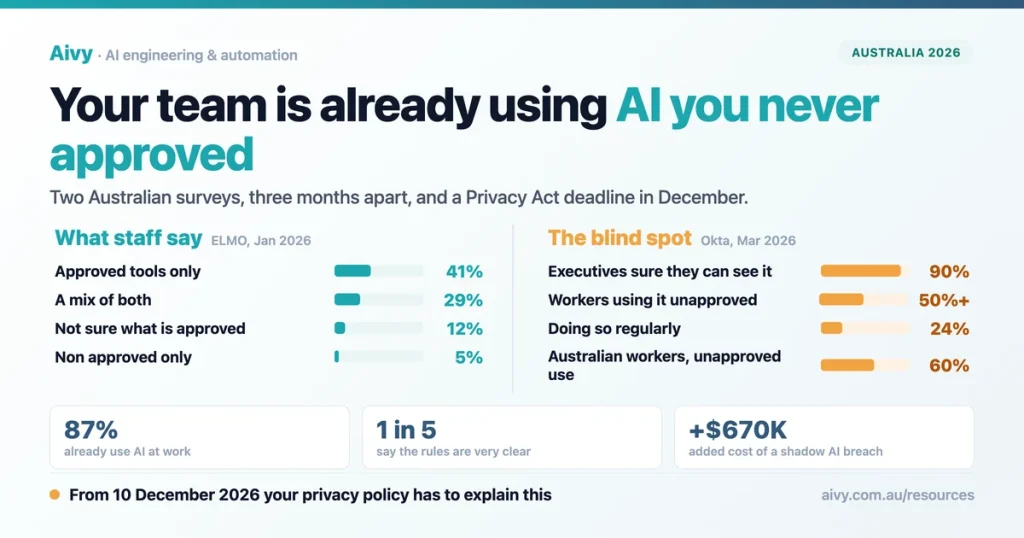
Two credible surveys measured this in Australia within three months of each other and landed a long way apart. YouGov, commissioned by ELMO Software, surveyed 1,055 Australian employees in January 2026 and found that 29% use a mix of approved and non approved AI tools while a further 5% use only non approved ones. That is 34% touching tools their employer has not sanctioned. Another 12% said they were not sure what was approved in the first place.
What Australian employees say they are actually using
Share of respondents, axis 0 to 100%. Source: YouGov for ELMO Software, 1,055 Australian employees aged 18 to 64, fieldwork 5 to 13 January 2026, weighted to ABS population estimates.
Then in March 2026, Apprize360 surveyed 784 executives and knowledge workers across seven countries for Okta and found that 60% of Australian workers reported unapproved AI use, putting Australia second of the seven. Same country, same year, nearly double the number. Publishing a sanctioned list is what closes that gap, and for most Australian teams it starts with ChatGPT, Claude and Copilot compared.
The gap is not sloppiness, it is population and phrasing. ELMO surveyed employees broadly and asked what tools they use. Okta surveyed knowledge workers, the group whose whole job is the kind of drafting and summarising that AI is good at, and asked about unapproved use directly.
Both numbers are real measurements of slightly different questions. The practical read for an Australian business is that the honest range sits somewhere between a third and three fifths of your staff, and that whichever end you assume, the 12% who do not know what is approved are yours to fix immediately.
Treat any prevalence figure as a floor, not a ceiling. Self reported surveys undercount behaviour people suspect is against the rules, and the group who cannot name the policy is the group most likely to breach it by accident.
Your leadership team believes it can see this, and it cannot
The most useful finding in the Okta research is not about employees at all. It is that 90% of executives said they were confident in their organisation’s visibility into which AI tools are being used, while more than half of knowledge workers admitted using AI tools without approval and 24% said they do it regularly. In the United Kingdom the gap was widest, with 96% of executives confident and over half of workers using unapproved tools anyway.
The visibility gap between the top floor and the desk
Share of respondents, axis 0 to 100%. Source: Apprize360 for Okta, AI Agents at Work 2026, 292 executives and 492 knowledge workers across seven countries, March 2026.
I bring this up first in every workshop, because a leadership team that believes it already has visibility will approve a policy and consider the problem closed. The policy then lands on people who have been quietly solving their own workflow problems for a year, and nothing changes except that the practice moves further out of sight. Confidence is the risk, not ignorance. If you would rather test that assumption than trust it, our AI readiness assessment is a quick place to start.
What actually gets pasted, and why people do it
In Australian businesses the pattern is consistent enough to predict. An accountant pastes a client trial balance in to draft a management report. A lawyer pastes a contract to get a summary. A developer drops a block of proprietary code into a free assistant to find a bug, which is its own risk given how differently these models handle code security. Someone in marketing uploads a spreadsheet of customer names and email addresses to build a segment. Someone in HR pastes a stack of CVs to shortlist them.
None of that is sabotage. The ELMO research found that 87% of employees are already using AI at work while only one in five say leadership expectations are very clear. When 87% of people are doing something and 20% understand the rules, you do not have a discipline problem. You have a specification problem.
What makes it dangerous in Australia specifically is the type of data involved. Client financials, contracts, CVs and customer lists are almost always personal information under the Privacy Act 1988, and in most cases the model sits on infrastructure outside Australia. That combination is what turns a productivity shortcut into a disclosure question, which we unpack in our guide to AI data residency in Australia.
What a shadow AI breach costs an Australian business
IBM’s annual Cost of a Data Breach research, built on 470 interviews across 600 organisations that suffered a breach between March 2024 and February 2025, put a number on this. One in five organisations said they had experienced a cyberattack because of security issues with shadow AI, and those organisations paid on average $951,400 more than firms with minimal shadow AI presence.
The shadow AI premium on a breach
Average additional cost versus organisations with minimal shadow AI presence. Source: IBM Cost of a Data Breach, reported by Cybersecurity Dive.
The follow on numbers explain why it costs more rather than just costing something. Of the organisations that reported breaches involving AI tools, 97% lacked proper AI access controls. In 60% of cases the attackers went on to compromise other stores of data after getting into the AI platform, and 31% suffered operational disruption. Closing those gaps usually means bringing someone in, which raises the next question: what that advice should cost you.
An unmanaged AI tool is rarely the whole breach. It is the way in. Access control here is unglamorous and mostly about who can sign in to what, the same discipline we cover for password managers in Australian businesses.
What happened in organisations breached through AI tools
Share of affected organisations, axis 0 to 100%. Source: IBM Cost of a Data Breach, reported by Cybersecurity Dive.
What the OAIC already says about pasting personal information into AI
Australian businesses often assume this area is unregulated until some future AI act arrives. It is not. The OAIC published guidance on privacy and the use of commercially available AI products, and its recommendation is unusually direct for a regulator. It says that as a matter of best practice, organisations should not enter personal information, and particularly sensitive information, into publicly available generative AI tools.
That single sentence is the whole shadow AI problem stated as a compliance position. The guidance also sets out which Australian Privacy Principles are engaged, and it is more of them than most people expect. It recommends that organisations establish policies and procedures for the use of AI systems, which is a lower bar than it sounds and one that a surprising number of businesses have not cleared.
Then there is a date. From 10 December 2026, transparency obligations for automated decision making commence under new APP 1.7 and 1.8. Your privacy policy will need to disclose the kinds of personal information used in automated decision making technology, the kinds of decisions made solely by it, and the kinds where it substantially and directly supports a decision.
The drafting is deliberately broad and captures AI enabled systems, rule based tools and automated assessment technologies alike. Businesses selling into Europe have a second timetable running alongside it, which we map in our EU AI Act checklist.
The OAIC also began its first privacy compliance sweep in January 2026, covering around 60 organisations across six sectors. The direction of travel is not subtle. If you want the full picture of what the Privacy Act now expects of AI systems, our Privacy Act 1988 compliance playbook goes through it principle by principle.
Why blocking it at the firewall does not work
The instinct, once a leadership team accepts the problem is real, is to block the domains and move on. I have watched this fail enough times to be blunt about why. Network level blocking is a binary. It can stop a request reaching a domain, but it cannot look inside what someone is about to send and remove the client name. You get all or nothing, and because the business genuinely needs these tools, nothing usually wins within a fortnight.
Blocking also only covers the traffic you control. It does nothing about the phone in someone’s pocket, the laptop at home, or the personal account someone signs into on a device your policy does not reach. What it reliably produces is displacement: the work moves to channels with even less visibility than the ones you just closed. The phone now has its own assistant too: Australians can switch on Siri AI and let it search work mail.
The only control that acts on the content rather than the connection is one that sits where the paste happens, in the browser itself. That is why the serious answers in this space are converging on a browser extension pushed by policy, which can inspect what is about to be sent and strip or flag the identifying parts before it leaves.
It is more work to deploy than a firewall rule, and it is the only approach that lets people keep using the tools while the client’s name stays in the building.
How to find out what your team is actually using
Before writing any policy, find out what is happening. Four methods have worked well for the Australian businesses I have helped, in rough order of effort.
Start with your single sign on logs and your expense system. Personal AI subscriptions show up on expense claims and corporate cards more often than people expect, and a spike in twenty dollar monthly charges is a good map of where the demand is. Then check which AI domains your network sees, not to block them, but to size the problem honestly. Knowing what each ChatGPT plan costs in Australia helps you read them.
The method that gets the truest picture, though, is the least technical. Run an amnesty survey: tell people plainly that nobody is in trouble, that you need to know what tools are genuinely useful, and that the goal is to get them a sanctioned version.
In my experience that single email surfaces more than any log review, because it converts a compliance exercise into a request for help. It also gives you the list of tools worth approving, which is the input to everything that follows. For a more structured version of the same exercise, our business audit works through it question by question.
A shadow AI policy people actually follow
The ELMO numbers point at why most AI policies fail. 87% of employees are already using AI at work, only one in five say leadership expectations are very clear, and just 14% feel strongly supported to use AI responsibly. Nearly half report limited support and 5% say they get none at all. A policy issued into that gap reads as a prohibition, and prohibitions without a sanctioned alternative are what created shadow AI in the first place.
Adoption has run far ahead of guidance
Share of Australian employees, axis 0 to 100%. Source: YouGov for ELMO Software, January 2026.
A policy that holds has three parts and fits on one page. First, a short approved list with the account people must sign in with, because the enterprise tier only protects you if someone is actually using it, and which tiers Australians can reach is its own question we cover in Claude access in Australia.
Second, a never list written in plain language: client identifying details, health information, credentials, unreleased financials. Not a category taxonomy, examples people recognise from their own desk. Third, a route to ask for a new tool that returns an answer in days rather than quarters, because a slow approval process is a shadow AI generator.
What I would avoid is a policy that leans on the word prohibited and stops there. The businesses that have got this under control did it by making the sanctioned path the easy path, then enforcing the edges. If your approved option is materially worse than the free one, people will keep choosing the free one and simply stop telling you.
What I would do in the first 30 days
If this is sitting on your desk and you want a sequence rather than a project plan, this is the order I use with clients. It is deliberately front loaded on finding out and light on tooling, because buying a control before you know the shape of the problem is how businesses end up with an expensive product nobody uses.
A 30 day sequence.
Week 1. Amnesty survey plus a scan of expense claims and single sign on logs. No enforcement, no consequences, just the list of what is genuinely in use and what people are trying to get done with it.
Week 2. Write the never list and circulate it on its own, before any policy. It is the highest value sentence in the whole exercise and it does not need approval from anyone to be useful.
Week 3. Pick and provision the sanctioned tools for the top three use cases the survey surfaced, on a tier with a data agreement, and make signing in to the right account trivial.
Week 4. Publish the one page policy, and start the automated decision making inventory you will need for 10 December 2026. Map which decisions in the business are already assisted by these tools. Include personal agents in that map, because tools like Dots, Spark and Cowork act on staff accounts rather than just answering questions.
That last item is the one people leave until November. Working out which of your decisions involve automated processing, and how personal information feeds them, takes longer than writing the privacy policy paragraph that describes it. If shadow AI is widespread, some of those decisions are running on tools that never appeared on an architecture diagram, which is exactly the problem the first three weeks are designed to surface.
Frequently asked questions about shadow AI
What is shadow AI?
Shadow AI is the use of AI tools that an organisation has not approved, with that organisation’s data. It covers unapproved tools, approved tools accessed through personal accounts, and AI automations connected to business systems without oversight.
How is shadow AI different from shadow IT?
Shadow IT moves files to services you do not control, but those files can usually be found and deleted. With shadow AI the data is pasted into a prompt, so there is typically no inventory to audit and no reliable way to retract it.
How common is shadow AI in Australia?
Two 2026 surveys put it between 34% and 60% of workers, depending on the population sampled. ELMO and YouGov found 34% of employees use non approved tools, while Okta found 60% of Australian knowledge workers reported unapproved use.
Is using ChatGPT at work against the Privacy Act?
Not automatically, but entering personal information can engage several Australian Privacy Principles. The OAIC recommends as best practice that organisations do not enter personal information, particularly sensitive information, into publicly available generative AI tools.
What changes on 10 December 2026?
Transparency obligations for automated decision making commence. Privacy policies will need to disclose the kinds of personal information used in automated decision making, and the kinds of decisions made solely or substantially with it.
Does blocking AI websites solve shadow AI?
Rarely. Network blocking is all or nothing, cannot inspect what is about to be sent, and does not reach personal devices. It typically displaces the behaviour to channels with even less visibility rather than stopping it.
What does a shadow AI breach cost?
IBM’s Cost of a Data Breach research found organisations affected by shadow AI paid on average $951,400 more than those with minimal shadow AI presence. One in five organisations reported an attack tied to shadow AI security issues.
Do I need to ban AI tools to stay compliant?
No, and bans tend to backfire. A short approved list, a plain language list of what must never be pasted anywhere, and a fast route to request new tools usually reduces risk more than a prohibition does.
Where should a small Australian business start?
Start with an amnesty survey and a review of expense claims for personal AI subscriptions. Knowing which tools are genuinely in use, and what people are trying to achieve, is the input to every other decision.
The bottom line for Australian businesses in 2026
Shadow AI is not a discipline problem and it is not a technology problem. It is what happens when adoption runs ahead of guidance, which the Australian data shows plainly: 87% of employees already using these tools, one in five clear on what is expected of them. The gap between those two numbers is where your exposure lives, and it closes with specification rather than prohibition.
A professional services client of ours in Melbourne ran the amnesty survey expecting to find two or three tools. They found eleven, including one that had been quietly summarising client correspondence for months. Nobody was disciplined. They approved four, blocked two outright, and had a one page policy circulating within three weeks. The value was not the policy, it was finally knowing.
If you want help working out what is actually running in your business, or getting the automated decision making inventory done before December, that is the kind of work we do at Aivy. You can see how we approach it or book a short call and we will talk through where to start. Whatever you do, start by finding out. Everything useful follows from that, and nothing useful precedes it.
Last updated: 11 August 2026. Prevalence figures reflect the ELMO and Okta surveys as published in 2026; the automated decision making obligations described here commence on 10 December 2026.
Sources
ELMO Software, Shadow AI on the rise as workplace guardrails lag behind: 41% approved tools only, 29% a mix, 5% non approved only, 12% unsure; 87% using AI at work, one in five say expectations are very clear, 14% strongly supported, 45% limited support, 5% none. YouGov, 1,055 Australian employees aged 18 to 64, fieldwork 5 to 13 January 2026, weighted to ABS estimates.
The Register, on Okta’s AI Agents at Work 2026: 60% of Australian workers reported unapproved AI use, second of seven countries; 90% of executives confident in visibility; over 50% of knowledge workers used unapproved tools, 24% regularly. Apprize360, 292 executives and 492 knowledge workers, March 2026.
Cybersecurity Dive, on IBM’s Cost of a Data Breach: one in five organisations reported an attack due to shadow AI security issues, at an average $951,400 more; 97% of AI breached organisations lacked AI access controls; 60% saw other data stores compromised; 31% operational disruption. 470 interviews across 600 organisations, breaches from March 2024 to February 2025.
OAIC, Guidance on privacy and the use of commercially available AI products: the best practice recommendation not to enter personal information, particularly sensitive information, into publicly available generative AI tools; the APPs engaged, including APP 6, APP 8 and APP 11; the recommendation to establish policies and procedures for AI use.
Lander & Rogers, Australian privacy law update for APP entities in 2026: the 10 December 2026 commencement of automated decision making transparency under APP 1.7 and 1.8, what privacy policies must disclose, the breadth of technologies captured, and the OAIC compliance sweep of around 60 organisations from January 2026.



