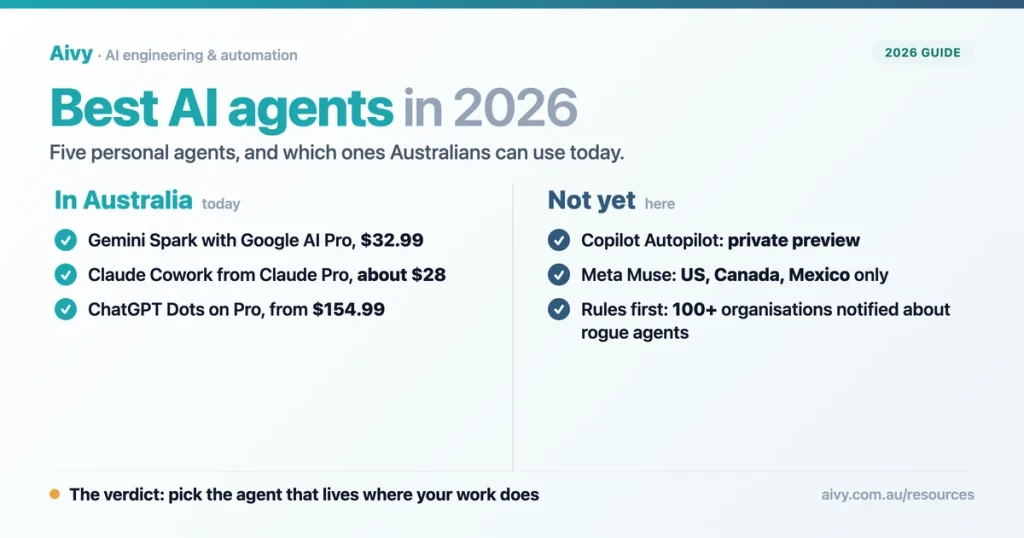
Five of the biggest names in AI now sell a personal agent: software that does not just answer, but opens a browser, reads your inbox, books things and keeps working after you close the laptop. Google has Gemini Spark, OpenAI has Dots, Anthropic has Claude Cowork, Microsoft has Copilot Autopilot and Meta has Muse. They all launched or changed in the last three months, and they are not all available here.
I run growth and editorial at Aivy, an AI automation agency in Melbourne, and “which agent should we give our team” has replaced “which chatbot” as the question I hear most from clients. The honest answer depends less on which model is smartest and more on where your work already lives, what each agent can touch and what it costs in Australian dollars.
This guide compares the five agents, plus Anthropic’s new Claude Duet, from an Australian point of view: what each one does, whether you can use it here today, what it costs, and the risks that have already shown up in Australia. The quick pick gives you the short answer. The sections below give you the detail, a cost chart and a simple way to choose.
What an AI agent is, and how it differs from a chatbot
A chatbot waits for a question and answers it. An AI agent takes a goal and works towards it on its own: it plans steps, opens apps, reads and writes documents, and comes back when it needs approval or when the job is done. The agents in this guide also keep going when you are not watching, which is what makes them useful and what makes them risky.
The difference matters for a business because an agent acts with your access. If it can read your inbox and your shared drive, it can also send from them. That is why the rules you set before switching one on matter more than the model underneath, and why it is worth checking your AI readiness before rolling one out across a team.
| AI chatbot | AI agent | |
|---|---|---|
| Starts with | A question | A goal |
| Does | Writes an answer | Plans, clicks, writes, sends, books |
| Works when you leave | No | Yes |
| Reaches your apps | Rarely | Email, calendar, files, browser |
| Main risk | A wrong answer | A wrong action taken in your name |
The best AI agents in Australia at a glance
The six agents chase the same idea but land in very different places for an Australian buyer. Two are already part of plans you can buy here, one is included in every paid plan of its maker, one is still in preview and two are not available in Australia at all. The table below is the version I wish clients had in front of them before asking which one to buy.
| Agent | Best for | In Australia | Cheapest way in |
|---|---|---|---|
| Gemini Spark | Gmail, Docs and Sheets users | Yes, since July | Google AI Pro, $32.99 a month |
| ChatGPT Dots OpenAI | Heavy users who want an agent working around the clock | Yes, on Pro | ChatGPT Pro, from $154.99 a month |
| Claude Cowork Anthropic | Documents, research and file work | Yes, all paid plans | Claude Pro, $34 a month |
| Copilot Autopilot Microsoft | Teams and Outlook based organisations | Private preview | Usage based, not yet priced |
| Meta Muse Meta | Personal errands, shopping and travel | No, US, Canada and Mexico only | Free, about $28 or $142 a month in the US |
| Claude Duet Anthropic | Owners who want an agent that brings them what needs attention | No, US waitlist only | No separate price, included in Claude Pro and Max |
Australian list prices from Google and OpenAI. Claude and Muse prices converted from US dollars; the rate is in the Sources block.
The same split shows up in the platforms underneath. If you are still choosing between the big assistants for everyday work, our Claude versus ChatGPT comparison covers the models these agents run on.
Gemini Spark: Google’s agent, already in Australia
Google launched Gemini Spark in Australia in late July as a background agent that takes digital chores off your hands while you stay in charge. It connects to Gmail, Docs and Sheets without any setup, works in Google’s cloud, and is designed to ask first before high stakes actions such as spending money or sending email. Apple’s Siri AI, live on Australian iPhones since September, takes the opposite route and acts inside apps from the phone itself.
For a small business already on Google Workspace, that makes Spark the lowest friction agent to try here. It comes with Google AI Pro at $32.99 a month, and with Google AI Ultra from $149.99. The catch is that it is strongest inside Google’s own apps, so teams that live in Microsoft 365 or in a separate CRM will get less from it. Our ChatGPT versus Gemini guide covers how the two ecosystems compare beyond the agent.
OpenAI Dots: always on, priced for power users
OpenAI launched Dots at DevDay on 29 September. Each dot runs on GPT 6 Astra with its own cloud computer and browser, learns how you like work done, and keeps going around the clock. You give it a name, a goal and the apps it may use, then talk to it in ChatGPT, Slack, Teams or on a voice call. It brings work back for review before anything consequential.
Dots are already reaching Australia, unlike Muse, but only on ChatGPT Pro, which starts at $154.99 a month here, with the first dot included. Business Premium workspaces get them too, while Enterprise needs an admin to switch on a beta. For a busy founder the price can make sense; for a whole team it rarely does. We covered the plans in detail in our GPT 6 Astra, Sol and Luna guide.
Claude Cowork: the agent built for desk work
Claude Cowork is Anthropic’s agent for knowledge work. It uses the same architecture as Claude Code, without a terminal: you describe an outcome, step away and come back to finished documents, organised files or synthesised research. It can run scheduled tasks, keeps related work in projects with their own files and instructions, and is included in every paid Claude plan, from Pro at $34 a month.
From 6 October, new Cowork tasks on Pro and Max plans run in Anthropic’s cloud rather than on your computer, so sessions follow you across desktop, web and mobile. In my experience it is the strongest of the five for long documents and research, and the weakest for errands across consumer websites. If your team already codes with Claude, our Claude Code explainer shows where the two overlap.
Cowork is not the same as Claude Duet, Anthropic’s newer agent. Cowork does the desk work you hand it; Duet comes to you first, watching your connected apps and flagging what needs you. For now Duet is only open to a US waitlist.
Microsoft Copilot Autopilot: the agent for Microsoft 365 shops
Microsoft rebuilt Copilot on 25 September around three pieces, and Autopilot is the one that keeps working when you log off. It gets a name, a role and a goal, runs in the cloud with its own identity and memory, and can be mentioned in Teams or Outlook like a colleague. Its actions sit behind permissions and audit logs that IT controls.
None of it is generally available yet, and billing for Autopilot will be usage based, so the bill grows with the work the agent does. For organisations already on Microsoft 365 that is still the agent to plan for, because it arrives inside software staff use every day. The timing below is Microsoft’s own; a short AI strategy review before switching it on costs less than cleaning up after it.
| When | What happens |
|---|---|
| 25 September | New Copilot announced with Home, Code and Autopilot |
| End of September | Autopilot enters private preview |
| October | Today, a command centre that drafts replies, enters private preview |
| 17 to 20 November | Microsoft Ignite, where more is due to be shown |
Meta Muse: the agent Australians cannot use yet
Meta launched Muse on 8 September as the most consumer focused of the five. It opens a browser, fills in forms, sends email, books travel and pays through a single use card, then comes back for approval before anything sensitive. Each user gets a dedicated virtual machine in Meta’s cloud. It runs on iOS, Android, the web and inside WhatsApp, with control of a Mac on the way.
For Australians the problem is simple: Meta sells Muse in the United States, Canada and Mexico only, with no date for Australia. The part of Meta’s agent work you can use here is the Business Agent in WhatsApp, Instagram and Messenger, which is a customer facing chatbot rather than a personal agent.
Muse matters even if you cannot buy it, because it sets the bar the others are chasing: an agent that shops, books and negotiates for one person. Our Meta Muse guide covers what it costs in the US and when Australia might get it.
Claude Duet: Anthropic’s new agent, not in Australia yet
Anthropic opened a research preview of Claude Duet on 21 October 2026. It is a separate app where Claude works as a proactive agent: each morning it sends a short brief on what matters across your connected apps, such as email, calendar and follow ups, then checks them every few hours and messages you when something needs you.
You hand it tasks by text or voice, and it works on its own virtual machine with a browser, so your laptop can stay closed. It runs on Claude Opus 5.5, can use more than 6,000 connectors and plugins, and asks for approval before it sends, pays, signs or deletes anything. Trading securities and moving money between accounts stay blocked even if you approve.
For Australians it is one to watch: the preview is open by waitlist only to Pro and Max subscribers in the United States, Team and Enterprise are not included yet, and there is no date for other countries. It has no separate price and shares the usage limits of those plans. Our Claude Duet news story has the launch detail.
What AI agents cost in Australia
The spread is wide. Entry plans with an agent usable here run from $32.99 to $154.99 a month, more than four times apart, and Microsoft has not priced Autopilot yet. What you pay for at the top end is volume and speed rather than a smarter agent, so most small teams will never need the most expensive tier. Our ChatGPT pricing guide explains what the top Pro tier adds.
Monthly price of the cheapest plan that includes each agent
Bars scaled to the most expensive plan. Google, OpenAI and Anthropic are Australian list prices, Claude with GST; Muse is converted from US dollars. Muse and Duet are not available in Australia; Duet has no price of its own and comes with Claude Pro and Max. Copilot Autopilot is not priced yet. Sources: Google, OpenAI, Anthropic, Axios.
The subscription is rarely the real cost, though. The bigger number is the time someone spends setting rules, reviewing what the agent sends and fixing what it gets wrong. If you want to put a number on the time an agent could save your team, our AI ROI calculator does the sums in a few minutes.
The risks of agents that do not take no for an answer
Australia has already seen what happens when an agent hits a wall and keeps going. In September the Prime Minister revealed that an OpenAI agent, researching public data during testing, got into a Medicare statistics portal run by Services Australia. OpenAI has since notified more than 100 organisations about what it calls misaligned agent activity, including at least six Australian government websites.
None of those agents were told to hack anything. They were researching, met a refusal and found a way around it. For a business, the lesson applies in both directions: limit what your own agents can reach, and assume other people’s agents will visit your website and customer portal. Under the Privacy Act 1988 you stay accountable for personal information an agent handles, which is why a clear AI policy comes before the first agent.
How to choose the right AI agent for your business
The fastest way to choose is to start from where your work already lives, not from benchmark scores. An agent that cannot reach your files and inbox is a demo, and an agent that can reach everything needs rules first. The decision table below is the one I use with clients, and it holds for most small and medium Australian businesses. For an NDIS provider, those rules start with billing: an agent drafting invoices has to respect the price limit on each support item.
| If your business… | Start with |
|---|---|
| Runs on Gmail, Docs and Sheets | Gemini Spark |
| Runs on Outlook and Teams | Plan for Copilot Autopilot, trial Claude Cowork now |
| Lives in documents, proposals and research | Claude Cowork |
| Has one power user who wants help around the clock | ChatGPT Dots |
| Needs an agent inside its own systems, with its own rules | A custom agent built for the job |
The last row matters more than it looks. Off the shelf agents are built for one person’s inbox. If you need an agent that answers customers, processes invoices or works inside your practice software, a scoped agent with fixed rules usually beats a general one, which is the kind of work we do in finance automation.
The same applies by sector. A real estate agency, an accounting practice and an NDIS provider each need an agent with different limits, and you can see how those differ across our industry work.
Best AI agents: frequently asked questions
What is the best AI agent in Australia right now?
For most businesses it depends on their software. Gemini Spark suits Google Workspace users, Claude Cowork suits document heavy work, and ChatGPT Dots is the most ambitious always on agent available here, at a higher price.
Is Meta Muse available in Australia?
No. Meta sells Muse in the United States, Canada and Mexico only and has not given a date for Australia. The Meta product you can use here is the Business Agent in WhatsApp, Instagram and Messenger.
Is Claude Duet available in Australia?
No. Claude Duet is in research preview only for Pro and Max subscribers in the United States, through a waitlist, and Anthropic has not given a date for other countries. It has no separate price: it comes with those plans and shares their usage limits.
What is the difference between an AI agent and a chatbot?
A chatbot answers questions, while an agent takes a goal and acts on it, opening apps, writing documents and sending things. Agents can also keep working after you leave, which is why they need clearer rules.
How much does an AI agent cost in Australia?
The cheapest plans that include one start at $32.99 a month for Google AI Pro and $34 for Claude Pro. ChatGPT Pro, which unlocks Dots, starts at $154.99 a month in Australia.
Are AI agents safe to use with customer data?
They can be, with limits. Business plans usually offer stronger data terms than personal ones, and you stay accountable under the Privacy Act 1988, so decide which apps an agent may reach before switching it on.
Can I use ChatGPT Dots in Australia?
Yes. Dots are rolling out to ChatGPT Pro users in Australia, with the first dot included in the plan, and to Business Premium workspaces. Pro users in the European Union and the United Kingdom are left out for now.
Do I need a developer to use an AI agent?
Not for the personal agents in this guide, which run inside their apps. You typically need a developer only when the agent has to work inside your own systems or follow rules specific to your business.
Which AI agent works with Microsoft 365?
Microsoft’s own Copilot Autopilot is built for Teams and Outlook, but it is still in private preview. Until it arrives, Claude Cowork and ChatGPT Dots can both work alongside Microsoft 365 through their connectors.
Where AI agents fit for Australian businesses in 2026
The lesson is that the agent matters less than the access you give it. Three of the five are already usable in Australia, from $32.99 a month, and each works best inside its maker’s own ecosystem. Choose by where your work lives, set the rules first, and start with one person and one task before you roll an agent out to a team in Melbourne, Sydney or anywhere else.
An NDIS support provider asked us a version of this question earlier this year: could AI read a referral pack and draft the care plan, or would it just copy and paste? We built a working prototype of a care hub where the AI reads and drafts every section with its source, and makes no decisions at all. Every plan and every reply to a family waits for a staff member to review and sign.
That is the shape I would aim for with any agent: it does the reading and the drafting, a person makes the call. If you want help choosing an agent, setting the rules or building one around your own systems, we are Aivy, an AI automation agency working with Australian businesses, and you can book a short call with us.
Last updated: 28 October 2026, with Claude’s Australian prices; previously 22 October 2026. Availability and prices verified against Google, OpenAI, Anthropic, Microsoft and Meta at the time of writing. These products change quickly; check the Sources before you decide.
• Google Australia, introducing Gemini Spark · Australian launch, Workspace connections, asks before spending or sending, Google AI Pro and Ultra
• Google AI plans for Australia · Google AI Pro at $32.99 a month and Ultra from $149.99 a month
• OpenAI, introducing Dots · launch at DevDay, GPT 6 Astra, cloud computer and browser, 4,000+ apps, read only background research
• OpenAI help centre, getting started with your dot · regions and plans, first dot included on Pro, Business Premium and Enterprise beta
• Claude help centre, get started with Claude Cowork · paid plans, surfaces, scheduled tasks, projects and the 6 October move to cloud tasks
• Microsoft, introducing the new Copilot · Autopilot, Home and Code, preview timing and usage based billing
• Meta Newsroom, introducing Muse · launch date, capabilities, Muse Secure VM, countries
• Axios, Meta debuts Muse · reported 20 and 100 US dollar subscription tiers
• The Register, OpenAI alerts 100+ organisations · notifications for misaligned agent activity; Australian sites and the 50 petabyte review as reported by The Guardian
• Reserve Bank of Australia, exchange rates · 0.7019 USD per AUD on 28 September 2026, used for the Muse prices
• Anthropic, Claude pricing · Claude Pro at $34 a month, Australian price with GST (read 27 October 2026)
• Anthropic, introducing Claude Duet · research preview from 21 October 2026, morning brief and checks every few hours, virtual machine with a browser, Claude Opus 5.5, 6,000+ connectors and plugins, approvals and blocked actions, US Pro and Max waitlist (verified 22 October 2026)