Every few weeks someone asks me whether Claude is even legal to use in Australia, usually after seeing a headline about ID checks or a model going dark. It is a fair question, and the honest answer is short: yes, you can use Claude here, on every plan, and there is no Australian law banning it. The longer answer, the one that actually matters for a business, is about the conditions attached to that access in 2026.
I run client success at Aivy, an AI automation agency in Melbourne, and access questions land on my desk before capability questions do. A finance manager does not care that a model scores well on a benchmark if she is worried her client data is leaving the country, or that staff will be asked to photograph a passport to keep using a tool she just rolled out. Those worries are reasonable, and most of them have clear, sourced answers.
So this guide sets out what Australians can actually access, what changed on 8 July 2026, the June export block that briefly pulled the top models, how Fable 5 access now splits by plan from 20 July 2026, and where the Privacy Act 1988 fits in. If you only read the quick pick, you already have the shape of it. The rest is the detail you will want before you standardise on Claude across a team.
The short answer, and the three real catches
Australia sits on Anthropic’s official list of supported regions, for both the consumer Claude apps and the commercial API. That means signing up, paying and using Claude here is entirely normal, the same as in the US or the UK. As an AI automation agency working with Australian clients every day, we build on Claude in production, so this is not a grey area.
The nuance is not whether you can access Claude, but the conditions that come with it. Three are worth holding in your head, and the rest of this guide unpacks each one.
Anthropic added Claude Opus 5.5 to its range on 22 September 2026, at $5.62 and $28.08 per million tokens on the RBA rate of that day. Its model documentation now suggests starting there for most workloads and moving up to Claude Fable, now Fable 5.2, only for demanding reasoning and long running agentic work, and Claude Opus 5 moves to the legacy list while staying available.
Which Claude plans and models Australians can access
Every Claude plan is available to Australians, from the free tier through to Enterprise. Anthropic now shows Australian visitors official prices in Australian dollars with GST included, and the table below uses them; only Enterprise is still set in US dollars. The table below is the practical map of who each plan suits, and all of them work here without a workaround.
| Plan | Price | Best for | In AU |
|---|---|---|---|
| Free | $0 | Everyday chat, trying it out | Yes |
| Pro | $34/mo ($28.33 annual) | Individuals, heavier daily use, Claude Code | Yes |
| Max | from $170.01/mo | Power users wanting 5x to 20x Pro usage | Yes |
| Team | $43/seat/mo ($34 annual) | Small teams, admin controls, no training on your content | Yes |
| Enterprise | $28.49/seat + usage | Larger orgs needing SSO, audit logs, data controls | Yes |
Anthropic’s Australian prices, GST included, read 27 October 2026. Annual is per month. Enterprise converted, RBA 27 October.
On the model side, the default changed on 1 July 2026, when Claude Sonnet 5, released on 30 June, became the standard model on the free and Pro plans. It sits in the value tier of the line-up, well below the flagship on price, which is why our write-up of the Sonnet 5 launch matters for anyone costing an automation project.
Claude Sonnet 5.5 followed on 28 September 2026, and Anthropic says anyone can chat with it on Claude.ai, on web, iOS and Android. It keeps the Sonnet 5 API price, $2.81 in and $14.04 out per million tokens, and Anthropic has not said whether it replaces Sonnet 5 as the default on the free and Pro plans, so check the model picker.
Claude Haiku 5.5 followed on 7 October 2026, on the API and the major cloud platforms, at $0.14 in and $0.70 out per million tokens for prompts up to 100,000 tokens, a tenth of the Haiku 4.5 rate. Above that the price rises fivefold. Anthropic has not said whether it reaches the Claude.ai plans. The chart shows where the models sit on running cost.
Claude model output price per 1M tokens
Lower is cheaper. Standard API rates at the RBA rate of 22 September 2026, Fable 5.2 at that of 9 November. Source: Anthropic pricing documentation. Fable 5.1 launched at Fable 5’s base rate, unchanged; Opus 5, now legacy, costs $35.10. Haiku 5.5 is shown for prompts up to 100,000 tokens.
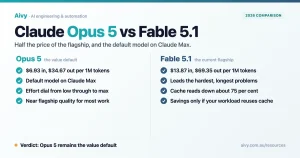
Anthropic has since moved Fable 5 to its legacy list and made Fable 5.1 the current flagship. The base rate did not move: $13.87 in and $69.35 out per million tokens, the same as Fable 5. What fell 75 per cent is the cache read, to about $0.35. On 9 November Fable 5.2 took over at the top, at a lower $11.60 and $58.02.
What was restricted, and what still is
The event that spooked a lot of Australian users was real, but it is worth stating plainly because it has already resolved. In June 2026 the two top models, Claude Fable 5 and Claude Mythos 5, went dark for everyone outside a narrow group. This was not Anthropic pulling out of Australia. It was a US export control directive, and it is the clearest recent example of a model reaching Australians later than Americans.
On or around 12 June 2026, the US government ordered Anthropic to suspend access to Fable 5 and Mythos 5 for all foreign nationals, Australians included. Anthropic disabled both models globally to comply, while every other model kept running normally. The controls were then lifted and access began to restore from 1 July 2026. Our news desk tracked the whole arc, from the order that pulled Fable 5 and Mythos 5 to the numbers behind the models in our Fable 5 review.
| Model | Access in Australia now | Note |
|---|---|---|
| Fable 5.2 | Available | The current flagship since 9 November 2026, at $11.60 and $58.02 per million tokens (RBA rate of that day). On Pro, Max, Ultra and Team plans, not Free. |
| Fable 5.1 | Available | Replaced at the top by Fable 5.2 on 9 November and still on sale, at the same $13.87 and $69.35 per million tokens as Fable 5. API id claude-fable-5-1 |
| Fable 5 | Available | Now on Anthropic’s legacy list. Restored globally on 1 July 2026. From 20 July, how you reach it depends on your plan |
| Mythos 5.2 | Limited | The same model as Fable 5.2 with fewer cyber and biology safeguards, for organisations verified through Anthropic’s Cyber or Life Sciences programmes |
| Mythos 5.1 | Not available | Limited to Project Glasswing participants at United States organisations |
| Mythos 5 | Limited | Gated to a limited-availability programme, not open sign-up |
| Opus 5.5 | Available | Anthropic’s suggested starting point for most workloads since 22 September 2026, and the Claude Code default on Pro, Max, Team, Enterprise and the API from version 2.1.280. $5.62 and $28.08 per million tokens |
| Opus 5 | Available | On Anthropic’s legacy list since 22 September 2026 and still available. Released 24 July 2026 at the same price as Opus 4.8, which stays available |
| Sonnet 5.5 | Available | On every Claude.ai plan, free included, since 28 September 2026 |
| Sonnet 5 | Available | Became the default on free and Pro on 1 July 2026 |
| Haiku 5.5 | Available | Released 7 October 2026 on the API and the major cloud platforms. The fastest, cheapest tier for high volume work, at $0.14 and $0.70 per million tokens up to 100,000 tokens |
| Haiku 4.5 | Available | The previous Haiku, still on sale through the API |
How Fable 5 access splits by plan, from 20 July 2026
The bigger change for Australians landed less than three weeks after the block was lifted. Since 20 July 2026, whether you can use Fable 5 is no longer a yes or no question, and it is not a country question either. It is a plan question, and the answer here is the same as anywhere else in the world.
On Max plans and premium Team seats Fable 5 is a standard part of the plan, usable for up to 50 per cent of your weekly usage limits at no extra cost. On Pro plans and standard Team seats it runs on pay-as-you-go usage credits instead, with a one-time credit for eligible seats.
Read that 50 per cent carefully, because it is the part teams get wrong when they budget. It is a ceiling, not extra headroom. Every model draws from the same weekly pool, so half a week spent on Fable 5 is half your week gone. Anthropic also states that Fable 5 draws down usage faster than other models, which shortens the week further again if you make it your default.
| Plan | Fable 5 access | What that means in practice |
|---|---|---|
| Free | Not available | Anthropic states Fable 5 is not available on the Free plan |
| Pro | Usage credits | Pay as you go, with a one-time credit for eligible seats |
| Max | Included | Up to 50 per cent of your weekly usage limits, no extra cost |
| Team, premium seats | Included | Same 50 per cent weekly allowance as Max |
| Team, standard seats | Usage credits | Pay as you go, with a one-time credit for eligible seats |
| Enterprise, legacy seat-based | Depends on the seat | Premium seats include it, standard seats use usage credits |
Plan-level Fable 5 access from Anthropic’s help centre, verified 21 July 2026. In Claude Code, Fable 5 needs version 2.1.170 or later before it appears in the model list.
ID and age verification, and who actually gets asked
This is the change that generated the most anxiety, and most of the fear is misplaced. Anthropic updated its privacy policy, effective 8 July 2026, to allow it to ask users to confirm their age or identity. The key word is selective. This is not a universal gate where every Australian must photograph a passport to keep chatting.
Reporting on the rollout describes it targeting a small subset of accounts that get flagged for possible fraud or policy issues, rather than banned outright, often as part of an appeals process. When it does apply, the check runs through a third party called Persona, and can ask for a government-issued photo ID and a live selfie.
Age checks for suspected under-18 users run through a separate provider, Yoti, which deletes the image once the check completes. If you want the full picture, our companion guide on Claude’s ID and face verification for Australia goes deeper on the legal side.
| Situation | What you may be asked for | Handled by |
|---|---|---|
| Normal sign-up, any plan | Name, email, phone number only | Anthropic |
| Account flagged, then appealing | Government photo ID plus a live selfie | Persona |
| Suspected under-18 user | Selfie for age estimate, or an ID document | Yoti |
| Standard developer API or Console | Email verification, no ID document found in the docs | Anthropic |
Reporting indicates Team, Enterprise and API accounts were described as out of scope for the flagged-account ID flow. That scoping comes from press coverage, not a verbatim statement on Anthropic’s help pages, so treat it as reported rather than official.
The Claude ban myth versus the real restrictions
The phrase I hear most is some version of “is Claude banned in Australia,” and it is worth clearing up because the answer is a clean no. There is no Australian law that bans Claude or any US chatbot. What exists is a set of privacy obligations on how you handle personal information, a social media age law that does not touch AI chatbots, and voluntary AI guidance. None of that stops you using Claude.
| What people believe | The reality |
|---|---|
| Claude is banned in Australia | No. It is an officially supported region for the apps and the API. |
| Everyone must upload ID from 8 July | No. Only a small subset of flagged accounts, and mostly during appeals. |
| Australia has an AI user ID law | No. The age-verification law targets social media, not AI chatbots. |
| The June outage meant Anthropic left | No. It was a US export control on two models, since lifted. |
If you like tracking how these models and their names evolve, and separating the signal from the hype cycle, our running explainer on Claude model codenames and leaks keeps that straight without the drama.
Your data and privacy under the Privacy Act 1988
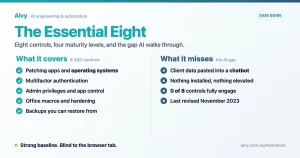
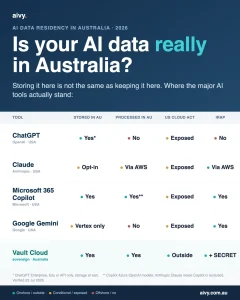
This is the part that actually deserves your attention, and it applies whether or not you are ever asked to verify anything. When an Australian uses Claude, their data is transferred to and processed on servers in the United States. For a business, that turns Claude into a cross-border disclosure question under the Privacy Act 1988, and there are real obligations attached. Privacy duties sit alongside cyber baselines, and this is exactly where the Essential Eight leaves a gap for AI tools.
Under Australian Privacy Principle 8, before you send personal information overseas you must take reasonable steps to ensure the recipient handles it in line with the principles, and you can stay accountable for a mishandling that happens offshore. Those reasonable steps are easier to evidence when the rules for overseas tools sit in an AI policy with explicit red lines rather than in each person’s judgement.
The OAIC’s own best-practice guidance is blunter still: do not enter personal information, and especially sensitive information, into publicly available generative AI tools. Facial and biometric data carries extra weight here, because the Privacy Act treats it as sensitive information that generally needs consent, a point the regulator underlined in its 2024 Bunnings facial recognition determination.
| Rule | What it means when your team uses Claude |
|---|---|
| APP 8, cross-border disclosure | You stay accountable when customer data is processed on US servers |
| Biometric data is sensitive | Facial data used in ID checks generally needs consent to collect |
| OAIC best-practice guidance | Keep personal and sensitive info out of public generative AI tools |
None of this is a reason to avoid Claude. It is a reason to set it up properly: a business plan where your content is not used for training, clear staff rules about what never gets pasted in, and a privacy notice that discloses the tool. This is exactly the groundwork we help clients lay through our AI consulting work, and our Privacy Act compliance playbook sets out the steps in full.
Australia’s age assurance push, explained
A lot of the ID anxiety bleeds over from a separate story, so it helps to keep the two apart. Australia has passed a genuine, world-first age law, but it targets social media platforms, not AI chatbots like Claude. Conflating the two is the single most common mistake I see in this conversation.
The Online Safety Amendment (Social Media Minimum Age) Act 2024 sets a minimum age of 16 for age-restricted social media, with the obligation on platforms live from 10 December 2025 and civil penalties reaching into the tens of millions.
A separate government-backed trial concluded in 2025 that age assurance can be done in Australia in a way that is private and workable. The direction of travel is clear: self-declared age is on the way out. But as it stands, this regime does not require you to verify your identity to use an AI assistant.
| Item | Detail |
|---|---|
| What it covers | Age-restricted social media platforms, not AI chatbots |
| Minimum age | 16, with platform obligations live from 10 December 2025 |
| Who is penalised | Platforms, with penalties up to $49.5 million. Not children or parents |
| Applies to Claude? | No. Claude’s own 18-plus rule is a separate, global Anthropic policy |
If a top model is gated, here are the alternatives
Access episodes like the June block are rare, and they tend to hit the single top model rather than the whole product. So the practical fallback is almost never to leave Claude. It is to step down a tier or reach for a comparable tool, neither of which costs you much in real work. Google’s new top model is gated today too: Gemini 4 Carbon opens first to cyber defenders, while Opus 5.5 is on sale.
Within Claude, dropping from the flagship to Sonnet 5.5 or Opus 5.5 keeps you productive at a fraction of the running cost, and for most automation the capability gap is small. The benchmark below, from the Sonnet 5 launch, shows how close the value model already sat to the top everyday model. If you want to look outside Anthropic entirely, our Claude versus ChatGPT comparison and our Claude versus Gemini guide weigh the realistic swaps, and teams building coding agents will want our Claude Code versus Codex breakdown.
Agentic coding benchmark (SWE-bench style)
Higher is better, axis 0-100%. Source: TechCrunch, citing Anthropic.
What Australian businesses should do next
Strip away the headlines and the position is stable. Claude is available to Australians on every plan, there is no ban, and the ID verification that arrived on 8 July 2026 is a targeted tool, not a turnstile.
The June model block was a US export control that has already been lifted, and Fable 5 is now a billing question rather than an availability one: from 20 July 2026 it comes as standard on Max plans and premium Team seats, and runs on usage credits on Pro and standard Team seats. If you were holding off a rollout because you thought access was shaky, that reason does not hold.
The thing that does deserve a decision is data. A Melbourne firm we work with had staff pasting client details into the free tier before anyone thought about where that data lived. We did not rip Claude out. We moved them to a business plan that excludes their content from training, wrote a one-page rule on what never goes in, and disclosed the tool in their privacy notice. Access was never the risk. Ungoverned use was.
If you want a hand mapping which plan, which model and which guardrails fit how your business actually runs, that is our day job. Aivy is an AI automation agency in Melbourne, you can gauge where you stand with our AI readiness assessment, and you can book a free discovery session to set it up right the first time.
For Australian teams standardising on Claude in 2026, work the setup, not the access:
• Use a Team or Enterprise plan so your content is excluded from training, and default to Claude Opus 5.5, the starting point Anthropic suggests for most workloads, at $5.62 and $28.08 per million tokens, well under half the flagship’s rate. Keep Sonnet 5.5, at the same price as Sonnet 5, for high-volume, low-stakes work.
• Write a one-page rule on what personal or sensitive information never gets pasted into a chat.
• Treat Claude as an offshore processor under APP 8, and disclose it in your privacy notice.
• Fable 5.2 is the current flagship since 9 November, and it costs a fifth less per token than Fable 5.1. Reach for it on demanding reasoning and long horizon agentic work, once Opus 5.5 at higher effort falls short.
Using Claude in Australia: frequently asked questions
Can Australians use Claude?
Yes. Australia is an officially supported region for both the Claude apps and the developer API, on every plan from the free tier to Enterprise. No Australian law bans Claude, and signing up and paying works the same as it does overseas.
Is Claude banned in Australia?
No. There is no Australian law banning Claude or other US AI chatbots. The June 2026 outage of the top models was a US export control that applied worldwide to foreign nationals, not an Australian ban, and it has since been lifted.
Do I need to verify my ID to use Claude?
Usually not. From 8 July 2026 Anthropic may ask a small subset of flagged accounts to verify identity through a partner called Persona, often during an appeal. Ordinary sign-up needs only a name, email and phone number.
What is the minimum age to use Claude in Australia?
You must be at least 18 to use the consumer Claude apps, per Anthropic’s global Consumer Terms. If under-18 signals are detected, an age check runs through a provider called Yoti, which deletes the image after the check.
Where is my Claude data stored?
On servers in the United States. For Australian users that makes Claude an offshore processor, so under the Privacy Act you should keep personal and sensitive information out of public chats and use a business plan for anything confidential.
Is it legal for an Australian business to use Claude?
Yes, and most do. The obligations are about handling data, not permission to use the tool. Under Australian Privacy Principle 8 you stay accountable when data is processed overseas, so set up the plan, staff rules and privacy notice accordingly.
Which Claude model is the default in 2026?
Claude Sonnet 5, released on 30 June 2026, became the default on the free and Pro plans from 1 July. It offers performance close to the flagship at a much lower running cost, which suits most automation work. Claude Sonnet 5.5, released on 28 September, is open to every Claude.ai plan; Anthropic has not said whether it replaces Sonnet 5 as the default. In Claude Code the default on Pro, Max, Team, Enterprise and the API is Claude Opus 5.5, from version 2.1.280.
Is Claude Fable 5 available in Australia?
Yes. A US export control directive around 12 June 2026 suspended Fable 5 and Mythos 5 for foreign nationals, then the controls were lifted and access was restored globally on 1 July 2026, with no nationality check. Since 20 July 2026 the real question is which plan you are on. Fable 5 now sits on Anthropic’s legacy list, with Fable 5.2 as the current flagship since 9 November 2026.
Fable 5 is a standard part of Max plans and premium Team seats, usable for up to 50 per cent of your weekly usage limits, while Pro plans and standard Team seats reach it through pay-as-you-go usage credits. Mythos 5 remains a limited-availability model.
Is Claude Fable 5 free?
No, not any more. The promotion that made Fable 5 free ended on 19 July 2026 at 11:59:59pm PT. From 20 July it is included in Max plans and premium Team seats within that 50 per cent weekly allowance, while Pro plans and standard Team seats pay for it through usage credits, with a one-time credit for eligible seats. Anthropic states it is not available on the Free plan.
Do Team or Enterprise plans need ID verification?
Reporting indicates the flagged-account ID flow was described as targeting consumer accounts, with Team, Enterprise and API out of scope. That scoping comes from press coverage rather than a verbatim Anthropic statement, so confirm it against the current policy before relying on it.
Last updated: 10 November 2026, for Claude Fable 5.2 and Mythos 5.2. Earlier updates: Australian plan prices on 28 October, Claude Haiku 5.5 on 8 October and Fable 5.1 on 2 September. Other availability and verification details were checked on 1 July 2026 and can change. This article is general information, not legal advice.
• Anthropic, Introducing Claude Fable 5.2 and Claude Mythos 5.2, with the Fable 5.2 launch offers. Supports: release on 9 November 2026, 8 and 40 United States dollars per million tokens, the plans that include Fable 5.2 (not Free) and Mythos 5.2 access through the verification programmes. Read 9 November 2026, converted at the RBA rate of that day, 0.6894.
• Anthropic, Supported countries and regions. Supports: Australia is a supported region for both Claude.ai and the commercial API (no ban).
• Anthropic, Claude plans and pricing. Supports: Free, Pro ($34), Max (from $170.01), Team ($43/seat, or $34 on annual billing) and Enterprise prices and inclusions, Australian prices with GST read 27 October 2026.
• Anthropic, Model pricing documentation. Supports: per model API rates in United States dollars per million tokens, 10 and 50 for Fable 5.1, 5 and 25 for Opus 5 and Opus 4.8, 4 and 20 for Opus 5.5, 2 and 10 for Sonnet 5 and for Sonnet 5.5 (read 28 September 2026), 1 and 5 for Haiku 4.5 (read 22 September 2026), and 0.10 and 0.50 for Haiku 5.5 on prompts up to 100,000 tokens, 0.50 and 2.50 above (read 7 October 2026).
• Anthropic, Introducing Claude Haiku 5.5 (read 7 October 2026). Supports: the 7 October 2026 release on the Claude API, Amazon Bedrock, Claude Platform on AWS, Google Cloud and Microsoft Foundry, with no mention of the Claude.ai plans.
• Anthropic, Claude Sonnet (read 28 September 2026). Supports: anyone can chat with Claude using Sonnet 5.5 on Claude.ai, on web, iOS and Android.
• Anthropic, models overview (read 22 September 2026). Supports: the advice to start with Claude Opus 5.5 for most workloads, and Claude Opus 5 on the legacy list.
• Claude Code, model configuration (read 23 September 2026). Supports: Claude Opus 5.5 as the Claude Code default on Pro, Max, Team, Enterprise and the API from version 2.1.280.
• Anthropic Privacy Center, Updates to our Privacy Policy. Supports: the identity and age verification update taking effect 8 July 2026.
• Anthropic, Identity verification on Claude. Supports: verification via Persona, government photo ID plus a live selfie, rolled out selectively.
• TechCrunch, Anthropic says Claude may want to see your ID. Supports: the ID flow targeting a small subset of flagged, not banned, consumer accounts, and the biometric facial-geometry detail.
• 9to5Mac, Claude Fable 5 cleared to return. Supports: the June export-control suspension of Fable 5 and Mythos 5 and its lifting, with access restored from 1 July 2026.
• OAIC, APP 8 cross-border disclosure. Supports: the obligation and accountability when Australian personal information is processed overseas.
• Online Safety Amendment (Social Media Minimum Age) Act 2024. Supports: the under-16 social media age law and its scope, distinct from AI chatbots.
• Anthropic, Claude Fable 5 on your plan (verified 21 July 2026). Supports: the free promotion ending 19 July 2026, Fable 5 as a standard inclusion on Max plans and premium Team and seat-based Enterprise seats at up to 50 per cent of weekly usage limits, usage credits with a one-time credit for eligible Pro and standard Team seats, Fable 5 not being available on the Free plan, and the Claude Code 2.1.170 requirement.
Model token prices converted at the Reserve Bank of Australia rate of 4 September 2026, one Australian dollar buying 0.7210 United States dollars; the Claude Opus 5.5, Claude Sonnet 5.5 and Claude Haiku 5.5 prices and the output price chart at the rate of 22 September 2026, one Australian dollar buying 0.7123 United States dollars. Seat and subscription prices converted at 1 USD = 1.42 AUD, 11 August 2026.