
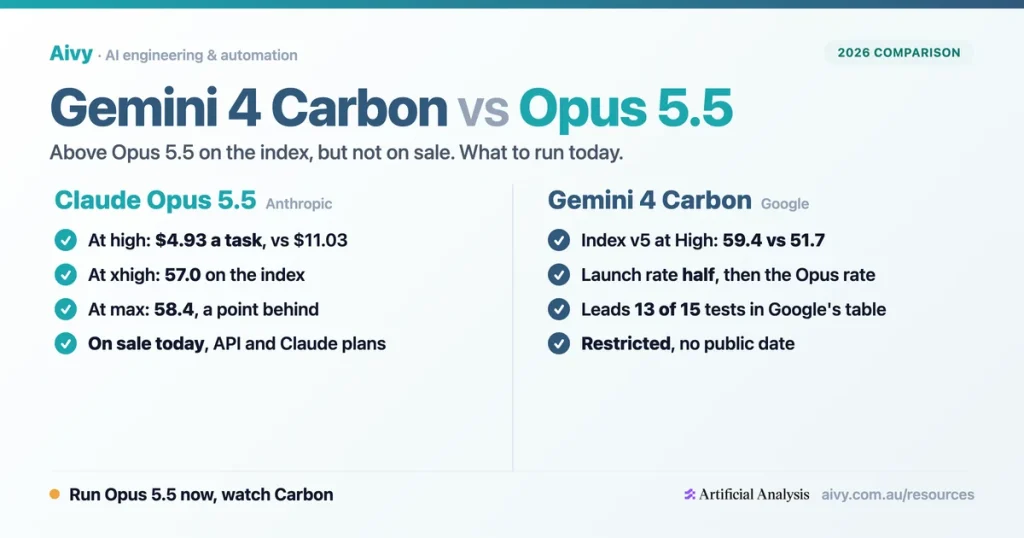
Google announced Gemini 4 Carbon on 28 October 2026, and it went straight to the top of the Artificial Analysis Intelligence Index, a point above Claude Opus 5.5 at max. That makes any Gemini 4 Carbon vs Opus 5.5 comparison urgent and a little odd, because Carbon is only open to a small group of cyber defenders. You can buy Opus 5.5 today. You cannot buy Carbon yet.
At Aivy my job most weeks is working out what a model really costs an Australian client once the work is done, and a launch day tests that habit hardest. Google’s post opens with a ranking, so I checked it against the independent index at matched effort, the cost of each task, and what a business here can actually sign up for this week.
Below are the scores effort for effort, the cost per task and per million tokens in Australian dollars, Google’s own table against Opus 5.5, the security results behind Carbon’s narrow launch, and the Opus 5.5 setting I would run meanwhile. If you want the Gemini model you can use now, start with our Gemini 4 Argon vs Opus 5.5 guide.
Key takeaways
- Gemini 4 Carbon scores 59.4 on the Artificial Analysis Intelligence Index v5 at High, against 51.7 for Claude Opus 5.5 at high and 58.4 at max.
- At the same effort Carbon costs $11.03 a task against $4.93. Opus 5.5 at max costs $14.27, so Carbon beats it on score and cost.
- Both list at $5.69 in and $28.43 out per million tokens; Carbon starts at an introductory $2.84 and $14.22.
- In Google’s launch table Carbon leads Opus 5.5 on 13 of 15 shared tests; Opus 5.5 leads on OSWorld 2.1 and FrontierSWE 2.
- Carbon is limited to cyber defenders and Fairwind partners for now. Google gives no date for developers, businesses or consumers.
Gemini 4 Carbon vs Opus 5.5 at a glance
These two arrive from opposite directions. Anthropic released Claude Opus 5.5 on 22 September, and it runs today on Anthropic’s API, the three big clouds and Claude’s paid plans. Google unveiled Gemini 4 Carbon on 28 October as its strongest model, with first access for a subset of cyber defenders, a fortnight after Gemini 4 Argon.
| At a glance | Gemini 4 Carbon | Claude Opus 5.5 |
|---|---|---|
| Maker and date | Google, announced 28 October 2026 | Anthropic, released 22 September 2026 |
| Can you use it today? | Restricted access | On sale |
| Who has it | A subset of cyber defenders, then partners in Google’s Fairwind Program | Claude API, Amazon Bedrock, Google Cloud, Microsoft Foundry; Claude Pro, Max, Team and Enterprise |
| Input and output, per million tokens | $2.84 and $14.22 introductory, then $5.69 and $28.43 | $5.69 and $28.43 |
| Index v5 at the same effort | 59.4 at High (its only reading) | 51.7 at high; 58.4 at max |
| Cost per index task, same effort | $11.03 | $4.93 |
| Context and output limits | Not given in Google’s announcement | 1M token context, 128K output |
| Data retention | Not covered in Google’s announcement | Zero data retention available |
Sources: Google, Gemini 4 Carbon announcement; Anthropic, Claude Opus 5.5 announcement and model page. Index and cost per task: Artificial Analysis, read 28 October 2026. Based on data from Artificial Analysis (artificialanalysis.ai), which does not endorse, validate or approve any of the analysis or conclusions drawn from it. Converted at 1 Australian dollar to 0.7034 United States dollars, Reserve Bank rate of 28 October 2026.
Two rows decide most plans. The first is access: whatever the score, Carbon cannot run on your work yet. The second is cost per task, where Opus 5.5 is the cheaper model at the same setting even though both list at the same rate. Our guide to Anthropic’s three model tiers explains when Opus 5.5 is worth it over Sonnet or Haiku.
Who can use Gemini 4 Carbon, and when
Google is rolling Carbon out on purpose, slowly. This week it goes to a subset of cyber defenders, then gradually to trusted partners in its Fairwind Program, which gives governments, healthcare providers and telecommunications services an early start on defence work. Developers, businesses and consumers come after that, on a timeline Google describes only as soon as possible.
Restricted
Cyber defenders, then Fairwind partners; no public date
$2.84 / $14.22
Introductory rate per million tokens, input and output
$5.69 / $28.43
Rate after the introductory period, the same as Opus 5.5
59.4
Intelligence Index v5 at High, the top score when I read it
Sources: Google, Gemini 4 Carbon announcement, 28 October 2026, including its footnote on pricing; Artificial Analysis, read 28 October 2026. Converted at 1 Australian dollar to 0.7034 United States dollars, Reserve Bank rate of 28 October 2026.
The precedent is Gemini 4 Argon. It also started with cyber defenders, on 30 September, and reached the paid Gemini API and Google AI Pro and Ultra on 13 October, about two weeks later. That is a hint, not a promise: Carbon’s announcement names no app, plan or country. For the Gemini models anyone can open today, see how Claude and Gemini compare.
So I would not hold any work back for Carbon. Waiting would not obviously save money either, as the cost section below shows, and Google’s own pricing footnote already says where the rate ends up. If your team is weighing Google against OpenAI rather than Anthropic, our ChatGPT vs Gemini guide is the better starting point.
Carbon and Opus 5.5 on the Intelligence Index v5, effort for effort
Artificial Analysis measures Carbon at one setting only, High, where it scores 59.4 on version 5 of its Intelligence Index. Opus 5.5 at the same high setting scores 51.7, so on a like for like reading Carbon leads by 7.7 points. Every Artificial Analysis figure in this article comes from one reading, on 28 October 2026.
Intelligence Index v5 by effort setting, axis 0 to 100
Higher is better. Carbon has a reading at High and nowhere else, so compare the dark blue bar with Claude Opus 5.5 (high). Light blue is Gemini 4 Argon, the Gemini 4 model open to paying customers today. Source: Artificial Analysis, Intelligence Index v5, read 28 October 2026.

The gap closes as Opus 5.5 thinks harder. At xhigh it scores 57.0 and at max 58.4, a point behind Carbon at High, and Carbon has no reading above High yet. Version 5 rescored every model, so these numbers do not line up with the version 4.3 scores in our older guides, such as GPT 6 Astra vs Opus 5.5.
Gemini 4 Argon at High, the Google model you can use today, scores 50.4, which places it above Opus 5.5 at medium and below it at high. Carbon arrived a fortnight after Argon and sits 9 points above it, which tells you how quickly the top of this table now moves. Any ranking you read this month carries a short shelf life.
Cost per task: what Carbon’s lead costs
Token prices only tell half the story, because a model that thinks longer burns more of them. Artificial Analysis records what each run of its index actually cost, so a score can be read with its price tag. At high, one task costs $4.93 on Opus 5.5 and $11.03 on Carbon: over twice the money for 7.7 extra points.
What one index task costs at each setting, Australian dollars
Lower is cheaper; longest bar $14.27. Both Gemini models are costed at $5.69 and $28.43 per million tokens, their rate once the launch offer ends, which is also the Opus 5.5 rate. Source: Artificial Analysis, Intelligence Index v5 cost to run, read 28 October 2026. Converted at 1 Australian dollar to 0.7034 United States dollars, Reserve Bank rate of 28 October 2026.
Both models are priced at $5.69 and $28.43 per million tokens in that reading, so the difference is tokens: Carbon at High spends roughly twice what Opus 5.5 at high does on the same tasks. Against Opus 5.5 at max the sums flip. Carbon scores a point higher and costs $3.24 less a task.
Opus 5.5 at xhigh is the middle path: 57.0 for $8.60, 2.4 points below Carbon for $2.43 less. At Carbon’s launch rate the same tokens would cost half, about $5.51 a task, for a period Google has left open ended. To see whether any of these bills pays off, try our AI ROI calculator.
Gemini 4 Carbon price per million tokens against Opus 5.5
Google and Anthropic both invoice API use in United States dollars; I have converted at 0.7034, the Reserve Bank figure for 28 October 2026. Carbon opens at the same launch price Argon had, half the Opus 5.5 rate for input and output, and Google’s footnote says it then climbs to exactly what Opus 5.5 charges.
List rate per million tokens: Gemini 4 Carbon against Claude Opus 5.5
Lower is cheaper; every panel has its own scale. At launch, cached input on Carbon costs a twentieth of its input rate; Google gives no cached figure for the period after that. Sources: Google, Gemini 4 Carbon announcement and footnote 1; Anthropic, pricing page. Converted at 1 Australian dollar to 0.7034 United States dollars, Reserve Bank rate of 28 October 2026.
Input, per million tokens
Output, per million tokens
Cached input read, per million tokens
Cached input is where the launch offer is sharpest: 95 per cent off input, or $0.14 per million tokens against $0.28 for Opus 5.5, though Google has not published a cached rate for later. Anthropic’s answer is the batch API, which halves both Opus 5.5 lines to $2.84 and $14.22 for work that can wait overnight.
Opus 5.5 also sells a fast mode on the Claude API, at $11.37 and $56.87 per million tokens, for work where waiting costs more than tokens. Our guide to Claude plans and prices in Australia covers the subscriptions and how API billing lands on an Australian card.
Domain scores and speed: where Carbon’s lead sits
Version 5 of the index adds domain scores, and they show where Carbon’s lead matters for business work. At the same high setting Carbon scores 62.6 on the Finance and Accounting Index against 53.3 for Opus 5.5, 62.0 against 52.0 on the Legal Index and 64.7 against 57.7 on the Engineering Index.
Domain scores at the same effort, axis 0 to 100
Higher is better. Carbon at High and Opus 5.5 at high, on three of the domain indices added in version 5. Source: Artificial Analysis, read 28 October 2026.
Even Opus 5.5 at max trails Carbon at High on finance and accounting (59.4) and legal (58.0), and roughly ties it on engineering at 64.6. At high Carbon also leads on strategy and operations and on economics, where Opus 5.5 at max edges back ahead. There is no healthcare score for Carbon yet. For accounting and advisory practices, that finance gap is the figure to watch.
Speed cuts the other way. In the same reading Carbon at High took about 97 seconds to its first token, then wrote about 100 tokens a second; Opus 5.5 at high answered after about 35 seconds at about 84 tokens a second. For a customer service chatbot, that first wait matters more than the score.
Google’s launch table: Carbon against Opus 5.5
Google’s post carries a benchmark table that sets Carbon beside Argon, GPT 6 Astra, Claude Opus 5.5 and Claude Fable 5.1. Leaving out the index row, 15 rows have a figure for both Carbon and Opus 5.5, and Carbon leads on 13. Opus 5.5 leads on two: OSWorld 2.1, a computer use test, and FrontierSWE 2, an agentic coding test.
| Benchmark | Gemini 4 Carbon | Claude Opus 5.5 | Higher in Google’s table |
|---|---|---|---|
| Vals Index v2.2 | 70.4% | 70.2% | Gemini 4 Carbon |
| SWE sweep | 9.6% | 3.6% | Gemini 4 Carbon |
| FrontierSWE 2 | 61.2% | 62.3% | Claude Opus 5.5 |
| Terminal Bench 4.0, Artificial Analysis run | 65.2% | 59.6% | Gemini 4 Carbon |
| Agents’ Last Exam v1.1 | 77.4% | 71.6% | Gemini 4 Carbon |
| OSWorld 2.1, offline subset | 81.5% | 87.2% | Claude Opus 5.5 |
| AutomationBench | 53.9% | 42.5% | Gemini 4 Carbon |
| GraphWalks, 256K to 1M | 96.2% | 66.8% | Gemini 4 Carbon |
| RiemannBench | 80.0% | 69.6% | Gemini 4 Carbon |
| CWE bench | 71.0% | 67.0% | Gemini 4 Carbon |
| ExploitGym | 54.8% | 34.5% | Gemini 4 Carbon |
Source: the benchmark image in Google’s Gemini 4 Carbon post, with the Carbon methodology document from Google DeepMind. These are vendor figures: Gemini ran with maximum thinking, and the other labs’ numbers are their own or leaderboard results, at their top reasoning setting where one exists. Eleven of the 15 rows with a figure for both models; Carbon also leads on Chartography, Blueprint Bench 2, Terminal Bench Science 0.1 and Vending Bench 2, which is scored as a simulated bank balance rather than a percentage.
Treat this table as a sales document, honestly sourced. Google’s methodology file says Gemini was run with maximum thinking and that the other labs’ numbers are self reported or from leaderboards, at their top setting. In practice that means top setting against top setting, not the matched High and high reading earlier, and two rows simply reuse Artificial Analysis runs.
Anthropic’s own launch post for Opus 5.5 conceded that, at the frontier, small leads on tests say less about daily work than they used to. That applies to Carbon’s lead too. If you are picking an AI coding assistant, a week of your own pull requests on each model will tell you more than this table.
Cyber defence: why Carbon starts with defenders
Google built Carbon’s launch around security work, and its own figures explain the narrow rollout. Carbon finds, exploits and patches vulnerabilities better than any model in Google’s table, with the widest margin over Opus 5.5 on ExploitGym. Google ran those tests without guardrails, which is exactly why it wants vetted defenders using the model first.
88.2%
SEC bench Pro, finding real vulnerabilities; no Opus 5.5 figure in Google’s table
54.8%
ExploitGym, exploitation, against 34.5% for Opus 5.5
71.0%
CWE bench, patching, against 67.0% for Opus 5.5
0.0%
Attack success on Gray Swan’s indirect prompt injection test; Argon 0.7%
Source: Google, Gemini 4 Carbon announcement and benchmark table, 28 October 2026. Google ran the security tests without guardrails; the Opus 5.5 figures are the ones Google reports.
On behaviour, Google says Carbon cut successful cheating on Terminal Bench 4.0 to zero and high severity misalignment alerts by almost 80 per cent in its own coding work. Anthropic applies cyber safeguards to Opus 5.5 similar to those on Fable 5.1, and says its Cyber Verification Program will soon include it. For everyday development, our security ranking of coding assistants matters more.
For an Australian security team the practical point is access. Unless you are a vetted defender, Carbon’s security results are a preview, not a tool. Our Essential Eight guide covers where AI tools strain the baseline controls that most Australian organisations already work to.
Picking an Opus 5.5 effort setting until Carbon opens
Since Opus 5.5 is the frontier model actually on offer, the real choice is how hard to let it think. Out of the box the API runs it at medium. For client work I begin at high and step up to xhigh for the difficult cases, because xhigh lands 2.4 points short of Carbon while costing less per task.
| Setting | Index v5 | Cost per task | When I would use it |
|---|---|---|---|
| Gemini 4 Carbon, High | 59.4 | $11.03 | Reference only: restricted access |
| Claude Opus 5.5, max | 58.4 | $14.27 | Only when one more point is worth the bill |
| Claude Opus 5.5, xhigh | 57.0 | $8.60 | Hard reasoning that can wait: audits, migrations, contract sets |
| Claude Opus 5.5, high | 51.7 | $4.93 | My default for most business work |
| Claude Opus 5.5, medium | 48.1 | $3.48 | Anthropic’s API default; test it on short, simple calls |
Based on data from Artificial Analysis (artificialanalysis.ai), which does not endorse, validate or approve any of the analysis or conclusions drawn from it. Index and cost per task read 28 October 2026, at the later Gemini rate. Converted at 1 Australian dollar to 0.7034 United States dollars, Reserve Bank rate of 28 October 2026.
Max is hard to justify now. It costs more per task than Carbon will at its later rate and still scores lower, so I would keep it for one off work where a single extra point matters. Our guide to Claude effort levels explains what each setting changes in practice.
One quirk to plan for: Opus 5.5 always reasons a little first, because Anthropic gives no option to turn its thinking off. Teams in professional services that fire off lots of quick lookups should trial medium on that traffic first; high may be more than those calls need.
What you can use today in Australia, and what it costs
For most people the first contact is an app subscription, not an API key. Opus 5.5 is included from Claude Pro upwards, through Max, Team and Enterprise. On Google’s side, the Australian plans page offers Gemini 4 Argon in AI Pro and Ultra and says nothing about Carbon. The table uses each company’s Australian price.
| Route | Australian price | Opus 5.5 | Gemini 4 Carbon |
|---|---|---|---|
| Claude Pro | $30.00 a month | Included | Not offered |
| Claude Max 5x or 20x | $199.99 or $399.99 a month | Included, higher limits | Not offered |
| Google AI Pro | $32.99 a month | Not offered | Not listed; Gemini 4 Argon instead |
| Google AI Ultra | From $149.99 a month | Not offered | Not listed; highest Argon limits |
| Claude API | $5.69 and $28.43 per million tokens | Available | Not offered |
| Gemini API | $2.84 and $14.22 at launch, then $5.69 and $28.43 | Not offered | No public date |
Claude: monthly prices on the Australian App Store. Google AI: Google’s subscriptions page for Australia. Checked on 28 October 2026; buying on the web may cost a different amount. Which plan includes which model: Anthropic’s Opus page, Google’s plans page and the Carbon announcement. API rates are billed in United States dollars. Converted at 1 Australian dollar to 0.7034 United States dollars, Reserve Bank rate of 28 October 2026.
The gap here is stark: thirty dollars a month gets you Opus 5.5, and no amount of money gets you Carbon yet. A Google AI Pro subscriber already has Argon to try. If I ran a team in Melbourne, I would keep my current Google plan as it is rather than pay more on the chance Carbon turns up there.
Data, privacy and the Australian angle
Clients here usually ask about location before anything else. Called directly from Anthropic, Opus 5.5 can run anywhere in its global fleet, or be pinned to American servers at 1.1 times the price, and stored workspace data sits in the United States either way. If onshore processing is a hard requirement, our data residency guide lists the tools that offer it.
With Opus 5.5 you can ask for zero data retention and confirm the regions on offer right now. Carbon is a blank on both counts: Google’s post is silent on processing location and retention, and no public endpoint exists to examine.
The Privacy Act 1988 makes this a question for the pilot stage, not the rollout. Under Australian Privacy Principle 8, the OAIC expects you to take reasonable steps before you send personal information to someone offshore. Our Privacy Act playbook turns that into questions for any vendor.
Currency is the quieter risk. Both APIs charge in United States dollars, so a weaker Australian dollar raises the bill with no change to the rate card. If you run agents at volume from Sydney or anywhere else, plan from a pilot’s cost per task at the later rate, never the launch offer.
Gemini 4 Carbon vs Opus 5.5: frequently asked questions
Is Gemini 4 Carbon better than Claude Opus 5.5?
On the independent index, yes. Artificial Analysis scores Carbon at 59.4 at High against 51.7 for Opus 5.5 at high and 58.4 at max. Google’s own table has Carbon ahead on 13 of 15 shared tests. Since 9 November, Claude Fable 5.2 scores higher than both.
Can I use Gemini 4 Carbon in Australia?
Not yet. Google is giving it to a subset of cyber defenders first, then partners in its Fairwind Program. Developers, businesses and consumers come later, with no date, and none of Google’s Australian plans lists it.
How much does Gemini 4 Carbon cost?
At launch, $2.84 for every million tokens in and $14.22 for every million out, in Australian dollars at the 28 October 2026 Reserve Bank rate. Once the offer ends Google moves it to $5.69 and $28.43, which matches Claude Opus 5.5.
Which is cheaper per task, Gemini 4 Carbon or Opus 5.5?
Opus 5.5 at the same effort: $4.93 a task at high against $11.03 for Carbon at High. Against Opus 5.5 at max, which costs $14.27 a task, Carbon is both cheaper and higher scoring.
Is Gemini 4 Carbon better than Opus 5.5 for coding?
On most of Google’s coding rows, yes: Carbon is ahead on SWE sweep and Terminal Bench 4.0, and Opus 5.5 is ahead on FrontierSWE 2. Neither model had a Coding Index score from Artificial Analysis when I read it on 28 October 2026.
Should I wait for Gemini 4 Carbon or start on Opus 5.5?
Begin with Opus 5.5 for anything due in the next few months. Note two or three jobs worth retrying on Carbon later, such as long engineering tasks or security reviews, and judge them on cost per task at the later rate.
Will Gemini 4 Carbon come to Google AI Pro or Ultra?
Google has not said. Argon reached Google AI Pro and Ultra about two weeks after its first release to cyber defenders, but that is a precedent rather than a promise, and Carbon’s announcement names no plan.
Which Gemini can I use today instead?
Gemini 4 Argon is open now through the paid Gemini API and to Google AI Pro and Ultra subscribers. Artificial Analysis puts it at 50.4 on version 5 of its index at High, a little under Opus 5.5 at high.
Does either model process data in Australia?
Not via Anthropic directly: Opus 5.5 runs on its global fleet or on United States servers only. A cloud provider may offer other regions, so ask yours. For Carbon, Google has published nothing on processing location.
The bottom line: run Opus 5.5, watch Carbon
Gemini 4 Carbon outscores Opus 5.5 on the independent index, with only Claude Fable 5.2 above it since 9 November, and at the top end it even beats Opus 5.5 at max on cost per task. At the same high setting, though, Opus 5.5 costs less than half as much per task, and nobody outside Google’s early cohort can run Carbon at all. That settles the decision for this quarter.
Put Claude Opus 5.5 to work now, at high by default and xhigh when the task is genuinely hard. Leave Gemini 4 Carbon out of this quarter’s budget; once Google opens it, trial it on long engineering and security jobs and cost it at the post launch rate.
Picture a Brisbane software firm deciding this month. I would have it run code review on Opus 5.5 at xhigh, record what each review costs, and keep a folder of old bug hunts with known answers. The day Carbon opens, rerunning that folder settles the question in an afternoon. Setting up that folder is the sort of work our AI consulting team does.
This page will age quickly: wider access for Carbon and fresh readings at other settings could shift every figure above, so look at the update date below first. And if you want someone to sanity check which jobs should sit on which model, grab a time with us.
Last updated: 10 November 2026
Sources
Google, Gemini 4 Carbon announcement. Restricted rollout to cyber defenders and Fairwind partners, the introductory rate and the rate after it (footnote 1), the cached input discount, the security and safety results and the benchmark table with Claude Opus 5.5. Published 28 October 2026.
Anthropic, Introducing Claude Fable 5.2 and Claude Mythos 5.2. Release of Claude Fable 5.2 on 9 November 2026. Read 9 November 2026.
Artificial Analysis, Intelligence Index v5, reading of 9 November 2026. Claude Fable 5.2 at max, Gemini 4 Carbon at High and Claude Opus 5.5 at max, for the update note only. Source: Artificial Analysis (artificialanalysis.ai), which does not endorse, validate or approve any of the analysis or conclusions drawn from it.
Google DeepMind, Gemini 4 Carbon evaluation methodology. Gemini run at its highest thinking setting, rival figures from providers’ own reports or public leaderboards at maximum reasoning where available, and the source of each row. Retrieved 28 October 2026.
Google DeepMind, Fairwind Program. Who the programme serves and the terms for partners. Retrieved 28 October 2026.
Google, Google AI plans for Australia. Monthly prices for Google AI Pro and Google AI Ultra in Australian dollars and the Gemini models each plan includes. Read 28 October 2026.
Anthropic, introducing Claude Opus 5.5. Release date, platforms, the note on benchmark margins, cyber safeguards and the Cyber Verification Program, and zero data retention. Published 22 September 2026.
Anthropic, Claude Opus 5.5 model page. Context window, maximum output, inputs, default effort and adaptive thinking always on. Retrieved 28 October 2026.
Anthropic, pricing. Opus 5.5 list, cache read, batch and fast mode rates. Retrieved 28 October 2026.
Anthropic, data residency. Global or United States inference, the 10 per cent premium for United States only inference and the United States workspace geography. Retrieved 28 October 2026.
Anthropic, Claude Opus page. Opus 5.5 on Claude’s Pro, Max, Team and Enterprise plans. Retrieved 28 October 2026.
App Store Australia, Claude listing. Monthly in app prices for Claude Pro, Max 5x and Max 20x. Read 28 October 2026.
Artificial Analysis, Intelligence Index v5 leaderboard. Index scores, cost per task, domain indices and speed by effort for Gemini 4 Carbon at High, Gemini 4 Argon at High and Claude Opus 5.5, and the missing Coding Index and healthcare readings, read through the Artificial Analysis API on 28 October 2026. Source: Artificial Analysis (artificialanalysis.ai).
Tables and charts using this data are based on data from Artificial Analysis (artificialanalysis.ai), which does not endorse, validate or approve any of the analysis or conclusions drawn from it.
OAIC, Australian Privacy Principle 8 guidelines. Reasonable steps before disclosing personal information to an overseas recipient. Retrieved 28 October 2026.
Reserve Bank of Australia, exchange rates. Every United States dollar figure converted at 1 Australian dollar to 0.7034 United States dollars, 28 October 2026.
Index and cost figures reflect the leaderboard as read on 28 October 2026 and move as models are measured again. Benchmark figures attributed to Google or Anthropic are the vendor’s own.



