
Every current Claude model ships with an effort dial, and most teams never touch it. Claude effort levels decide how hard the model works on each reply: low, medium, high, xhigh or max. Pick wrong and you pay for thinking you did not need, or you get a shallow answer on the one task that mattered. For Australian teams paying per token in dollars, that choice now moves the bill more than the model does.
At our AI automation agency I spend a lot of time reading benchmark tables beside invoices, and effort is where the two drift apart. Anthropic changed the defaults with the Claude 5.5 family, so a request that never sets effort can now run one level lower than it did, without anyone noticing. Our guide to which Claude model fits which job covers the model choice; this one covers the dial.
Below you will find what each level does, the default on every model, what a finished task costs and how long it takes at each setting, when to switch model instead, and how ChatGPT’s thinking levels compare. If you are weighing two models, our Sonnet 5.5 vs Opus 5.5 comparison pairs with it. The quick pick sits right below.
Key takeaways
- Effort sets how many tokens Claude spends on a reply, thinking and tool calls included. The price per token never changes; the bill does.
- Opus 5.5 and Haiku 5.5 default to medium on the Claude API; Sonnet 5.5, Fable 5.1 and Fable 5.2 default to high.
- Opus 5.5 at max scores 58 against 56 at xhigh, for 73 per cent more per task and a wait of 9.4 min.
- Past high on Sonnet 5.5, switching to Opus 5.5 gets the same score for less.
- ChatGPT’s Medium, High and Extra High are the same idea under other names, and Plus stops at High.
What the Claude effort level actually controls
Effort is a single setting that tells Claude how many tokens to spend on a reply. Anthropic is specific that it covers every output token: the visible answer, any tool calls and their arguments, and the thinking before the answer. Lower effort also means fewer tool calls and terser ones. It is a behavioural signal rather than a hard budget, so Claude still thinks on a hard problem at low, just less.
That distinction matters because effort is not the same as the thinking switch. On Opus 5.5 thinking is always on and cannot be disabled; effort is the main control over how deep it goes. If you use Claude Code you will see the same idea in its effort slider, calibrated per model, so high on Haiku 5.5 is not the same amount of work as high on Opus 5.5.
| Level | What Anthropic says it does | Typical job | Models |
|---|---|---|---|
| low | Most efficient, with significant token savings and some loss of capability | Simple tasks and subagents where speed and cost matter most | Every model with effort |
| medium | Balanced, with moderate token savings | Agent work that needs a balance of speed, cost and quality | Every model with effort |
| high | Spends as many tokens as the task needs | Complex reasoning, difficult code, agents | Every model with effort |
| xhigh | Extended capability for long work | Coding and agent runs over 30 minutes with token budgets in the millions | Opus 5.5, Sonnet 5.5, Haiku 5.5, Fable 5.1 and more; not every model |
| max | No limit on token spend | The deepest reasoning on the hardest problems | Opus 5.5, Sonnet 5.5, Haiku 5.5, Fable 5.1 and more |
Source: Anthropic, effort documentation for the Claude API, retrieved 18 October 2026. Wording paraphrased from Anthropic’s level table.
One practical point for Australian businesses: effort changes the number of tokens, never the rate per token. A Melbourne team on the Claude API pays the same price per million tokens at low and at max; what changes is how many million tokens a job burns. If you are still deciding where AI fits in your operations, our AI readiness assessment takes a few minutes.
Default effort on every Claude model, app and Claude Code
The default is the setting most of your requests will run at, so it is worth knowing exactly. On the Claude API, most models default to high. The exceptions are Claude Opus 5.5 and Claude Haiku 5.5, which default to medium. Anthropic notes that a request to Opus 5.5 with no effort set now runs one level lower than the same request to Opus 5, which defaulted to high.
Claude Code has its own defaults: medium on Opus 5.5, Sonnet 5.5 and Haiku 5.5, xhigh on Opus 4.7 and high on everything else. In the Claude apps, each model marks its own default in the effort menu. Australian teams reaching Claude through Amazon Bedrock or Google Cloud, covered in our piece on how to access Claude in Australia, get the same effort control as the API.
| Model | Claude API default | Claude Code default | Thinking |
|---|---|---|---|
| Claude Opus 5.5 | medium | medium | Adaptive, always on |
| Claude Sonnet 5.5 | high | medium | Adaptive; can be cut back with between_tools up to high |
| Claude Haiku 5.5 | medium | medium | On by default; can be turned off up to high |
| Claude Fable 5.2 | high | medium | Adaptive, always on |
| Claude Fable 5.1 | high | high | Adaptive |
| Claude Opus 5 and older Opus | high | high (Opus 4.7: xhigh) | Varies by model |
Sources: Anthropic, effort documentation; Claude Code, model configuration. Both retrieved 18 October 2026. In the Claude apps each model marks its own default in the effort menu.
Anthropic’s own testing gives a reason not to panic about the lower default: in Claude Code, Opus 5.5 at medium matches or beats Opus 5 at high on coding and knowledge work. The catch is settings carried over from older models. Anthropic recommends a fresh effort test on your own tasks for every new model, which is the kind of review our AI consulting work often starts with.
Opus 5.5 effort levels: score, cost and wait compared
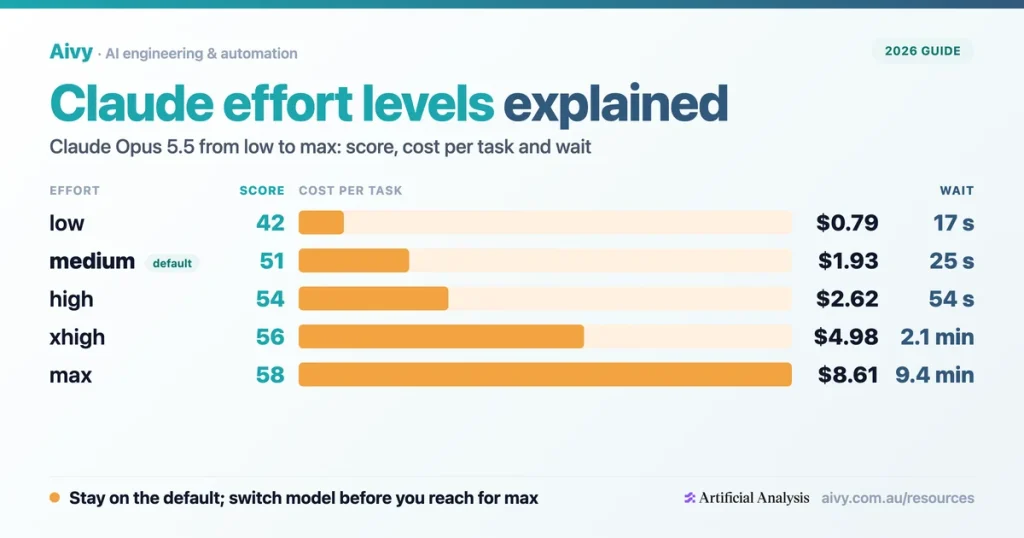
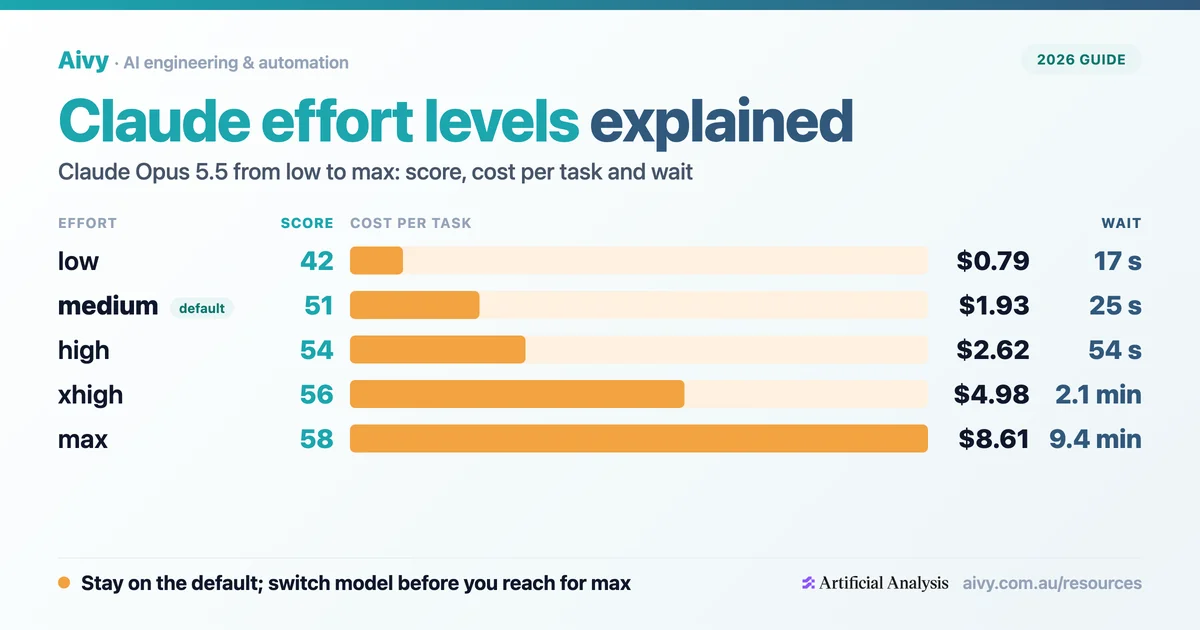
Artificial Analysis runs each Claude model at every effort level through its Intelligence Index and publishes the score, the cost of a finished task and the time to a full answer. On 18 October 2026, Opus 5.5 at medium scored 51 for $1.93 a task and a 25 s wait. At high it scored 54 for $2.62, roughly twice the wait. Google’s Gemini 4 Carbon beats Opus 5.5 at high, but few can use it yet.
The curve flattens fast. Low to medium adds 9 points; medium to high adds 3; high to xhigh adds 2 for 90 per cent more per task. The comparison with Opus 5.5 vs Fable 5.1 showed the same pattern between models: past a point, more spend buys very little.
Claude Opus 5.5 at each effort level: score, cost per task and wait
Medium, in bold, is the default. Cost and time panels are scaled to the max row. Source: Artificial Analysis, Intelligence Index, cost per task and total response time, read 18 October 2026. Converted at 1 Australian dollar to 0.6947 United States dollars, Reserve Bank of Australia, 16 October 2026.
Intelligence Index, axis 0 to 100
Cost per task
Time to a full answer

The wait is the number most people miss. At max, Opus 5.5 took 9.4 min for a full answer, against 25 s at medium. For a person waiting at a desk in Brisbane, that is the difference between a tool and a queue. Before you change a default across a team, put the extra cost into our AI ROI calculator next to the time it saves.
Xhigh vs max: what the last step of effort buys
Xhigh and max are the two settings people ask about most, and the honest answer is that max rarely earns its keep. Anthropic itself describes xhigh as the level for long coding and agent runs of more than 30 minutes, and max as the absolute ceiling with no limit on spend. For older Opus models it warned that max can add significant cost for small gains and even lead to overthinking.
+2 points
Opus 5.5 from xhigh to max on the Intelligence Index
+73%
cost per task for that step, $4.98 to $8.61
4.4x
longer wait, 2.1 min to 9.4 min
9.6x
longer wait for Sonnet 5.5 on the same step, 40 s to 6.4 min
Based on data from Artificial Analysis (artificialanalysis.ai), which does not endorse, validate or approve any of the analysis or conclusions drawn from it. Index, cost per task and total response time read 18 October 2026. Converted at 1 Australian dollar to 0.6947 United States dollars, Reserve Bank of Australia, 16 October 2026.
The numbers back that up. On Opus 5.5 the step from xhigh to max adds 2 points for 73 per cent more per task, and the wait grows 4.4 times. On Sonnet 5.5 the same step adds 4 points for 172 per cent more, and the wait grows almost tenfold, from 40 s to 6.4 min.
Treat max as a tool for one hard problem, not a setting for a workload. If xhigh fails, read why before you pay 73 per cent more for two points.
Where xhigh does make sense is the long run that would otherwise stop early: an agent working through a backlog overnight, or a large migration. Those are the jobs in our guide to the best AI agents in Australia. In Claude Code, max applies to the current session only unless you set it through an environment variable, which is a sensible guard. If you run agents like that for a Melbourne operation, our Melbourne AI automation team can help set the limits.
Sonnet 5.5 high vs Opus 5.5 medium: switch model, not effort
Many people search for Sonnet 5.5 at high against Opus 5.5 at medium, and it is the right question. Sonnet 5.5 at high scores 47 for $1.27 a task and answers in 16 s. Opus 5.5 at medium scores 51 for $1.93 in 25 s. So Opus at its default is the stronger and slower option, for about half as much again per task.
Above that point the logic flips in Opus’s favour. Turning Sonnet 5.5 up to xhigh reaches 52 for $2.89, which costs more than Opus 5.5 at medium for about the same score. The same thing happens one row up, and it is the clearest rule in this article. A similar matched spend test sits in our Sonnet 5.5 vs GPT 6.1 Sol comparison.
| If you run | Score, cost, wait | Try instead | Score, cost, wait | Why |
|---|---|---|---|---|
| Sonnet 5.5 at xhigh | 52 for $2.89, 40 s | Opus 5.5 at medium | 51 for $1.93, 25 s | About the same score for a third less, and faster |
| Sonnet 5.5 at max | 56 for $7.86, 6.4 min | Opus 5.5 at xhigh | 56 for $4.98, 2.1 min | The same score for about a third less, three times faster |
| Fable 5.1 at max | 53 for $10.98, 3.0 min | Opus 5.5 at high | 54 for $2.62, 54 s | A higher score for under a quarter of the cost |
| Opus 5.5 at low | 42 for $0.79, 17 s | Haiku 5.5 at max | 43 for $0.30, 5.3 min | A point higher for less, but a far longer wait |
Based on data from Artificial Analysis (artificialanalysis.ai), which does not endorse, validate or approve any of the analysis or conclusions drawn from it. Index, cost per task and total response time read 18 October 2026. Converted at 1 Australian dollar to 0.6947 United States dollars, Reserve Bank of Australia, 16 October 2026.
The last row is the odd one. Haiku 5.5 at max edges Opus 5.5 at low on score and costs less, but it took 5.3 min to answer against 17 s. For an Australian firm in professional services running document checks overnight, that trade can work. For anything a client waits on, it does not.
Haiku 5.5 and Fable 5.1 at each effort level
The two ends of the range behave differently. Haiku 5.5 is so cheap per task that even max costs $0.60, against $0.06 at low. What moves is the wait, which climbs from 12 s to 5.6 min. For chat at volume, such as the AI chatbots we build for Australian support teams, low or medium is the sensible start.
Anthropic’s own guidance for Haiku 5.5 fits that reading. It suggests medium for most work, low for chat and simple requests at volume, and high for knowledge work and longer agent tasks. It also warns that at low, in long agent prompts, the model is more likely to skip a search, stop early or skip a check.
| Effort | Haiku 5.5 index | Haiku per task | Haiku wait | Fable 5.1 index | Fable per task | Fable wait |
|---|---|---|---|---|---|---|
| low | 18.6 | $0.06 | 12 s | 38.7 | $6.49 | 11 s |
| medium | 24.6 | $0.13 | 15 s | 43.2 | $8.07 | 13 s |
| high | 29.9 | $0.23 | 34 s | 47.2 | $10.94 | 31 s |
| xhigh | 34.6 | $0.36 | 80 s | 50.0 | $15.73 | 99 s |
| max | 36.5 | $0.60 | 5.6 min | 49.2 | $18.85 | 4.7 min |
Based on data from Artificial Analysis (artificialanalysis.ai), which does not endorse, validate or approve any of the analysis or conclusions drawn from it. Intelligence Index v5, cost per task and total response time read 9 November 2026. Converted at 1 Australian dollar to 0.6894 United States dollars, Reserve Bank of Australia, 9 November 2026.
Fable 5.1 sits at the other end. It defaults to high, and on this v5 reading max scores 49.2, below xhigh on 50.0, so max on Fable 5.1 buys nothing but cost and time. More telling, Opus 5.5 at high scores 51.8 for $5.03, above Fable 5.1 at any setting. Our GPT 6 Astra vs Fable 5.1 comparison explains where Fable still earns a place.
Claude Fable 5.2 at each effort level
Claude Fable 5.2, released on 9 November, defaults to high on the API and to medium in the Claude apps and Claude Code. Anthropic’s advice is to start at high, where most of the gain already sits, and the index agrees: xhigh adds 0.4 points for 63 per cent more per task, and max another 2.4 for 79 per cent more again.
| Effort | Fable 5.2 index | Fable 5.2 per task |
|---|---|---|
| low | 53.9 | $4.49 |
| medium | 56.4 | $5.52 |
| high | 61.8 | $13.17 |
| xhigh | 62.2 | $21.51 |
| max | 64.6 | $38.50 |
Based on data from Artificial Analysis (artificialanalysis.ai), which does not endorse, validate or approve any of the analysis or conclusions drawn from it. Intelligence Index v5 and cost per task read 9 November 2026, not comparable with the v4.3 figures above; response time not measured yet. Converted at 1 Australian dollar to 0.6894 United States dollars, Reserve Bank of Australia, 9 November 2026.
How to change effort in the Claude app and Claude Code
In the Claude apps, click the model name next to the send button and open Effort. The menu offers Low, Medium, High, Extra high and Max, with each model’s default marked. The Claude Help Center is clear on the trade: higher effort takes longer and uses more tokens, so you reach your usage limit sooner, while low and medium stretch it further.
In Claude Code you have more ways in: the /effort command and its slider, the slider inside /model, the –effort flag at launch and the CLAUDE_CODE_EFFORT_LEVEL environment variable. Two keywords cause confusion. Typing ultrathink asks for deeper reasoning on that one turn without changing the setting. Ultracode is not an effort level at all: it is a setting that plans a workflow for larger tasks. Our Claude Code vs Codex guide covers the rest of the tool.
| Where | How to change effort | Worth knowing |
|---|---|---|
| Claude apps (web, desktop, mobile) | Click the model name next to the send button, then Effort | Low, Medium, High, Extra high and Max; higher levels use your plan limits faster |
| Claude Code | /effort, the slider in /model, –effort at launch or CLAUDE_CODE_EFFORT_LEVEL | Max lasts for the session unless set by the variable; ultrathink deepens one turn only |
| Claude API | output_config.effort on the request | Per message changes keep the prompt cache on Opus 5.5, Sonnet 5.5 and Haiku 5.5 (beta) |
| Claude Enterprise | Admins can cap effort per role and model | Levels above the cap are not offered |
Sources: Claude Help Center, changing the model effort and thinking settings; Claude Code, model configuration; Anthropic, effort documentation. All retrieved 18 October 2026.
For teams on Claude Enterprise, administrators can cap effort per role and model, so a contractor seat cannot run max all day. That is worth setting before a wide rollout. A business in Sydney rolling Claude Code out to forty developers would want those caps in place on day one.
ChatGPT thinking levels and GPT reasoning effort
OpenAI uses the same idea under different names. In ChatGPT, with GPT 6 selected, a Thinking slider offers Instant, Medium for standard thinking, High for extended thinking, Extra High, and Pro. GPT 6 Sol powers everything from Instant to Extra High, and Pro runs GPT 6 Pro, powered by GPT 6 Astra. OpenAI adds that asking ChatGPT to think harder does not switch the level for you.
Plan matters more than in Claude. Plus gets Medium and High but not Extra High or Pro; Pro, Business and Enterprise get all of them. Free and Go run GPT 5.6 Luna, with a Think option. Our Claude vs ChatGPT comparison covers what each plan costs in Australia.
| ChatGPT plan | Instant | Medium and High | Extra High | Pro (GPT 6 Astra) |
|---|---|---|---|---|
| Free and Go | GPT 5.6 Luna | Not included (Think uses Luna) | Not included | Not included |
| Plus | Included | Included | Not included | Not included |
| Pro | Included | Included | Included | Included |
| Business and Enterprise | Included | Included | Included | Included |
Source: OpenAI Help Center, GPT 6 and other models in ChatGPT, retrieved 18 October 2026. With GPT 6 selected, GPT 6 Sol powers Instant to Extra High.
On the API, OpenAI’s reasoning effort runs from none to max depending on the model, with medium the default on GPT 6.1 Sol. Its cost curve is much flatter than Claude’s. GPT 6.1 Sol at max scored 52 for $1.04 a task, below Opus 5.5 at high on score but for well under half the cost. Our guide to GPT 6 Astra, Sol and Luna explains the family.
Cost per task at each effort level, Claude Opus 5.5 and GPT 6.1 Sol
Lower is cheaper; bars scaled to Opus 5.5 at max. The heading of each pair gives both Intelligence Index scores. Source: Artificial Analysis, read 18 October 2026. Converted at 1 Australian dollar to 0.6947 United States dollars, Reserve Bank of Australia, 16 October 2026.
Which Claude effort level to use for each job
If you take one thing from this article, take the order of operations: choose the model first, leave it on its default, and only change effort after a real failure you can describe. The model can matter more: GPT 6.1 Terra ties Sonnet 5.5 at medium. Raising effort fixes reasoning that runs out of road. It does not fix a vague prompt, missing context or the wrong tool.
| Job | Model and effort I would start with | Move up when |
|---|---|---|
| Chat replies, triage, tagging at volume | Haiku 5.5 at low or medium | Answers skip steps or miss instructions |
| Emails, summaries, everyday documents | Sonnet 5.5 at medium | Drafts need heavy editing |
| Everyday coding and bug fixes | Sonnet 5.5 at high, or Opus 5.5 at medium | Fixes fail tests or miss edge cases |
| Analysis that needs judgment | Opus 5.5 at medium, the default | The reasoning has gaps you can name |
| Long agent runs and large refactors | Opus 5.5 at high or xhigh | The run stops early or skips checks |
| The one problem that justifies a long wait | Opus 5.5 at max | Rarely: try xhigh first |
Starting points drawn from Anthropic’s effort guidance and the Artificial Analysis readings above. Test on your own tasks before you commit a workload.
For finance and accounting automation that runs thousands of small steps a month, the low and medium rows carry the budget, and a single step up across the board can double the bill. For an Australian clinic using AI on healthcare paperwork, the right move is often a cheaper model at a higher effort rather than the reverse.
My recommendation: set effort per job, not per team. Run a week of real tasks at the default and one level up, compare the results and the bill, and keep the cheapest setting that passes.
Claude effort levels: frequently asked questions
What is the best effort level for Claude?
For most work, the default: medium on Opus 5.5 and Haiku 5.5, high on Sonnet 5.5 and the Fable models. Move up only when you can name what went wrong, such as a run that stops early or reasoning with gaps.
What is the difference between xhigh and max effort?
Xhigh is Anthropic’s level for long coding and agent runs; max removes every limit on token spend. On Opus 5.5, max scored 2 points more than xhigh for 73 per cent more per task and a far longer wait.
Is max effort worth it on Claude Opus 5.5?
Rarely. It suits a single hard problem where a long wait is acceptable. At max, Opus 5.5 took 9.4 min for a full answer on the Artificial Analysis run, against 2.1 min at xhigh.
Does higher effort use more of my Claude usage limit?
Yes. Higher effort produces more tokens, so on a Claude plan you reach your usage limit sooner. Anthropic’s Help Center says low and medium stretch your usage further.
What does ultrathink do in Claude Code?
Typing ultrathink asks Claude Code for deeper reasoning on that turn only. The effort setting sent to the API does not change. Phrases such as think hard are passed through as ordinary text.
Is ultracode the same as max effort?
No. Ultracode is a Claude Code setting that plans a dynamic workflow for larger tasks, at whatever effort the session runs at. Launching with ultracode switches it on and sets effort to xhigh.
Is Sonnet 5.5 at high better than Opus 5.5 at medium?
Opus 5.5 at medium scored 51 against 47 for Sonnet 5.5 at high, but cost more and took longer. If Sonnet 5.5 at high is not enough, switch to Opus 5.5 rather than raising Sonnet’s effort.
What effort does Claude Code use by default?
Medium on Opus 5.5, Sonnet 5.5, Haiku 5.5 and Fable 5.2, xhigh on Opus 4.7 and high on other models that support effort. You can check the level in effect with /effort status.
Does effort change the price per token?
No. The rate per million tokens stays the same at every level. Effort changes how many tokens a reply uses, which is why the cost of a finished task rises so quickly at the top of the range.
What are ChatGPT’s thinking levels?
Instant, Medium, High, Extra High and Pro, chosen with the Thinking slider when GPT 6 is selected. Plus includes Medium and High; Extra High and Pro need Pro, Business or Enterprise. Prices for each are in the full list of ChatGPT plans.
The bottom line: start at the default, then measure
Effort is the cheapest lever you have, and the easiest one to waste. The defaults on the Claude 5.5 family are sensible, the gains above high are small, and max is a tool for one hard problem rather than a setting for a team. When a cheaper model at high stops being enough, switching to Opus 5.5 usually beats turning the dial further.
Picture a Melbourne accounting practice with Claude drafting client emails and checking reconciliations. On these readings, moving that work from Opus 5.5 at medium to max would lift the cost of each task from $1.93 to $8.61 and stretch each answer from 25 s to 9.4 min. A short business audit usually shows where that money is better spent.
+7 points
Opus 5.5 from medium, the default, to max
4.5x
cost per task, $1.93 to $8.61
22x
wait for a full answer, 25 s to 9.4 min
Based on data from Artificial Analysis (artificialanalysis.ai), which does not endorse, validate or approve any of the analysis or conclusions drawn from it. Index, cost per task and total response time read 18 October 2026. Converted at 1 Australian dollar to 0.6947 United States dollars, Reserve Bank of Australia, 16 October 2026.
Artificial Analysis measures these models again as they change, so check the date at the foot of this page before you rely on the numbers. If you would like a second opinion on which model and effort level each of your workloads should run at, you can book a time with our team whenever it suits you.
Last updated: 10 November 2026
Sources
Anthropic, effort documentation. What effort controls, the five levels and their typical uses, which models support xhigh and max, the medium default on Opus 5.5 and Haiku 5.5 and high on other models, per model recommendations for Opus 5.5, Sonnet 5.5, Haiku 5.5, Fable 5.1 and Opus 4.7, and per message effort changes. Retrieved 18 October 2026, and on 9 November 2026 for Fable 5.2.
Anthropic, Introducing Claude Fable 5.2 and Claude Mythos 5.2. Medium as the default effort in the Claude apps and Claude Code. Read 9 November 2026.
Artificial Analysis, Intelligence Index v5, reading of 9 November 2026. Claude Fable 5.2 index and cost per task at each effort, read through the Artificial Analysis API.
Claude Code, model configuration. Default effort per model in Claude Code, the /effort command, the –effort flag and environment variable, max for the session only, ultrathink, ultracode, Enterprise effort caps, and Opus 5.5 at medium against Opus 5 at high. Retrieved 18 October 2026.
Claude Help Center, changing the model effort and thinking settings. Where the effort menu sits in the Claude apps, the models and levels offered, and the effect of higher effort on usage limits. Retrieved 18 October 2026.
OpenAI Help Center, GPT 6 and other models in ChatGPT. The Thinking slider levels, which model powers each, availability by plan, and the note that asking to think harder does not switch level. Retrieved 18 October 2026.
OpenAI, reasoning models guide. Reasoning effort values from none to max, the medium default on GPT 6.1 Sol, and guidance on when to use each level. Retrieved 18 October 2026.
Artificial Analysis, models leaderboard. Intelligence Index scores, cost per task and total response time at every effort level for Claude Opus 5.5, Sonnet 5.5, Haiku 5.5, Fable 5.1 and GPT 6.1 Sol, read on 18 October 2026. Source: Artificial Analysis (artificialanalysis.ai).
Tables and charts using this data are based on data from Artificial Analysis (artificialanalysis.ai), which does not endorse, validate or approve any of the analysis or conclusions drawn from it.
Reserve Bank of Australia, exchange rates. Every United States dollar figure converted at 1 Australian dollar to 0.6947 United States dollars, 16 October 2026.
Index, cost and time figures reflect the leaderboard as read on 18 October 2026 and move as models are measured again.



