
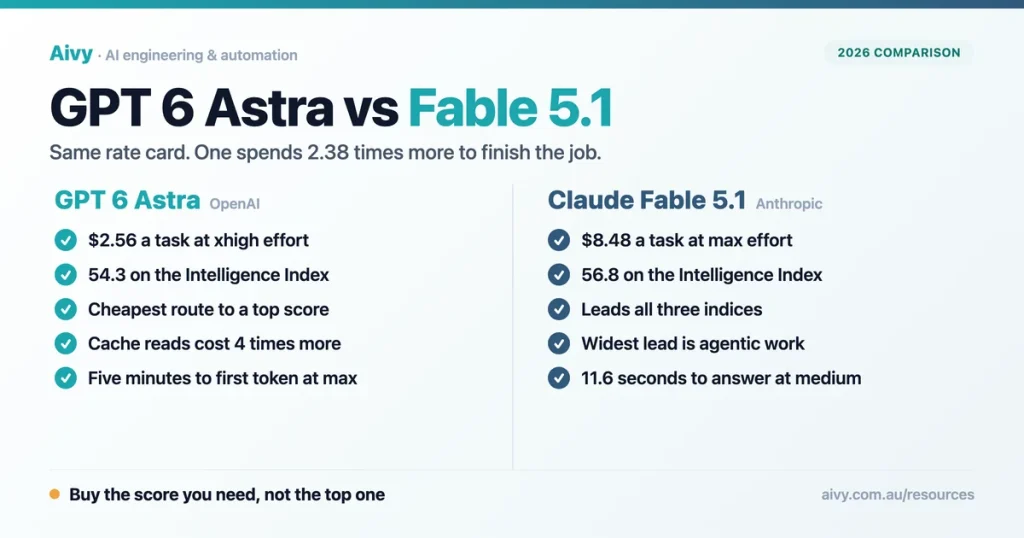
OpenAI and Anthropic have priced their two flagships identically on the lines that carry the volume. GPT 6 Astra and Claude Fable 5.1 both list the same rate, $13.87 per million input tokens and $69.35 per million output tokens. Same rate card, to the cent. Then the invoice arrives, and one of them has cost more than twice as much for the same work.
Across the Artificial Analysis Intelligence Index v4.2, one task costs $8.48 on Claude Fable 5.1 at maximum effort and $3.56 on GPT 6 Astra at maximum. The rates match, so the whole gap is token spend: Fable 5.1 spends 2.38 times more and scores 2.1 points higher. Both vendors bill in United States dollars; every figure here is Australian, at the RBA rate of 4 September 2026 except the 22 September additions.
The verdict in three lines. Run GPT 6 Astra at xhigh when the bill matters more than the last 2.5 points: $2.56 a task for 54.3. Run Claude Fable 5.1 at medium effort when a person is waiting. Keep Fable 5.1 at maximum for agents, and queue them.
Key takeaways
- Identical list rates on both: $13.87 per million tokens in, $69.35 per million out.
- One index task costs $8.48 on Claude Fable 5.1 at maximum effort against $3.56 on GPT 6 Astra at maximum. That is 2.38 times the token spend for 2.1 more points.
- The cheapest strong setting is GPT 6 Astra at xhigh: 54.3 on Intelligence for $2.56 a task.
- Cache reads are the only line where the two rate cards disagree. Fable 5.1 reads at $0.35 per million, Astra at $1.39.
- Maximum effort is paid in minutes as well as dollars. Fable 5.1 takes 276.8 seconds to first token at maximum and 11.6 seconds at medium.
GPT 6 Astra vs Claude Fable 5.1 at a glance
Four settings decide this for most teams: the top of each vendor, plus the two notches underneath that undercut both on price and on wait.
All scores, costs, latency and throughput figures measured by Artificial Analysis, Intelligence Index v4.2, retrieved 7 September 2026. Prices converted at the Reserve Bank of Australia rate of 4 September 2026. Based on data from Artificial Analysis. Artificial Analysis does not endorse Aivy, this article or the conclusions drawn from its data.
What each model is, and why the effort setting matters
GPT 6 Astra is the current OpenAI flagship. A reasoning control decides how long it thinks before answering, and three levels are measured here: maximum, xhigh and a non reasoning tier. We covered the release in our GPT 6 Astra launch note.
Claude Fable 5.1 was the Anthropic flagship until Fable 5.2 arrived on 9 November, with an adaptive reasoning dial running from low through medium to maximum. On price those notches behave like three separate products: $2.36, $2.97 and $8.48 a task. Anthropic still sells Claude Opus 5 and Claude Sonnet 5, and both matter further down this page.
Artificial Analysis scores every effort setting as its own entry, which is the only honest way to read the board. Two notches of one model can differ by more than two different models do. Inside Claude Fable 5.1 alone, Intelligence runs from 50.9 to 56.8 and cost per task from $2.36 to $8.48.
Benchmark scores: intelligence, coding and agentic indices
Claude Fable 5.1 at maximum effort wins all three. The margins are not equal, and that is what decides whether the spend is defensible.
Intelligence, Coding and Agentic, axis 0 to 100
Higher is better. Source: Artificial Analysis Intelligence Index v4.2, 7 September 2026, and v4.3, 22 September 2026, for the last block. Coding and Agentic sub indices for Claude Opus 5.5 are not in our reading.
Intelligence
Coding
Agentic
Intelligence on the rebuilt v4.3 index
Read 22 September 2026; Claude Sonnet 5.5 read 28 September 2026; GPT 6.1 Sol, in grey, 29 September 2026. A new scale: compare these bars with each other, not with the v4.2 bars above.

On general reasoning the market has bunched up. Intelligence separates the two flagships at maximum by 2.1 points, and GPT 6 Astra at xhigh sits 0.4 points below its own top setting. Coding is 4.7 points apart. Agentic is 6.6, and that is the one gap wide enough to change a decision. Since 28 October, the newer v5 index has Gemini 4 Carbon clear of GPT 6 Astra, though few can use it.
Agentic tracks long tool loops, where a wrong turn costs a retry and every retry is another task on the invoice. Read the coding row too. Claude Fable 5.1 at medium effort scores 77.1, above GPT 6 Astra at maximum on 76.9. One vendor’s middle notch beats the other’s top notch, and Claude Opus 5 at xhigh does the same on 77.0.
Anthropic added Claude Opus 5.5 to its range on 22 September 2026, at $5.62 and $28.08 per million tokens on the RBA rate of that day. Its model documentation now suggests starting there for most workloads and moving up to Claude Fable, now Fable 5.2, only for demanding reasoning and long running agentic work, and Claude Opus 5 moves to the legacy list while staying available.
OpenAI added GPT 6 Sol and GPT 6 Luna on 22 September 2026, at $2.81 and $14.04 per million tokens for Sol and $0.14 and $0.70 for Luna, on the RBA rate of that day. OpenAI positions Sol for complex coding and agentic workflows and Luna as its most efficient model for focused, high volume tasks. There is no GPT 6 Terra.
On 29 September OpenAI followed with GPT 6.1 Sol, an upgrade to GPT 6 Sol at the same $2.81 and $14.04, with cache reads at $0.14. It says the model nearly matches GPT 6 Astra on agentic coding, computer use and professional work at a fifth of the price. On the v4.3 index it scores 51.8 at max against 52.7 for Astra, for $1.02 a task against $4.57.
Pricing and cost per task: same rate card, very different bill
What one index task costs, in Australian dollars
Lower is better, axis 0 to $8.48. Source: Artificial Analysis, converted at the RBA rate of 4 September 2026.
Cost per task on the rebuilt v4.3 index
Read 22 September 2026, converted at the RBA rate of that day; GPT 6.1 Sol, in grey, read 29 September at the same rate. Bars in this block scaled to $10.71; the task suite changed, so these costs do not line up with the block above.
Read that against the index chart above and the scores fall gently while the costs fall off a cliff. With input and output matching to the cent, the cliff cannot be pricing. It is appetite. Cost per task reads directly as how heavily each model spends tokens getting to an answer, and at maximum effort Claude Fable 5.1 spends 2.38 times more than GPT 6 Astra on the identical tasks.
That is the number to take to your finance lead. It is not a discount anyone can negotiate, and it will never show up on a comparison of pricing pages, because both pages say the same thing. You meet the difference at the end of the month.
The clean way to judge a notch is to price the points it adds over the notch below. From the published costs, each step buys this:
- GPT 6 Astra, xhigh to max: 0.4 Intelligence points for $1.00 more per task.
- Claude Fable 5.1, low to medium: 1.9 points for $0.61 more.
- Claude Fable 5.1, medium to max: 4.0 points for $5.51 more.
- GPT 6 Astra at xhigh to Claude Fable 5.1 at max: 2.5 points for $5.92 more.
The second step is the bargain of the four. The first and the last are the dearest points in the dataset, and the last is the matchup most comparisons stop at: 54.3 for $2.56 against 56.8 for $8.48, which is 3.31 times the money for 2.5 points. That is the widest price gap between two adjacent settings on this board.
Cache pricing: the one line where Claude Fable 5.1 is cheaper
Exactly one line differs between the two rate cards, and it cuts against the argument so far. Reading a cached token costs $0.35 per million on Claude Fable 5.1 and $1.39 on GPT 6 Astra, four times more. Cache writes are identical at $17.34 per million, as are input and output.
Cache read price per million tokens, in Australian dollars
Lower is better, axis 0 to $1.39. The only line where the two flagship rate cards differ. Source: Artificial Analysis. Claude Opus 5.5 added on 22 September 2026 from Anthropic’s pricing page; at two decimals it reads $0.28 at both the 4 and the 22 September RBA rates. GPT 6.1 Sol, in grey, from its model page on 29 September at the 22 September rate; GPT 5.6 Sol, $0.55, left the chart when it joined.
This matters for one shape of workload: anything that sends the same large context over and over. Support assistants on a fixed knowledge base, coding agents reloading a repository each turn, document tools rereading the same policy pack. There, most of the input is cache reads, and the cheaper line does real work on the invoice.
The index does not report a cached figure, so it cannot show that. It does not cancel the token spend gap either, since output still bills at $69.35 per million on both. So measure your own hit rate. Artificial Analysis does not measure whether cache hits shorten the wait, so do not assume they do until you have timed it.
Speed and latency: what maximum effort costs in seconds
Here is the number that rarely makes the launch posts. At maximum effort, GPT 6 Astra takes 322.5 seconds to emit its first token and Claude Fable 5.1 takes 276.8. Those are not response times. That is the blank screen before anything appears at all. Full answers land at 330.5 and 284.1 seconds. In a support widget, that is not a slow answer. It is a timeout.
Time to first token, in seconds
Lower is better, axis 0 to 330 seconds. Measured by Artificial Analysis, 7 September 2026; the Claude Opus 5.5 bars were measured on 22 September 2026, and its maximum setting has no latency figure in that reading; the Claude Sonnet 5.5 bars on 28 September 2026, when its maximum setting had none either. GPT 6.1 Sol, first timed late on 29 September, is left out: 118.5 seconds at max and 37.5 at xhigh.
Run the dial down and the picture inverts. Claude Fable 5.1 at medium effort reaches its first token in 11.6 seconds and finishes in 20.8. Its low setting starts in 5.8 seconds. GPT 6 Astra at xhigh starts in 155.2 seconds, roughly half of its own maximum, and still two and a half minutes of nothing.
It is tempting to blame throughput for the wait. The data will not let you. Output speed across every measured configuration sits between 52 and 75 tokens per second. Claude Fable 5.1 at maximum runs at 68, quicker than GPT 6 Astra at maximum on 62 and quicker than its own medium setting on 54. It still waits 276.8 seconds to begin.
Split the two numbers and it becomes obvious. Of the 284.1 seconds Fable 5.1 spends end to end at maximum, 276.8 pass before the first token. GPT 6 Astra spends 322.5 of its 330.5 the same way. At medium the balance flips: 11.6 seconds of thinking, then 9.2 of writing. The wait is reasoning time, and the effort dial is the only lever on it.
So maximum effort belongs in batch work that runs overnight, never in a request a person is watching. We treat roughly 30 seconds as the practical ceiling for interactive work, and Claude Opus 5 at xhigh sits right on that edge, starting in 30.0 seconds and finishing in 39.7. Our Claude Opus 5 comparison covers where it still earns its place.
Which model should an Australian team run
Nothing here argues for standardising on one vendor, or one notch. Cost per task across the measured settings runs from $0.31 to $8.48, and most work does not need the top of that range. Route by workload and let the invoice follow the value. The next contender is already on the index: Gemini 4 Argon reaches Astra’s top score at a lower setting, though nobody can buy it yet.
One trap is worth naming. Do not push a smaller model to maximum effort to save money. Claude Sonnet 5 at maximum costs $4.60 and scores 45.1. Claude Opus 5 at xhigh costs $4.66 and scores 53.4. Six cents bought 8.3 index points. Move up a model class before you move up the dial.
Claude Sonnet 5.5 repeats the lesson on the v4.3 index of 28 September. At maximum it costs $10.67 a task for 56.0, while Claude Opus 5.5 at xhigh reaches the same 56.0 for $4.86. Its value setting is high: 46.7 for $1.52, at the same list price as Sonnet 5.
Teams still on the previous generation have less to change than they think. GPT 5.6 Sol at low effort scores 40.8 for $0.31 a task and starts answering in 2.5 seconds and finishes in 9.9, which is still the right tool for bulk tagging and routing. Our GPT 5.6 Sol against Claude Fable 5 comparison covers that tier in full.
What the benchmark data does not cover
Two blanks are worth naming plainly. Claude Sonnet 5 at low effort has the fastest first token among the settings measured here, at 1.3 seconds and a full answer in 9.6, but no index scores, so nobody can say what that speed costs in quality. GPT 6 Astra without reasoning has scores and a price but no measured latency. In both cases the data is absent, not zero.
These are also single measurements from one harness running one task suite, and an index task is not your task. Your prompt lengths, your context and your retry logic will move every number here. Benchmark figures pick the shortlist. Your own traffic picks the winner, so time two candidates on real requests before committing a budget.
GPT 6 Astra vs Claude Fable 5.1: frequently asked questions
Do GPT 6 Astra and Claude Fable 5.1 really cost the same?
On the rate card, yes. Both list $13.87 per million input tokens, $69.35 per million output tokens and $17.34 per million for cache writes. Cache reads are the only line that differs. What varies in practice is how heavily each one spends tokens reaching an answer.
Why does one task cost more than twice as much if the rates match?
Because a bill is rate multiplied by volume. With the rate identical on these two, cost per task reads directly as token spend between them. Claude Fable 5.1 at maximum effort spends 2.38 times more than GPT 6 Astra at maximum on the same tasks, and returns 2.1 more Intelligence points for it.
What is the cheapest setting that still scores well?
On the 7 September reading, GPT 6 Astra at xhigh: 54.3 on Intelligence for $2.56 a task, 2.5 points behind the leader at under a third of the cost. On a tighter budget, GPT 6 Astra without reasoning scores 76.2 on Coding for $1.97, though its speed was not measured in this dataset. On the rebuilt v4.3 index, Claude Opus 5.5 at high scores 53.6 for $2.56, Claude Sonnet 5.5 at high 46.7 for $1.52, and GPT 6.1 Sol at xhigh, since 29 September, 51.0 for $0.55.
Is maximum effort ever worth paying for?
Only when the extra points change the outcome and nobody is waiting. On Claude Fable 5.1, medium to maximum buys 4.0 Intelligence points for $5.51 a task and pushes first token from 11.6 seconds to 276.8. On GPT 6 Astra, xhigh to maximum buys 0.4 points for $1.00 and 167.3 extra seconds.
Which one is better for agents?
Claude Fable 5.1 at maximum effort, by the widest margin on the board: 58.2 on Agentic against 51.6 for GPT 6 Astra at maximum. Claude Opus 5 at xhigh sits between them at 55.7 for $4.66 and starts in 30.0 seconds. Since 22 September Anthropic suggests starting with Claude Opus 5.5 and stepping up to Fable 5.1 only when Opus 5.5 at higher effort falls short; its Agentic score is not in our reading yet.
Which setting answers fastest?
Claude Sonnet 5 at low effort, at 1.3 seconds to first token and 9.6 seconds to a full answer, although its index scores are not measured. Among scored settings, Claude Opus 5 at low starts in 2.3 seconds and GPT 5.6 Sol at low in 2.5. Within the two flagships, Claude Fable 5.1 at low is quickest at 5.8 seconds. On the 28 September reading, Claude Sonnet 5.5 at low started in 0.7 seconds and does carry a score, 35.8 on v4.3.
Are these prices in Australian dollars?
Yes. Both vendors publish and bill in United States dollars, and every figure here is converted at the Reserve Bank of Australia rate of 4 September 2026. Your invoice moves with the exchange rate as well as with your usage, which is one more reason to review spend monthly.
The bottom line for Australian teams
Two flagships, one rate card, and a 2.38 times difference in what they charge to finish the same task. That is the story, and it is invisible on either pricing page. The sharpest version of it sits at the top of the board: 3.31 times the money for 2.5 index points.
Deciding this week, the defaults are these. General reasoning on GPT 6 Astra at xhigh, $2.56 a task for 54.3. Anything with a person waiting on Claude Fable 5.1 at medium effort, for the 11.6 second first token and a coding score above the other vendor’s top setting. Agents on Fable 5.1 at maximum, batched.
Then check your cache hit rate before you commit. It is the only line where the two rate cards disagree, and at four times the read price it is the one thing on this page that could flip the answer for your workload.
Last updated 10 November 2026.
- Artificial Analysis, Data API, language models endpoint. Artificial Analysis Intelligence Index v4.2, Coding Index, Agentic Index, cost per task, latency and throughput, retrieved 7 September 2026. artificialanalysis.ai. Scores and prices reproduced with attribution under the Artificial Analysis data licence.
- Reserve Bank of Australia, exchange rate statistics, 4 September 2026. Conversion used: 1 Australian dollar to 0.7210 United States dollars. rba.gov.au
- Source: Artificial Analysis (artificialanalysis.ai), Intelligence Index v4.3, cost per task and time to first token by reasoning effort, read 22 September 2026, converted at the Reserve Bank of Australia rate of that day, 1 Australian dollar to 0.7123 United States dollars. Based on data from Artificial Analysis. Artificial Analysis does not endorse Aivy, this article or the conclusions drawn from its data.
- OpenAI, Introducing GPT 6.1 Sol: the upgrade to GPT 6 Sol at 2 and 10 United States dollars per million tokens with cached input at 0.10, and its positioning against GPT 6 Astra (read 29 September 2026).
- Artificial Analysis, reading of 29 September 2026: GPT 6.1 Sol index scores and cost per task at max and xhigh, and its first token latency, read later that day. Based on data from Artificial Analysis, which does not endorse, validate or approve any of the analysis or conclusions drawn from it.
- Anthropic, Claude pricing: Claude Opus 5.5 at 4 and 20 United States dollars per million input and output tokens, 0.20 for cache reads (read 22 September 2026).
- Anthropic, Introducing Claude Fable 5.2 and Claude Mythos 5.2: released 9 November 2026 at 8 and 40 United States dollars per million tokens (RBA 0.6894).
- Artificial Analysis, Intelligence Index v5, reading of 9 November 2026: Fable 5.2 at max and GPT 6 Astra at max. Source: Artificial Analysis (artificialanalysis.ai), which does not endorse, validate or approve any of the analysis or conclusions drawn from it.
- Anthropic, Models overview: start with Claude Opus 5.5 for most workloads, Claude Fable 5.1 for demanding reasoning (read 22 September 2026), and Claude Sonnet 5.5 at 2 and 10 United States dollars per million tokens (read 28 September 2026).
Figures reflect the index as measured on 7 September 2026 and change as models are measured again.



