
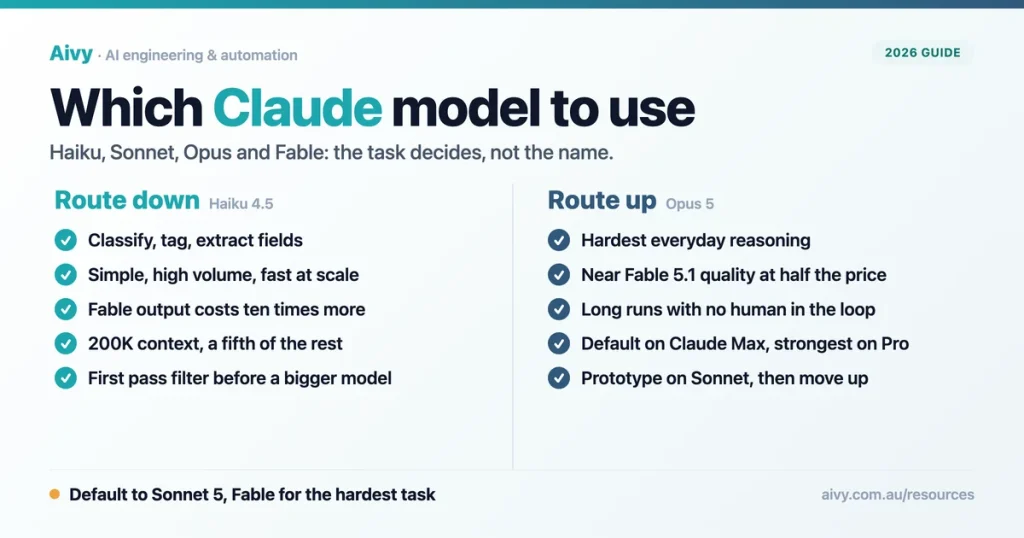
At Aivy we have built automations on Claude since the first Opus shipped, and the question Melbourne operations teams ask most is not whether to use Claude, but which Claude model to use. Anthropic now ships four current models under one name, and the gap between the cheapest and the dearest runs a hundredfold on output tokens. Choosing wrong does not throw an error. It quietly inflates your bill.
Over the past year I have moved real client workloads across the whole range, from a finance team classifying thousands of invoices a day to a professional services firm running long research agents overnight. The lesson holds: the shape of the task matters far more than the model name. A cheap model on the right job beats an expensive one on the wrong job, on cost and on reliability.
This guide is how I actually decide, written for Australian businesses paying in United States dollars. I walk through each model, show what it costs to run and give you a routing table for your team. The short version: start with Sonnet 5.5 for most work, and with Haiku 5.5 when the task is simple and high volume. Haiku is now good enough for far more than it was.
Update, 10 November 2026: Anthropic released Claude Fable 5.2 on 9 November, now the top of the range, at $11.60 in and $58.02 out per million tokens (RBA rate of that day), a fifth below Fable 5.1. Our advice does not change: Fable is for your single hardest problem, and Anthropic still suggests starting most work on Opus 5.5.
The Claude model range at a glance
Anthropic’s current range is Haiku 5.5, Sonnet 5.5, Opus 5.5 and Fable 5.2, and each sits at a deliberate point on the price and capability curve. Haiku is the small, fast one. Sonnet is the workhorse. Opus is the heavyweight for autonomous work. Fable is the frontier tier, the most capable Anthropic ships. Outside Anthropic, Google’s restricted Gemini 4 Carbon now edges past Opus 5.5 on the independent index.
The table below also carries Haiku 4.5 and Sonnet 5, each still on sale beside its successor, and Opus 4.8 and Opus 5, which Anthropic no longer counts among the current models.
Before we get into where each one earns its place, here is the whole range in one view, with the numbers that actually drive a decision. As an AI automation agency we keep this table pinned in every project, because the context window and price per million tokens decide more than any benchmark.
| Model | Input / Output per 1M tokens | Context | Best for |
|---|---|---|---|
| Haiku 4.5 | $1.40 / $7.02 | 200K | Previous Haiku, still on sale |
| Haiku 5.5 | $0.14 / $0.70 (prompts over 100K tokens: $0.70 / $3.51) | 1M | High volume work, and where it should start |
| Sonnet 5 | $2.81 / $14.04 | 1M | Previous Sonnet, same list price |
| Sonnet 5.5 | $2.81 / $14.04 | 1M | Most production work |
| Opus 4.8 | $6.93 / $34.67 | 1M | Long autonomous agents |
| Opus 5 | $6.93 / $34.67 | 1M | Legacy since 22 September 2026 |
| Opus 5.5 | $5.62 / $28.08 | 1M | The step up from Sonnet for harder work |
| Fable 5.1 | $13.87 / $69.35 | 1M | Previous Fable, still on sale |
| Fable 5.2 | $11.60 / $58.02 (9 November rate) | 1M | The single hardest task |
In July 2026 Anthropic added Claude Opus 5, priced at $6.93 / $34.67 and pitched as close to Fable 5 quality at half the cost, and at launch it became the default on Claude Max. On 22 September 2026 Claude Opus 5.5 took its place at $5.62 / $28.08, at the RBA rate of that day, and Opus 5 moved to the legacy list. See our coverage of Claude Opus 5.
Notice that seven of the eight now carry a one million token context window. Capacity is rarely the reason to move up the range anymore. Price and reasoning depth are. If you want help mapping these to your own workflows, our AI consulting team does exactly this scoping work.
Anthropic released Claude Opus 5.5 on 22 September 2026, at $5.62 and $28.08 per million tokens on the RBA rate of that day, and its model documentation now suggests starting there for most workloads and moving up to Claude Fable, now Fable 5.2, only for demanding reasoning and long running agentic work. Claude Opus 5 moves to the legacy list and stays available.
Claude Sonnet 5.5 followed on 28 September 2026 at the same list price as Sonnet 5, $2.81 in and $14.04 out per million tokens, with cache reads at $0.14 since Anthropic halved them on 7 October 2026 (RBA rate of 22 September). Anthropic pitches it as the faster, cheaper partner to Opus 5.5 for well scoped daily work, and still rates Opus 5.5 clearly ahead on complex, open ended tasks. It carries the same one million token context window.
Independent testing backs the jump. On the Artificial Analysis Intelligence Index v4.3, Sonnet 5.5 scores 56 at maximum effort, level with Opus 5.5 at extra high effort, against 38 for Sonnet 5. The catch is cost: at that setting a task costs about $10.67 on Sonnet 5.5 and $4.86 on Opus 5.5. At high effort, Sonnet 5.5 scores 47 for about $1.52 a task.
What each model costs to run
Output tokens are where the money goes, because a model generates far more than it reads on most jobs. Here the spread is stark: Fable 5.2 at $58.02 per million output tokens costs eighty times what Haiku 5.5 does. You do not want your most expensive model touching work a cheaper one could finish. Before committing to any model, run your token estimate through our AI ROI calculator first.
Output cost per 1 million tokens
Lower is cheaper to run at volume. Source: Anthropic official pricing. Fable 5.2 at the RBA rate of 9 November 2026.
Haiku 4.5, Claude Haiku 5.5, Sonnet 5, Claude Sonnet 5.5 and Claude Opus 5.5 at the RBA rate of 22 September 2026; the other bars at the 4 September rate. Claude Haiku 5.5 is shown for prompts up to 100,000 tokens.
The takeaway is not that Fable is bad value. It is that price and capability are tightly coupled, so paying more is only worth it when the harder model actually changes the outcome. On most business tasks it does not.
Haiku 5.5 for high volume work, and when it is enough
Haiku is the model I reach for when a task is simple, repetitive and needs to happen fast at scale. Claude Haiku 5.5, released on 7 October 2026, is built for exactly that: classification, field extraction, routing, summaries, database lookups, live customer support and browser use. On a client finance and accounting automation pipeline, Haiku reads thousands of invoices a day and pulls supplier, amount and GST line by line.
Haiku 5.5 costs $0.14 in and $0.70 out per million tokens for prompts up to 100,000 tokens, with cache reads at $0.014, at the RBA rate of 22 September. Haiku 4.5 cost $1.40 and $7.02. Anthropic puts the real saving at around 75 per cent on average, not the 90 per cent the token price suggests, because Haiku 5.5 uses a newer tokenizer and spends slightly more tokens on the same work.
Input cost per 1 million tokens
Haiku reads cheaply, which is why it wins on high volume. Source: Anthropic official pricing. Fable 5.2 at the RBA rate of 9 November 2026.
Haiku 4.5, Claude Haiku 5.5, Sonnet 5, Claude Sonnet 5.5 and Claude Opus 5.5 at the RBA rate of 22 September 2026; the other bars at the 4 September rate. Claude Haiku 5.5 is shown for prompts up to 100,000 tokens.
Independent testing backs the jump. On the Artificial Analysis Intelligence Index v4.3, read on 7 October, Haiku 5.5 scores 43.4 at maximum effort, ahead of July’s Sonnet 5 at 38.2 for a twentieth of the price, and 5.3 points clear of OpenAI’s GPT 6 Luna, which lists at exactly the same price. Haiku 4.5 scored 16.9. At medium, its default effort, Haiku 5.5 scores 34.5. Its speed and cost per task are not yet measured.
So when is Haiku 5.5 enough? For short, well scoped, repeated work, which is most of what a business runs at volume. Context is no longer the limit: Haiku 5.5 carries one million tokens, where Haiku 4.5 stopped at two hundred thousand. The limit now is price. Past 100,000 tokens a prompt costs five times more, $0.70 in and $3.51 out, so the big saving lands on short prompts, which Anthropic says made up about 90 per cent of requests to its previous Haiku.
And when is it not? Complex agentic coding is the clearest case. Anthropic itself says Sonnet 5.5 and Opus 5.5 remain the better choices there, and on Terminal Bench 4.0 Haiku 5.5 scores 39.2 per cent against 70.6 for Sonnet 5.5. Open ended work where a wrong step compounds also belongs higher up the range. Use Haiku 5.5 as the fast subagent, and let a bigger model lead.
If you are moving an existing Haiku 4.5 workflow, test before you switch. Anthropic warns that code written for Haiku 4.5 can break: manual thinking budgets now return an error, adaptive thinking is on by default so a reply can open with thinking blocks, and the same text counts as more tokens. Haiku 4.5 is still on sale, so there is no reason to rush the move.
Sonnet 5.5 as the sensible default
If I could only pick one model for a business, it would be Sonnet 5.5. It delivers reasoning close to Opus on coding and agentic work, yet costs $2.81 in and $14.04 out per million tokens at the RBA rate of 22 September, the same list price as Sonnet 5, a rate Anthropic made permanent on the eleventh of August 2026.
Sonnet 5.5 keeps that price while Anthropic reports it runs more than 30 per cent faster and uses fewer tokens per task, which makes the value even harder to argue with. Most of the automations we ship, including the ones behind our writeup on the best AI assistant for developers, run on Sonnet by default.
OpenAI’s GPT 6.1 Sol, released at the end of September, lists at the same $2.81 and $14.04 per million tokens as Sonnet 5.5. On the Artificial Analysis index the two nearly tie at xhigh, 51.0 against 51.9, and GPT 6.1 Sol finishes a task for $0.55 against $3.85. This guide covers the Claude range, and its advice for Claude users does not change.
Sonnet 5 output price, before and after 11 August
Anthropic made the lower rate permanent on 11 August 2026. Source: Anthropic official pricing.
Claude Sonnet 5.5 launched on 28 September 2026 at the same list price, 10 United States dollars per million output tokens.
Sonnet also carries the full one million token context window, so it holds long documents, whole codebases and multi-turn histories without complaint. For nine businesses in ten, Sonnet is the answer, and the interesting question is only where to step up or down from it. Often a step up in effort does the job first, and when to raise Claude effort instead of the model explains the trade.
Opus 4.8 for long-haul autonomous work
Opus earns its keep on work that runs a long time without a human in the loop. Multi-step research agents, complex refactoring across a large codebase, planning tasks that branch and backtrack, anything where a small early mistake compounds over hours. At $6.93 in and $34.67 out per million tokens it costs meaningfully more than Sonnet, and the reason to pay it is reliability over a long horizon, not a nicer single answer. For professional services firms running overnight analysis, that durability is worth the premium.
Output cost, Sonnet vs Opus vs Fable
The step up to Opus is real money. Source: Anthropic official pricing. Fable 5.2 at the RBA rate of 9 November 2026.
Haiku 4.5, Claude Haiku 5.5, Sonnet 5, Claude Sonnet 5.5 and Claude Opus 5.5 at the RBA rate of 22 September 2026; the other bars at the 4 September rate. Claude Haiku 5.5 is shown for prompts up to 100,000 tokens.
My rule with Opus is to prototype the agent on Sonnet first, prove the logic, then move only the long-running production path to Opus if Sonnet drifts over many steps. Starting on Opus is how teams burn budget before they know if the workflow even holds together.
Where Fable 5 fits
Claude Fable 5.2, released on 9 November 2026, is now the most capable model Anthropic ships; Fable 5.1 stays on sale and Fable 5 is legacy. Fable stays the most expensive tier, at $11.60 in and $58.02 out per million tokens for Fable 5.2. It also consumes shared weekly usage limits faster than the rest of the range, so it is not a model you leave running on everything.
I keep it for the single hardest problem in a project, the one where Sonnet and Opus both fall short and the outcome justifies the cost. If your interest is how Fable stacks up against rival frontier models, that comparison lives in our frontier model comparison.
How much more Fable 5.2 output costs vs the others
Times more expensive per output token than each model. Source: Anthropic official pricing.
Ratios are the same at any exchange rate: Fable 5.2 lists at 40 United States dollars per million output tokens, Fable 5.1 at 50, Opus 5.5 at 20, Sonnet 5.5 at 10 and Haiku 5.5 at 0.50 for prompts up to 100,000 tokens.
Used with discipline, Fable is a scalpel, not a default. If you find it running across a whole pipeline, that is usually a sign the pipeline was never routed properly in the first place.
Read the new pricing carefully. Fable 5.1 lists at the same United States dollar rate as Fable 5, $13.87 in and $69.35 out per million tokens at the 4 September exchange rate, so the base price has not moved. What falls 75 per cent is the cache read, now about $0.35. Anthropic’s 25 to 45 per cent saving therefore only lands if your workload reuses cache. Without reuse, Fable 5.1 costs double Opus 5.
Routing by task, not by name
The mistake I see most often is picking a model by reputation, then applying it everywhere. Good systems route each task to the cheapest model that clears the quality bar, and only that task. That is how you get frontier quality where it counts and Haiku economics everywhere else. Whether you self-host, use the API directly or work through a platform, the routing logic is the same, and our guide to using Claude from Australia covers the setup side.
| Task | Model | Why |
|---|---|---|
| Classify, tag, extract, summarise, route | Haiku 5.5 | Fast and cheap at volume, a tenth of the price of Haiku 4.5 |
| Draft, summarise, answer, code | Sonnet 5.5 | Near Opus quality, lower price |
| Long autonomous agents | Opus 4.8 | Holds up over many steps |
| Hardest everyday reasoning | Opus 5.5 | The next step up from Sonnet 5.5, and where Anthropic suggests most workloads start |
| The one hardest problem | Fable 5.2 | Frontier reasoning when it pays |
A common and powerful pattern is to chain them: Haiku filters and triages, Sonnet does the substantive work, and only edge cases escalate to Opus or Fable. Most workloads never need the top of the range at all. Across vendors, GPT 6.1 Terra can take the routine share from Sonnet for less.
What it means for Australian businesses
Two practical points matter here in Australia. First, Anthropic bills in United States dollars, so the figures above are converted and your real cost moves with the exchange rate. Budget with a buffer, because a shift in the Australian dollar changes your invoice without any change in usage. Second, GST treatment depends on how you buy and whether the supply is a taxable importation, so confirm the treatment with your accountant. Our finance automation work often starts exactly here, getting these costs coded correctly.
| Consideration | What to do |
|---|---|
| Billed in USD | Budget with an FX buffer; costs move with AUD/USD |
| GST on imported services | Confirm treatment with your accountant |
| Volume forecasting | Estimate tokens per task, not per month |
| Data residency | Check where requests are processed for your policy |
None of this is a reason to hesitate. It is a reason to set the workflow up properly once, with an automation partner who has costed these systems before, so the bill is predictable and the accounting is clean from day one.
How to choose in practice
My process is simple and it saves clients real money. Default everything to Sonnet 5.5. For each task, ask two questions: is it simple and high volume, and does it run autonomously for a long time. Simple and high volume goes down to Haiku 5.5. Long and autonomous goes up to Opus, and only your single hardest task goes to Fable. To see how the same workflow prices out across the range, run the numbers through the ROI calculator before you commit.
Cost of one 10K-output-token task by model
Illustrative, output only, at standard rates. Source: Anthropic official pricing. Fable 5.2 at the RBA rate of 9 November 2026.
Haiku 4.5, Claude Haiku 5.5, Sonnet 5, Claude Sonnet 5.5 and Claude Opus 5.5 at the RBA rate of 22 September 2026; the other bars at the 4 September rate. Claude Haiku 5.5 is shown for prompts up to 100,000 tokens.
At single task level the difference looks trivial. Multiply by tens of thousands of runs a month and it becomes a staffing decision. If you want a second set of eyes on your routing before you scale, book a short call with our team and we will map your tasks to models in about half an hour.
Frequently asked questions
Which Claude model should most businesses use?
For the majority of production work, Claude Sonnet 5.5 is the sensible default. It gives reasoning close to Opus at a much lower price, costs the same as Sonnet 5, holds a one million token context window, and covers drafting, summarising, coding and support. Move off it only when a task is clearly simpler and high volume, down to Claude Haiku 5.5, or clearly harder, up to Claude Opus 5.5.
Is Sonnet 5 better than Opus 4.8?
They serve different jobs rather than one being strictly better. Sonnet 5 is close in quality for most tasks at lower cost, while Opus 4.8 is more reliable over long, autonomous runs. For a single answer Sonnet usually suffices; for hours of unattended agent work Opus holds up better.
When is Opus 4.8 worth the extra cost?
Opus is worth it when a task runs a long time without a human checking each step, such as research agents, large refactors or branching planning work. In those cases a small early error compounds, and Opus reliability over the full horizon justifies the higher output price against Sonnet.
When is Claude Haiku 5.5 enough?
Claude Haiku 5.5 is enough for high volume, well scoped work: classification, extraction, routing, summaries, database lookups, live customer support and browser use. It costs $0.14 in and $0.70 out per million tokens for prompts up to 100,000 tokens, and outscores July’s Sonnet 5 on the Artificial Analysis index. Step up to Sonnet 5.5 or Opus 5.5 for complex agentic coding, and watch prompts above 100,000 tokens, where its price rises fivefold.
Do I ever need Fable 5?
Rarely, and only for your single hardest problem, and for new work that model is now Fable 5.2, released on 9 November 2026; Fable 5 is on Anthropic’s legacy list. Fable 5.2 is the most capable model Anthropic ships and the most expensive to operate, and it uses shared weekly limits faster. Reserve it for cases where Sonnet and Opus both fall short and the answer clearly justifies the cost.
How much do the Claude models cost?
Per million tokens at the rate of 22 September: Claude Haiku 5.5 is $0.14 in and $0.70 out for prompts up to 100,000 tokens, Haiku 4.5 is $1.40 and $7.02, Sonnet 5 and Sonnet 5.5 are $2.81 and $14.04, and Opus 5.5 is $5.62 and $28.08. Fable 5.1 is $13.87 and $69.35 at the 4 September rate, and Fable 5.2 $11.60 and $58.02 at the 9 November rate.
Can I use more than one Claude model in one workflow?
Yes, and it is often the best design. A common pattern chains models: Haiku triages and filters, Sonnet handles the substantive work, and only edge cases escalate to Opus or Fable. Routing each task to the cheapest capable model keeps quality high and cost low across the whole system.
How does GST work for Australian businesses using Claude?
Anthropic bills in United States dollars, and the GST treatment depends on how you buy and whether the supply counts as a taxable importation. Because the details vary by arrangement, confirm the correct treatment with your accountant and keep the invoices coded consistently for your reporting.
What context window does each model have?
Every current Claude model except Haiku 4.5, from Haiku 5.5 to Fable 5.2, carries a one million token context window, large enough for long documents, whole codebases and extended histories. Opus 5 tops out at 128K output tokens, the same ceiling as the rest of the million token tier. Haiku 4.5 is smaller at two hundred thousand tokens, ample for short, repeated tasks but not for very large single inputs.
Last updated: 10 November 2026.
- Anthropic: official per million token pricing and context windows for Haiku, Sonnet, Opus and Fable.
- Anthropic, Introducing Claude Fable 5.2 and Claude Mythos 5.2: release on 9 November 2026 at 8 and 40 United States dollars per million tokens, converted at the RBA rate of that day, 0.6894 (read 9 November 2026).
- OpenAI, Introducing GPT 6.1 Sol: list price of 2 and 10 United States dollars per million tokens (read 29 September 2026).
- Artificial Analysis, reading of 29 September 2026: GPT 6.1 Sol and Claude Sonnet 5.5 at xhigh, index score and cost per task. Based on data from Artificial Analysis, which does not endorse, validate or approve any of the analysis or conclusions drawn from it.
- Artificial Analysis: independent latency and throughput comparisons across large language models.
- Australian Taxation Office: GST rules for imported services and digital products.
- Reserve Bank of Australia: AUD/USD exchange rate data for budgeting USD billed services.
- TechCrunch: coverage of Anthropic model releases and positioning.
- business.gov.au: guidance for Australian small and medium businesses adopting new technology.
- Anthropic, models overview: Claude Opus 5.5 at 4 and 20 United States dollars per million tokens with a 1M context window, the advice to start there for most workloads, and Claude Opus 5 on the legacy list. Read 22 September 2026, and again on 28 September for Claude Sonnet 5.5 and its 1M context window.
- Anthropic, Introducing Claude Sonnet 5.5: 2 and 10 United States dollars per million tokens with cache reads at 0.20, the speed and cost per task claims against Claude Sonnet 5, the positioning against Claude Opus 5.5 and the manufacturer benchmark table. Read 28 September 2026.
- Source: Artificial Analysis (artificialanalysis.ai): Intelligence Index v4.3, cost per task and output speed by reasoning effort for Claude Sonnet 5.5. Read 28 September 2026. Based on data from Artificial Analysis, which does not endorse, validate or approve any of the analysis or conclusions drawn from it.
- Anthropic, Introducing Claude Haiku 5.5: 0.10 and 0.50 United States dollars per million tokens up to 100,000 tokens and 0.50 and 2.50 above, the average saving of around 75 per cent against Haiku 4.5, the Terminal Bench 4.0 scores and the Sonnet 5.5 cache read cut to 0.10. Read 7 October 2026, with the platform release notes on migration.
- Source: Artificial Analysis (artificialanalysis.ai): Intelligence Index v4.3 for Claude Haiku 5.5, Haiku 4.5, Sonnet 5 and GPT 6 Luna. Read 7 October 2026. Based on data from Artificial Analysis, which does not endorse, validate or approve any of the analysis or conclusions drawn from it.
All prices in this guide are in Australian dollars. Converted at one Australian dollar buying 0.7210 United States dollars, the Reserve Bank of Australia rate of 4 September 2026. Claude Haiku 5.5, Haiku 4.5, Claude Opus 5.5, Sonnet 5 and Claude Sonnet 5.5, and the Artificial Analysis cost per task, are converted at the rate of 22 September 2026, one Australian dollar buying 0.7123 United States dollars.



