
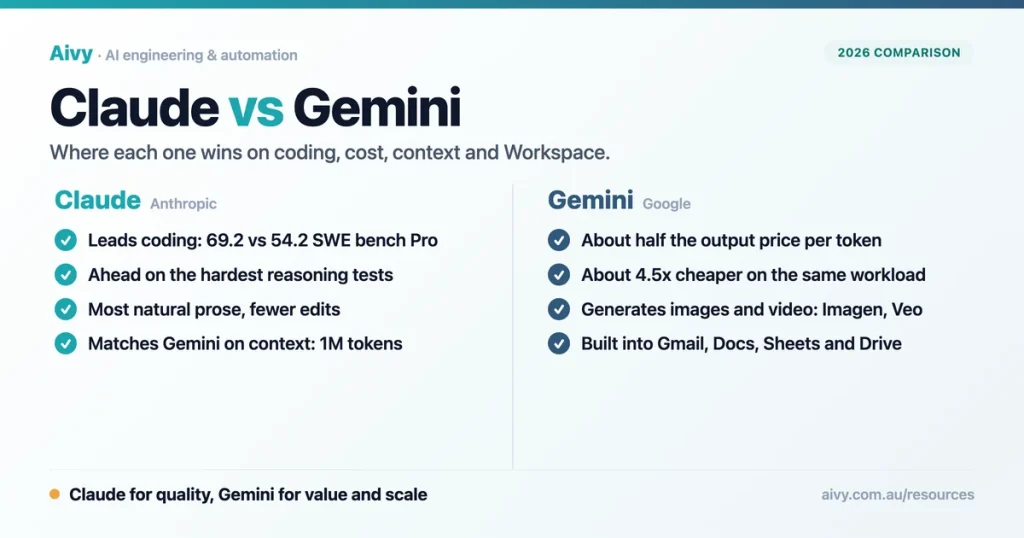
Most of the Claude versus Gemini debate I hear from Australian businesses comes down to one tension: the model that scores highest is not the model that costs least. As part of Aivy, an AI automation consultancy based in Melbourne, I run both with clients every week, and in 2026 they have pulled into very different lanes.
Anthropic’s line runs from Claude Fable 5.2 through Claude Opus 5.5 and Claude Sonnet 5.5, both released in late September 2026. Google sells Gemini 4 Argon, open since 13 October, and the cheaper Gemini 3.8 Flash, while Gemini 4 Carbon, second only to Fable 5.2 on independent tests, waits behind a restricted programme. So the real question is how much that smartness is worth to you.
This guide breaks the two down across the work that matters to Australian teams: coding, reasoning, writing, context, multimodal, and the part most comparisons skip, what it actually costs to run each one. No hype, just what holds up in practice.
Claude vs Gemini: key differences at a glance
Here is where each platform stands. Anthropic’s flagship is now Claude Fable 5.2, released 9 November 2026, with Claude Opus 5.5 and Claude Sonnet 5.5 as the models most teams run. Google’s strongest model on sale is Gemini 4 Argon, open since 13 October, with Gemini 3.8 Flash as its cheaper option and Gemini 4 Carbon announced on 28 October but not yet open.
Claude Opus 5.5 arrived on 22 September 2026 and Claude Sonnet 5.5 on 28 September; how their predecessors compared is in our Claude Opus 5 versus Fable 5 guide.
Google’s line has moved fast, from Gemini 3.6 Flash in July to Gemini 3.8 Flash and then Gemini 4 Argon, which scores well above both on the Artificial Analysis index. So the table below carries Gemini 4 Argon as Google’s best model you can use today and Gemini 4 Carbon as the one coming next.
| Feature | Claude (Anthropic) | Gemini (Google) |
|---|---|---|
| Flagship model | Claude Fable 5.2 (from 9 November 2026), with Claude Opus 5.5 as the everyday pick since 22 September and Claude Sonnet 5.5 below it since 28 September | Gemini 4 Argon, on sale since 13 October; Gemini 4 Carbon announced 28 October, restricted access |
| Intelligence Index (v5, 28 October 2026) | 58.4 Opus 5.5, 54.2 Sonnet 5.5 (max) | 50.4 Gemini 4 Argon; 59.4 Gemini 4 Carbon, restricted (High) |
| Context window | 1M tokens | 1M tokens |
| Image and video | No (text and vision only) | Imagen + Veo video |
| Office integration | Via API and partners | Native Google Workspace |
| API output price (per 1M) | $28.43 (Opus 5.5); $14.22 (Sonnet 5.5) | $14.22 (Gemini 4 Argon to 30 November, $28.43 from 1 December); $5.33 (3.8 Flash, to 31 December) |
| Best for | Coding, reasoning, writing quality · Fable 5.1 is the current top tier, Fable 5 now legacy | Multimodal, Workspace, value against Opus |
The index row is Artificial Analysis v5, read 28 October 2026, with Claude at max effort and the Gemini models at high, the only setting measured for them. Based on data from Artificial Analysis, which does not endorse, validate or approve any of the analysis or conclusions drawn from it. Prices at the RBA rate of 28 October 2026.
On raw capability, the Artificial Analysis Intelligence Index has a Claude model back on top, and one you can buy. On v5, read 9 November 2026, Claude Fable 5.2 scores 64.6 at max, ahead of Gemini 4 Carbon at 60.0 at high, still restricted, and Claude Opus 5.5 at 59.1. Gemini 4 Argon, the best Gemini on sale, scores 50.4. Fable 5.2 now heads the Claude line.
If you want to see how the three big assistants stack up for local teams, our ChatGPT, Claude and Copilot comparison for Australia runs the full matchup.
Artificial Analysis Intelligence Index v5 (higher is better)
Axis 0 to 100. Claude models at max effort and the Gemini models at high, the only setting measured for them. Read 9 November 2026. Source: Artificial Analysis.
Gemini 4 Carbon, in lighter steel, is in restricted access. Artificial Analysis recalculated v5 after 28 October, so Opus 5.5 at max shows 59.1 here and 58.4 in the tables below, which keep that reading. Claude Fable 5.1 scores 50.0 at xhigh; Gemini 3.8 Flash 30.8 at high. Based on data from Artificial Analysis, which does not endorse, validate or approve any of the analysis or conclusions drawn from it.

The sections below show where that lead is real, where it is a tie, and where Gemini turns the tables on price and context.
Claude vs Gemini for coding and development
Coding is Claude’s strongest suit and the clearest gap in this comparison. On SWE-bench Pro, which measures real repository issues, Claude Opus 4.8 leads Gemini 3.1 Pro by around 15 points. On the original SWE-bench Verified set the two are closer, 88.6 to 80.6, but on the harder Pro variant Claude pulls well clear. If you are choosing the editor or IDE assistant to run these models in, our Cursor vs GitHub Copilot guide compares the two most popular options.
SWE-bench Pro: real repository coding (higher is better)
Axis 0 to 100%. Source: Anthropic Claude Opus 4.8 release; vendor benchmarks. Includes Claude Fable 5 (system card, June 2026).
Claude Opus 5.5: Anthropic’s Claude Opus 5.5 system card, Table 8.1.A, max effort, averaged over five runs, 22 September 2026.
In daily work that shows up as cleaner diffs and fewer broken edits on large, multi file changes. Both have coding agents (Claude Code in the terminal, Gemini’s Jules), and we go deep on the agent fight in our Claude Code vs Codex comparison. Gemini is perfectly capable for everyday scripting and shines when a task needs its huge context, but for hard engineering Claude is the safer pick.
Google says Gemini 4 Argon scores 77.9 per cent on DeepSWE v1.1, a different coding test, so it has no bar on the chart above, and that Gemini 4 Carbon climbed 89 points to fourth place on WebDev Arena. Both are Google’s own figures. On the Artificial Analysis Coding Index, Gemini 3.8 Flash scores 76.3 against 81.6 for Claude Fable 5.1; the newer models have no coding score there yet.
Claude vs Gemini for reasoning and knowledge work
Claude also leads on the hardest reasoning and knowledge tests. On Humanity’s Last Exam without tools, a deliberately tough set, Opus 4.8 finishes ahead of Gemini 3.1 Pro. The two are effectively tied on GPQA Diamond, a science benchmark frontier models have largely saturated, but on broad knowledge work the gap is wide in Claude’s favour.
Related reading: if your knowledge work is mostly research and live web search, our Perplexity vs ChatGPT comparison is the better starting point.
Humanity’s Last Exam, no tools (higher is better)
Axis 0 to 100%. Source: Anthropic Claude Opus 4.8 release.
Claude Opus 5.5: Anthropic’s Claude Opus 5.5 system card, Table 8.1.A, max effort, averaged over five runs, 22 September 2026.
For Australian professional services that lean on careful analysis, contracts, research and advice, that edge is worth real money. Gemini is close enough that most teams will not notice on everyday questions, but on the hardest material Claude is more dependable.
Claude vs Gemini for writing and creativity
For writing, Claude still produces the most natural prose in my experience, needing fewer edits to sound human, and it holds tone across long documents better than anything else I use. That makes it my default for client proposals, reports and anything that ships under a byline, though it is worth knowing that Fable 5, now on Anthropic’s legacy list, was recently pulled by a US government order.
Gemini writes well too, and it has one real advantage: it grounds answers in Google Search and cites sources inline, which makes fact checking faster and reduces invented statistics. For content that leans on live information, Gemini is the safer drafting partner. For polished, voice consistent long form from your own material, Claude leads.
Claude vs Gemini context window in 2026
This used to be Gemini’s clearest structural win, and it is now a tie. Google’s model card lists Gemini 3.1 Pro at up to 1M tokens, the same ceiling as Claude Opus 4.8. Both are large by any standard, so the question is no longer who has more headroom but who holds detail better deep into it.
Default context window (tokens)
Bars scaled to the largest. Sources: Google Gemini API docs, including the Gemini 3.8 Flash model page, read 1 October 2026; Anthropic Claude API docs, including the Claude Opus 5.5 model page, read 22 September 2026, and the models overview for Claude Sonnet 5.5, read 28 September 2026.
A 1M window fits roughly 750,000 words, so either model can hold whole data rooms, large contract sets or sprawling codebases in one session. That is enormous and enough for most real documents, and because neither one has extra headroom now, price and recall across the bundle decide it. Not sure how document heavy your processes really are? Our free AI readiness assessment helps map that in two minutes.
Gemini 3.8 Flash has the same 1M window as Gemini 3.1 Pro. Gemini 4 Argon adds a different kind of headroom: Google says it can write up to 1M tokens in a single response, up from 64K, which matters for long reports and large code migrations, and it has been open to test on the paid API since 13 October.
Multimodal and Google Workspace: where Gemini pulls ahead
Claude is text and vision only, with no image or video generation by design. Gemini generates images with Imagen and video with Veo, and it leads on broad multimodal and grounded tasks. If your work involves creating or analysing a lot of visual material, that is a real gap. Google says Gemini 4 Argon, open since 13 October, scores 91.7 per cent on LVBench, a long video test.
The bigger practical advantage for many businesses is Workspace. Gemini is built into Gmail, Docs, Sheets and Drive, so it can summarise, draft and pull data across your documents with no extra setup. If your business runs on Google Workspace, Gemini is the lower friction choice. Claude integrates through its API and partners, which is powerful but usually means a build. For a custom assistant on your own systems either way, we build a tailored AI chatbot rather than rely on a single vendor’s app.
Google added another tier on 13 August 2026 with Gemini 3.7 Flash, and Gemini 3.8 Flash has since taken over the top of the Flash line at the same introductory price, about $1.07 per million input tokens and $5.33 output until 31 December, rising to $2.13 and $10.66 from 1 January 2027. Our Gemini 3.7 Flash launch report has the benchmark detail of that first step.
Google opened a separate line on 15 September 2026 with Gemini 3.8 Live and Gemini 3.8 Live Extended Thinking. Both are speech models rather than text models. Despite the version number, neither is Gemini 3.8 Flash, the text model this guide sets against Claude alongside Gemini 3.1 Pro.
Google reports first place on the Artificial Analysis Speech to Speech Quality Index at 82.6, with 97 languages, detection of a language switch mid conversation and real time visual input. Both models are in the Gemini API and AI Studio now. Google published no pricing, no model IDs and no context window, so there is nothing yet to fold into the cost comparison below. Our Gemini 3.8 Live launch report has the detail.
Claude vs Gemini pricing and value
This is where Gemini hits hardest, per token. On the API, Claude Opus 5.5 costs $5.69 input and $28.43 output per million tokens and Claude Sonnet 5.5 $2.84 and $14.22. Gemini 4 Argon matches Sonnet 5.5 until 30 November and the Opus 5.5 rate from 1 December, and Gemini 3.8 Flash lists at $1.07 and $5.33 until 31 December.
API price, output (per million tokens)
Bars scaled to the largest. Sources: Anthropic models overview; Gemini API pricing page, read 28 October 2026. All bars at the RBA rate of 28 October 2026.
Gemini 4 Argon at its introductory rate to 30 November 2026, $28.43 from 1 December. Gemini 4 Carbon is announced at the same two rates but is not on sale. Gemini 3.8 Flash at its introductory rate to 31 December 2026, $10.66 from 1 January 2027. Claude Opus 4.8, $34.67 at the 4 September rate, left the chart now that Claude Opus 5.5 has replaced it.
But the per token price understates the gap, because Claude is famously verbose. Artificial Analysis flagged Opus 4.8 as very wordy: it generated about 120 million output tokens to run their full Intelligence Index, close to twice the 66 million median. Once you multiply tokens by price, the cost to do the same work diverges sharply. It diverges hardest between the two frontier models, which share a rate card but not a bill.
If price per token is your priority, Gemini’s Flash line is the cheapest way in. Gemini 3.8 Flash scores 30.5 on Artificial Analysis v5 at high effort, well below the models above, and Gemini 3.5 Flash Lite lists at $0.43 input and $3.55 output per million tokens for high volume work where top scores matter less.
Cost per task on the Artificial Analysis index (v5)
Bars scaled to the largest. Australian dollars per task at the RBA rate of 28 October 2026. Read 28 October 2026. Source: Artificial Analysis.
Index scores at these settings: 58.4, 54.2, 59.4, 50.4, 51.7 and 41.1. Artificial Analysis costs both Gemini 4 models at 4 and 20 United States dollars per million tokens; Gemini 4 Carbon is in restricted access. Gemini 3.8 Flash costs $11.04 a task at high. Based on data from Artificial Analysis, which does not endorse, validate or approve any of the analysis or conclusions drawn from it.
On v5 the gap per finished task has nearly closed. At max, Claude Opus 5.5 costs $14.27 a task against $10.92 for Gemini 4 Argon at high, and scores eight points more. At high, Opus 5.5 scores 51.7 for $4.93, above Argon for less than half the money, and Claude Sonnet 5.5 costs $2.33. The table below puts capability, price and speed side by side.
| Metric | Claude Opus 5.5 | Claude Sonnet 5.5 | Gemini 4 Argon | Gemini 4 Carbon |
|---|---|---|---|---|
| Intelligence Index (v5) | 58.4 (max) | 54.2 (max) | 50.4 (high) | 59.4 (high) |
| Cost per task | $14.27 | $14.25 | $10.92 | $11.03 |
| API price, input (per 1M) | $5.69 | $2.84 | $2.84 to 30 November, then $5.69 | $2.84 at launch, then $5.69 |
| API price, output (per 1M) | $28.43 | $14.22 | $14.22 to 30 November, then $28.43 | $14.22 at launch, then $28.43 |
| Output speed (tokens per second) | 98 | 138 | 83 | 100 |
| Can you buy it? | Yes | Yes | Yes, since 13 October | No, restricted access |
Based on data from Artificial Analysis (Intelligence Index v5, read 28 October 2026), which does not endorse, validate or approve any of the analysis or conclusions drawn from it. Claude at max effort, the Gemini models at high, the only setting measured for them; cost per task uses the full Gemini 4 rate. Prices and cost per task at the RBA rate of 28 October 2026.
For high volume API work against Opus, the maths favours Gemini hard. For a team that needs the very best output on the hardest tasks, Claude can still pay for itself in saved review time. To see what your current manual work costs before you choose, run our free business audit.
One update since this comparison was written. On 30 June 2026 Anthropic released Claude Sonnet 5, which became the default model on the free and Pro plans. It sits close to Opus 4.8 on capability at well under half the running cost, so Claude’s value tier is stronger than its flagship pricing suggests when you weigh it against Gemini, so it pays to know when a cheaper Claude tier is enough. For access, plans and ID rules in Australia, see our guide on whether Australians can use Claude.
Claude Sonnet 5.5 followed on 28 September 2026 at the same list price, $2.81 input and $14.04 output per million tokens at the RBA rate of 22 September, so it matches Gemini 3.1 Pro on input, where both list at 2 United States dollars per million tokens, and charges less per output token. Anthropic says it is over 30 per cent faster and up to 30 per cent cheaper per task than Sonnet 5, and our news report on the Claude Opus 5.5 launch covers its bigger sibling.
On Artificial Analysis v5, read on 28 October, Sonnet 5.5 scores 54.2 for $14.25 a task on max and 41.1 for $2.33 on high. On medium it scores 30.3 for $1.11 a task, against 30.5 for $11.04 from Gemini 3.8 Flash at high, so at the budget end Claude now matches Google’s Flash model for about a tenth of the money per task.
Artificial Analysis also publishes a cost per task next to the index, which sharpens the value question. On the 28 October reading, Claude Opus 5.5 at xhigh scores 57.0 for $8.60 a task, close to its 58.4 at max for about 60 per cent of the money, and Gemini 4 Carbon lands at 59.4 for $11.03. Read per point of index, the cheaper settings are far better value.
AI safety and governance: Anthropic vs Google
Anthropic was founded around AI safety, and Claude leans cautious by design, with strong guardrails that suit teams worried about misuse. Google brings enterprise grade governance through Google Cloud, including regional controls that can matter for regulated work.
Neither offers Australian data residency by default on consumer tiers, so check that against your obligations under the Privacy Act before connecting sensitive data. Google’s Cloud tiers give more regional options, while Anthropic’s conservative defaults reduce risky outputs. We cover the detail in our Privacy Act AI compliance playbook.
Claude vs Gemini for business: which is better?
After rolling AI out with dozens of Australian teams, the split is clear. Choose Claude if quality is the priority: the best coding, the hardest reasoning, and writing that ships with the least editing. It is the model to reach for when getting it right matters more than the bill.
Choose Gemini if value, scale or Google Workspace lead your decision. Its lower price per token than Opus compounds fast for data heavy, high volume teams, and on routine work most teams will not feel the capability gap. Many clients run both: Claude for the hard, high stakes work and Gemini for everything at volume, and we can map the right setup for your team in a short call.
If you are weighing all three big models, this pairs well with our Claude vs ChatGPT comparison and our ChatGPT vs Gemini comparison, so you can see every matchup before you commit.
The bottom line for Australian teams in 2026
Across these comparisons Claude takes coding, reasoning and writing quality plus the top intelligence score, now held by Fable 5.2, while Gemini takes multimodal, Workspace and price per token against Opus, with context and safety both a draw. Only Gemini 4 Carbon, still restricted, outscores Claude Opus 5.5 on the independent index. And OpenAI’s GPT 6 Astra, since 3 September 2026, keeps this from being a two horse race.
Lean Claude when output quality on hard problems is what you are paying for. Lean Gemini when multimodal work, Google Workspace or cost at scale lead the decision. For many Australian businesses the honest answer is both, routed by task. And as more people ask Claude and Gemini directly instead of searching Google, getting your business cited in those answers, through generative engine optimisation, is becoming its own priority.
On the API, Gemini 4 Argon is the Gemini to test first for hard work, at the Claude Sonnet 5.5 rate until 30 November, and Gemini 3.8 Flash for simple steps at volume. In the Gemini app, Argon starts at Google AI Pro, and what each Gemini plan costs in Australia shows when Ultra is worth it.
Frequently asked questions
Is Claude or Gemini better in 2026?
Claude is better for coding, hard reasoning and writing quality, and leads the Artificial Analysis index: Claude Fable 5.2 scores 64.6 on the 9 November reading, ahead of the restricted Gemini 4 Carbon, and on 28 October Claude Opus 5.5 scored 58.4 against 50.4 for Gemini 4 Argon. Gemini is better for multimodal work, Google Workspace and price per token, and the two tie on context size.
What is the difference between Claude and Gemini?
Claude, by Anthropic, focuses on coding, reasoning and careful writing, with a 1M token context window and no image generation. Gemini, by Google, offers the same 1M token context window, native Workspace integration, image and video generation, and lower pricing than Claude’s Opus models.
Claude Opus 4.8 vs Gemini 3.1 Pro: which is smarter?
Claude Opus 4.8 leads, and by more than it used to. On the August Artificial Analysis Intelligence Index it scores 57 to Gemini 3.1 Pro’s 48, with Claude Fable 5 at 62 and Claude Opus 5 top of the index at 63. Claude Fable 5.1 has since replaced Fable 5, which Anthropic now lists as legacy, and now sits above Opus 5. Opus 4.8 also leads on hard coding and reasoning benchmarks. The two are effectively tied on saturated science tests like GPQA Diamond.
Is Claude or Gemini better for coding?
Claude is better for coding. Opus 4.8 leads Gemini 3.1 Pro on SWE-bench Pro (69.2% to 54.2%) and on SWE-bench Verified (88.6% to 80.6%), producing cleaner changes on large, multi file work. Both ship capable coding agents.
Which has a bigger context window, Claude or Gemini?
They match at the top today. Google’s current documentation lists Gemini 3.1 Pro at 1M tokens, the same as Claude Opus 4.8 and Fable 5; Google’s Gemini 3.5 Pro, still testing with partners, targets 2M. Both are large, so on the biggest document sets or codebases neither has a headroom advantage today.
Is Gemini cheaper than Claude?
Per token, yes, against Opus. Gemini 3.8 Flash lists at $1.07 input and $5.33 output per million tokens until 31 December and Gemini 4 Argon at $2.84 and $14.22 until 30 November, against $5.69 and $28.43 for Claude Opus 5.5 at the RBA rate of 28 October 2026. Per finished task, no longer: on Artificial Analysis v5, Opus 5.5 at high costs $4.93 a task against $10.92 for Argon.
Is Gemini 4 Argon better than Claude?
Not on the independent numbers. Artificial Analysis v5 scores Gemini 4 Argon 50.4 at high effort, below Claude Opus 5.5 at 51.7 on the same setting and 58.4 at max. Google’s own results, such as 77.9 per cent on DeepSWE v1.1, come from its own runs. Argon has been open since 13 October 2026 on the paid Gemini API and in Google AI Pro and Ultra.
Is Gemini 4 Carbon better than Claude?
Not than Claude’s best. On Artificial Analysis v5, read 9 November, Claude Fable 5.2 scores 64.6 at max against 60.0 for Gemini 4 Carbon at high, which still edges Claude Opus 5.5 at max, on 59.1. You cannot use Carbon yet: Google opened it on 28 October 2026 only to some cyber defenders and its Fairwind partners, with no date for anyone else.
Can Claude generate images like Gemini?
No. Claude is text and vision only and does not generate images or video. Gemini generates images with Imagen and video with Veo. If you need visual generation inside your assistant, Gemini is the choice between these two.
Is Claude or Gemini better for Google Workspace users?
Gemini, clearly. It is built into Gmail, Docs, Sheets and Drive and can act across them with no extra setup. Claude integrates through its API and partners, which is powerful but usually means a build.
Should my Australian business use Claude or Gemini?
Use Claude when quality on hard coding, reasoning or writing matters most. Use Gemini for large documents, multimodal work, Google Workspace or cost at volume. Many businesses run both and route each task to the stronger tool.
Do I need both Claude and Gemini?
Not always, but many teams benefit from both. You get Claude’s top tier quality for hard work plus Gemini’s context, Workspace integration and low cost for everything at volume. Start with one, then add the second if a clear gap appears.
Last updated: 10 November 2026 with Claude Fable 5.2 and the Artificial Analysis reading of 9 November; previously on 28 October with Gemini 4 Carbon and Gemini 4 Argon on sale, and on 1 October with the Gemini 4 Argon announcement.
Prices restated in Australian dollars at the Reserve Bank rate of 28 October 2026, except where a figure names the 22 September or 4 September 2026 rate. Figures verified against Anthropic, Google, OpenAI and Artificial Analysis. We review this comparison every quarter.
- Anthropic, Claude Opus 4.8 release: SWE-bench Pro 69.2%, HLE no tools 49.8%, Intelligence Index leadership, 1M context.
- Google Gemini API pricing: Gemini 3.1 Pro Preview $3 input / $17 output per million tokens up to 200k, $6 / $26 above 200k; 1M context window.
- Google Gemini API pricing (read 28 October 2026): Gemini 4 Argon at 2 and 10 United States dollars per million tokens to 30 November 2026, then 4 and 20; Gemini 3.8 Flash at 0.75 and 3.75 until 31 December 2026 and 1.50 and 7.50 from 1 January 2027; Gemini 3.5 Flash Lite at 0.30 and 2.50; Gemini 3.5 Pro was in partner testing in July 2026.
- Google, Gemini API models: Gemini 3.8 Flash as a stable model and Google’s most intelligent Flash model, and Gemini 3.1 Pro still listed as a preview. Read 1 October 2026.
- Google, Gemini 4 Argon announcement: announced on 30 September 2026 as Google’s new frontier model, first for trusted cyber defenders in the Fairwind programme and open since 13 October 2026 on the paid Gemini API and in Google AI Pro and Ultra; Google’s own results, including 77.9% on DeepSWE v1.1, 51.3% on AutomationBench and 91.7% on LVBench.
- Anthropic, Introducing Claude Fable 5.2 and Claude Mythos 5.2: released on 9 November 2026 at 8 and 40 United States dollars per million tokens, on Claude’s paid plans and the API. Read 9 November 2026.
- Google, Gemini 4 Carbon announcement: announced on 28 October 2026 as Google’s strongest model, open first to a subset of cyber defenders and partners in the Fairwind Program, with developers, businesses and consumers to follow and no date given; the same introductory price as Gemini 4 Argon; 89 Elo points up to fourth on WebDev Arena. Read 28 October 2026.
- Claude pricing: Claude Opus 4.8 API $6.93 input / $34.67 output per million tokens.
- Artificial Analysis: Intelligence Index v4.1.1, 57 vs 48, output verbosity, cost to run the eval ~$5,328 vs ~$1,153.
- Anthropic, models overview: Claude Opus 5.5 at 4 and 20 United States dollars per million tokens, cache reads at 0.20, the advice to start with Claude Opus 5.5 for most workloads, and Claude Opus 5 on the legacy list. Read 22 September 2026, and again on 28 September for Claude Sonnet 5.5 and its 1M context window.
- Anthropic, Introducing Claude Sonnet 5.5: 2 and 10 United States dollars per million tokens with cache reads at 0.20, the speed and cost per task claims against Claude Sonnet 5, the positioning against Claude Opus 5.5 and the manufacturer benchmark table. Read 28 September 2026.
- Anthropic, Claude Opus 5.5 system card: Table 8.1.A, SWE bench Pro 89.9% and Humanity’s Last Exam without tools 64.4% for Claude Opus 5.5, max effort, averaged over five runs. Read 22 September 2026.
- Source: Artificial Analysis (artificialanalysis.ai): Intelligence Index v5, cost per task and output speed by reasoning effort, read through its API on 28 October 2026, and on 9 November 2026 for the index chart; Gemini 4 Carbon and Gemini 4 Argon are measured at high effort only. Based on data from Artificial Analysis, which does not endorse, validate or approve any of the analysis or conclusions drawn from it.
All dollar figures in this article are Australian dollars. Figures updated on 28 October 2026, including every price and Intelligence Index v5 cost per task in the charts and tables, use the Reserve Bank of Australia rate of that day, one Australian dollar buying 0.7034 United States dollars. Older figures name their rate: 4 September 2026 (0.7210), 22 September 2026 (0.7123) or, for Fable 5.2, 9 November 2026 (0.6894).



