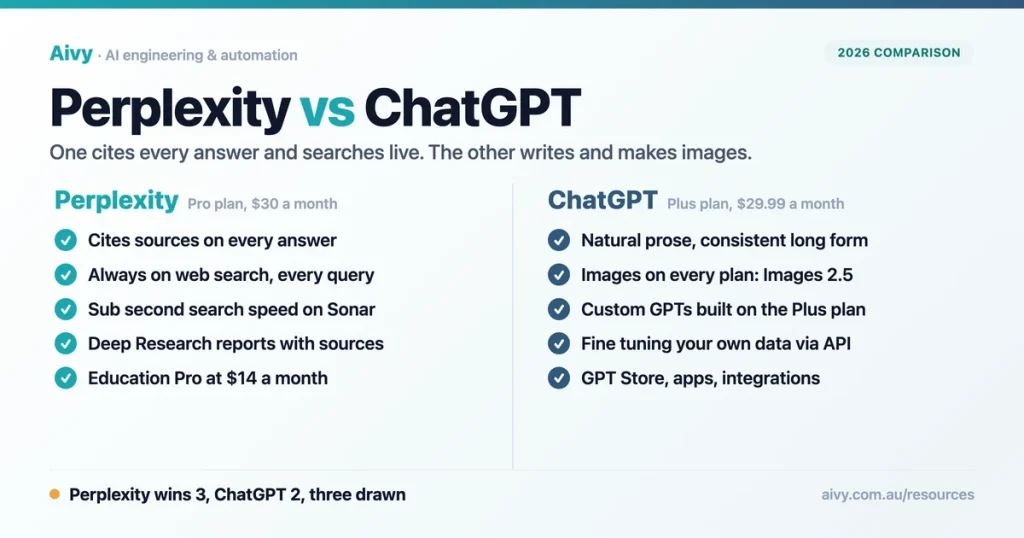
I have spent the past three years testing AI tools and helping Australian businesses implement them at scale. As the founder of Aivy, an AI automation consultancy based in Melbourne, I hear the Perplexity versus ChatGPT question in nearly every client meeting. The answer depends entirely on what you need, and both products have changed a great deal over 2026.
Perplexity launched in December 2022 with a different vision than ChatGPT. Where OpenAI built a conversational AI that can do almost anything, Perplexity focused on one thing: finding accurate information fast. The company processes over 30 million queries daily and has hit a $30 billion valuation, growth that reflects genuine utility rather than hype, and it now runs frontier models from several labs side by side.
This guide breaks down where each tool excels, based on months of real world testing: research, writing, live search, images, pricing in Australian dollars, the models behind each one, privacy and business use, with a verdict for each. You will find practical comparisons, honest assessments of limitations and specific recommendations for Australian professionals. No marketing speak, just what actually works.
Perplexity vs ChatGPT: Key differences at a glance
Before examining specific use cases, here is a direct comparison of where each platform stands in 2026.
| Feature | Perplexity | ChatGPT |
|---|---|---|
| Company | Perplexity AI (San Francisco) | OpenAI |
| Founded | August 2022 | November 2022 |
| Core approach | Search engine with AI synthesis | Conversational AI assistant |
| Citations | Yes, inline sources for every answer | Yes, when it searches the web |
| Web search | Always on, real time | Automatic when needed |
| Image generation | Yes, on Pro and above | Yes, ChatGPT Images 2.5 on every plan (Sora video closed in April 2026) |
| Voice mode | Yes | Yes |
| Context window | ~128K tokens | Up to 400K tokens on Pro |
| AI models | Sonar, plus GPT 6.1 Sol, Claude Sonnet 5.5, Gemini 3.8 Flash, Kimi K3, GLM 5.3 and Grok 4.7 on Pro | GPT 6 (GPT 6 Sol) in Chat on paid plans, GPT 6 Pro (Astra) from Pro 100, GPT 5.6 Luna on Free and Go; GPT 6 Astra and GPT 6.1 Sol in Work and Codex |
| Pro pricing | $30/month (App Store, Australia) | $29.99/month (Plus), from $154.99/month (Pro) |
| Best for | Research, fact checking, citations | Creative work, images, custom bots |
The core difference comes down to philosophy. Perplexity treats every query as a research task, searching the web and citing sources automatically. ChatGPT treats queries as conversations, drawing primarily on its training data and searching the web only when a question clearly calls for it.
| Category | Winner | Why |
|---|---|---|
| Research accuracy | Perplexity | Real time sources with citations |
| Creative writing | ChatGPT | Better at long form, imaginative content |
| Image generation | ChatGPT | ChatGPT Images on every plan; Perplexity needs Pro |
| Speed for facts | Perplexity | Purpose built for quick answers |
| Ecosystem | ChatGPT | GPT Store, apps, integrations |
| Source transparency | Perplexity | Every answer shows where info came from |

Perplexity vs ChatGPT for research and fact checking
This is where Perplexity genuinely shines. Every response includes numbered citations linking to original sources, so you can verify claims without leaving the interface. I tested both with the same query, “What are Australia’s current renewable energy targets for 2030?” Perplexity answered in seconds with six citations from government sources, energy authorities and recent news. ChatGPT gave a general answer, noted its training cutoff and suggested I verify elsewhere.
| Research Feature | Perplexity | ChatGPT |
|---|---|---|
| Inline citations | ✅ Every answer | ⚠️ When it searches |
| Real time sources | ✅ Always on | ⚠️ Automatic when needed |
| Source verification | ✅ Built in | ❌ Manual |
| Deep Research mode | ✅ Pro feature | ✅ All plans, limits vary |
| Academic focus mode | ✅ Yes | ❌ No |
| Fact checking speed | Sub second (Sonar) | Slower when browsing |
Perplexity’s Focus modes narrow a search to specific source types, and Deep Research goes further: point it at a complex topic and it builds a report with dozens of sources, organised into sections with proper citations, in minutes rather than hours. For consultants and analysts, that alone can justify Pro. Weighing tools across a whole team? Our breakdown of ChatGPT, Claude and Copilot for Australian teams covers the wider options.
- Academic focus prioritises peer reviewed papers and connects to scholarly databases, which makes literature reviews significantly faster for Australian researchers and students.
- Writing focus emphasises authoritative publications.
ChatGPT searches the web on its own when a question calls for it, but the experience feels different. Search feels layered on rather than core to the product. Citations appear inconsistently. The tool often defaults to its training data even when current information would serve better.
Perplexity vs ChatGPT for writing and content creation
Writing quality tells a different story. ChatGPT produces more natural, varied prose that needs less editing, so marketing copy, blog posts, or creative content reads as if a professional wrote it. Asked for an introduction to an article on sustainable architecture in Melbourne, ChatGPT delivered three paragraphs with a clear arc and natural transitions; Perplexity produced accurate facts on green building, structured like a fact sheet.
| Writing Feature | Perplexity | ChatGPT |
|---|---|---|
| Prose naturalness | ⚠️ Functional | ✅ Natural & varied |
| Long form consistency | ⚠️ Moderate | ✅ Excellent |
| Creative writing | ❌ Limited | ✅ Strong |
| Research backed writing | ✅ Cited sources | ⚠️ Occasional |
| Tone customisation | ⚠️ Basic | ✅ Advanced |
| Marketing copy | ⚠️ Adequate | ✅ Strong |
For long form content, ChatGPT keeps voice, terminology and style consistent across thousands of words, which matters for reports, white papers and extended documentation; Perplexity handles shorter responses well but can lose coherence in longer pieces. ChatGPT also adapts readily to specific styles, tones and unconventional formats, while Perplexity stays closer to straightforward, informative answers however you frame the request.
That said, Perplexity excels at research backed writing. If you need content grounded in verifiable facts with proper attribution, Perplexity’s approach produces more defensible outputs. For academic writing, legal documents, or anything requiring citations, the built in sourcing saves significant time.

Real time search: Perplexity vs ChatGPT compared
Perplexity was built as a search engine first: every query triggers a web search and a synthesis of several sources, which is why being cited in its answers is now a discipline of its own, with tools that track your AI search visibility. Ask about yesterday’s markets, a recent policy announcement or breaking news and it returns current information with sources; ChatGPT searches too, with less consistent sourcing.
| Search Feature | Perplexity | ChatGPT |
|---|---|---|
| Always on web search | ✅ Default | ⚠️ Automatic |
| Search speed | ✅ Sub second (Sonar) | ⚠️ Slower |
| Multi source synthesis | ✅ Core feature | ⚠️ Limited |
| Model Council (compare AIs) | ✅ Max plan | ❌ No |
| Breaking news queries | ✅ Instant | ⚠️ Depends on browsing |
| Search first design | ✅ Built for search | ❌ Extra feature |
Perplexity’s Sonar model, built for search, processes queries faster than general purpose models: the company claims sub second responses for most queries, and in my testing simple factual questions return almost instantly. The Model Council feature runs one query across several frontier models and synthesises the answers, but it sits on the Max plan rather than Pro, which matters when you are budgeting.
ChatGPT’s search has improved but remains secondary to its conversational strengths: it searches on its own only when a question looks like it needs the web, and the results feel less integrated. For users who mainly need current information, and anyone thinking about how AI search shapes visibility in generative engines, Perplexity’s always on search delivers more consistently.
Image generation: ChatGPT vs Perplexity capabilities
ChatGPT still leads here, but the field has changed shape. ChatGPT now makes images with ChatGPT Images, whose 2.5 version arrived on 8 September 2026 for every ChatGPT plan, free included, and which replaced DALL·E 3. OpenAI closed Sora, its video app, on 26 April 2026. Perplexity does images and video too, but only from the Pro plan upwards.
Built in image generation means you can write a blog post and create matching illustrations in the same conversation, which removes a major bottleneck for marketing teams, social media managers and content creators. The quality has improved dramatically, occasionally passing for professional stock photography, and if you are weighing the major models for this kind of work, our Claude vs Gemini comparison is a useful companion read.
Perplexity treats visuals as a supporting feature: image and video generation sit inside Pro, alongside the research tools, and the free plan gets neither. If visual production fills your week, dedicated tools like Midjourney or Runway go further than either assistant. If your work centres on text, analysis and research, Perplexity’s focus costs you nothing; if visuals matter, ChatGPT becomes essential.

Perplexity Pro vs ChatGPT Plus: Pricing compared
Perplexity Pro costs $30 a month on Australia’s App Store and ChatGPT Plus $29.99, close enough to call level. The similarity ends there: what you get for that price differs substantially. Where Plus sits against Go and the three Pro tiers is in our breakdown of ChatGPT plans.
| Plan | Perplexity | ChatGPT |
|---|---|---|
| Free tier | Limited searches, basic model | GPT 5.6 Luna, which also powers Think, with limited usage (OpenAI Help Center, 19 October 2026) |
| Standard paid | Pro: $30/month | Plus: $29.99/month |
| Premium tier | Max: $300/month, Enterprise: Custom | Pro 100: $154.99/month, Pro 200: $300/month, Pro 500: $769.99/month (monthly only) |
| Annual discount | $300 a year, $25/month | $29.99/month (no discount) |
| Student/edu | Education Pro: $14/month | Discount programs available |
- Perplexity Pro unlocks premium models alongside Sonar (GPT 6.1 Sol, Claude Sonnet 5.5, Gemini 3.8 Flash, Kimi K3, GLM 5.3 and Grok 4.7 on its plan page today), and you can switch between them mid conversation. It also adds image and video generation, Deep Research, more file uploads and higher usage limits.
- ChatGPT Plus gives you GPT 6 in Chat, powered by GPT 6 Sol at the Medium and High thinking levels, GPT 6 Astra and GPT 6.1 Sol in ChatGPT Work and Codex, ChatGPT Images, browsing and custom GPTs for specialised assistants. ChatGPT Go, at $13 a month, sits below it on GPT 5.6 Luna.
- ChatGPT Pro comes in three plans, at $154.99, $300 and $769.99 a month. GPT 6 Astra has sat above the whole 5.6 generation as OpenAI’s most capable model since 3 September 2026, and GPT 6 Pro, powered by Astra, is in Chat from Pro 100.
- The API: since 22 September 2026, OpenAI lists GPT 6 Sol at $2.81 and $14.04 per million tokens and GPT 6 Luna at $0.14 and $0.70 (RBA rate of 22 September), Sol for complex coding and agentic workflows and Luna for focused, high volume tasks. There is no GPT 6 Terra.
The Pro plans differ mainly in headroom. Since 29 September 2026 the top one, Pro 500, carries 25 times the usage of Plus and is the only plan with Ultrafast, up to eight times faster in Codex. Pro 200 is open to new subscribers again with a smaller allowance, as OpenAI’s help centre explains, and Pro subscribers in Australia also get their first dot, OpenAI’s always on agent.
For Australian students, Perplexity runs a discounted Education Pro plan, verified through SheerID, at about $14 a month converted from its US price, so it is no longer free. ChatGPT has discount programs, none as straightforward. Enterprise pricing varies on both sides: Perplexity Enterprise Pro adds admin controls, SSO and indexing of up to 500 internal documents, and ChatGPT Enterprise adds dedicated support and higher security certifications.
AI models in Perplexity vs ChatGPT
Both platforms now offer several AI models, but the selection differs meaningfully. The table below reflects what each product offered on 19 October 2026. OpenAI released GPT 6 Astra on 3 September 2026, its most capable model for the hardest end to end work, and opened API access to everyone on 4 September through the Responses, Chat Completions and Batch endpoints.
| Model | Perplexity | ChatGPT |
|---|---|---|
| OpenAI GPT models | ✅ Pro tier | ✅ Native |
| Anthropic Claude models | ✅ Pro tier | ❌ Not available |
| Gemini 3.8 Flash | ✅ Pro tier | ❌ Not available |
| GPT 6 Sol, GPT 6.1 Sol and GPT 6 Luna | ✅ GPT 6.1 Sol on Pro | ✅ GPT 6 Sol behind GPT 6 in Chat on paid plans; GPT 6.1 Sol in ChatGPT Work and Codex |
| GPT 6 Pro (Astra) | ❌ Not on the Pro model list | ✅ Pro 100, Pro 200, Business and Enterprise |
| Sonar | ✅ Default search model | ❌ Perplexity only |
| Custom models | ❌ | ⚠️ Fine tuning closed to new users; existing ones until 6 January 2027 |
Perplexity’s model diversity stands out: it runs models from OpenAI, Anthropic, Google, Moonshot, Z.ai and xAI, and its Model Council, on the Max plan, queries several at once so you can compare responses. Anthropic refreshed its own line most recently on 9 November 2026 with Claude Fable 5.2 and Claude Mythos 5.2; for Claude against ChatGPT specifically, see our guide on Claude vs ChatGPT.
ChatGPT remains the direct route to OpenAI’s own models, but API fine tuning is winding down: closed to new users since 7 May 2026, with new jobs for existing users ending on 6 January 2027. Perplexity’s Sonar, built for search, optimises for speed and factual accuracy, which suits its typical use case better than a larger model would. The line up shifts every few months; for the wider picture, our guide to ChatGPT vs Gemini covers the full competitive landscape.

Privacy: Perplexity vs ChatGPT data handling
Privacy conscious users should understand how each platform handles their data, particularly Australian businesses navigating local privacy requirements. Perplexity’s approach prioritises transparency: it states clearly that Pro subscribers’ data is not used for model training, search history can be deleted, and the enterprise tier adds data protection guarantees and compliance certifications relevant to business use.
ChatGPT’s data practices have evolved: by default conversations may be used for model improvement, though you can opt out in settings, and ChatGPT Enterprise commits that business data will not train models. Perplexity’s search first design may also store less context about your interests than an assistant that builds understanding over long dialogues, depending on which privacy concerns matter most to you.
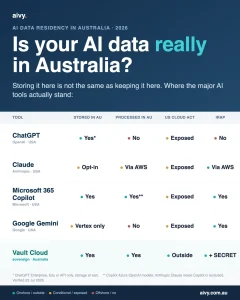
Neither platform processes your queries in Australia. OpenAI does offer Australian data residency on its Enterprise, Edu and API plans, which keeps stored content onshore, but inference still runs overseas. Perplexity offers no Australian residency at all. For organisations handling sensitive information under Australian privacy law, this creates compliance considerations regardless of which tool you choose. Both platforms offer enterprise agreements that may address specific regulatory requirements.
Perplexity vs ChatGPT for business use
After helping dozens of Australian businesses implement AI tools, I have learned that “better” depends entirely on use case. Choose Perplexity if your team needs verifiable information: consulting firms, legal practices, research organisations and anyone producing content that must withstand scrutiny will value the built in citations, and Deep Research alone can save hours per project.
| Use Case | Better Choice | Why |
|---|---|---|
| Market research | Perplexity | Real time data with citations |
| Content marketing | ChatGPT | Better writing, image generation |
| Legal research | Perplexity | Source verification essential |
| Customer service bots | ChatGPT | Custom GPTs, API flexibility |
| Academic work | Perplexity | Citation management built in |
| Creative campaigns | ChatGPT | Visual generation, creative writing |
| Due diligence | Perplexity | Audit trail of sources |
| Internal documentation | ChatGPT | Better long form coherence |
For professionals in regulated industries, our guide to AI tools for lawyers in Australia covers how Perplexity performs in legal research. Choose ChatGPT if your team needs versatility: marketing benefits from integrated image generation, customer facing teams can build custom GPTs for specific workflows, and developers get better coding assistance and more mature API tooling.
Many Australian businesses run both platforms: Perplexity for research and fact checking, ChatGPT for creative work and automation. At about $60 a month for both paid subscriptions, the cost stays modest against the productivity gains, and if you want to put numbers on that, our AI ROI calculator can estimate the payback for your team.
The verdict: Perplexity or ChatGPT in 2026?
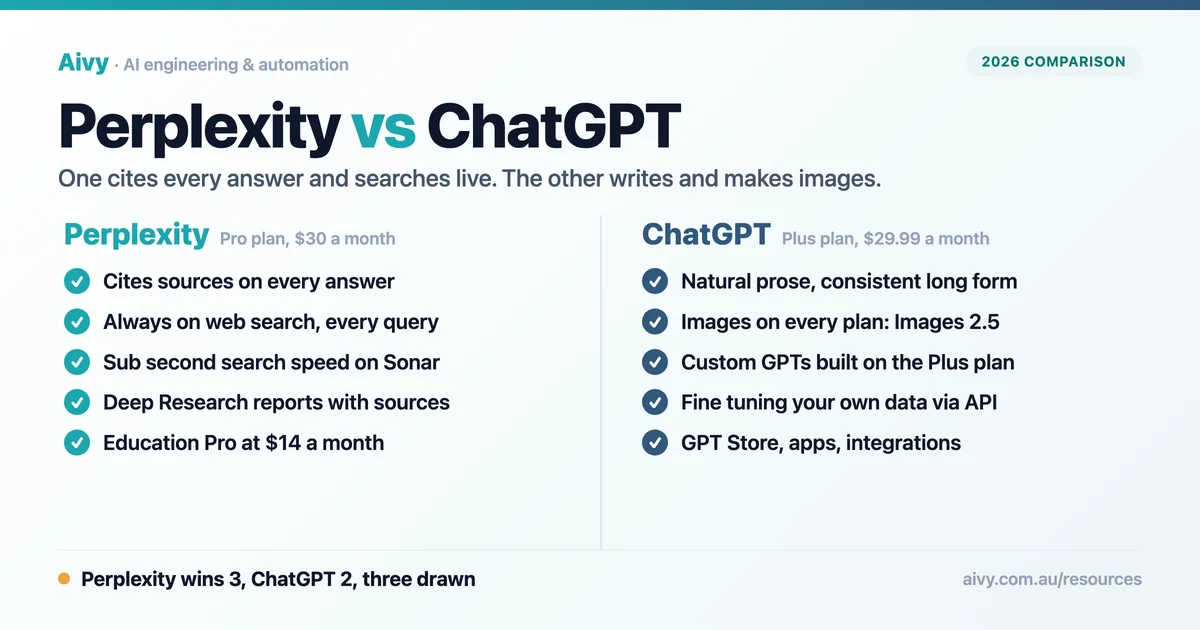
After comparing eight categories, Perplexity wins three (research, real time search, privacy), ChatGPT wins two (writing, images), and three end in draws. But counting victories misses the point.
Choose Perplexity if you
- Need verifiable information with citations
- Prioritise research accuracy over creative flexibility
- Want current, real time data in every response
- Work in fields requiring source transparency
- Prefer cleaner privacy practices
Choose ChatGPT if you
- Create visual content alongside text
- Need maximum creative writing flexibility
- Want to build custom AI assistants
- Rely on integrations with other tools
- Prefer a more established ecosystem
Or choose both. That is what I recommend to most clients: Perplexity when you need facts, ChatGPT when you need creativity, for about $60 a month combined. Perplexity’s strengths align with fields that dominate our economy, such as legal services, consulting, financial analysis and academic research; if your work involves marketing, design or customer facing content, ChatGPT’s versatility is harder to replace.
Both platforms keep improving, and features that distinguish them today may converge tomorrow, so start with whichever fits your immediate needs and reassess as they evolve. Aivy helps Australian businesses integrate AI tools that lift research capability and creative output: book a free discovery session to explore how Perplexity, ChatGPT and other AI tools can work for your team.
Perplexity vs ChatGPT: Frequently Asked Questions
Is Perplexity better than ChatGPT?
Perplexity is better for research and fact checking with its real time citations. ChatGPT is better for creative writing and image generation. Neither is universally superior. Choose based on whether you need verified facts or creative flexibility.
What is the difference between Perplexity and ChatGPT?
Perplexity is a search engine that uses AI to synthesise web results with citations. ChatGPT is a conversational AI that draws primarily on training data. Perplexity searches the web for every query. ChatGPT searches only when it judges that a question needs live information, so some answers carry sources and some do not.
Should I use Perplexity or ChatGPT?
Use Perplexity for research, fact checking, and any task requiring source verification. Use ChatGPT for creative writing, image generation, and building custom AI assistants. Many professionals use both tools for different purposes.
Can Perplexity replace ChatGPT?
Not entirely. Perplexity generates images and video on its paid plans, but it lacks ChatGPT’s custom GPT ecosystem and extensive integrations. For research focused workflows, Perplexity may serve as your primary AI tool with ChatGPT reserved for creative tasks.
Is Perplexity better for research than ChatGPT?
Yes, for work that has to be source checked. Perplexity was built for research, with real time web search and automatic citations on every answer. ChatGPT now searches the web on its own when a question calls for it, but it decides case by case, so citations are not guaranteed on every reply.
Does Perplexity give more accurate answers than ChatGPT?
For current information, Perplexity is the safer default because it searches the web and cites sources on every answer. ChatGPT searches automatically when it judges a question needs it, but replies drawn from training data alone carry no citation to check. For timeless knowledge, accuracy is comparable.
Why does Perplexity show sources but ChatGPT doesn’t?
ChatGPT does show sources, but only on replies where it searched the web. Perplexity was designed as a search engine, so citations are fundamental and appear on every answer. ChatGPT was designed as a conversational assistant, so sourcing depends on whether a given reply used search.
Can Perplexity create images?
Yes, on paid plans. Perplexity Pro and above include image and video generation; the free plan does not. ChatGPT Images, on every ChatGPT plan, still produces stronger results for most creative work, and dedicated tools like Midjourney go further again.
Does Perplexity have a free version?
Yes. Perplexity offers free access with limited searches and basic model access. Pro, at $30 a month on Australia’s App Store, unlocks premium models, Deep Research, more file uploads and higher usage limits. Students get a discounted Education Pro plan, about $14 a month.
What AI models does Perplexity use?
Perplexity Pro routes queries to frontier models from OpenAI, Anthropic, Google, Moonshot, Z.ai and xAI alongside Perplexity’s own Sonar; in October 2026 its plan page lists GPT 6.1 Sol, Claude Sonnet 5.5, Gemini 3.8 Flash, Kimi K3, GLM 5.3 and Grok 4.7. The Model Council feature, which compares several models on one query, sits on the Max plan rather than Pro.
Is Perplexity Pro worth it?
For regular researchers, yes. Pro unlocks premium AI models, Deep Research for comprehensive reports and more room to upload and search your documents. At $30 a month, a few hours of saved research time covers the cost.
How much does Perplexity cost compared to ChatGPT?
Perplexity Pro costs $30 a month on Australia’s App Store and ChatGPT Plus $29.99. Perplexity’s annual plan costs $300, or $25 a month. For power users ChatGPT sells three Pro plans, at $154.99, $300 and $769.99 a month, while Perplexity Max costs $300.
Which is cheaper, Perplexity Pro or ChatGPT Plus?
ChatGPT Plus, by a cent: $29.99 a month against $30 for Perplexity Pro on Australia’s App Store. Perplexity’s annual plan, at $300 a year, saves $60 against monthly billing, and ChatGPT Plus has no annual discount, so for budget conscious users Perplexity’s annual option is the better value.
Is Perplexity better for students?
Broadly, yes. Perplexity’s Education Pro plan is discounted to about $14 a month with SheerID verification, and the citation features help with academic writing and research. ChatGPT has education programs but nothing as simple to sign up for.
Should I use Perplexity or ChatGPT for work?
It depends on your work. Use Perplexity for research, analysis, and tasks requiring source verification. Use ChatGPT for content creation, image generation, and automation. Many professionals subscribe to both and route tasks accordingly.
This article is updated quarterly to reflect the latest features and pricing. Last updated: 10 November 2026, with Claude Fable 5.2; previously 23 October 2026, with the wind down of OpenAI’s API fine tuning. Model token prices and Education Pro are converted at the RBA rate of 22 September 2026, 1 USD = 1.4039 AUD; ChatGPT and Perplexity plans are local Australian prices, read 18 and 19 October 2026.