
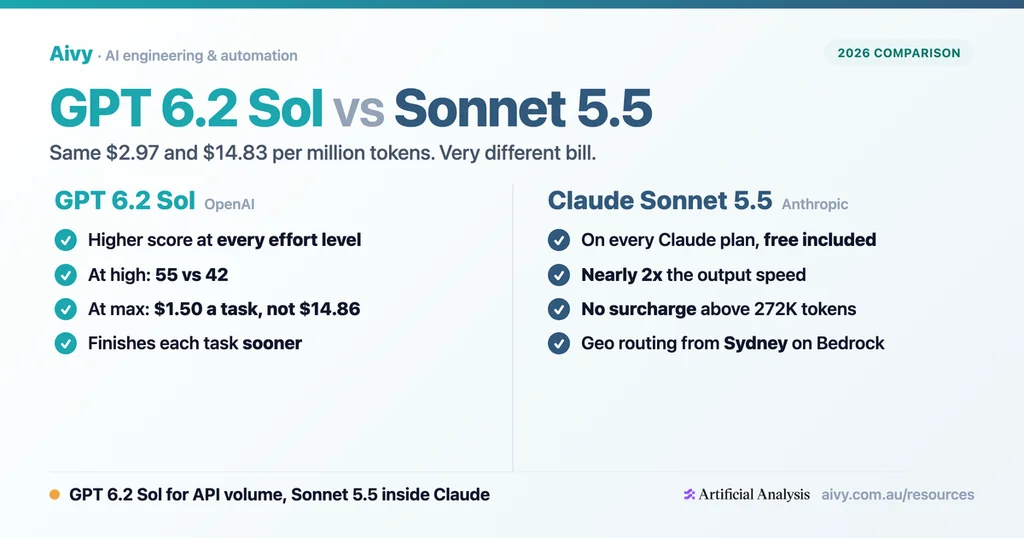
GPT 6.2 Sol, OpenAI's everyday model, arrived on 17 November 2026 at exactly the same token price as Claude Sonnet 5.5: $2.97 per million input tokens and $14.83 per million output. With the rate card tied, the real question is which one gets more work done for that money.
At Aivy I help Australian teams choose which model their money goes on, and on this pair the independent index is clear: Sol outscores Sonnet 5.5 at all five effort levels and spends far fewer tokens per task. Sonnet keeps real advantages, but they sit in access and in the fine print, not in the score.
Below you will find a two question pick, where each one sits next to Fable, Opus, Haiku and Luna, the score and cost at every effort level, a calculator and what each plan includes. Both companies bill in US dollars; I convert at the Reserve Bank rate of 17 November 2026, when one Australian dollar bought 0.6742 US dollars.
GPT 6.2 Sol or Claude Sonnet 5.5: a two question pick
With the token price tied, what decides it is how you pay and where you work. Someone calling the API from an agent and someone using Claude in the browser end up choosing differently, and both are right. Answer two questions for a starting point; the numbers behind it follow.
How will you mostly use it?
What do your requests look like?
Which plan do you already pay for?
GPT 6.2 Sol at high
- Scores 55 on the independent index for about $0.83 a task, against 42 and $2.43 for Sonnet 5.5 at high
- Finishes in 4.3 minutes on average, against 6.8
- See the score at each effort level
Claude Sonnet 5.5
- Charges the same at any length, up to a million tokens
- Sol doubles input and lifts output to 1.5 times above 272,000 input tokens
- See the prices
Step up a tier: Astra, Opus or Fable
- Neither Sol nor Sonnet is the model for the hardest work
- GPT 6.2 Astra scores 62 and Claude Fable 5.2 scores 65
- See where each model sits
Sonnet 5.5 on Bedrock, after checking the routing
- OpenAI offers GPT 6.2 data residency in the US and EU only
- Sonnet 5.5 can be called from Sydney and Melbourne on Bedrock through geographic routing
- Check where requests land: see data handling
Try Sol in ChatGPT Work or Codex
- GPT 6.2 Sol is in Work and Codex, not in regular Chat
- Pro 200 adds Sol on Ultrafast inside Codex
- See what each plan includes
Stay on Sonnet 5.5
- Sonnet 5.5 is on every Claude plan, Free included
- Switching tools for the score alone rarely pays inside a subscription
- See what each plan includes
Start free with Claude
- Claude Free already includes Sonnet 5.5; ChatGPT Free and Go do not get GPT 6.2
- To try Sol on real work, ChatGPT Plus is $29.99 a month
- See what each plan includes
Aivy's starting points from the independent numbers in this guide. Test both on your own tasks before you commit.
If you are torn between Sonnet and Anthropic's tier above it, our Claude Sonnet 5.5 vs Opus 5.5 comparison settles that step first. Plenty of teams end up using both.
Where Sol and Sonnet sit in each family
Sol and Sonnet 5.5 are the middle tier. Above them, OpenAI has GPT 6.2 Astra and Anthropic has Opus 5.5 and Fable 5.2; below them sit GPT 6 Luna and Claude Haiku 5.5. Each tier competes with its own, and each pair charges the same per token, except at the top, where Opus costs half.
On score, Sol sits closer to the flagships than Sonnet does. At max effort, Sol scores 57, two points above Sonnet 5.5 and two below Opus 5.5. The matching pair one tier up is in GPT 6.2 Astra vs Claude Fable 5.2.
Further down, Luna and Haiku cost a twentieth as much and suit classifying, extracting or routing. If you are choosing within Claude, our guide to which Claude model to use ranks all four by task.
GPT 6.2 Sol vs Claude Sonnet 5.5 head to head
Here is the whole comparison in one table. Filter by what matters to you: price, performance, access or data. The line that matters most is cost per task, because with the same token price the bill depends on how many tokens each model burns.
Claude Sonnet 5.5 and GPT 6.2 Sol compared
| In Australian dollars | Claude Sonnet 5.5 | GPT 6.2 Sol |
|---|---|---|
| Per million tokens, input and output | $2.97 and $14.83 | $2.97 and $14.83 |
| Reading a million cached tokens | $0.15 | $0.15 |
| Context and very long prompts | 1 million, same price at any length | 1.05 million; above 272,000 input tokens, input doubles and output rises 1.5 times |
| Independent index, low to max | 26, 31, 42, 50 and 55 | 41, 53, 55, 56 and 57 |
| Cost and time per task at high | $2.43, 6.8 min | $0.83, 4.3 min |
| Output speed at high | 144 tokens a second | 78 tokens a second |
| Subscriptions | Every Claude plan, Free included | ChatGPT Work and Codex on Plus, Pro, Business, Enterprise and Edu |
| Data residency | US only at 10% more on Anthropic's API; geographic routing from Sydney on Bedrock | US or EU at 10% more; zero retention for approved organisations |
Independent figures: Artificial Analysis Intelligence Index v5.0.1. Based on data from Artificial Analysis (artificialanalysis.ai), which does not endorse, validate or approve any of the analysis or conclusions drawn from it.
There is one row Sonnet clearly wins: it writes nearly twice as many tokens a second. Even so, Sol finishes each task sooner because it needs far fewer tokens to reach the answer. Raw speed helps only with very long text in one pass, a trade off that also comes up between Claude Fable 5.2 and Opus 5.5.
GPT 6.2 Sol and Sonnet 5.5: price per million tokens
The base rate is identical and so is the cache read, at $0.15 per million. The differences sit in the smaller lines: how long the cache lasts, what happens with very long prompts and whether you can pay for more speed. How Anthropic bills is covered in our guide to Claude plans in Australia.
| Price per million tokens | Claude Sonnet 5.5 | GPT 6.2 Sol |
|---|---|---|
| Input and output | $2.97 and $14.83 | $2.97 and $14.83 |
| Cache read | $0.15 | $0.15 |
| Cache write | $3.71 for five minutes, $5.93 for one hour | $3.71 for 30 minutes, $7.42 for 12 hours |
| Prompts above 272,000 tokens | No surcharge | $5.93 in and $22.25 out |
| Batch, input and output | $1.48 and $7.42 | $1.48 and $7.42 |
| Fast mode, input and output | Not offered | $5.93 and $29.66 |
| Ultrafast, input and output | Not offered | $8.90 and $44.50 until 28 February 2027 |
Sol wins on the cache, which for the same price lasts 30 minutes instead of five, and on speed options. Sonnet wins on long prompts: above 272,000 tokens, Sol charges more for the whole request, not just the part past the threshold.
For coding, the same rates carry over to Claude Code vs Codex, because those tools run on these models. But the token price is the small half of the story.
How each one scores at every effort level
Both models let you choose how hard they think: low, medium, high, xhigh and max. Artificial Analysis has run all five levels of each through its Intelligence Index v5.0.1, a battery of office, coding and science tests. Its result on 17 November: Sol outscores Sonnet 5.5 at every level.
GPT 6.2 Sol and Claude Sonnet 5.5 at each effort level
Intelligence Index (higher is better)
Minutes per index task (lower is better)
Output tokens a second (higher is better)
Source: Artificial Analysis model pages for GPT 6.2 Sol and Claude Sonnet 5.5 and models leaderboard, read 17 November 2026. Based on data from Artificial Analysis (artificialanalysis.ai), which does not endorse, validate or approve any of the analysis or conclusions drawn from it.
The gap is huge at the lower settings: at medium, Sol scores 53 and Sonnet 5.5 scores 31. It narrows at the top, and at max they are two points apart. So Sonnet has to climb a long way up the effort scale to get close, and every step costs it more tokens and more minutes.
How each effort level works in Claude, and when it is worth raising, is in our guide to Claude effort levels. OpenAI recommends starting Sol at medium, and GPT 6.2 does not accept the "none" setting.
What one task costs on each model
The bill is the rate times the tokens a model burns before it finishes. With the same list price, the whole difference comes from there: Sonnet 5.5 writes faster, but it writes a lot more to reach a lower score. Artificial Analysis publishes that cost beside every score.
| Effort | GPT 6.2 Sol | Claude Sonnet 5.5 | Sol's cost against Sonnet |
|---|---|---|---|
| max | 57, $1.50 | 55, $14.86 | 10% |
| xhigh | 56, $0.96 | 50, $6.07 | 16% |
| high | 55, $0.83 | 42, $2.43 | 34% |
| medium | 53, $0.61 | 31, $1.16 | 53% |
| low | 41, $0.27 | 26, $0.76 | 35% |
The early read going round, "same price, higher score at every effort level", holds on the v5 index. It also undersells it: on top of the higher score, Sol costs less per task at all five levels, from half at medium to a tenth at max.
Your tasks will not match the index. Move the sliders to your own volumes; the last one is the share of Sonnet's tokens Sol needs for the same job. If you want to weigh staff hours too, our guide to AI consulting costs in Australia shows how we price that side.
What would each model cost you a month on the API?
List rates in Australian dollars, with 80% of input read from cache. Counts model cost only, not staff time.
- Claude Sonnet 5.5 a month
- $439
- GPT 6.2 Sol a month
- $220
- Saving with Sol instead of Sonnet
- $220
Starting values: 2,000 tasks a month of 100,000 input and 10,000 output tokens, with Sol using half of Sonnet's tokens, a cautious figure against the 34% cost share at high effort. Input stops at 270,000 tokens because Sol charges more above that. An estimate, not a quote.
Set the last slider to 100% and the two come out the same, because they charge the same per token and per cache read. Sol only saves money if it really finishes your tasks with fewer tokens, so measure that on a sample of your own work before you move anything.
What each ChatGPT and Claude plan includes
This is where the gap is widest. Sonnet 5.5 is on every Claude plan, Free included. GPT 6.2 Sol is only in ChatGPT Work and Codex, from Plus up: OpenAI says the rollout does not add it to regular Chat, and Free and Go users do not get it. Our guide to ChatGPT plans in Australia covers them all.
Where GPT 6.2 Sol and Sonnet 5.5 sit on each plan, price a month in Australian dollars
ChatGPT plans with GPT 6.2 Sol
| Plan, price a month | GPT 6.2 Sol | Ultrafast |
|---|---|---|
| Free and Go, $0 and $13 | Not included | No |
| Plus, $29.99 | In Work and Codex | No |
| Pro 100, $154.99 | In Work and Codex | No |
| Pro 200, $300 | In Work and Codex | Sol, in Codex only |
| Pro 500, $769.99 | In Work and Codex | Sol and Astra |
| Business, Enterprise, Edu | In Work and Codex, as the workspace allows | Enterprise and Edu, on credits |
Claude plans with Sonnet 5.5
| Plan, price a month | Sonnet 5.5 | Opus 5.5 |
|---|---|---|
| Free, $0 | Included, with limited use | Not included |
| Pro, $34 | Included | Included |
| Max, $170.01 | Included, five times Pro's usage | Included |
| Ultra, $340 | Included, no five hour limit on verified accounts | Included |
Sources: ChatGPT on the Australian App Store and OpenAI Help Center, ChatGPT Work and Codex; claude.com/pricing as shown to Australian visitors and Anthropic Help Center. All read 17 November 2026, GST included.
Ultrafast draws the included allowance at six times the Standard rate, so on Pro 200 it is best kept for Codex sessions where waiting costs money. On Claude, Sonnet stretches the allowance further than Opus or Fable, and our Claude plans guide shows where each limit sits.
Australian data and cyber safeguards
For client data that has to stay onshore, neither vendor's own API is the answer today. OpenAI offers GPT 6.2 residency in the US and EU only, at 10 per cent more. Anthropic's API can pin requests to the US at 10 per cent more, or run them globally.
| Where the data is processed | Claude Sonnet 5.5 | GPT 6.2 Sol |
|---|---|---|
| Vendor's own API | Global, or US only at 10% more | US or EU at 10% more |
| Processing in Australia | Possible on Bedrock through geographic routing from Sydney and Melbourne; check the destination Regions | Not offered by OpenAI today |
| Cyber safeguards | Anthropic's standard safeguards | Rated "Critical": more refusals on security work |
Sonnet 5.5 can be called from Sydney and Melbourne on Bedrock, but only through cross Region routing. Check the destination Regions of the profile with AWS before any client file goes in, and read our Privacy Act playbook for what else to confirm.
OpenAI rates Sol "Critical" for cybersecurity, like Astra, and ships it with stricter safeguards. If your team does penetration testing or vulnerability research, expect more refusals than on Sonnet.
Which one an Australian business should use
My rule: with the price tied, pay for the result. For most API and agent work, Sol does more with the same money. Sonnet 5.5 is still the better pick inside Claude, with very long prompts and when raw writing speed is what matters.
| The job | Model and effort | Why |
|---|---|---|
| Agents and API at scale | GPT 6.2 Sol at high | Score 55 for $0.83 a task, against 42 and $2.43 on Sonnet |
| Lots of cheap volume | GPT 6.2 Sol at low or medium | Score 41 to 53 for under $0.65 a task |
| Whole contracts or repositories at once | Claude Sonnet 5.5 | No surcharge above 272,000 tokens |
| Daily work inside Claude | Claude Sonnet 5.5 | Included on every plan, Free too |
| Very long text in one pass | Claude Sonnet 5.5 | Nearly twice the tokens a second |
| Security testing | Test both before choosing | Sol ships with stricter cyber safeguards |
Before you move a workload from Sonnet 5.5 to Sol
Tick what your team has already done.
Too early to switch. Run the side by side test first.
Close. Finish the open checks before you move anything that matters.
Ready for a pilot. Move one workload and compare the first month's bill.
Aivy's checklist for moving a workload between model providers.
To see how Sonnet stacked up against OpenAI's previous mid tier model, read GPT 6.1 Terra vs Claude Sonnet 5.5. If you would like help testing both on your own tasks, our AI consulting team runs that comparison for Australian businesses.
GPT 6.2 Sol vs Claude Sonnet 5.5: frequently asked questions
Is GPT 6.2 Sol better than Claude Sonnet 5.5?
On the Artificial Analysis independent index, yes: it scores higher at all five effort levels, from 41 against 26 at low to 57 against 55 at max, and it costs less per task at every level. Sonnet 5.5 writes faster and charges no surcharge for very long prompts.
How much does GPT 6.2 Sol cost in Australia?
On the API, $2.97 per million input tokens and $14.83 per million output, at the RBA rate of 17 November 2026. That is the same as Claude Sonnet 5.5. Cached input costs $0.15 on both.
If they cost the same, why is Sol cheaper?
Because it uses far fewer tokens to finish the same task. At high effort, an index task costs $0.83 on Sol and $2.43 on Sonnet 5.5; at max, $1.50 against $14.86.
Can I use GPT 6.2 Sol on ChatGPT Plus or for free?
On Plus, yes, in ChatGPT Work and Codex. It is not in regular Chat, and Free and Go do not include it. Pro 200 adds Sol on Ultrafast inside Codex. Our ChatGPT plans guide has the detail.
Is Claude Sonnet 5.5 on the free plan?
Yes. Sonnet 5.5 is on every Claude plan, Free included, with limited use every five hours and every week. Pro, Max and Ultra give more use of the same model.
Which effort level should I use on Sol?
OpenAI recommends starting at medium, where Sol already scores 53. High lifts it to 55 for a little more; xhigh and max add a point or two for a lot more time. GPT 6.2 does not offer a "none" setting.
Which one is faster?
It depends on what you measure. Sonnet 5.5 writes nearly twice as many tokens a second, but Sol finishes each index task sooner because it needs far fewer tokens: 4.3 minutes against 6.8 at high effort.
Sol or Astra? Sonnet or Opus?
Astra and Opus 5.5 are the tier above: higher scores at max, 62 and 59, for a lot more money. For most daily work, Sol at high is enough. We compare OpenAI's line up in Astra, Sol and Luna.
Can I keep client data in Australia with either model?
Not through either vendor's own API. OpenAI offers US and EU residency for GPT 6.2. Sonnet 5.5 can be called from Sydney and Melbourne on Amazon Bedrock through geographic routing, so check the profile's destination Regions before relying on it.
The bottom line: same price per token, more score per dollar
OpenAI priced Sol to the cent against Sonnet 5.5, and the independent numbers give it the edge at every effort level, at between half and a tenth of the cost per task. Sonnet keeps its place inside Claude, for very long prompts and where raw writing speed rules.
Picture a Perth property manager running an agent that sorts tenant emails and drafts replies on Sonnet 5.5. Moving it to Sol at medium would likely cut the model bill without losing quality, but only a week of side by side runs on its own inbox will confirm it.
If you would like a second opinion on which of your workloads belong on which model, our team at Aivy runs that review with Australian businesses every week. You can book a time with us whenever it suits you.
Last updated: 18 November 2026
Sources
- OpenAI API, GPT 6.2 Sol model page. Input, cached input, cache write and output prices, context window, maximum input and output, knowledge cutoff and the long context rule. Read 17 November 2026.
- OpenAI API, pricing. Standard, Batch, Fast and Ultrafast rates and the 10% uplift for data residency. Read 17 November 2026.
- OpenAI API, using GPT 6.2. US and EU data residency, zero data retention and the advice to start at medium effort. Read 17 November 2026.
- OpenAI, GPT 6.2 Astra and Sol system card. The "Critical" cybersecurity rating and safeguards. Read 17 November 2026.
- OpenAI Help Center, ChatGPT Work and Codex. GPT 6.2 in Work and Codex only, the plans that include it and the Ultrafast rules on Pro 500 and Pro 200. Read 17 November 2026.
- ChatGPT on the Australian App Store. Monthly prices for Go, Plus, Pro 100, Pro 200 and Pro 500, GST included. Read 17 November 2026.
- Anthropic, API pricing. Rates for Claude Sonnet 5.5, Opus 5.5, Fable 5.2 and Haiku 5.5, caching, batch, fast mode, US only inference and no long context surcharge. Read 17 November 2026.
- Anthropic, models overview. Context window, maximum output, knowledge cutoff, default effort and Bedrock ID for Sonnet 5.5. Read 17 November 2026.
- Claude, plans and pricing and Anthropic Help Center, change the model and effort settings. Sonnet on every plan, Free included, Australian plan prices with GST and Sonnet 5.5's effort levels. Read 17 November 2026.
- Amazon Bedrock, Regional availability. Geographic and global routing for Claude Sonnet 5.5 from Sydney and Melbourne. Read 17 November 2026.
- Artificial Analysis, models leaderboard and the model pages for GPT 6.2 Sol and Claude Sonnet 5.5. Intelligence Index v5.0.1, cost and time per task and output speed at each effort level, and the max effort scores of Fable 5.2, Astra, Opus 5.5, Haiku 5.5 and Luna. Read 17 November 2026. Based on data from Artificial Analysis (artificialanalysis.ai), which does not endorse, validate or approve any of the analysis or conclusions drawn from it.
- Reserve Bank of Australia, exchange rates. One Australian dollar bought 0.6742 US dollars on 17 November 2026; every converted figure uses this rate.



