
OpenAI released GPT 6.2 Astra and GPT 6.2 Sol on 17 November 2026, and the headline was aimed squarely at Anthropic: on one agent test, Astra scores 5.5 points above Claude Fable 5.2 "at just 5% of the cost". That is OpenAI's own figure, so the first job is to check it.
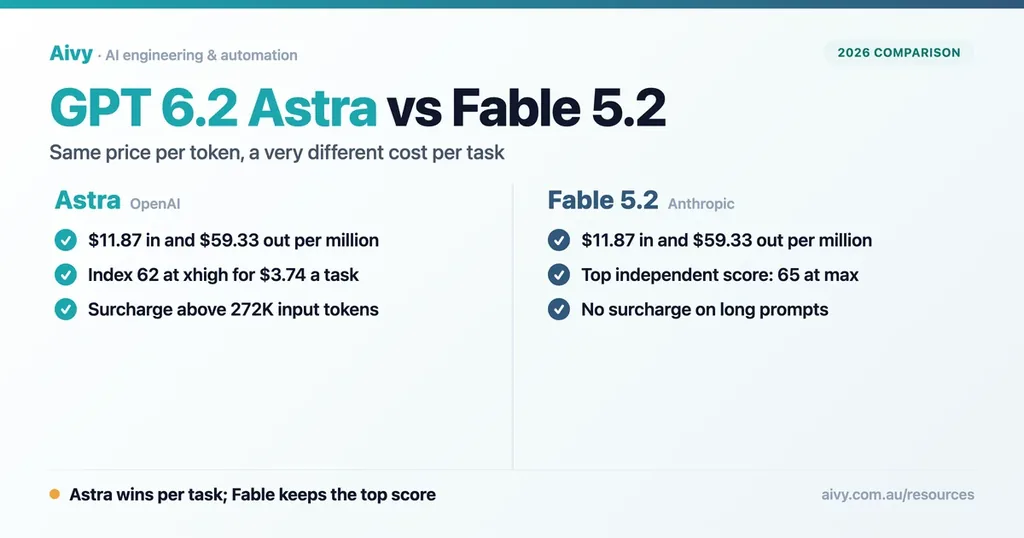
At Aivy I help Australian teams choose which model their money goes on, and this one is closer than either launch post suggests. Per token, the two flagships now cost exactly the same. Per finished task, Astra is far cheaper. On the hardest work, Fable still scores higher.
Below you will find a two question pick, prices in Australian dollars, OpenAI's claims beside the independent numbers, a cost calculator and what each ChatGPT and Claude plan includes. Both companies bill in US dollars; I convert at the Reserve Bank rate of 17 November 2026, when one Australian dollar bought 0.6742 US dollars.
GPT 6.2 Astra or Claude Fable 5.2: a two question pick
The right answer depends less on which model is "best" and more on how you pay and what the work is. A developer billing by the token and a Claude Max subscriber end up with different picks, and both are right. Answer two questions for a starting point, then read the numbers behind it.
How will you mostly use it?
What matters most on the jobs you run?
Which plan do you already pay for?
GPT 6.2 Astra at xhigh
- Scores 62 on the independent index for about $3.74 a task, against $13.47 for Fable 5.2 at the same score
- Finishes in 5.9 minutes on average, against 14.6
- Watch the long context surcharge above 272,000 input tokens: see the comparison table
Claude Fable 5.2 at high, max only when it pays
- Fable 5.2 at max scores 65, the top independent score, three points above Astra
- It costs about $39 a task there, so test whether those points change your result
- No surcharge on very long prompts: see the comparison table
GPT 6.2 Sol at medium or high
- Scores 53 to 55 for well under $1 a task
- A quarter of Astra's token price: see the prices
- Move single hard steps up to Astra rather than running everything on it
Neither flagship, for now
- OpenAI offers GPT 6.2 data residency in the US and EU only
- Fable 5.2 is listed on Amazon Bedrock with a global ID only
- Claude Opus 5.5 can run in Sydney and Melbourne on Bedrock: see data handling
Try Astra in ChatGPT Work or Codex
- Both GPT 6.2 models are in Work and Codex, not in regular Chat
- Plus has limited flagship use; Pro tiers have more
- See what each plan includes
Stay on Opus 5.5, add Fable with a cap
- Fable 5.2 on Pro is paid with usage credits at API rates
- Set a monthly cap before anyone picks it
- See what each plan includes
Use the Fable allowance you already have
- Max and Ultra can spend up to half the weekly limit on Fable 5.2
- Switching to ChatGPT for Astra only makes sense if cost per task drives you
- See what each plan includes
Start with ChatGPT Plus at $29.99
- The cheapest way to try Astra on real work, in ChatGPT Work
- Claude Pro at $34 gets you Opus 5.5, with Fable 5.2 paid on top
- See what each plan includes
Aivy's starting points from the independent figures below. Test both on your own tasks before you commit.
If you are still choosing between Claude models, our Claude Fable 5.2 vs Opus 5.5 comparison covers that step first. Most Claude users should start there.
What OpenAI released on 17 November
GPT 6.2 Astra is OpenAI's new flagship for hard projects, and GPT 6.2 Sol its cheaper everyday model. OpenAI says both reach better results with fewer output tokens, which is the claim that matters most for your bill. It replaces GPT 6 Astra, out since 3 September, which our guide to GPT 6 Astra, Sol and Luna covers.
Astra is 20 per cent cheaper per token than GPT 6 Astra, and cached input is 60 per cent cheaper. Sol keeps GPT 6.1 Sol's price. Both models take text and images, hold a context window of 1.05 million tokens with up to 922,000 of input, and write up to 128,000 tokens per answer.
OpenAI also rates Astra as its first released model to reach "High" for AI self improvement under its safety framework, and both models reach "Critical" for cybersecurity. That brings tighter safeguards for security work, which I cover further down.
GPT 6.2 Astra vs Claude Fable 5.2 head to head
Here is the whole comparison in one table. Filter by what you care about: price, performance, access or data. GPT 6.2 Sol sits in the last column because many teams will end up pairing it with Astra, the way Claude users pair Opus with Fable.
Claude Fable 5.2, GPT 6.2 Astra and GPT 6.2 Sol compared
| In Australian dollars | Claude Fable 5.2 | GPT 6.2 Astra | GPT 6.2 Sol |
|---|---|---|---|
| Per million tokens, in and out | $11.87 and $59.33 | $11.87 and $59.33 | $2.97 and $14.83 |
| Reading a million cached tokens | $0.30 | $0.59 | $0.15 |
| Context and long prompts | 1M tokens, same rate at any length | 1.05M; above 272K input, input doubles and output is 1.5 times | Same as Astra |
| Independent index, best setting | 65 at max, $39.37 a task | 62 at max, $5.93 a task | 57 at max, $1.50 a task |
| Cost per task at a score of 62 | $13.47 at high, 14.6 min | $3.74 at xhigh, 5.9 min | Does not reach 62 |
| Subscriptions | Claude Pro with credits; Max and Ultra up to half the weekly limit | ChatGPT Work and Codex on Plus, Pro, Business, Enterprise, Edu | Same as Astra |
| Data residency | Global ID only on Bedrock; 30 day retention by default | US or EU residency at 10% more; zero retention for approved organisations | Same as Astra |
| Knowledge cutoff | June 2026 | 18 May 2026 | 1 June 2026 |
Independent figures: Artificial Analysis Intelligence Index v5.0.1. Based on data from Artificial Analysis (artificialanalysis.ai), which does not endorse, validate or approve any of the analysis or conclusions drawn from it.
Two rows decide most cases. The token price is identical, so cost comes down to how many tokens each model burns. And the long prompt surcharge only hits Astra, so for jobs that feed in whole contracts or codebases at once, run the numbers on your real prompt size.
GPT 6.2 Astra and Fable 5.2: price per million tokens
For the first time, OpenAI's and Anthropic's flagships carry the same list price: $11.87 per million input tokens and $59.33 per million output tokens. The differences sit in the smaller lines, and they cut both ways. Our explainer on buying Claude in Australia covers how Anthropic bills locally.
| Rate per million tokens | Claude Fable 5.2 | GPT 6.2 Astra |
|---|---|---|
| Input and output | $11.87 and $59.33 | $11.87 and $59.33 |
| Cache read | $0.30 | $0.59 |
| Cache write | $14.83 for five minutes, $23.73 for an hour | $14.83 for 30 minutes, $29.66 for 12 hours |
| Prompts above 272,000 tokens | No surcharge | $23.73 in and $88.99 out |
| Batch, input and output | $5.93 and $29.66 | $5.93 and $29.66 |
| Fast mode, input and output | $23.73 and $118.66 | $23.73 and $118.66 |
| Ultrafast, input and output | Not offered | $35.60 and $177.99 until 28 February 2027 |
Fable 5.2 wins on cache reads, at half Astra's price, and on long prompts, where Astra charges more for the whole request. That matters for agents, where most tokens are often cache reads. Astra wins on how long a cache can live, up to 12 hours, and offers Ultrafast for those who will pay three times the rate for speed.
If you code in a terminal, the same maths feeds into Claude Code vs Codex, since those tools run these two models. Price per token, though, is the smaller half of the story.
OpenAI's claims against the independent tests
OpenAI's launch post makes four headline claims. Each is a vendor result: chosen by OpenAI, run on OpenAI's setup and published on launch day. I keep them apart from the independent numbers, which come next.
| OpenAI's claim, 17 November 2026 | What it says | What to keep in mind |
|---|---|---|
| Agents' Last Exam, long professional workflows | Astra 5.5 points ahead of Fable 5.2 at 5% of the cost | OpenAI notes Fable's results exclude nine tasks that used a fallback model |
| Agents' Last Exam against GPT 6 Astra | 5.2 points higher, for well under half the cost | A comparison with OpenAI's own older model |
| Harvey LAB AA, legal work | More than double Fable 5.2's pass rate at about a sixth of the cost | Run with Harvey and Artificial Analysis; no Anthropic figure to set beside it |
| AA 3D, blind votes on built 3D experiences | Astra 1,318 Elo, Fable 5.2 1,271, Sol 1,259 | Human preference votes, not task success |
| ExploitBench Internal Port, cyber | 53.5% for Astra against 31.5% for GPT 6 Astra | The 22 point jump that triggered tighter safeguards |
The independent check that already exists is the Artificial Analysis Intelligence Index, which runs every model through nine tests of knowledge work, coding and science. Its verdict splits the difference. Fable 5.2 still holds the top score, 65 at max. Astra at max scores 62, and so does Fable at high.
So OpenAI's "ahead of Fable" holds on its chosen test, not on the broad independent index. The "5% of the cost" does not reproduce either: at their best settings, Astra costs 15 per cent of Fable per task, and at an equal score of 62, 28 per cent. Still a large gap, just not twenty to one.
Anthropic, for its part, published Fable 5.2's own table on 9 November, which our Fable 5.2 vs Opus 5.5 guide lists. OpenAI's footnote notes one overlap: Anthropic reported 74.6 per cent for Fable 5.2 on Terminal Bench Science at max in Claude Code, a different harness from the one OpenAI quotes.
What one task costs on each model
The bill is the rate multiplied by the tokens a model burns to finish the job, and this is where the two part ways. With the same list price, Astra's lower cost per task comes almost entirely from using fewer tokens and finishing sooner. Artificial Analysis publishes that cost beside every score.
| Effort setting | GPT 6.2 Astra | Claude Fable 5.2 | Astra's cost as a share |
|---|---|---|---|
| max | 62, $5.93, 10.4 min | 65, $39.37, 40.8 min | 15% |
| xhigh | 62, $3.74, 5.9 min | 62, $22.00, 25.5 min | 17% |
| high | 60, $3.07, 4.8 min | 62, $13.47, 14.6 min | 23% |
| medium | 57, $2.40, 3.7 min | 56, $5.64, 6.8 min | 43% |
| low | 46, $0.98, 1.4 min | 54, $4.60, 5.4 min | 21% |
Two rows stand out. At medium, the two score almost the same and Astra costs less than half. At low, Fable keeps far more of its quality: 54 against 46. If you run cheap settings at volume, Fable at low or Sol at high may serve you better than Astra at low.
Your own jobs will not match an index task. Move the sliders to your volumes; the last slider is the share of Fable's tokens that GPT 6.2 needs for the same job. For staff time saved rather than model cost, use our AI ROI calculator.
What would your monthly API bill be on each model?
List rates in Australian dollars, with 80% of input read from cache. Counts model cost only, not staff time.
- Claude Fable 5.2 a month
- $499
- GPT 6.2 Astra a month
- $261
- GPT 6.2 Sol a month
- $65
- Saved with Astra instead of Fable
- $238
Starting values: 200 tasks a month of 500,000 input and 20,000 output tokens, and GPT 6.2 using half Fable's tokens, a cautious figure against the 28% cost share at equal scores above. Prompts above 272,000 tokens cost more on GPT 6.2 and are not modelled. An estimate, not a quote.
Set the last slider to 100 per cent and the result flips: with identical token counts, Fable is slightly cheaper because its cache reads cost half as much. Astra only saves money if it really does finish your jobs with fewer tokens, so measure that on a sample before you move a workload.
What each ChatGPT and Claude plan includes
On a subscription you pay for an allowance, not for tokens. Both GPT 6.2 models live in ChatGPT Work and Codex only; OpenAI says the rollout does not add them to regular Chat. Free and Go users do not get them. Our guide to ChatGPT plans in Australia covers every tier in detail.
Where GPT 6.2 and Fable 5.2 sit on each plan, price a month in Australian dollars
ChatGPT plans with GPT 6.2
| Plan, price a month | Flagship access | Ultrafast |
|---|---|---|
| Plus, $29.99 | GPT 6.2 in Work and Codex, with limited flagship use | No |
| Pro 100, $154.99 | GPT 6.2 in Work and Codex | No |
| Pro 200, $300 | GPT 6.2 in Work and Codex | Sol only, in Codex |
| Pro 500, $769.99 | GPT 6.2 in Work and Codex | Astra and Sol |
| Business, Enterprise, Edu | GPT 6.2 in Work and Codex, as the workspace allows | Enterprise and Edu, on credits |
Claude plans with Fable 5.2
| Plan, price a month | Fable 5.2 | Opus 5.5 |
|---|---|---|
| Free, $0 | Not included | Not included |
| Pro, $34 | Usage credits at API rates | Included |
| Max, $170.01 | Up to half the weekly limit, then credits | Included |
| Ultra, $340 | Up to half the weekly limit, then credits | Included |
Sources: ChatGPT on the Australian App Store and OpenAI Help Center, ChatGPT Work and Codex; claude.com/pricing as shown to Australian visitors and Anthropic Help Center. All read 17 November 2026, GST included.
Ultrafast on Pro 500 uses the included allowance at six times the Standard rate, so it drains fast. On Claude, Anthropic says Fable uses limits faster than other Claude models. Either way, a flagship on a subscription is a budget to manage, and our guide to Claude plans in Australia shows where each limit sits.
Cyber safeguards and Australian data
OpenAI rates both GPT 6.2 models "Critical" for cybersecurity, so they launch with tighter safeguards. OpenAI says these "restrict some legitimate vulnerability research and security testing workflows". If your team does penetration testing, expect more refusals than on GPT 6 Astra until OpenAI brings GPT 6.2 to its Daybreak programme.
For client data, neither flagship can be kept in Australia today. OpenAI offers US and EU data residency for GPT 6.2, at 10 per cent more. Fable 5.2 carries 30 day retention for safety checks unless an eligible enterprise arranges otherwise, and on Bedrock it has a global ID only.
If data must stay onshore, Claude Opus 5.5 runs in Sydney and Melbourne on Bedrock. Our Privacy Act playbook covers what to check before any client file goes into either model.
Which one an Australian business should use
My rule: pay for the result, not the model name. For most API and agent work, Astra now does the same job as Fable for a fraction of the money. Fable keeps the top independent score, and that still matters when a single run is long, hard and worth a lot.
| The job | Model and effort | Why |
|---|---|---|
| Agents and API work at scale | GPT 6.2 Astra at xhigh or high | Index 62 for $3.74 a task, against $13.47 for Fable |
| High volume, simpler steps | GPT 6.2 Sol at medium or high | Index 53 to 55 for under $1 a task |
| The hardest long runs | Claude Fable 5.2 at high, max only if tested | Top independent score, 65 at max |
| Whole contracts or codebases in one prompt | Claude Fable 5.2 | No surcharge above 272,000 tokens |
| Security testing | Test both before you commit | GPT 6.2 launches with tighter cyber safeguards |
| Client data that must stay in Australia | Claude Opus 5.5 on Bedrock | Neither flagship offers Australian processing |
Before you move a workload from Fable 5.2 to Astra
Tick what your team has already done.
Too early to switch. Run the side by side test first.
Close. Finish the open checks before you move anything that matters.
Ready for a pilot. Move one workload and compare the first month's bill.
Aivy's checklist for moving a workload between model providers.
If you would like help testing both on your own tasks, our AI consulting team runs that comparison for Australian businesses. It usually takes a day of sample runs to see which model your work actually favours.
GPT 6.2 Astra vs Claude Fable 5.2: frequently asked questions
Is GPT 6.2 Astra better than Claude Fable 5.2?
It depends on the measure. OpenAI reports Astra 5.5 points ahead on Agents' Last Exam. On the independent Artificial Analysis index, Fable 5.2 scores 65 at max against 62 for Astra, but Astra reaches 62 for about 28 per cent of Fable's cost per task.
How much does GPT 6.2 Astra cost in Australia?
On the API, $11.87 per million input tokens and $59.33 per million output tokens, converted at the RBA rate of 17 November 2026. That is the same as Claude Fable 5.2. Cached input costs $0.59 on Astra and $0.30 on Fable.
Is GPT 6.2 Astra really 5% of the cost of Fable 5.2?
That is OpenAI's figure for one test, Agents' Last Exam. On the independent index, Astra at max costs about 15 per cent of Fable at max per task, and 28 per cent when both score 62. Still far cheaper, but not twenty times.
Can I use GPT 6.2 Astra on ChatGPT Plus?
Yes, in ChatGPT Work and Codex, with limited flagship use on Plus. It is not in regular Chat, and Free and Go plans do not include it. Pro tiers give more use, and only Pro 500 gets Ultrafast on Astra.
What is the difference between GPT 6.2 Astra and Sol?
Astra is the flagship for hard projects; Sol is the efficient everyday model at a quarter of the token price, $2.97 in and $14.83 out. On the independent index Sol scores 57 at max against 62 for Astra, and it beats its direct rival at every effort level, as our GPT 6.2 Sol vs Claude Sonnet 5.5 comparison shows.
Which is better for coding, Astra or Fable 5.2?
For everyday coding agents, Astra gives similar results for much less per task, and OpenAI says Sol nearly matches Astra on FrontierCode 2.0. For very large codebases in one prompt, Fable avoids Astra's surcharge above 272,000 tokens.
Can I keep client data in Australia with either model?
Not with these two today. OpenAI offers US and EU data residency for GPT 6.2, and Fable 5.2 is listed with a global ID only on Amazon Bedrock. Claude Opus 5.5 can run in Sydney and Melbourne on Bedrock.
Should I move from Claude to ChatGPT for Astra?
Not on launch day alone. If cost per task drives your API spend, test Astra on a sample of your real jobs first. If you are on Claude Max or Ultra, you already pay for a Fable allowance, so compare on your own work before switching.
The bottom line: same price per token, not per task
OpenAI matched Anthropic's flagship price to the cent and then claimed to beat it for a twentieth of the cost. The independent numbers back the direction, not the size: Astra finishes the same task for a quarter to a sixth of Fable's cost, while Fable keeps the top score.
Picture a Brisbane software firm running a coding agent on Fable 5.2 at high. Moving that agent to Astra at xhigh would likely cut the model bill by two thirds for a similar index score, but only a week of side by side runs on its own tickets will show whether the quality holds.
If you would like a second opinion on which of your workloads belong on which model, our team at Aivy runs that review with Australian businesses every week. You can book a time with us whenever it suits you.
Last updated: 17 November 2026
Sources
- OpenAI, Introducing GPT 6.2 Astra and Sol. Agents' Last Exam, Harvey LAB AA, AA 3D and FrontierCode 2.0 claims, the Terminal Bench Science footnote, cyber safeguards, availability and API prices. Published 17 November 2026.
- OpenAI Developer Community, GPT 6.2 Astra and Sol are now available. Plans, Ultrafast on Pro 500 and Pro 200, and the ExploitBench gain. Published 17 November 2026.
- OpenAI, GPT 6.2 Astra and Sol system card. Preparedness ratings for cybersecurity, biology and AI self improvement, and ExploitBench scores. Read 17 November 2026.
- OpenAI API, GPT 6.2 Astra model page and GPT 6.2 Sol model page. Context window, maximum input and output, knowledge cutoff, cache writes and the long context rule. Read 17 November 2026.
- OpenAI API, pricing. Standard, Batch, Fast and Ultrafast rates, GPT 6 Astra's rates and the 10% uplift for data residency. Read 17 November 2026.
- OpenAI API, using GPT 6.2. US and EU data residency, zero data retention and effort advice. Read 17 November 2026.
- OpenAI Help Center, ChatGPT Work and Codex. Work and Codex only, the plans covered, and Ultrafast rules on Pro 500 and Pro 200. Read 17 November 2026.
- ChatGPT on the Australian App Store. Monthly prices for Plus, Pro 100, Pro 200 and Pro 500, GST included. Read 17 November 2026.
- Anthropic, pricing. Claude Fable 5.2 and Opus 5.5 rates, cache writes and reads, batch, fast mode and no long context surcharge. Read 17 November 2026.
- Anthropic, models overview. Context window, maximum output, knowledge cutoff, the advice to start on Opus 5.5 and Bedrock IDs. Read 17 November 2026.
- Anthropic, Introducing Claude Fable 5.2 and Claude Mythos 5.2. Anthropic's benchmark table and 30 day retention. Published 9 November 2026.
- Claude, plans and pricing and Anthropic Help Center, Claude Fable models on your plan. Australian plan prices with GST, and Fable on each plan. Read 17 November 2026.
- Artificial Analysis, models leaderboard. Intelligence Index, cost and time per task for GPT 6.2 Astra, GPT 6.2 Sol, Claude Fable 5.2 and Claude Opus 5.5 at each effort setting. Read 17 November 2026. Based on data from Artificial Analysis (artificialanalysis.ai), which does not endorse, validate or approve any of the analysis or conclusions drawn from it.
- Reserve Bank of Australia, exchange rates. One Australian dollar bought 0.6742 US dollars on 17 November 2026; every converted figure uses this rate.



