
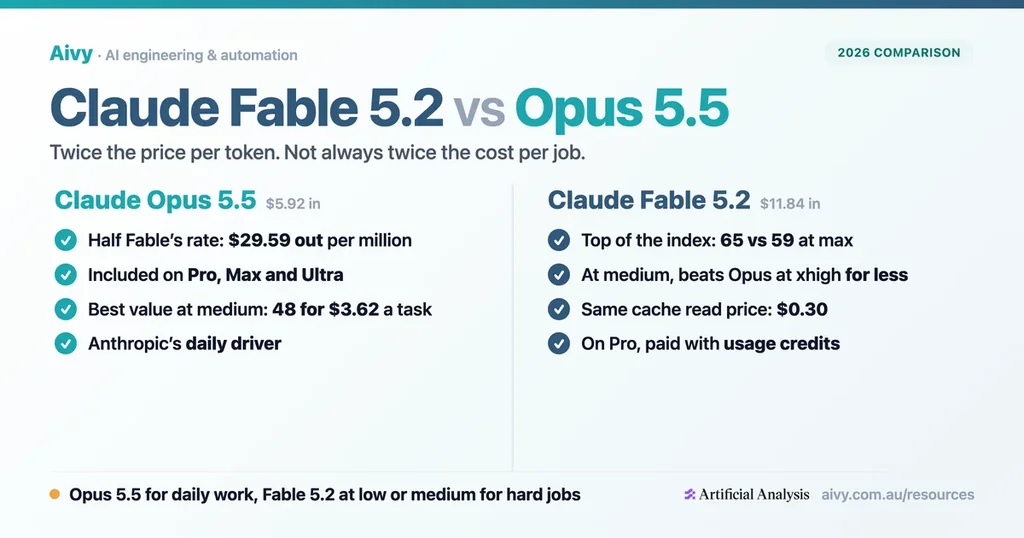
Fable 5.2 is Anthropic's strongest public model, and from this week most people pay extra to use it. The free launch week for Pro ended at 6:59 pm on 17 November in Melbourne. Fable on Pro now runs on usage credits at API rates, while Max and Ultra can spend up to half their weekly limit on it.
At Aivy I help Australian teams decide which Claude model their money should go on, and the question I hear most this month is simple: is Fable worth twice the price of Opus 5.5? Per token, it costs exactly double. Per finished task, the independent numbers tell a more interesting story.
Below you will find a two question pick, both price lists in Australian dollars, what each Claude plan now includes, the benchmarks sorted by who ran them, a cost calculator and the effort level I would pick. Anthropic bills in US dollars; I convert at the Reserve Bank rate of 16 November 2026.
Claude Fable 5.2 or Opus 5.5: a two question pick
The right model depends less on which one is "best" and more on how you pay and how hard the job is. Most teams end up using both, with Opus 5.5 for daily work and Fable 5.2 for the jobs where Opus would need to work hardest. Answer two questions for a starting point.
How do you pay for Claude?
How hard is the job?
How hard is the job?
What matters most on this workload?
Opus 5.5 at medium
- Index 48 for $3.62 a task, the best value for everyday work
- Anthropic also tells most users to start here
- See the effort settings
Fable 5.2 at medium, on capped usage credits
- On Pro, Fable is paid at API rates through usage credits
- Set a monthly cap under Settings, then Usage, first
- See what each plan includes
Fable 5.2 at medium, high for long runs
- Up to half your weekly limit is included
- Fable at high scores 62, above Opus at max
- See the effort settings
Opus 5.5 at low
- The cheapest rung at $1.45 a task and 3.1 minutes
- Move single hard steps up to Fable rather than the whole agent
- Try the cost calculator
Fable 5.2 at low or medium
- Fable at medium scores 56 for $5.62, against 57 for $8.95 on Opus at xhigh
- Cache reads cost the same on both, so agents narrow the gap
- Try the cost calculator
Opus 5.5 on Amazon Bedrock
- Opus 5.5 can run in Sydney and Melbourne on Bedrock
- Fable 5.2 is listed with a global ID only
- See when each model wins
Aivy's starting points from the Artificial Analysis figures in this guide. Test both on your own tasks before you commit.
If you are still weighing Fable 5.1, our Opus 5.5 vs Fable 5.1 comparison covers that pairing. For OpenAI's new flagship against Fable, see the comparison linked in the note above.
What changes in Claude Fable 5.2
Anthropic released Fable 5.2 on 9 November 2026 alongside Mythos 5.2, the same underlying model with some safeguards removed and sold only to verified organisations. Our launch coverage of Fable 5.2 has the day one details. Anthropic says it improves on Fable 5.1 in coding, reasoning and vision, and communicates more clearly.
The practical changes are price and speed. Fable 5.2 costs a fifth less than Fable 5.1, which stays on sale at $14.80 and $73.98, and Anthropic says it finishes hard tasks with fewer tokens at medium effort.
What has not changed is Anthropic's advice. It calls Opus 5.5 its strongest daily driver and tells most users to start there, moving up to Fable for the most ambitious technical work. On paper the two now match: one million tokens of context, 128K of output, a June 2026 knowledge cutoff and thinking that is always on.
Fable 5.2 vs Opus 5.5: price per million tokens
The list price is the easy part. Fable 5.2 charges $11.84 per million input tokens and $59.18 per million output tokens; Opus 5.5 charges $5.92 and $29.59. That is a clean two to one ratio on both lines, and because Anthropic bills in US dollars, the ratio holds whatever the Australian dollar does.
The detail most comparisons miss is caching. Both models charge $0.30 to read a million cached tokens, so on agentic work, where most tokens are often read back from the cache, the gap narrows. Batch processing halves every rate, and fast mode doubles it. Our guide to buying Claude in Australia covers the ways to pay.
| Rate per million tokens | Claude Opus 5.5 | Claude Fable 5.2 |
|---|---|---|
| Input | $5.92 | $11.84 |
| Output | $29.59 | $59.18 |
| Cache write, five minutes | $7.40 | $14.80 |
| Cache read | $0.30 | $0.30 |
| Batch, input and output | $2.96 and $14.80 | $5.92 and $29.59 |
| Fast mode, input and output | $11.84 and $59.18 | $23.67 and $118.36 |
What each Claude plan includes since 17 November
On a subscription the question changes from price per token to whose allowance you spend. Anthropic's Australian prices include GST. Opus 5.5 is included on every paid plan. Fable 5.2 is not on Free at all, and on Pro it is paid separately through usage credits at API rates.
Fable 5.2 and Opus 5.5 on each Claude plan
Free, $0
- Opus 5.5
- Not included
- Fable 5.2
- Not included
Pro, $34 a month or $340 a year
- Opus 5.5
- Included in your limits
- Fable 5.2
- Usage credits only, at API rates
Max, $170.01 a month
- Opus 5.5
- Included, five times Pro
- Fable 5.2
- Up to half your weekly limit, then credits
Ultra, $340 a month
- Opus 5.5
- Included, ten times Pro a week
- Fable 5.2
- Up to half your weekly limit, then credits
Team seats
- Standard, $34 a seat yearly or $43 monthly
- Opus 5.5 included; Fable 5.2 on usage credits only
- Premium, $170 a seat yearly or $213 monthly
- Opus 5.5 included; Fable 5.2 up to half the weekly limit, then credits
Claude API and usage based Enterprise
- Opus 5.5
- API rates
- Fable 5.2
- API rates; Enterprise standard seats need an admin to enable credits
Source: claude.com/pricing as shown to Australian visitors, read 17 November 2026, GST included. Fable rules: Anthropic Help Center, Claude Fable models on your plan, read 17 November 2026.
On Max, Ultra and premium Team seats, Fable can use up to half your weekly limit at no extra cost, but Anthropic says it uses limits faster than other Claude models. Those plans also keep one to three free Fable resets until 9 March 2027. Our guide to Claude plans in Australia covers every tier.
Usage credits are switched on under Settings, then Usage, where you can also set a monthly spending cap. I would do that before anyone on Pro picks Fable from the model selector. Claude Code users need version 2.1.321 or later; our explainer on what Claude Code is covers the plans it runs on.
Benchmarks for Fable 5.2 and Opus 5.5, and who measured them
Independent and vendor numbers agree on the order: Fable 5.2 is ahead. On the Artificial Analysis Intelligence Index, Fable 5.2 at max scores 65, first on the whole board, against 59 for Opus 5.5 at max. The gap holds at every effort setting, and it is widest at low, where Fable scores 54 and Opus 35.

Anthropic's own table, run at the highest available effort, puts Fable 5.2 ahead of Opus 5.5 on every comparable row but one. The widest gap is the Remote Labor Index, which measures paid knowledge work. The exception is the Briefcase knowledge work Elo, where Opus 5.5 edges ahead. These are vendor results, so read them beside the independent index.
| Benchmark (Anthropic's figures) | Claude Opus 5.5 | Claude Fable 5.2 |
|---|---|---|
| FrontierSWE v2, agentic coding | 62.3% | 69.9% |
| FrontierCode 2.0, agentic coding | 45.5% | 49.1% |
| AutomationBench, business workflows | 42.5% | 51.4% |
| Remote Labor Index, knowledge work | 21.3% | 41.3% |
| OSWorld 2.1, computer use | 87.2% | 89.3% |
| Humanity's Last Exam, with tools | 67.7% | 74.2% |
| Briefcase knowledge work, Elo rating | 1800 | 1785 |
Gemini 4 Carbon sits between the two Claude models on the independent board, and our Gemini 4 Carbon vs Opus 5.5 comparison covers that matchup. For coding tools rather than models, see our best AI coding assistant ranking.
OpenAI's GPT 6.2 Astra, out on 17 November, lists at the same US dollar price per token as Fable 5.2 and scores 62 on the same index at max, three points below Fable, for about 15 per cent of the cost per task. Our GPT 6.2 Astra vs Claude Fable 5.2 comparison checks OpenAI's launch claims against the independent numbers.
What a real job costs on each model
The bill is the rate times the tokens a model burns to finish. Artificial Analysis publishes a cost per task beside each index score, close to a real job. At the same effort setting, Fable 5.2 costs between 1.6 and 3.2 times as much as Opus 5.5. That is the comparison most readers make, and the wrong one.
| Effort setting | Claude Opus 5.5 | Claude Fable 5.2 |
|---|---|---|
| max | 59 for $14.85 | 65 for $39.27 |
| xhigh | 57 for $8.95 | 62 for $21.94 |
| high | 52 for $5.12 | 62 for $13.43 |
| medium | 48 for $3.62 | 56 for $5.62 |
| low | 35 for $1.45 | 54 for $4.59 |
The useful comparison is across settings. Fable 5.2 at low scores 54 for $4.59 a task, above Opus 5.5 at high (52 for $5.12). Fable at high scores 62 for $13.43, above Opus at max (59 for $14.85), and finishes in 15.2 minutes against 24.7. Our AI ROI calculator helps weigh that against staff time.
On the API, the token maths for your own work looks like this. Move the sliders to your sessions; the starting values are a long coding session with the same token counts on both models. Because cache reads cost the same, Fable comes out at about 1.9 times Opus, not double.
What would your sessions cost each month?
List rates in Australian dollars, same token counts on both models, cache writes left out. Counts model cost only.
- Opus 5.5 a month
- $189
- Fable 5.2 a month
- $355
- Fable as a multiple of Opus
- 1.9×
- Extra for Fable each month
- $166
Starting values: 20 sessions a month of 4 million cached tokens, 400,000 fresh input tokens and 200,000 output tokens. Source: Anthropic pricing page, read 17 November 2026, at the RBA rate of 16 November 2026. An estimate, not a quote.
On Pro that Fable session would come out of your usage credits; on Max it would come out of your weekly limit, faster than the same work on Opus. If Fable finishes the job in fewer tokens, as it often does at medium, the real gap is smaller than the calculator shows.
When Fable 5.2 is worth paying for, and when Opus 5.5 is enough
My rule is simple: never pay for Fable to do a job Opus 5.5 does well at medium. Drafting, summaries, client emails and routine code belong on Opus, which is what our guide to choosing a Claude model recommends for most teams. Fable earns its price when you would otherwise turn Opus up to high or beyond.
| The job | Model and effort | Why |
|---|---|---|
| Drafting, summaries, email, quick code fixes | Opus 5.5 at medium | Index 48 for $3.62 a task; Fable adds little here |
| High volume steps inside an agent | Opus 5.5 at low | Cheapest rung at $1.45 a task and 3.1 minutes |
| Harder reasoning you would run at high or xhigh | Fable 5.2 at low or medium | Index 56 for $5.62, against 57 for $8.95 on Opus at xhigh |
| Long autonomous runs, big migrations, research | Fable 5.2 at high | Index 62 for $13.43, above Opus 5.5 at max for less |
| Client data that must stay in Australia | Opus 5.5 | Sydney and Melbourne routing on Bedrock; Fable 5.2 is listed with a global ID only |
Data handling can decide it before price does. Fable 5.2 requests carry 30 day retention for safety monitoring unless an eligible enterprise customer arranges zero retention. Our Privacy Act playbook covers what to check with client data.
Which effort level to use on each model
Effort is the dial that moves cost most, and the two models start in different places. On the API, Opus 5.5 defaults to medium and Fable 5.2 to high; in the Claude apps and Claude Code, Fable runs at medium by default. Thinking cannot be turned off on either. Our guide to Claude effort levels explains each step.
Index score, cost and time per task at each effort setting
Claude Opus 5.5
- max
- 59, $14.85, 24.7 min
- xhigh
- 57, $8.95, 15.8 min
- high
- 52, $5.12, 9.4 min
- medium (API default)
- 48, $3.62, 6.9 min
- low
- 35, $1.45, 3.1 min
Claude Fable 5.2
- max
- 65, $39.27, 41.4 min
- xhigh
- 62, $21.94, 26.1 min
- high (API default)
- 62, $13.43, 15.2 min
- medium (apps and Claude Code default)
- 56, $5.62, 6.9 min
- low
- 54, $4.59, 5.5 min
Source: Artificial Analysis, Intelligence Index, cost and time per task, read 17 November 2026. Converted from US dollars at the RBA rate of 16 November 2026. Based on data from Artificial Analysis (artificialanalysis.ai), which does not endorse, validate or approve any of the analysis or conclusions drawn from it.
Two settings stand out. Fable 5.2 at max costs $39.27 a task, almost three times high, for three more points, so I would skip it. And Fable at xhigh scores the same as at high for $21.94 instead of $13.43. If you want help testing these settings on your own work, our AI consulting team runs exactly that review.
Claude Fable 5.2 vs Opus 5.5: frequently asked questions
Is Claude Fable 5.2 better than Opus 5.5?
On the benchmarks, yes. Fable 5.2 scores 65 on the Artificial Analysis index at max against 59 for Opus 5.5, and leads most of Anthropic's own tests. It costs twice as much per token, so Anthropic still recommends starting everyday work on Opus 5.5.
How much does Claude Fable 5.2 cost in Australia?
On the API, $11.84 per million input tokens and $59.18 per million output tokens, converted at the RBA rate of 16 November 2026. Opus 5.5 costs $5.92 and $29.59. Cached reads cost $0.30 per million on both models.
Is Claude Fable 5.2 free?
No. The Free plan does not include any Fable model, and the free launch week for Pro ended at 6:59 pm on 17 November, Melbourne time. Pro users now pay with usage credits, while Max and Ultra include Fable up to half the weekly limit.
Is there a Claude Fable 5.5?
No. The newest Fable model is Claude Fable 5.2, released on 9 November 2026. The 5.5 number belongs to the Opus, Sonnet and Haiku models, so Fable 5.2 is compared with Opus 5.5 as the current top two.
Does Fable 5.2 use up my Claude plan faster?
Yes, on Max, Ultra and premium Team seats Anthropic says Fable uses your limits faster than other Claude models, and it can never take more than half your weekly limit. On Pro and standard Team seats it does not touch your limits, because it is billed through usage credits.
Which effort level should I use on Fable 5.2?
Start at medium, the default in the Claude apps and Claude Code, and go to high for long autonomous jobs. Max costs almost three times as much as high for a few more points on the independent index, so it rarely pays off.
Which one should I use for coding?
Start with Opus 5.5 for everyday coding in Claude Code. Move to Fable 5.2 for big migrations or long agentic runs: Anthropic reports 69.9 per cent on FrontierSWE v2 against 62.3 for Opus 5.5, and the independent index agrees on the order.
How does Fable 5.2 compare with GPT 6.2 Astra?
Both list at the same US dollar price per token. On the Artificial Analysis index, Fable 5.2 keeps the top score, 65 at max against 62 for Astra, but Astra reaches 62 for far less per task. OpenAI's claim of beating Fable at 5% of the cost is a vendor result on one test.
Is Fable 5.2 cheaper than Fable 5.1?
Yes. Fable 5.2 costs $11.84 and $59.18 per million tokens against $14.80 and $73.98 for Fable 5.1, a fifth less. Fable 5.1 stays available, but on price and on the benchmarks there is little reason to choose it now.
The bottom line: pay for the task, not the token
At twice the Opus 5.5 rate, Fable 5.2 looks like a luxury. The cost per task tells a different story: used at low or medium effort, Fable often does more than Opus at high or xhigh for the same money or less. The trap is paying for Fable at max, or on jobs Opus handles well at medium.
Picture a Melbourne accounting practice on Pro, with one person running a large spreadsheet migration in Claude Code. Opus 5.5 at medium handles the daily work. For the migration, turning on capped usage credits and running Fable 5.2 at medium is likely to cost less than grinding through Opus at max, and it finishes sooner.
If you would like a second pair of eyes on which of your workloads belong on which model, our team at Aivy runs that review with Australian businesses every week. You can book a time with us whenever it suits you, and we will test both models on your own tasks before you commit.
Last updated: 17 November 2026
Sources
- Anthropic, pricing. List rates for Claude Fable 5.2, Claude Opus 5.5 and Claude Fable 5.1, cache write and cache read rates, batch and fast mode rates, and no long context surcharge. Read 17 November 2026.
- Anthropic, models overview. The advice to start with Opus 5.5 and use Fable 5.2 for demanding reasoning and long horizon agentic work, context window, maximum output, knowledge cutoff, default effort, retirement dates and Bedrock IDs. Read 17 November 2026.
- Anthropic, Introducing Claude Fable 5.2 and Claude Mythos 5.2. Speed against Fable 5.1, fewer tokens at medium, the benchmark table, medium as the default in the apps and Claude Code, and 30 day retention. Published 9 November 2026.
- Claude, plans and pricing. Australian prices with GST for Pro, Max, Ultra and Team seats, and Fable on each plan. Read 17 November 2026 as shown to Australian visitors.
- Anthropic Help Center, Claude Fable models on your plan. Usage credits on Pro and standard seats, half the weekly limit on Max, Ultra and premium seats, faster use of limits, and the Claude Code version. Read 17 November 2026.
- Anthropic Help Center, Claude Fable 5.2 launch offers. The end of the Pro launch week and the resets for Max, Ultra and premium seats. Read 17 November 2026.
- Artificial Analysis, models leaderboard. Intelligence Index, cost per task and time per task for Claude Fable 5.2, Claude Opus 5.5 and GPT 6.2 Astra at each effort setting. Read 17 November 2026. Based on data from Artificial Analysis (artificialanalysis.ai), which does not endorse, validate or approve any of the analysis or conclusions drawn from it.
- Reserve Bank of Australia, exchange rates. One Australian dollar bought 0.6759 US dollars on 16 November 2026; every converted figure uses this rate.



