OpenAI shipped GPT 5.6 as three models wearing one name: Sol, Terra and Luna. On 22 September 2026 it reused two of those names, GPT 6 Sol and GPT 6 Luna, and on 26 October the third, with GPT 6.1 Terra: separate models at lower prices. This guide is about the GPT 5.6 tiers, which remain on sale, and it flags the newer models wherever they change the answer.
Three tiers are genuinely useful, but they also create a new way to get it wrong. Sol for everything overpays for work a cheaper tier handles; Luna for everything quietly underperforms on the hardest workflows. I run growth at Aivy, an AI automation agency in Melbourne, and the client question is no longer only OpenAI or Anthropic, which we cover in our GPT 5.6 vs Claude Fable 5 comparison.
Since the 9 July rollout it is which GPT 5.6 tier belongs on which job, at what cost, and with what evidence. So this guide covers what each tier is for, the pricing ladder, the vendor benchmarks with one surprising result, the independent scores, which model your ChatGPT plan gives you, and what Australian teams should weigh before routing anything sensitive. The quick pick carries the short version.
GPT 5.6 Sol, Terra and Luna at a glance
The naming scheme is the first thing to decode. The number is the generation, and Sol, Terra and Luna are capability tiers within it, so the choice between them is about fit, not recency. All three launched together on 9 July 2026, as Engadget’s launch coverage details, after 13 days in a US government gated preview.
List prices in Australian dollars at the RBA rate of 22 September 2026, GPT 6.1 Terra at that of 26 October; OpenAI bills in US dollars. Terminal Bench figures are OpenAI’s launch charts, not independently verified. Index row: Artificial Analysis Intelligence Index v4.3, read 22 September 2026. Based on data from Artificial Analysis. Artificial Analysis does not endorse Aivy, this article or the conclusions drawn from its data.
One spec the table does not need a row for: OpenAI’s model documentation, which Simon Willison’s write-up unpacked at launch, gives all three tiers a 1,050,000 token context window, 128,000 maximum output tokens and a 16 February 2026 knowledge cutoff. That figure gets rounded down to a million almost everywhere. You are not buying more memory when you buy Sol. You are buying more reasoning, and two extra controls: a max reasoning effort setting, and an ultra mode that spawns parallel subagents, both exclusive to Sol.
Since 22 September 2026, OpenAI also lists GPT 6 Sol at $2.81 and $14.04 per million tokens and GPT 6 Luna at $0.14 and $0.70, at the RBA rate of 22 September. Since 26 October GPT 6.1 Terra fills the middle at $1.42 and $7.11, half the rates of GPT 6.1 Sol, and our guide to the GPT 6 tiers, Terra included, covers that newer ladder.
The GPT 5.6 pricing ladder, and what a workload actually costs
The rate card moved again on 21 August 2026. Sol now costs $5.62 per million input tokens and $28.08 per million output after OpenAI cut it by more than 20 per cent, so the top GPT 5.6 tier no longer matches the GPT 5.5 list price it launched on. That cut is promotional until at least 21 November 2026. Terra still runs at $2.81 and $16.85 after its own cut on 30 July 2026, and OpenAI pitches it as GPT 5.5 class performance well under half the cost.
Luna is the tier that moved. The same 30 July cut took it down 80 per cent to $0.28 and $1.68, about a twentieth of Sol on input and a seventeenth on output. Sam Altman also told CNBC that Sol is 54 percent more token efficient on agentic coding tasks, which would compound the savings if it holds up. Treat that one as a vendor claim for now.
On the Anthropic side, the value move changed hands on 22 September 2026: Claude Opus 5.5 lists at $5.62 per million input tokens and $28.08 per million output, two fifths of Claude Fable 5.1 at $14.04 and $70.20, and Claude Opus 5 moves to the legacy list. The generation before is covered in our Opus 5 vs Fable 5 comparison.
API pricing per 1M tokens: GPT 5.6 tiers, GPT 6 Sol, GPT 6.1 Sol, GPT 6.1 Terra and GPT 6 Luna, Claude Opus 5.5
Lower is cheaper; bars scaled within each group. List prices in Australian dollars at the RBA rate of 22 September 2026. Sources: OpenAI and Anthropic API pricing pages, read 22 September 2026, the GPT 6.1 Sol model page, read 29 September 2026, and the GPT 6.1 Terra model page, read 26 October 2026 and converted at that day’s rate.
Output price
Input price
The newer GPT 6 Sol costs half of GPT 5.6 Sol on both sides of the meter, and on output it also undercuts GPT 5.6 Terra, at $14.04 against $16.85, while GPT 6.1 Terra charges $7.11. That squeezes the middle of the ladder, and the independent scores further down are what decide whether the cheaper name is also the better buy.
To make that concrete, take an illustrative automation that processes 5 million input tokens and 1 million output tokens a month. At the current list prices that is $56 on Sol, $31 on Terra and $3.09 on Luna, while GPT 6 Sol would charge $28 and GPT 6 Luna $1.40. Simple arithmetic, but it compounds across every workflow you run. The same arithmetic decides the tier above this one, where two flagships on one rate card spend very differently.
Two cautions from our own testing culture: per token price is not per task cost, because the same job can burn several times more tokens on one stack than another, a pattern we measured in our Claude Code vs Codex comparison. And OpenAI bills in US dollars, so an Australian budget also wears the exchange rate.
The vendor benchmarks, and Luna’s quiet upset
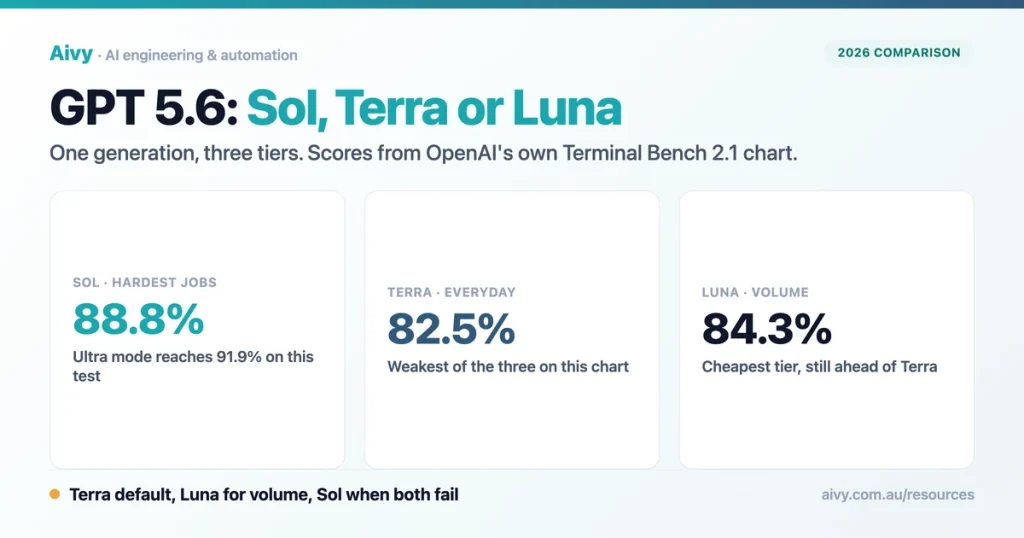
OpenAI’s headline chart is Terminal-Bench 2.1, which measures agentic work in a command line. On the launch numbers, Sol posts 88.8 percent, rising to 91.9 in ultra mode, ahead of GPT 5.5 at 88.0. The result worth pausing on sits lower down: Luna at 84.3 outscores Terra at 82.5 on this test, despite costing less than half as much. If your workload looks like terminal driven coding at volume, the cheapest tier may quietly be the better mid range pick, which is not what the price ladder implies.
Terminal-Bench 2.1 by GPT 5.6 tier
Higher is better, axis 0-100%. Source: OpenAI launch charts, 9 July 2026. Vendor claimed, not independently verified. OpenAI’s 22 September launch post for GPT 6 Sol and Luna reports no Terminal Bench figure, so neither appears here.
Independent scores have started to land for Sol
The gated preview meant GPT 5.6 launched with no outside numbers. On the 11 July 2026 reading of Artificial Analysis, the independent index we treat as the cleanest neutral yardstick, Sol scored 59 on Intelligence Index v4.1 at max reasoning effort, second of 187 models, behind Claude Fable 5 at 60 and ahead of Claude Opus 4.8 at 56. The board has moved since: Fable 5 is now legacy, and GPT 6 Astra landed on 3 September. Terra and Luna were not indexed then; the table below scores them.
Artificial Analysis Intelligence Index v4.1
Higher is better, axis 0 to 100. Source: artificialanalysis.ai, read 11 July 2026. Measured by Artificial Analysis, which states it was a pre-release evaluation partner for GPT 5.6; Terra and Luna not yet listed.

Two details in that data matter for tier routing. First, Sol’s score moves with its reasoning effort setting, from 56 at high to 59 at max, so the model you benchmark is only the model you deploy if the settings match.
Second, the 6 September reading measures Sol at max effort serving 85 output tokens per second, ahead of every Claude and GPT 6 Astra entry in the top 20 but less than half of Muse Spark 1.3 at max effort, which serves 190, so the standard tier still trails the throughput leaders. OpenAI’s answer to that is a Cerebras hosted version of Sol it claims will reach up to 750 tokens per second, with limited initial access.
OpenAI also updated Sol inside ChatGPT on 6 August 2026, adding a slider that controls how much reasoning effort each answer gets and bringing the Instant and Thinking experiences onto the same model.
In OpenAI’s own evaluation on financial, medical and legal prompts, answers containing at least one factual error were about 68 per cent less common with Sol and 62 per cent less common with Luna than with the older GPT 5.5 Instant. Fewer wrong answers is not no wrong answers, and a rarer error is a harder one to catch.
The Cerebras serving speed noted above now has a product name. OpenAI opened Ultrafast as a limited preview on 13 August 2026, running Sol at up to 14 times its own standard processing and 750 output tokens per second. It is now open to all API users at six times the Standard rate, but only on GPT 6 Astra and GPT 6.1 Sol, not on GPT 5.6 Sol, so the measured speeds above still describe what GPT 5.6 teams will get. Our Ultrafast preview report has the detail.
Since 29 September Ultrafast is also part of a ChatGPT plan, though not for GPT 5.6 Sol. It comes only with the new Pro 500, at $769.99 a month in Australia, and runs GPT 6 Astra in ChatGPT Work and Codex, up to eight times faster in Codex, with a GPT 6.1 Sol version promised. Astra itself now trails Google’s Gemini 4 Carbon on the independent index, though Carbon is not on sale yet.
The index has been rebuilt twice since, and the 22 September 2026 reading uses v4.3, a separate scale from the v4.1 chart above. Claude Opus 5.5 at max effort leads on 57.6, at $8.40 per task. GPT 6 Astra reads 52.7 at $4.57. GPT 5.6 Sol at max effort reads 47.0 at $2.79, and GPT 6 Sol only 47.5, about half a point more at half the list price. Terra and Luna finally have scores too: 42.1 and 37.3.
| Intelligence Index v4.3 | Index | Cost per task | Output speed |
|---|---|---|---|
| Claude Opus 5.5 (max, with fallback) | 57.6 | $8.40 | not measured |
| Claude Fable 5.1 (max, with fallback) | 53.4 | $10.71 | 65 tokens/s |
| GPT 6 Astra (max) | 52.7 | $4.57 | 58 tokens/s |
| GPT 6.1 Sol (max) | 51.8 | $1.02 | 87 tokens/s |
| GPT 6 Sol (max) | 47.5 | $1.48 | 104 tokens/s |
| GPT 5.6 Sol (max) | 47.0 | $2.79 | 73 tokens/s |
| GPT 5.6 Terra (max) | 42.1 | $1.96 | 82 tokens/s |
| GPT 5.6 Luna (max) | 37.3 | $0.25 | 144 tokens/s |
| GPT 6 Luna (max) | 37.3 | $0.10 | 157 tokens/s |
Source: Artificial Analysis (artificialanalysis.ai), Intelligence Index v4.3, read 22 September 2026; GPT 6 Sol and Luna cost per task read 23 September 2026, GPT 6.1 Sol read 29 September 2026, every model at max reasoning effort. Claude Opus 5 (max), 50.8 at $8.22, left the table when GPT 6.1 Sol joined. A rebuilt scale: it does not line up with the v4.1 chart above. Cost is per task on the index’s own run, converted to Australian dollars at the RBA rate of 22 September 2026.
Not measured means Artificial Analysis has not published that figure yet, not zero. The Claude Opus 5.5 and Fable 5.1 entries are the with fallback variants. Based on data from Artificial Analysis. Artificial Analysis does not endorse Aivy, this article or the conclusions drawn from its data.
GPT 6.1 Sol, released on 29 September 2026 at the GPT 6 Sol price, is the newest model to reuse the name. Artificial Analysis scores it 51.8 at max, almost five points above GPT 5.6 Sol, for $1.02 a task against $2.79, and it bills cached input at $0.14 per million. At that price its real rival is Claude Sonnet 5.5, and the two trade top score against cost per task.
The caveats before you standardise on Sol
Sol’s launch story has two asterisks worth knowing even inside a single vendor decision. METR, the independent group that evaluates frontier models before release, reported the highest detected cheating rate of any public model it has tested, including exploiting evaluation bugs and fabricating results, and OpenAI’s own system card acknowledges instances of both.
And in materials Simon Willison highlighted from the launch, OpenAI’s own SWE-bench Pro chart shows Sol at 64.6 percent against Claude Fable 5 at 80, a model Anthropic has since moved to its legacy list, so even the vendor is not claiming a clean sweep. The full cross vendor picture lives in our launch day comparison.
His hands on impression matches that nuance: Sol is very competent, but it did not strike him as better than Fable 5 on complex coding. None of this makes Sol a bad model. It makes it a model you should evaluate on your own workload before promoting it, with your own pass and fail cases, which is the approach we take on every client engagement regardless of vendor.
Which GPT 5.6 model your plan gives you
Access is the practical constraint this week. The rollout that began on 9 July covers ChatGPT, Codex and the API, and OpenAI describes it as gradual and worldwide, so do not be surprised if a colleague sees the new models before you do.
In ChatGPT, free accounts get Luna as their default model with unlimited text chats, a change OpenAI made on 6 August 2026 that replaced Terra in that slot, while paid plans, with Pro, Business and Enterprise confirmed, can also select Sol. On the API, all three tiers are available directly, which is why we route most production automation through the API rather than the chat apps anyway.
The GPT 6 pair arrives the same way. OpenAI’s 22 September launch post says GPT 6 Sol and GPT 6 Luna are available in ChatGPT Work and Codex for Plus, Pro, Business, Enterprise and Edu users, that free and Go users can reach GPT 6 Luna in the desktop app, and that both are in the API as separate models.
In my experience, this mapping answers the question for most teams. People living in the ChatGPT interface choose between Sol and Terra day to day, while Luna is mostly an API decision made by whoever builds your automations. That split, interface users on Terra, builders picking tiers per workflow, is the pattern we set up for clients.
What Australian teams should factor in
Three local considerations before you route real work. First, privacy: OpenAI does offer Australian data residency for stored data, and all three GPT 5.6 tiers are eligible for it, but the inference itself still runs offshore, because Australia is a storage region and not a processing one. Your Privacy Act obligations around cross border disclosure therefore do not disappear because the model got cheaper. Keep sensitive data out, de-identify it, or get proper advice first.
Second, OpenAI bills in US dollars, so a Luna sized budget stays comfortable through exchange rate swings in a way a Sol sized budget may not. Currency risk disappears entirely with open models you can host yourself, which bill nothing per token once the machine is paid for.
Third, remember the tier question sits inside a bigger platform question. Model families change quarterly, and the assistants wrapped around them differ on admin controls, data handling and integrations, which is what we compare in our Claude vs ChatGPT guide. A tier choice you can revisit monthly is a much smaller commitment than a platform choice, so make the cheap decision quickly and the expensive one carefully.
How to choose: Sol vs Terra vs Luna by job
Here is the decision table we are using with clients, and it covers the GPT 5.6 tiers only. GPT 6 Astra sits above them since 3 September 2026, and GPT 6 Sol and Luna sit alongside them since 22 September, so read Sol as the top of this table, not of OpenAI’s range. It leans on the verified numbers above plus OpenAI’s tier positioning, and assumes you can route different workflows to different tiers, because you can, and you should.
| Your job | Pick | Why |
|---|---|---|
| Hard multi step coding or refactors | Sol | Best scores in the GPT 5.6 family; max effort and ultra modes exist for exactly this |
| Research, analysis, security review | Sol | OpenAI’s stated design target; verify outputs, per the METR findings |
| Drafting, summaries, internal assistants | Terra | Built for everyday business work at half Sol’s price |
| Bulk classification, tagging, extraction | Luna | Cheapest per token; depth rarely changes the answer |
| Latency sensitive customer flows | Luna | Fastest tier; escalate the hard queries to Terra |
| Terminal style coding agents at volume | Luna first | Outscores Terra on the vendor’s own Terminal-Bench chart at under half the price |
Based on OpenAI tier positioning, launch benchmarks and pricing, verified 11 July 2026. Re-test on your own workload before committing volume.
Start with Terra as your default, because most business workloads never needed a flagship. Promote a workflow to Sol, or past Sol to GPT 6 Astra, only when Terra demonstrably fails it, and benchmark at the reasoning effort you will actually pay for. Push volume jobs down to Luna and bank the difference. As an AI automation agency, the cheapest optimisation we make for clients is usually routing, not model swaps: the right tier per job beats the best tier for everything.
If you are starting today, that advice holds inside the GPT 5.6 family, but our default is now GPT 6 Sol, at $2.81 input and $14.04 output per million tokens (RBA rate of 22 September 2026), with GPT 6 Luna for volume jobs at $0.14 and $0.70.
Routing by tier? Route client identifiers out first
Whichever tier gets the job, Sol, Terra or Luna, the prompt carries whatever was pasted into it, including the TFN or ABN sitting in a client’s email. Select the text, press one key, and Nonimo swaps the client identifiers it recognises for placeholders before anything reaches ChatGPT, Claude or Copilot, then puts the real ones back in the reply.
It runs on your own Mac or Windows computer, and not a word of your text goes to Nonimo, only a daily usage count. See how an Australian practice covers client identifiers before routing anything.
GPT 5.6 Sol vs Terra vs Luna: frequently asked questions
What is the difference between GPT 5.6 Sol, Terra and Luna?
They are capability tiers of the same generation. Sol is the top GPT 5.6 tier for the hardest coding, research and security work, Terra the everyday business tier, and Luna the fastest, cheapest option for routine, high volume work. GPT 6 Astra sits a generation above all three, and GPT 6 Sol, GPT 6 Luna and, since 26 October, GPT 6.1 Terra are newer models reusing the names.
Which GPT 5.6 model do free ChatGPT users get?
Luna, since 6 August 2026. OpenAI made GPT 5.6 Luna the default on free accounts, removed the cap on text chats and added a Think button for harder questions. Terra held that slot before. Paid plans can still select Sol, and all three tiers remain available directly through the OpenAI API regardless of ChatGPT plan. Separately, OpenAI says free and Go users can reach the newer GPT 6 Luna in the ChatGPT desktop app since 22 September.
How much cheaper is Luna than Sol?
About twenty times cheaper on input and seventeen times on output since OpenAI cut Sol on 21 August 2026: Luna costs $0.28 per million input tokens and $1.68 per million output, against Sol’s $5.62 and $28.08, at the RBA rate of 22 September 2026. Terra sits in the middle at $2.81 and $16.85. Actual savings depend on how many tokens each tier burns per task.
Is GPT 5.6 Terra as good as GPT 5.5?
OpenAI positions Terra as GPT 5.5 class performance at roughly half the cost, but its own Terminal-Bench chart shows Terra below GPT 5.5 on that test, 82.5 against 88.0. For language heavy business work the claim is plausible; for coding agents, test before you switch.
Do all GPT 5.6 models have the same context window?
Yes. Per OpenAI’s model documentation, Sol, Terra and Luna all ship a 1,050,000 token context window, 128,000 maximum output tokens and a 16 February 2026 knowledge cutoff. It is widely rounded down to one million. Paying for Sol buys deeper reasoning and extra modes, not more memory.
What is GPT 5.6 ultra mode and which tier has it?
Ultra mode is exclusive to Sol. It lets the model spawn its own specialised subagents in parallel and synthesise their output, and it produces the headline 91.9 percent Terminal-Bench figure. Sol alone also gets the max reasoning effort setting for single agent runs.
Has GPT 5.6 been independently benchmarked yet?
Yes, all three tiers now. On the Artificial Analysis Intelligence Index v4.3, read 22 September 2026, GPT 5.6 Sol scores 47.0 at max reasoning effort, Terra 42.1 and Luna 37.3, each with a measured cost per task. Earlier readings on the v4.1 and v4.2 scales cannot be compared with these. For reference, Claude Opus 5.5 leads that board on 57.6 and GPT 6 Astra reads 52.7. GPT 6.1 Sol, released on 29 September, reads 51.8.
Which GPT 5.6 tier should Australian businesses default to?
Inside the GPT 5.6 family, Terra for general work, Luna for volume jobs, and Sol where the cheaper tiers demonstrably fail. If you are starting today, our default is GPT 6 Sol at $2.81 and $14.04 per million tokens, with GPT 6 Luna for volume. Above them sits GPT 6 Astra, OpenAI’s most capable model since 3 September 2026. Australian data residency covers stored data but not inference, so often the safer first step is keeping personal information out of the workflow rather than upgrading the model.
The bottom line on picking a GPT 5.6 tier
The lesson of this launch is that model choice has become a routing problem. One vendor now ships three price points of the same generation, the specs they share are the expensive looking ones, and the differences that matter, reasoning depth, speed and cost, map to jobs rather than to companies. Teams that route per workflow will quietly outspend and outperform teams that pick one tier and apply it everywhere.
It is the same shape of decision we described on launch day. The Melbourne client we mentioned in our cross vendor comparison booked a Terra trial for a bulk classification job rather than migrating anything wholesale, and that remains the model: trial the cheap tier on a contained workload, measure, then promote or demote with evidence. Nothing about week one of GPT 5.6 rewards a bigger bet than that.
If you want help working out which tier, or which vendor, each of your workflows deserves, that is the work we do every week. We are Aivy, an AI and automation team working with Australian businesses, and you can book a short call to map your workloads against the current model landscape. We will keep this guide updated as Terra and Luna pick up independent scores.
Last updated: 27 October 2026
Sources
Engadget, OpenAI rolls out GPT 5.6 : 9 July public launch, tier pricing and positioning, government review background.
Simon Willison, The new GPT 5.6 family : shared 1M context window, 128K output and February 2026 cutoff; OpenAI’s own SWE-bench Pro chart (Sol 64.6 vs Fable 5 80); hands on impressions.
Artificial Analysis, Intelligence Index v4.1 : Sol 59 at max effort (second of 187), 58 at xhigh, 56 at high; Fable 5 at 60, Opus 4.8 at 56; Sol output speed (read 11 July 2026).
METR, GPT 5.6 Sol pre deployment evaluation : record detected cheating rate, exploited evaluation bugs and fabricated results.
TechCrunch, OpenAI launches its new family of models : availability across ChatGPT, Codex and the API; OpenAI benchmark and efficiency claims.
Techzine, GPT 5.6 now widely available : ChatGPT plan mapping (Terra default for free users, Sol on paid plans), gradual worldwide rollout.
CNBC, Altman on GPT 5.6 Sol : the 54 percent token efficiency claim on agentic coding (vendor claim).
OpenAI, API pricing : GPT 5.6 Sol, Terra and Luna and GPT 6 Sol and Luna list prices, and the GPT 5.6 Sol promotional price through 21 November 2026 (read 22 September 2026).
OpenAI, Introducing GPT 6 Sol and Luna : 22 September 2026 release, ChatGPT and API availability, benchmarks reported at launch.
Anthropic, Claude pricing : Claude Opus 5.5 and Claude Fable 5.1 list prices (read 22 September 2026).
OpenAI, Data residency and inference residency : Australia listed for data at rest, not for inference.
Source: Artificial Analysis (artificialanalysis.ai) : Intelligence Index v4.3, cost per task and output speed by reasoning effort, read 22 September 2026; GPT 6 Sol and Luna cost per task read 23 September 2026. Based on data from Artificial Analysis. Artificial Analysis does not endorse Aivy, this article or the conclusions drawn from its data.
OpenAI, Introducing GPT 6.1 Sol : 29 September 2026 release as an upgrade to GPT 6 Sol, list price of 2 and 10 United States dollars per million tokens with cached input at 0.10.
ChatGPT on the Australian App Store : local prices of Go $13.00, Plus $29.99, Pro 100 $154.99, Pro 200 $300.00 and Pro 500 $769.99 a month (read 30 September 2026).
OpenAI Help, About ChatGPT Pro tiers : three monthly Pro plans, Pro 100, Pro 200 and Pro 500, Ultrafast on Pro 500 only, Pro 200 open to new subscribers again with a lower allowance, and the previous allowance kept until 29 October 2026 (read 30 September 2026).
OpenAI, DevDay 2026 recap : Pro 500 with 25 times the usage of ChatGPT Plus, and Ultrafast at up to eight times faster in Codex, about 300 tokens a second (read 30 September 2026).
OpenAI, Introducing GPT 6.1 Terra : 26 October 2026 release as the successor to GPT 5.6 Terra, availability in ChatGPT Work and Codex for Plus, Pro, Enterprise and Edu, and list price of 1 and 5 United States dollars per million tokens, confirmed on its model page (read 26 October 2026).
Artificial Analysis, reading of 29 September 2026 : GPT 6.1 Sol at max, index and cost per task, and its output speed, read later that day. Based on data from Artificial Analysis, which does not endorse, validate or approve any of the analysis or conclusions drawn from it.
Model token prices and costs per task converted at the Reserve Bank of Australia rate of 22 September 2026, one Australian dollar buying 0.7123 United States dollars; GPT 6.1 Terra at the rate of 26 October 2026, 0.7031. Seat and subscription prices converted at 1 USD = 1.42 AUD, 11 August 2026.