Most Australian businesses I talk to have already decided they want AI automation. What they have not worked out is who should build it, and that second decision quietly determines whether the project pays for itself or becomes an expensive distraction. A good AI automation agency can compress months of trial and error into a few focused weeks. The wrong one can leave you with a system nobody on your team understands and a bill to match.
I run Aivy, an AI automation agency based in Melbourne, so I have a clear stake in this. I am also the person businesses call when a previous agency has left them with an unfinished build and no documentation. After enough of those conversations, I have a firm view of what separates an agency worth paying from one that costs you twice, once for the original build and again for the rebuild.
This is the guide I wish every owner had before signing a contract. It covers what an agency actually does, an honest test for whether you need one at all, the questions that expose a weak partner, and the red flags worth walking away from. It also adds an Australian layer that most overseas advice skips entirely: the Privacy Act, where your data lives, and contracts that do not trap you. The Quick-pick box has the short version.
Source: McKinsey, The State of AI, 2025
Why the agency matters more than the AI you’ll use
It is tempting to fixate on which model or platform an agency uses. In practice, the tooling is rarely what makes or breaks an automation project. MIT’s Project NANDA studied enterprise AI through 2025 and found that around 95 percent of generative AI pilots delivered no measurable return. The researchers were blunt about the cause. The failures were organisational, not technical. Businesses simply could not fit the tools into how they actually work.
The same research found something directly useful for this decision. AI delivered through external partnerships succeeded about 67 percent of the time, while purely internal builds succeeded at roughly a third of that rate. A capable agency is not just writing code. It is bringing a method for scoping the right problem, designing the workflow around your team, and handing it over so it keeps running once the novelty fades.
So the real question is not which AI an agency will use. It is whether they can turn a messy business process into something dependable, and whether they will still be useful to you a year from now. That is a judgement about people and method, not technology. It is also what the rest of this guide is built to help you assess, before you have signed anything.

What an AI automation agency actually does
An AI automation agency designs and builds systems that take repetitive, low judgement work off your team. In practice that means mapping a process, connecting the software you already run, and adding AI where it genuinely helps: reading documents, drafting replies, sorting requests, and in a clinic, running an AI scribe that turns the consult into a clinical note, all while moving data between systems that were never built to talk to each other.
The exact mix depends on your industry, from AI tools for real estate agents to logistics and healthcare. The aim is a workflow that runs on its own and only asks for a human when it should.
The good agencies spend most of their time on the unglamorous parts. A customer service bot is maybe a fifth of the work. The rest is integration, error handling, and making sure the thing behaves when a real customer sends a confusing message at 11pm on a Sunday.
We once built a support assistant for a removals company in Melbourne, and the model was the easy part. Teaching it to read their booking system correctly was the real job.
It also helps to know what an agency is not. It is not a staffing firm renting you developers by the hour. It is not a generic web shop that added AI to its menu last quarter. And it is not a reseller that hands you a licence and disappears. A real automation agency owns the outcome. The workflow works in production, or they fix it. If a prospective partner cannot describe their work in those terms, keep looking.
Sources: National AI Centre AI adoption insights (December 2025 to February 2026), ABS Research and Experimental Development, Businesses 2023-24, and Deloitte Access Economics for Amazon, 2025
When you genuinely need an agency, and when you don’t
Here is the part most agency guides leave out, because agencies wrote them. You do not always need one.
If your automation is a single, well defined task inside one platform, like sending a reminder when a deal closes in your CRM, a no-code tool such as Zapier or Make will handle it, and you keep full control. Paying an agency for that is overkill, and an honest one will tell you so.
You also might not need a full agency if you have one clear project and a capable technical freelancer who has done that exact work before. Where freelancers struggle is breadth. When the work spans several systems, needs a genuine custom build, or has to keep running reliably for years, a single contractor becomes a single point of failure.
The day they take other work or move on, your automation has nobody. Sometimes the smarter first step is just comparing the AI already in your tools, like Xero versus Microsoft Copilot, before hiring anyone.
An agency earns its fee when the problem is genuinely hard. That usually means automation crossing multiple systems, a custom build with no off-the-shelf equivalent, work touching sensitive data that carries compliance risk, or a process important enough that downtime really hurts. If two or more of those are true, the structure and continuity of an agency is worth paying for. If none of them are, start smaller and save your money.
The short version
A single, well defined task inside one platform: a no-code tool such as Zapier or Make will handle it, and you keep full control.
One clear project: a capable technical freelancer who has done that exact work before.
An agency: when two or more of these are true. Automation crossing multiple systems, a custom build with no off-the-shelf equivalent, work touching sensitive data that carries compliance risk, or a process important enough that downtime really hurts.

In-house, freelancer or agency: the real trade-offs
Most Australian businesses weighing AI automation are really choosing between three paths: build it in-house, hire a freelancer, or engage an agency. None of them is universally right. What each path actually costs is the part nobody publishes, and we went through the public contract record to find out. The honest comparison comes down to four things: what it costs upfront, how quickly you see a working result, the range of skills on hand, and what happens when something breaks at the worst possible moment.
Building in-house gives you the deepest knowledge of your own processes and the most control, but only if you already employ someone with both the skills and the spare time, which most small and mid-sized firms do not. A freelancer is the fastest, cheapest way to ship one well defined project. An agency costs more upfront and brings a team, a method, and someone to call eighteen months later when a vendor changes an API without warning.
The table below puts the three side by side. Read it against your own situation rather than hunting for an overall winner. One thing worth saying: these are not permanent choices. Plenty of businesses start with a freelancer or a no-code tool and bring in an agency later, once the automation matters enough to need proper support.
| Factor | In-house | Freelancer | Agency |
|---|---|---|---|
| Upfront cost | High if hiring; low if staff already exist | Lowest | Higher |
| Time to first result | Slow unless skills are already in place | Fast for one defined task | Fast, with a repeatable method |
| Range of skills | Narrow, one or two people | Narrow, a single person | Broad, a full team |
| Support when it breaks | Depends on the staff member staying | Gone if the freelancer moves on | Ongoing and contracted |
| Best when | You already employ skilled staff with spare capacity | You have one clear, well defined project | Work spans systems, needs a custom build, or carries compliance risk |
A general comparison. The right path changes with the size of the job and the team you already have.
Source: Gartner, 2025
The questions to ask an AI automation agency before you sign
By the time you are deep in conversation with an agency, the demo will look impressive. Demos always do. They are built with clean inputs in a controlled setting, and they tell you almost nothing about how a system behaves in production, under real load, with real customers and messy real data. The way to see past the demo is to ask pointed questions and listen carefully to the shape of the answers.
Strong agencies welcome these questions, because clear answers are how they win work. Weak ones get vague, steer the conversation back to features, or promise everything at once. You are not testing technical trivia. You are testing whether they think about your business the way you do, and whether they will still be standing beside you when the build meets a genuine workload.
The table below lists the questions worth asking, why each one matters, and what a confident answer actually sounds like. If an agency cannot answer most of these clearly, that is your answer.
| Question to ask | Why it matters | What a strong answer sounds like |
|---|---|---|
| What business outcome are we solving? | A tool-first pitch ignores your actual problem | They ask about your process before proposing anything |
| Can we see something you built running in production? | Demos hide how a system behaves under real load | A live system you can look at, and how long it has run |
| Who owns the code and the workflow at the end? | Ownership decides whether you control your own automation | You do, with full documentation handed over |
| What happens when an integration breaks in six months? | The software around the build keeps changing | A named, costed support arrangement, not a shrug |
| How will you handle our data and the Privacy Act? | You stay accountable for personal information | Specifics on storage, residency and who has access |
| When will we see a first working result? | Long discovery phases can just mean billable hours | Weeks, with something usable early |
| Can we speak to two of your current clients? | References reveal what a sales pitch will not | Yes, given without hesitation |

Agency red flags that should make you walk away
Some warning signs are serious enough to end a conversation. The first is an agency that proposes a solution before it understands your problem. If they lead with a promise to build you a chatbot before asking what actually slows your team down, they are selling a product, not solving anything. The same caution applies to off-the-shelf platforms you could buy yourself, the way many businesses weigh up Podium alternatives before committing. A good agency is curious about your operations before it is enthusiastic about its own tools.
Watch for the opposite failure too. A discovery phase that runs three months before a single line of code is written often optimises for billable hours rather than your result. Most genuine projects can show something working within a few weeks.
Other red flags include pricing that will not commit to a number, a refusal to name the people who will do the work, no clear answer on support after launch, and any promise that AI will replace your whole team or multiply revenue overnight. Confident agencies are precise about what AI will and will not do.
The quietest red flag is lock-in. If the build lives entirely on the agency’s own accounts, with their API keys, their logins and no documentation, you do not own an automation. You own a dependency. Ask early, and ask in writing, exactly what you would keep and be able to run if the relationship ended tomorrow. An agency confident in its work has no reason to hesitate.
Sources: MIT Project NANDA and McKinsey, 2025
How to judge an agency’s technical capability when you’re not technical
You do not need to read code to judge whether an agency can build well. You need to ask for proof and notice how they handle the unglamorous questions. Ask to see a system they built that is live right now, and ask how long it has been running. Anything that has been in production for more than a year has survived real users, real edge cases and real load.
Then ask what breaks, and how they would know. A capable agency talks naturally about error handling, monitoring and alerts, because those are what keep an automation alive once the launch excitement fades. An agency that only wants to talk about features has probably never supported a build past go-live. Ask a plain question: who fixes a failure at 9am on a Monday, and how quickly does it get fixed?
Reference calls are the strongest signal available to a non-technical buyer. Ask for two current clients and actually ring them. Ask those clients what they would change, whether the handover was clean, and whether they could run the system without the agency if they had to. Honest references give you a real answer, and a real answer from someone with no reason to flatter is worth more than any demo.
Data, security and the Privacy Act when you hire an agency
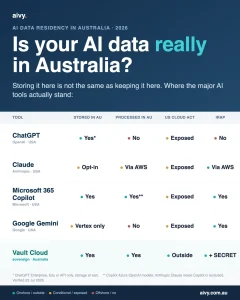
The moment you hire an automation agency, you give outsiders access to your systems and, very often, to personal information about your customers and staff. In Australia, that brings real obligations. The Privacy Act 1988 and the Australian Privacy Principles govern how that information is handled, including when it passes through an AI system. Those obligations stay with you, the business, even when a third party does the processing.
In October 2024 the Office of the Australian Information Commissioner published guidance on using commercially available AI products, and it is worth reading before you brief any agency. A good agency can speak to this without flinching. They will tell you where data is stored, whether it leaves Australia, which AI providers will see it, and how access is controlled and removed. The Australian Government’s Voluntary AI Safety Standard sets out the governance practices a serious partner should already be following.
Ask the practical questions out loud. Where exactly will our data live? Will customer information be used to train an external model, and can we opt out? How is access removed when a contractor rolls off the project?
For healthcare practices (and the broader stack in our guide on the AI tools Australian clinics can actually use in 2026) and other businesses handling sensitive records, those answers carry even more weight. If an agency treats the questions as an irritation rather than a normal part of the brief, that tells you how it will treat your customers’ trust once the contract is signed.
Sources: Gartner, ABS and McKinsey, 2025. Converted at 1 USD = 1.42 AUD, 11 August 2026.
Agency pricing, contracts and support in Australia
Australian automation work is usually priced one of two ways. A fixed project fee suits a build with a clear, defined scope. A monthly retainer suits ongoing work, where the agency monitors the system, maintains it, and improves it as your business changes. Fixed pricing protects you on a known job. A retainer makes sense once the automation is live and genuinely needs looking after. Be wary of vague hourly arrangements with no ceiling.
Whatever the model, the contract should make a few things explicit. You should own the intellectual property in whatever is built for you. You should receive documentation written for your team, not just for the agency. And there should be a clear exit: what happens, and what you keep, if you part ways. Agreements that stay silent on ownership, or quietly route every system through the agency’s own accounts, are a problem you can see coming.
Support after launch is not an optional upsell. It is the job. Automations break because the software around them keeps changing, and a workflow that ran perfectly for six months will eventually hit a snag. Before you sign, get the support arrangement in writing: response times, what is covered, and the cost. The cheapest quote that quietly excludes support is rarely the cheapest option once a workflow fails during your busiest week of the year.
| Contract point | What good looks like |
|---|---|
| Pricing model | A fixed project fee for a clear, defined scope, or a monthly retainer for ongoing work. Be wary of vague hourly arrangements with no ceiling. |
| Intellectual property | You own whatever is built for you. |
| Documentation | Written for your team, not just for the agency. |
| Exit terms | Clear on what happens, and what you keep, if you part ways. |
| Support after launch | In writing: response times, what is covered, and the cost. |

Test an agency with a small paid pilot
The best way to test an agency is not a longer sales process or a thicker proposal. It is a small, paid pilot. Pick one real workflow, agree a fixed scope and a fixed price, and set a clear measure of success before any work starts. A pilot turns an abstract pitch into evidence you can actually judge, and it does it in weeks rather than quarters.
A good pilot is genuinely useful on its own, not a throwaway demo. It should ship in a few weeks, solve one real problem, and leave you with something that keeps working afterwards. Along the way you learn the things that actually matter: how the agency communicates, how they react to a surprise, whether they hit the date they promised, and whether the handover is clean enough for your own team to follow.
Expect to pay for a pilot, and treat a free one with suspicion. Free pilots tend to get free effort and tell you little. A modest paid engagement, scoped tightly, is the cheapest insurance you can buy before a larger commitment. If it goes well, you scale with a partner you have already tested under real conditions. If it goes badly, you have lost a few weeks instead of a year and a budget.
What a good pilot looks like
Scope: one real workflow, a fixed scope and a fixed price, with a clear measure of success agreed before any work starts.
Shape: it ships in a few weeks, solves one real problem, and leaves you with something that keeps working afterwards.
Price: expect to pay for it, and treat a free one with suspicion. Free pilots tend to get free effort.
Choosing an AI automation agency: frequently asked questions
What does an AI automation agency do?
An AI automation agency designs and builds systems that automate repetitive work, connecting the software you already use and adding AI where it helps. Most of the job is integration, error handling and ongoing support, not just building a chatbot.
How much does an AI automation agency cost in Australia?
Pricing is usually a fixed fee for a defined build or a monthly retainer for ongoing support. Costs vary widely with scope, so compare detailed proposals with line-item pricing rather than judging on a single headline number.
Do I need an AI automation agency, or can I use Zapier myself?
For a single, simple task inside one platform, a no-code tool like Zapier or Make is usually enough and keeps you in control. An agency earns its fee when automation spans several systems, needs a custom build, or carries compliance risk.
What are the biggest risks of hiring an AI automation agency?
The main risks are vendor lock-in, poor documentation and no support after launch. If the build lives on the agency’s accounts with no handover, you own a dependency rather than an automation. Insist on ownership and documentation in writing.
How do I check an AI automation agency is any good?
Ask to see a system they built that is live in production, not a demo. Request two current client references and actually call them. Strong agencies answer questions about data handling, ownership and support without hesitation.
Should I pay for a pilot project?
Yes. A small paid pilot with a fixed scope and a clear measure of success is the best way to test an agency before a larger commitment. Free pilots tend to receive free effort and prove very little.
What should an AI automation agency know about the Privacy Act?
They should explain where your data is stored, whether it leaves Australia, and which AI providers can access it. The Privacy Act 1988 and Australian Privacy Principles apply, and the OAIC has published guidance on using commercial AI products. If you serve customers in Europe or California, ask whether they understand your cross-border AI compliance exposure too, not just the Privacy Act.
How long should an AI automation project take?
Most genuine projects can show a working result within a few weeks. Be cautious of agencies that need a three-month discovery phase before any build, as long discovery phases can favour billable hours over outcomes.
Who owns the automation an agency builds for me?
You should. A fair contract gives you the intellectual property, the documentation, and access to the systems involved. If ownership is unclear, or everything runs through the agency’s own accounts, treat that as a red flag.

Getting the partner decision right
AI automation is rarely won or lost on the technology. It is won or lost on the partner you choose to deliver it. The agency that asks hard questions about your process, shows you real systems running in production, and writes ownership and support into the contract is the one worth paying. A slick demo and the lowest quote are not the same thing as the right decision, and confusing them is expensive.
I think about the Australian businesses that come to us after a difficult first experience. They signed on the strength of a polished pitch, and a year later they have an automation nobody can change and no documentation to work from. We can usually rebuild it, but the real cost was the lost year. A short, paid pilot would have surfaced every one of those problems inside a fortnight, for a fraction of the price.
If you are weighing up this decision, use the questions and the red flags here as your filter, whoever you end up choosing. And if you would like a second opinion, that is something we are glad to give. We are Aivy, an AI automation agency in Melbourne, and we would rather tell you honestly whether a project needs an agency at all than win work that was never the right fit for your business.
Last updated: 11 August 2026