Most of the businesses that ask me about Podium are not asking about features. They are asking how to leave. The pattern is almost always the same: a long contract that renewed itself, an SMS automation that quietly stopped, and customer data they cannot get out. In Australia it has a sharper edge, because Podium was built for the United States market.
I run growth at Aivy, an AI automation agency in Melbourne, and a good share of the clinics and local service businesses I speak with are on Podium or its closest rival GoHighLevel. The conversation usually starts with “what should we switch to” and ends somewhere more interesting, which is “should we be renting this category of software at all”.
Most comparison articles skip that second question, because the sites publishing them sell the alternative they recommend; our guide to choosing an AI automation partner in Australia covers spotting conflicted advice. This guide covers why people leave Podium, eight alternatives, which suit a clinic, what switching costs, and the option almost nobody lays out honestly: owning your platform instead of renting the next one.
Why Australian businesses are leaving Podium
Podium does the core job well. It pulls reviews, messages and payments into one inbox, and for a busy reception desk that consolidation is genuinely useful. People rarely leave over the daily product; they leave over the commercial model and the reliability of the automation underneath. In my experience the same three complaints come up again and again.
- The contract: Podium typically sells on an annual term that renews automatically, and a large share of the negative reviews on Trustpilot, Capterra and ProductReview.com.au are about how hard it is to cancel and how long it takes to get a phone number released afterwards.
- Automation drift: SMS campaigns and reminders that ran cleanly for months stop firing without an obvious cause, often after a settings change or a merge of contacts, and there is little visibility into why. For a clinic relying on those reminders to fill its book, that is not a minor bug.
- The Australian gap: Podium has no native integration with Best Practice or Halaxy, the two practice management systems most Australian clinics run. A Sydney telehealth group I spoke with this year exports a CSV from its clinical software every morning and uploads it into Podium again by hand: hours of admin a week papering over a gap the platform was never going to close.
None of this means Podium is a bad product; the fit for an Australian clinic is often weaker than the demo suggests. Podium’s own users put numbers to it. On Capterra it rates solidly on ease of use and features, but value for money sits lowest of its four headline scores, the commercial model complaint turning up in the data.
Podium’s own users score value for money the lowest
User ratings out of 5, axis 0 to 5, higher is better. Source: Capterra, 520+ Podium reviews, May 2026.
Podium alternatives at a glance
Before the detail, here is the shape of the market. The table groups the main Podium alternatives by who they suit, how they price, and the question almost no comparison covers: whether you own your data and your setup at the end of it. Treat the lock in and ownership columns as the ones that matter most, because they are why most people are reading this.
| Platform | Best for | AU presence | Contract | You own it? |
|---|---|---|---|---|
| Podium (baseline) | Local business reviews + messaging | Yes (US built) | Annual, renews automatically | No |
| Birdeye | Reviews across locations | Yes | Annual | No |
| Weave | Dental / medical front desk | Limited (US) | Annual | No |
| GoHighLevel | Agencies, power users | Via resellers | Monthly / annual | No |
| Thryv | Small business all in one | Yes (AU support) | Annual | No |
| Solutionreach | Patient recall + reminders | Limited (US) | Annual | No |
| NiceJob | Reviews only, simple | Yes | Month to month | No |
| Coax (AU) | AU retail / ecommerce | Yes (AU built) | Subscription | No |
| Custom platform (e.g. Aivy) | Clinics / businesses wanting control | Yes (AU hosted) | No lock in | Yes |
A pattern jumps out of that table. Almost every option is another subscription platform, mostly built in the United States, each with its own contract and its own version of the lock in you are trying to escape. That is fine if a straight swap is what you need, but if the deeper frustration is renting software you cannot control, another rented platform only resets the clock.
The table leaves out one column on purpose: the star rating. On G2 the whole field already scores between 4.3 and 4.8, so the average review score tells you almost nothing useful when you are choosing between them. The real differences are the ones in the table above, fit, lock in and ownership, not the stars.
On G2, the whole field already scores high
Overall G2 rating out of 5, axis 0 to 5. Scores across this category cluster, so star ratings are a weak basis for switching. Source: G2 product pages, May 2026.
The eight best Podium alternatives in 2026
Birdeye
- What it is: the closest direct competitor to Podium and the most common name in comparisons. It covers reviews, messaging, surveys and a unified inbox, scales well for businesses with several locations, has an Australian presence, and is the strongest pick for a near identical replacement with a broader reputation and marketing toolkit.
- Choose it if: your priority is reviews and reporting across locations and you are comfortable staying on a US platform with a contract model similar to Podium’s.
Weave
- What it is: built specifically for healthcare and dental front offices, pairing phone, text, reviews and scheduling around the patient relationship. For a dental practice its feature set is deeper and more relevant than Podium’s generic toolkit for local businesses.
- The catch: Weave is built in the US, frames its compliance around HIPAA rather than the Privacy Act, and integrates with US dental systems, not Best Practice or Halaxy.
- Choose it if: you run a dental or medical practice and the depth of its front desk features outweighs the data residency questions.
GoHighLevel
- What it is: the most powerful all in one platform on this list, combining CRM, marketing automation, funnels, scheduling and AI, which is why agencies love it. For a single clinic or shopfront it is genuinely overwhelming, the setup never quite ends, and you often pay an agency to run it; I have seen Australian businesses use perhaps a tenth of it.
- Choose it if: you are an agency reselling to clients, or you have the appetite to run complex software in house.
Thryv
- What it is: an all in one platform for small business, with CRM, marketing, scheduling and payments, a real Australian presence and local support. It sits between Podium and GoHighLevel in complexity, a sensible pick for a tradie, salon or small services business that wants more than reviews but less than an agency platform.
- Choose it if: you want a small business all rounder with Australian support and you are not in a regulated clinical setting.
Solutionreach
- What it is: a patient relationship platform aimed squarely at healthcare, with recall, reminders and patient messaging at its core. In the United States it is a strong Podium alternative for medical and dental practices; in Australia its footprint is thinner and, like the others, it is built around US systems and US compliance.
- Choose it if: patient recall and reminders are your single biggest pain and you can verify that the Australian data and integration story holds up for your practice.
NiceJob
- What it is: the simplest option here, focused on reviews and reputation, easy to set up and cheaper than the all in one platforms. If your only real use of Podium was collecting reviews, NiceJob does that one job cleanly without the contract weight.
- Choose it if: reviews are genuinely all you need and you want to drop the rest of the bundle.
Coax
- What it is: the Australian option on this list, and the only one that markets itself directly as a Podium alternative for local businesses here. It covers customer messaging, reviews and payments, and being based in Australia it sidesteps some of the data residency questions that hang over the US platforms. It leans towards retail and ecommerce rather than clinics.
- Choose it if: you want an Australian vendor with local support and your business is a shopfront or online store rather than a regulated practice.
Broadly
- What it is: another US platform for reviews and messaging, aimed at small and local service businesses. It is a competent alternative with a friendly interface, competing on simplicity and price against Podium and Birdeye.
- Choose it if: you want a straightforward tool for reviews plus messaging and the gaps specific to Australia are not a dealbreaker.
The best Podium alternative for Australian clinics and healthcare practices
Healthcare is where the standard alternatives fall down hardest. Weave and Solutionreach have the richest patient communication features, but both are built around US systems and frame compliance around HIPAA, which does not transfer. In Australia your obligations sit under the Privacy Act 1988, the Australian Privacy Principles and, for advertising, the AHPRA rules.
So the first job is confirming where patient data is stored and getting the vendor’s data flow in writing. The second is integration. Best Practice, Halaxy and Cliniko have no native connectors into Podium, Weave or most US alternatives, hence the daily CSV export. Halaxy and Cliniko publish proper APIs, but most platforms will not connect to them, because the Australian clinical market is too small for their roadmap.
This is the point where a clinic should at least consider not buying any of these platforms. The patient communication job, automated reminders, recall and reactivation campaigns, a shared inbox, lead capture, can be built as a system connected directly to your Halaxy or Cliniko data, running on Australian infrastructure and belonging to you. That is the work my team does with healthcare and medical practices across Australia.
- When it pays: it is not the right answer for every clinic, but for a group with several sites doing manual data ferrying every morning, it usually costs less over three years than the rented stack it replaces, and the automations stop being a black box.
- The wider picture: for the compliant tooling around it, our guide to the AHPRA and APP ready AI stack for Australian clinics covers the scribes, practice management systems and patient data rules in depth.
The verdict for an Australian clinic
Feature depth is not the deciding factor. Confirm where patient data is stored, get the vendor’s data flow in writing, and check whether the tool connects to Best Practice, Halaxy or Cliniko. If it does not, you are buying the daily manual export along with the platform.
What it really costs to leave Podium
The sticker price of the alternative is the easy part of the maths and the least important. The real cost of leaving Podium sits in three places people rarely budget for, and each one is easier to manage if you plan it before you sign anything new rather than after you have given notice.
Related reading: if the job Podium really does for you is front desk messaging, compare your options in our guide to the best AI customer service chatbots in Australia.
- The exit itself: getting your contacts and conversation history out of Podium in a usable format, and getting your business phone number released, are both commonly reported as slow and painful. Build that time in and start the export before you sign anything new, so you are not negotiating from weakness.
- The overlap: for a clean switch you will usually run both systems in parallel for a few weeks while you migrate contacts, rebuild automations and port your number. That temporary double cost is normal and worth it, but it surprises people who budgeted for a straight swap.
- The rebuild: every automation, template and review request flow you set up in Podium has to be recreated, and on a tool like GoHighLevel that rebuild is substantial. None of this is a reason to stay. It is a reason to plan.
There is also a quieter cost that only shows up later, and it is the one I care most about. If you switch to another subscription platform, you sign up for the same dynamic that frustrated you with Podium: a vendor who owns your data and sets the price. The cheaper the monthly fee looks, the more it is worth asking what leaving will cost in three years.
Switch software, or build the platform you own
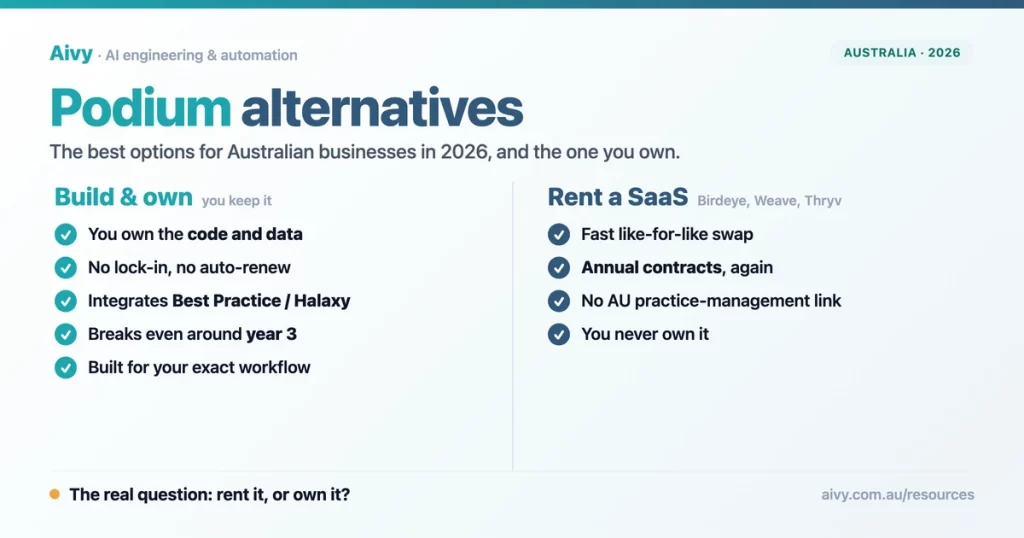
Here is the option comparison sites never table, because they are paid to recommend a product: build the platform you need and own it. For the messaging job Podium does, that means SMS reminders and recall, a shared inbox, review requests, lead capture and real reporting, connected to the Australian systems you already run, with no contract per location, no automatic renewal and no vendor who can switch it off.
- Cost: building costs more than a subscription in year one, because there is a one off build. From year two, it typically costs the same or less than the stack it replaced, and the gap widens every year you would otherwise have kept paying rising subscriptions.
- Control: you own the code and the data, you can change anything, and your automations are no longer a black box when they stop firing. The cost is that you need a competent team to build and maintain it. That is the real decision, and it is genuinely build versus buy.
- Beyond messaging: the same logic extends past customer messaging, and our guide to the best Zapier alternatives in Australia takes the ownership question further across the wider stack.
The cumulative picture makes the trade visible. For a group with several locations the first year of owning runs higher because of the build, the totals roughly break even around year three, and from there renting keeps climbing while the owned system levels off. The numbers below are illustrative, but the shape holds for any business paying for the same software across several sites.
Renting never stops. Owning has one hump, then runs cheaper.
Cumulative cost for a group with several locations (example: three clinics). Renting includes the manual data admin an owned system removes; owning includes the one off build. Break even is around year three. Source: Aivy cost model, representative figures.
Modern AI tooling has changed this calculation: work that took a development team six months can now be built in a fraction of the time, which makes an owned platform viable for a mid sized clinic, not only for enterprise. Price both paths before you sign another contract; our companion guide on whether an Australian business should build its own platform has the numbers.
How to switch off Podium without losing your data
If you do decide to move, the order of operations protects you more than the choice of platform. Four steps, in this order, avoid the most common horror stories in the reviews, whether you are moving to a rented alternative or to a platform you have had built.
- Export first: pull every contact, conversation history and review out of Podium in a usable format, and confirm in writing how and when your business phone number will be released. Doing this before you give notice means you are never stuck between a cancelled platform and data you cannot retrieve.
- Run in parallel: stand up the new system, migrate your contacts and rebuild your core automations while Podium is still live. Test the reminders and review flows on real appointments before you cut over, because an automation that looks right in setup can still fail silently in production.
- Then give notice: only once the new flows fire reliably, mindful of your contract’s notice period. For a clinic, line the cutover up with a quieter week so a missed reminder does not cost you a booked patient.
- Keep the evidence: document where your data now lives, who can access it, and how you would export and process that data again if you ever needed to leave. The businesses least likely to get trapped by their next platform treat that exit plan as a requirement from the first day; if you build, it comes as standard.
The order of operations, in short
Export contacts, conversation history and reviews first, and confirm the phone number release in writing. Run both systems in parallel and test the reminders on real appointments. Give notice only once the new flows fire reliably.
Frequently asked questions
Who are Podium’s main competitors?
Podium’s closest competitors are Birdeye, Weave, Thryv, GoHighLevel, Broadly, Solutionreach and NiceJob, plus the Australian option Coax. Most cover reviews, messaging and payments in one inbox. They differ mainly on vertical focus, complexity and price, not core function.
Is there a cheaper alternative to Podium?
Yes. NiceJob and Broadly are generally cheaper if you mainly want reviews and messaging, and Coax competes on price in Australia. The bigger saving usually comes from dropping features you were paying for but not using, rather than finding a matching platform at a lower price.
What is the best Podium alternative for a clinic or dental practice?
Weave and Solutionreach have the strongest patient communication features, but both are built in the US and frame compliance around HIPAA, not the Australian Privacy Act. For an Australian clinic, the deciding factors are data residency and whether the tool integrates with Best Practice, Halaxy or Cliniko, which most do not.
Is there an Australian alternative to Podium?
Coax is the main Australian built alternative and markets itself directly as a Podium replacement for local businesses. For clinics with patient data, an Australian hosted custom platform that connects to your practice management system is often a better fit than any off the shelf option, local or overseas.
Can I export my data from Podium?
You can, but it is commonly reported as slow, and releasing your business phone number can take time. Always export your contacts, conversation history and reviews and confirm in writing how the number will be released before you cancel, so you are never left without your data.
What is the best Podium alternative with AI?
GoHighLevel has the deepest built in AI of the off the shelf platforms, though it is complex to run. The more flexible route is an AI assisted custom platform built around your own workflow and data, which lets you apply automation to your exact follow up and recall process rather than a generic template.
Should I switch to another platform or build my own?
Switch to another platform if you want a fast change with little commitment and a matching feature set. Build your own if your real frustration is contracts, lock in and data you cannot control, and you have a three year horizon. Building costs more in year one and usually less from year two.
Where this leaves an Australian business in 2026
If you take one thing from this guide, let it be that the Podium decision is a question about control over the software your business runs on. Birdeye, Weave, Thryv and the rest are competent, and for plenty of businesses a clean swap is right. But one rented US platform for another resets the same clock, and for a clinic often leaves the integration problem unsolved.
The Sydney telehealth group I mentioned earlier is a good illustration: three clinics, a daily manual CSV export into Podium, reminders that had quietly degraded, and no reporting. Another subscription would have moved that problem sideways. What fit was a system connected straight to their clinical data, built for how they work and owned by them.
So before you sign the next contract, price both paths honestly. If a straight alternative fits, this guide gives you the shortlist; if your frustration is about ownership, that deserves a proper conversation. We are Aivy, an Australian AI and automation team, and we do not resell software, so we have no stake in which way you go. You can book a chat with the Aivy team.
Last updated 19 October 2026. Ratings and pricing change over time; verify current figures with each vendor before deciding.
Sources
Capterra, Podium reviews: user ratings by dimension (ease of use, functionality, customer service, value for money) across 520+ reviews. Used in the Podium scorecard chart.
G2, Podium and competitor product pages: overall star ratings for Podium, Birdeye, Weave, GoHighLevel, Thryv and NiceJob. Used in the G2 ratings chart.
OAIC, Australian Privacy Principles: the Australian privacy framework that applies to clinics handling patient data, referenced in the healthcare section.