
← All use cases / Finance automation
Synthetic data only
Multi-site services · NSW
One finance console for 19 sites
A multi-site car-wash group on Australia’s east coast runs 19 wash sites, plus a service and supply division that builds and installs the wash equipment itself. Group finance ran on QuickBooks, spreadsheets and one long-serving bookkeeper: mornings meant re-keying takings site by site, while build labour and parts quietly disappeared into wages and repairs.
We built a working prototype of the fix: one finance console fed overnight by Xero, Tanda rostering, Weel expense cards and per-site takings. Each morning it reconciles all 19 sites against the bank, codes supplier bills under rules the group’s accountant owns, and queues only the exceptions that genuinely need a person. A companion crew app captures hours, receipts and parts at source, and everything lands in Xero and the group’s own BigQuery warehouse. Every figure in the prototype is synthetic.
Explore the actual prototype
- Everything is synthetic: a fabricated wash group (“Aquavale”), invented sites and suppliers, no client data.
- No live systems: the accounting, rostering and spend feeds are simulated, so there is nothing to configure and nothing to break.
- Nothing to sign up for: click through every screen, approve a bill, capitalise a job.
Opens in a new tab · synthetic data only
The problem
- Takings from 19 sites, across POS, card settlements and cash, were checked against the bank by hand. That is most of a morning, every morning.
- The service crew builds and installs wash equipment, but their hours land in wages and their parts in repairs. Six-figure builds never appear on the books as the assets they are.
- Parts bought on expense cards rarely reach the job they were bought for, and warehouse stock sits outside the books entirely.
- Experimental build work that could qualify for R&D is never captured with evidence, so an adviser has nothing to assess.
- The rules for all of it live in one long-serving bookkeeper’s head, and the bookkeeper is retiring.
sites reconciled against the bank in one screen each morning: POS takings = card + cash = bank deposit, with only the mismatches surfaced.
journals posted without a person or an accountant-approved rule behind them. R&D items are only ever flagged as candidates; the group’s adviser assesses eligibility.
What the prototype does
Feeds land before the office does
Overnight and early each morning, Xero, Tanda rosters, Weel card spend and per-site POS takings sync into one console. No re-keying, no CSV shuffling.
Automated feeds
The accountant’s rules code the routine
Supplier bills and card spend arrive pre-coded against a plain-English rules table the group’s accountant owns. AI drafts the judgement calls, capital versus repairs, with its confidence shown.
AI drafts
Only exceptions reach a person
An unmatched receipt, an unclassified hour, a settlement that has not hit the bank: the queue holds the handful of items that need judgement. The clean routine posts itself under approval rules.
Human decides
Every site squares with the bank
Per site, every morning: what the POS says was taken, what the card processor settled, what landed in the bank. A summary journal posts to Xero; the detail stays queryable in the group’s BigQuery.
Daily check
Crew work becomes assets, not a black hole
A crew app captures hours, receipts and part movements at source. Build labour and parts accumulate as work in progress and capitalise on completion, while experimental work is held as R&D candidates for the adviser.
Capture at source
A peek inside
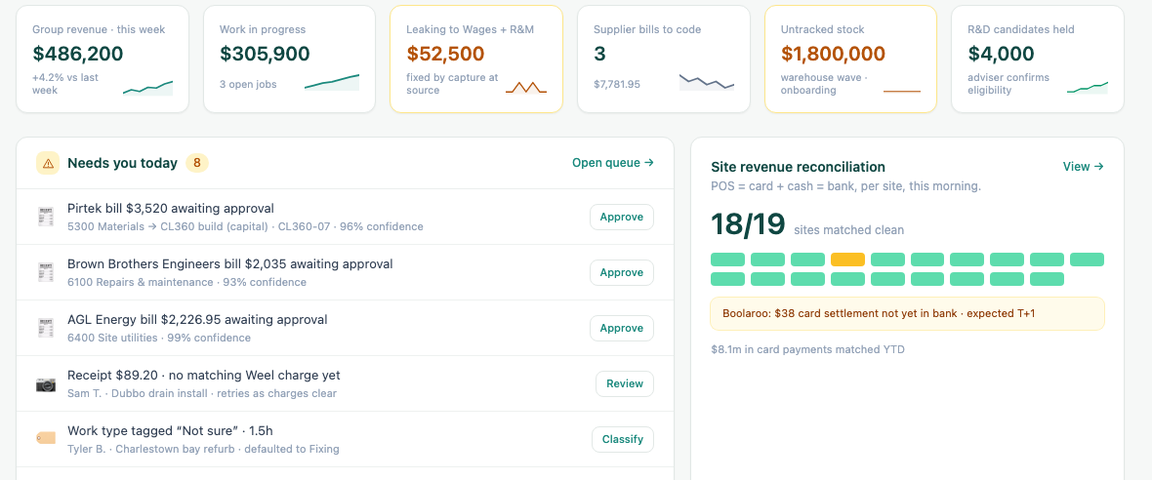
The actual working prototype. Every site, supplier, name and figure in it is synthetic.
How it runs in production
Your tools stay
Xero stays the ledger of record, Tanda keeps the rosters, Weel keeps the cards, and the group’s own BigQuery warehouse keeps doing the reporting. The console connects them; it replaces none of them.
Rules the accountant owns
Coding logic lives in a readable rules table captured with the group’s accountant, not buried in code. A supplier only earns auto-posting once its coding record proves right; new suppliers stay manual.
Humans sign off
AI drafting runs on Claude with zero data retention and never posts on its own. R&D stays candidate-only until an adviser assesses it, and BAS stays with the accountant.
What this page doesn’t claim
No invented ROI percentages, no anonymous five-star quotes. This is a working prototype built in days to make a proposed build concrete, and every connection it shows (Xero, Tanda, Weel, bank feeds) is simulated with synthetic data. When a build like this goes to production, the results section gets real numbers, and not before.
Related services
Do your mornings start with re-keying?
Tell us which numbers your team checks by hand every day. If it looks like a fit, the next thing you see is a working prototype on your workflow, not a proposal.