
← All use cases / Retail operations
Synthetic data only
Retail · consignment
From three systems to one consignment ops console
A rent-a-rack consignment boutique rents racks to consignors a few weeks at a time, on concierge and self-service packages. The store runs on Shopify, Xero and a specialist consignment till, and every rack that ends means bills typed into Xero by hand, rack fees netted line by line, and lay-bys tracked from memory. We designed an ops console that sits on top of all three: the owner keeps her tools and loses the retyping.
Explore the actual concept
- Everything is synthetic: a fictional boutique (“Rackhouse Preloved”), invented consignors and figures, no client data.
- It is a visual concept: a static mock-up of the ops console, so there is nothing to configure and nothing to break.
- Nothing to sign up for: explore racks, payouts, lay-bys and approvals exactly as presented to the client.
Opens in a new tab · synthetic data only
The problem
- When a rack ends, the payout is read line by line out of the till system and each bill is typed into Xero by hand, five to ten times a week.
- Rack fees and extension charges have to be netted off every payout and coded to the right account, correctly, every single time.
- A consignor must never be paid for a lay-by before the customer finishes paying. Today that safeguard is a separate bill and a mental note.
- A new consignor is keyed into two or three places, and a clashing product code quietly breaks the accounting upload.
- Portal sign-ups are checked by hand against real rack bookings so a fake or competitor account does not slip in, and it is easy to forget one.
Shopify, Xero and the specialist consignment till all stay. The console is designed to read from all three and prepare the work; it replaces none of them.
payouts released without a human. Every bill waits for the owner to confirm, and lay-bys stay on hold until the sale is fully paid.
What the console is designed to do
The whole week on one screen
What is owed to consignors, which racks end this week, which lay-bys are on hold and who is waiting for approval, in one dashboard instead of three open tabs.
One view
Rack ends, bill ready in Xero
The payout comes off the till system, rack-fee and extension deductions are netted to the right account codes, and one click raises the bill in Xero. Once paid, it is marked off on both sides.
Owner confirms
Lay-bys that hold themselves
The console watches the Shopify order and keeps the payout at “awaiting customer” until the sale settles, then flags it ready to pay. No separate bills, no remembering.
Held by default
New consignors entered once
One counter form creates the Xero contact with bank details, the consignor record in the till system and a unique product code, clash-checked so uploads stop breaking.
Entered once
Approvals with the checking done
Portal sign-ups are verified against real rack bookings and duplicates before the owner clicks approve. Self-service submissions are checked against the store’s title rules, then published to Shopify with product code and tags.
Human approves
A peek inside
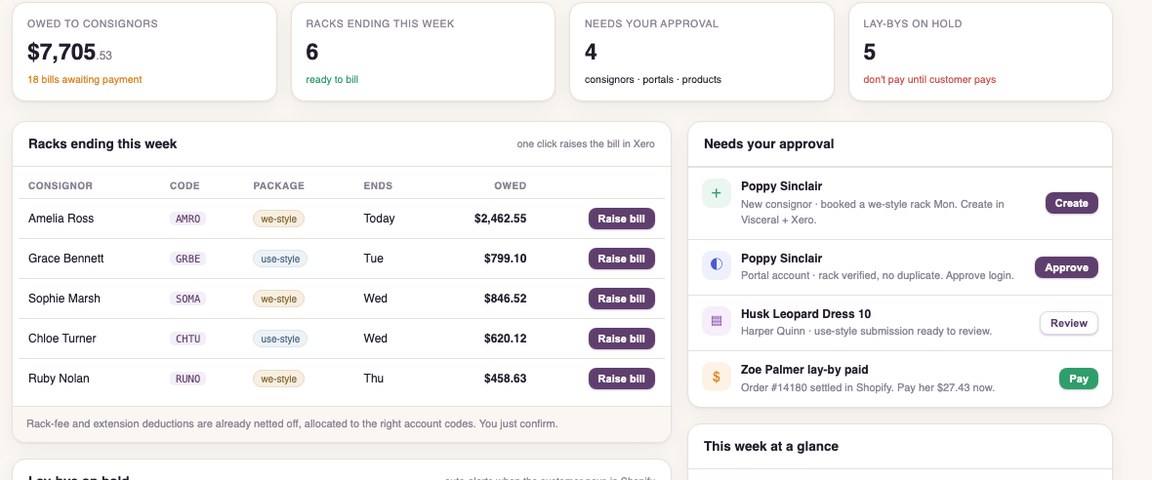
The clickable mockup walked through with the client, loaded with sample data. Every name, code and figure is invented.
How it would run in production
Your tools stay
Shopify, Xero and the existing till remain the systems of record. That is what AI for consignment retail should look like: an orchestration layer above the till, not a rip-and-replace.
Honest about the till
The incumbent till system has no public API today, so the design leans on one-click exports and ready-to-import files, and those last manual steps are scoped to disappear over time.
The owner signs off
No bill is raised and no payout is released without a person confirming it. Lay-by holds are the default behaviour, not a reminder.
What this page doesn’t claim
No invented ROI percentages, no anonymous five-star quotes. This is a solution design: a static, clickable mockup with sample data, built between scoping calls so the owner could walk her own week through it before committing to a build. There is no working code behind it yet. If the build ships and runs in production, this page gets real numbers, and not before.
Related services
Running your store across systems that don’t talk?
Tell us where the week goes. If it looks like a fit, the next thing you see is a design like this mapped to your own workflow, not a generic proposal.